Learning Spanish past tenses can feel confusing at first. English usually lets you describe past events with the simple past, such as “I studied,” “I played,” or “I lived.” Spanish, however, often requires you to choose between two forms: the preterite and the imperfect.
Both tenses describe the past, but they don’t present past events in the same way. The preterite typically reports an event as a complete whole. The imperfect describes what was happening, what used to happen, or what a situation was like.
The first sentence reports a particular study session as a completed event. The second describes a repeated activity during childhood. Both sentences refer to the past, yet each uses a different tense because the speaker presents the action differently.
Once you understand this distinction, Spanish past-tense choices become much easier. You’ll also learn to recognize how context, time expressions, verb meanings, and storytelling influence your decision.
Quick Answer:
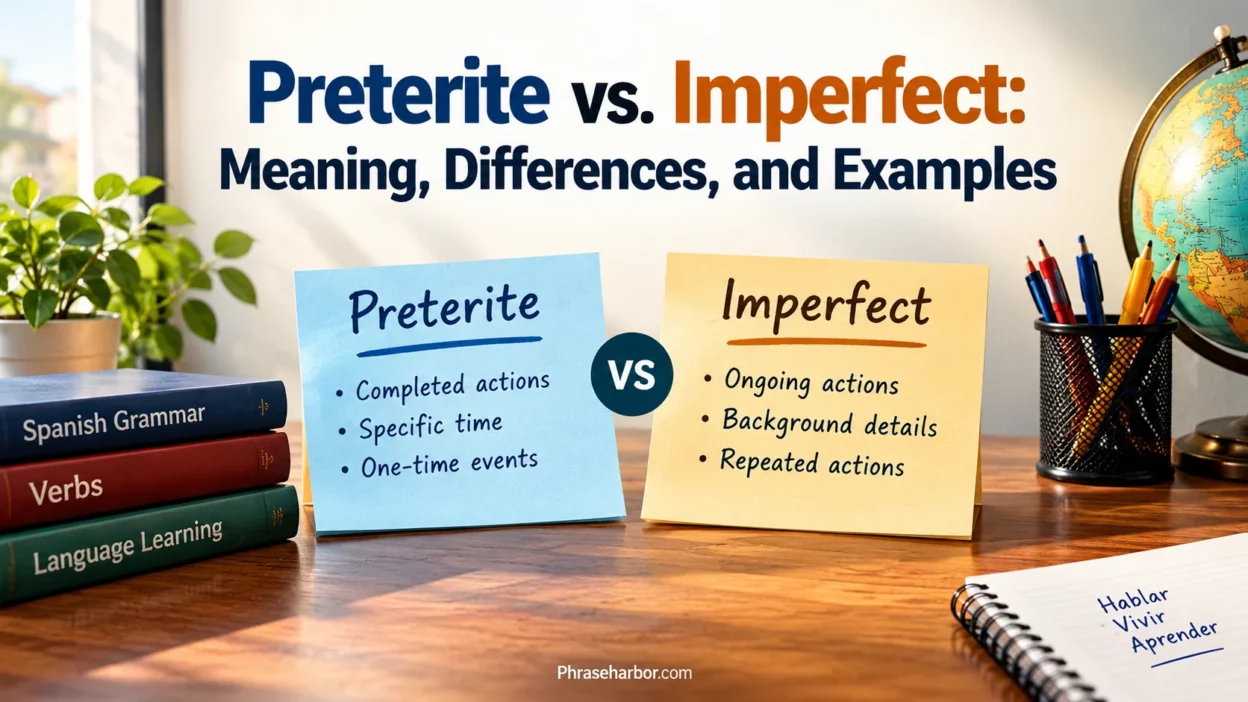
The preterite describes past events as completed wholes, while the imperfect describes past habits, ongoing activities, and background conditions without focusing on their completion.
Use the preterite when reporting what happened. Use the imperfect when explaining what was happening, what usually happened, or what things were like.
| Preterite | Imperfect |
| Ayer comí pizza. — I ate pizza yesterday. | Antes comía pizza todos los viernes. — I used to eat pizza every Friday. |
| Llegó a las ocho. — He arrived at eight. | Eran las ocho. — It was eight o’clock. |
| La película terminó. — The movie ended. | La película era interesante. — The movie was interesting. |
| Sonó el teléfono. — The phone rang. | Yo dormía. — I was sleeping. |
The key rule: Think about how you want to present the event, not just when it happened. A specific time or duration can help, but neither automatically determines the correct tense.
Comparison Overview
The preterite and imperfect serve different purposes in Spanish. Understanding their main uses will help you choose the right form in everyday conversations, written stories, and descriptions of past experiences.
| Feature | Preterite | Imperfect |
| Main purpose | Presents a past event as a complete whole | Describes a past situation or activity in progress |
| Completed events | Commonly used | Possible when completion isn’t the focus |
| Past habits | Usually not the default for repeated routines | Commonly used |
| Ongoing past actions | Used to report completed events within an ongoing activity | Commonly used for actions in progress |
| Descriptions | Reports a change or a bounded event | Describes people, places, weather, and conditions |
| Storytelling | Moves the sequence of events forward | Establishes the background |
| Interruptions | Often marks the interrupting event | Often describes the interrupted activity |
| Typical expressions | ayer, anoche, de repente | siempre, a menudo, mientras |
| Example | Ayer fui al médico. — I went to the doctor yesterday. | Iba al médico con frecuencia. — I used to go to the doctor frequently. |
These patterns provide a useful starting point, but they aren’t rigid formulas. Spanish speakers can use either tense with the same verb when the context or intended meaning changes.
What Is the Preterite Tense in Spanish?
The Spanish preterite, also called the pretérito indefinido or pretérito perfecto simple, describes past events by presenting them as complete wholes. It often answers the question, “What happened?”
For example, Ayer compré un libro means “I bought a book yesterday.” The speaker presents the purchase as a completed event rather than focusing on the process of shopping.
The preterite doesn’t necessarily mean that an action lasted a short time. You can use it for an event that took several hours, days, or years, provided you present that period as a completed whole.
When to Use the Preterite
Several common situations call for the preterite. The most important factor is how the speaker frames the event.
Completed actions
Use the preterite to report an action as completed.
- Terminé mi tarea. — I finished my homework.
- Ella preparó la cena. — She prepared dinner.
- Compramos una computadora nueva. — We bought a new computer.
Each sentence reports an event as a complete unit.
A sequence of past events
The preterite is especially useful when describing actions that happened one after another.
Me levanté, me duché, desayuné y salí de casa.
I got up, took a shower, ate breakfast, and left the house.
Each verb advances the story. The reader follows the events in sequence.
Events with a defined beginning or end
Use the preterite when you report a change or a particular event that marks a beginning or ending.
- La clase empezó a las nueve. — The class started at nine.
- El concierto terminó tarde. — The concert ended late.
- De repente, empezó a llover. — Suddenly, it started to rain.
The preterite emphasizes the occurrence of the change.
Actions that happened a specific number of times
The preterite often describes completed events with a countable frequency.
- Visité Madrid dos veces. — I visited Madrid twice.
- Llamé a mi hermana tres veces. — I called my sister three times.
- Vimos esa película una vez. — We saw that movie once.
These examples count completed occurrences rather than describe a continuing habit.
Completed periods of time
A period can be long and still take the preterite when the speaker presents it as a completed span.
- Viví en México durante cinco años. — I lived in Mexico for five years.
- Trabajó allí desde 2018 hasta 2023. — He worked there from 2018 to 2023.
- Estudiamos durante tres horas. — We studied for three hours.
The emphasis falls on the completed period. Duration alone doesn’t force the imperfect.
Preterite Conjugation Patterns
Regular Spanish verbs follow predictable preterite endings. Learning these patterns gives you a foundation for forming the tense correctly.
| Subject | Hablar (to speak) | Comer (to eat) | Vivir (to live) |
| Yo | hablé | comí | viví |
| Tú | hablaste | comiste | viviste |
| Él/Ella/Usted | habló | comió | vivió |
| Nosotros/as | hablamos | comimos | vivimos |
| Vosotros/as | hablasteis | comisteis | vivisteis |
| Ellos/Ellas/Ustedes | hablaron | comieron | vivieron |
In the preterite, regular -er and -ir verbs share the same endings. Regular -ar verbs use a different set.
Notice the accent marks in hablé, habló, comí, and comió. These marks are part of the correct spelling and can distinguish forms with different subjects.
Important: The first-person plural forms hablamos and vivimos can look identical to their present-tense forms. Context tells you whether the sentence refers to the present or past.
Common Irregular Preterite Verbs
Many frequently used Spanish verbs have irregular preterite forms. These are worth memorizing because you’ll encounter them constantly.
| Infinitive | Yo | Él/Ella/Usted | English meaning |
| Ser / Ir | fui | fue | I was / went; he or she was / went |
| Tener | tuve | tuvo | I had |
| Estar | estuve | estuvo | I was |
| Hacer | hice | hizo | I did / made |
| Poder | pude | pudo | I could / managed |
| Poner | puse | puso | I put |
| Venir | vine | vino | I came |
| Decir | dije | dijo | I said / told |
The preterite forms of ser and ir are identical. You determine their meanings from context.
- Ayer fui al supermercado. — Yesterday I went to the supermarket.
- La película fue excelente. — The movie was excellent.
The first sentence uses fui from ir. The second uses fue from ser.
Read More: Grand Niece vs. Great Niece: Meaning, and Correct Usage
Common Preterite Time Expressions
Certain expressions frequently appear with the preterite because they identify a particular event or completed period.
- Ayer — yesterday
- Anoche — last night
- La semana pasada — last week
- El año pasado — last year
- Una vez — once
- De repente — suddenly
- Hace dos días — two days ago
- En 2020 — in 2020
For example, Anoche vimos una película means “We watched a movie last night.”
However, don’t choose the preterite simply because you see one of these expressions. The context still matters. A sentence can mention a specific past date while describing a situation that was ongoing at that time.
What Is the Imperfect Tense in Spanish?
The Spanish imperfect, known as the pretérito imperfecto, describes past actions, habits, and situations without presenting them primarily as completed events. It often answers questions such as “What was happening?” or “What used to happen?”
For example, Cuando era niño, jugaba en el parque means “When I was a child, I used to play in the park.” The sentence describes a repeated childhood activity rather than one particular game.
The imperfect also establishes background information. It helps readers understand a person’s age, appearance, emotions, surroundings, or circumstances when another event occurred.
When to Use the Imperfect
The imperfect appears in several common situations. Learning these uses will help you recognize when the tense fits naturally.
Past habits and repeated actions
Use the imperfect to describe activities that happened regularly in the past.
- Todos los veranos visitábamos a mis abuelos. — We used to visit my grandparents every summer.
- Mi padre leía el periódico cada mañana. — My father used to read the newspaper every morning.
- De niña, Ana jugaba al tenis. — As a child, Ana used to play tennis.
These sentences describe routines rather than focus on one completed occurrence.
Ongoing actions in the past
Use the imperfect when you want to describe an action that was in progress at a particular moment.
- Estudiaba en mi habitación. — I was studying in my room.
- Los niños jugaban afuera. — The children were playing outside.
- Mi madre preparaba la cena. — My mother was preparing dinner.
The sentences don’t tell you whether the activities eventually ended. Their purpose is to describe what was happening.
Descriptions of people and places
The imperfect commonly describes how people and places looked or what they were like.
- Mi abuelo era muy amable. — My grandfather was very kind.
- La casa tenía un jardín grande. — The house had a large garden.
- Las calles eran estrechas. — The streets were narrow.
These details establish the scene instead of reporting a single event.
Age and time
Spanish generally uses the imperfect to state someone’s age or describe the time during a past situation.
- Tenía doce años cuando aprendí a nadar. — I was twelve when I learned to swim.
- Eran las siete de la mañana. — It was seven in the morning.
- Era tarde cuando llegamos. — It was late when we arrived.
In the first example, tenía describes the speaker’s age. The preterite aprendí reports the completed event of learning to swim.
Weather and environmental conditions
Use the imperfect to describe weather conditions that formed the background of a past event.
- Llovía cuando salimos. — It was raining when we left.
- Hacía mucho frío. — It was very cold.
- El sol brillaba y los pájaros cantaban. — The sun was shining and the birds were singing.
The imperfect paints a picture of the circumstances surrounding the events.
Thoughts, feelings, and physical states
The imperfect often describes mental or physical conditions that existed in the past.
- Estaba cansado. — I was tired.
- Quería aprender español. — I wanted to learn Spanish.
- No sabía qué hacer. — I didn’t know what to do.
- Tenía hambre. — I was hungry.
These examples describe states rather than report a specific change or outcome.
Imperfect Conjugation Patterns
The imperfect has fewer irregular verbs than the preterite. Regular verbs follow two sets of endings: one for -ar verbs and another for -er and -ir verbs.
| Subject | Hablar (to speak) | Comer (to eat) | Vivir (to live) |
| Yo | hablaba | comía | vivía |
| Tú | hablabas | comías | vivías |
| Él/Ella/Usted | hablaba | comía | vivía |
| Nosotros/as | hablábamos | comíamos | vivíamos |
| Vosotros/as | hablabais | comíais | vivíais |
| Ellos/Ellas/Ustedes | hablaban | comían | vivían |
Notice that -er and -ir verbs share the same imperfect endings. Accent marks appear in forms such as comía, vivía, hablábamos, and comíamos.
Three common verbs have irregular imperfect forms:
| Subject | Ser (to be) | Ir (to go) | Ver (to see) |
| Yo | era | iba | veía |
| Tú | eras | ibas | veías |
| Él/Ella/Usted | era | iba | veía |
| Nosotros/as | éramos | íbamos | veíamos |
| Vosotros/as | erais | ibais | veíais |
| Ellos/Ellas/Ustedes | eran | iban | veían |
For example, Cuando era pequeño, iba a la escuela a pie means “When I was little, I used to walk to school.”
The imperfect forms era, iba, and veía are especially useful when describing childhood, routines, and memories.
Common Imperfect Time Expressions
Certain expressions often accompany the imperfect because they suggest repetition, duration, or background circumstances.
- Siempre — always
- A menudo — often
- Todos los días — every day
- Cada semana — every week
- De niño/a — as a child
- Mientras — while
- Generalmente — generally
- Con frecuencia — frequently
For example, Siempre desayunábamos juntos means “We always used to eat breakfast together.”
Still, these words aren’t automatic signals. The intended meaning determines the tense. A sentence containing siempre can use the preterite if the speaker frames a situation as a completed period or a completed series of events.
Main Differences Between Preterite and Imperfect
The main difference between the preterite and imperfect isn’t simply that one describes finished actions and the other describes unfinished ones. Instead, the tenses show how a speaker presents an event within the past.
The preterite typically presents an event as a complete whole. The imperfect looks inside a past situation or describes it as a habit, ongoing activity, or background condition.
Completed Actions vs. Ongoing Actions
Compare these sentences:
- Leí el libro. — I read the book.
- Leía el libro. — I was reading the book.
The first sentence presents reading the book as a completed event. The second focuses on the activity in progress without stating whether the reader finished.
Context can change how you interpret either sentence. For example, Leía el libro cuando llegaste means “I was reading the book when you arrived.” The imperfect establishes the ongoing activity, while the preterite identifies the arrival.
FAQs:
What Is the Main Difference Between Preterite and Imperfect?
The preterite presents a past event as a complete whole. The imperfect describes a past habit, ongoing activity, or background situation. For example, comí means “I ate,” while comía can mean “I was eating” or “I used to eat.”
Is the Preterite the Same as the Simple Past in English?
Not exactly. English often uses the simple past for meanings that Spanish divides between the preterite and imperfect. Depending on context, “I lived there” could translate as viví allí or vivía allí.
Can the Same Spanish Verb Be Used in Both Tenses?
Yes. Most Spanish verbs can appear in both tenses. The choice changes how you present the action or situation. For example, sabía usually means “I knew,” while supe often means “I found out.”
Does the Imperfect Always Describe an Unfinished Action?
No. The imperfect doesn’t necessarily mean an action never ended. It means the speaker isn’t presenting the action primarily as a completed whole. A past activity may have ended even when the imperfect describes it.
Which Tense Should I Use for an Action That Lasted Several Hours?
Use the preterite if you present the activity as a completed period, such as Estudié durante tres horas (“I studied for three hours”). Use the imperfect if you describe what was happening during another event, such as Estudiaba cuando llamaste (“I was studying when you called”).
Conclusion:
Understanding preterite vs. imperfect comes down to recognizing how Spanish speakers present past events. The preterite usually reports a completed event or a sequence of events. The imperfect describes past habits, ongoing activities, and background details. Neither tense is simply the “finished” or “unfinished” past. A long action can take the preterite when you present it as a completed period, while an action that eventually ended can take the imperfect when you focus on its progress or circumstances.