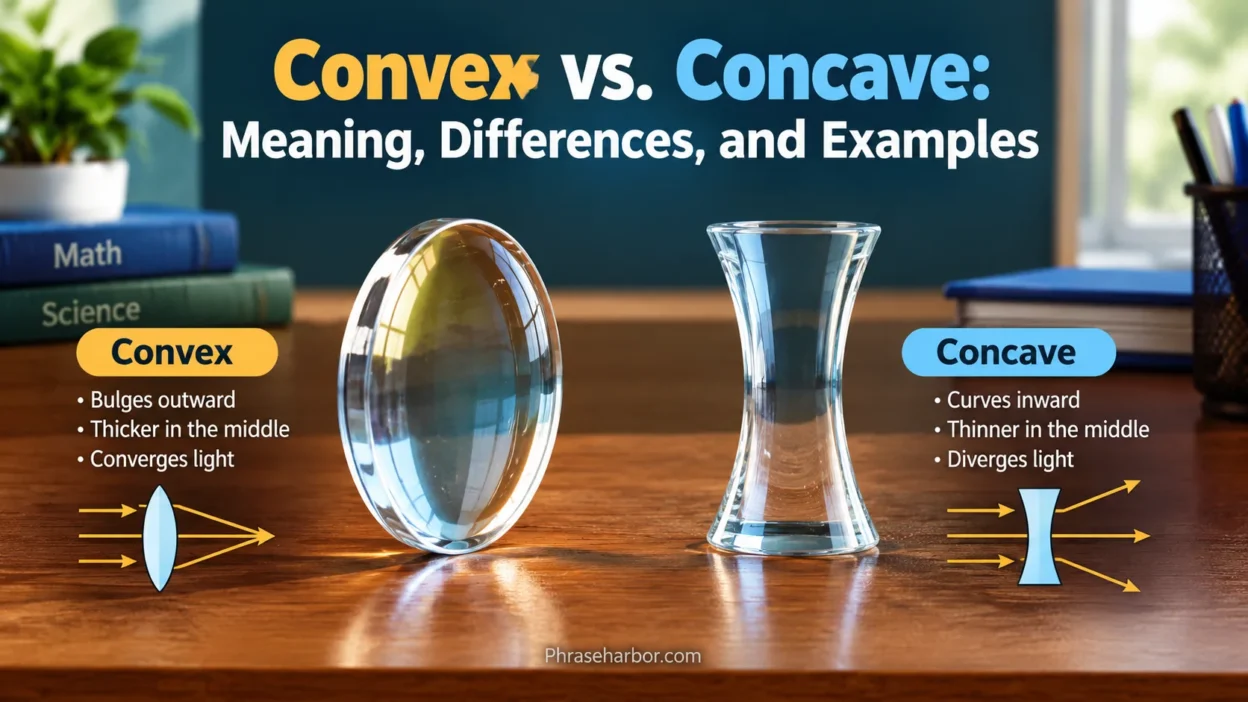
When you look at the inside of a spoon and then turn it over, you’ll notice something interesting. One side curves inward, while the other bulges outward. These two shapes illustrate the basic difference between concave and convex.
Although the terms may sound technical, they’re easy to understand once you connect them with familiar objects. You’ll encounter them in geometry, science, eyeglasses, mirrors, magnifying glasses, and everyday household items.
However, convex and concave don’t simply describe how an object looks. In geometry, they help classify shapes. In optics, they explain how mirrors and lenses interact with light. Understanding these differences will help you use both terms correctly and recognize them in real-world situations.
Quick Answer
Convex means curving or bulging outward, while concave means curving or bending inward. The outside of a spoon is a helpful example of a convex surface, and the hollow inside is concave.
Remember this simple comparison:
- Convex = bulges outward.
- Concave = caves inward.
These terms describe the shape of a surface or object. Their effects on light depend on whether you’re dealing with a mirror or a lens.
Comparison Overview
The following table summarizes the main differences between convex and concave shapes.
| Feature | Convex | Concave |
| Basic meaning | Curves outward | Curves inward |
| Appearance | Bulging or rounded outward | Hollow or indented |
| Everyday example | Outside of a spoon | Inside of a spoon |
| Geometry | Has no inward indentation | May have an inward indentation |
| Polygon angles | Every interior angle is less than 180° | At least one interior angle exceeds 180° |
| Mirror behavior | Spreads reflected parallel rays | Can bring reflected parallel rays together |
| Lens behavior | Usually converges parallel light rays | Usually diverges parallel light rays |
| Common application | Security mirrors and magnifying glasses | Makeup mirrors and nearsightedness correction |
The most important point is that convex and concave describe shape, not one universal effect. A convex mirror and a convex lens both curve outward, but they affect light differently because one reflects light and the other refracts it.
Main Differences Between Convex vs. Concave
Convex and concave are opposites in the way their surfaces curve. However, their differences become more specific when you examine geometric shapes, mirrors, and lenses.
Shape and Appearance
A convex surface bulges outward, much like the exterior of a ball. Its middle may project farther outward than the edges, depending on the object’s orientation and shape.
A concave surface curves inward, creating a hollow or recessed appearance. Think of the inside of a bowl or the center of a shallow dent in a surface.
For example, hold a spoon under a light and examine both sides. The rounded back illustrates a convex surface, while the hollow front illustrates a concave surface.
Behavior in Geometry
In geometry, convexity has a precise mathematical meaning. A shape is convex if the straight line segment connecting any two points inside it stays entirely within the shape.
A concave shape breaks this rule. You can choose two points inside the shape and connect them with a straight line that passes partly outside its boundary.
This distinction matters because a shape can look rounded without being convex everywhere. A shape with even one inward indentation may be concave.
Behavior With Light
Convex and concave surfaces also play different roles in optics. Mirrors reflect light, while lenses bend light as it passes through them.
- Convex mirrors spread out reflected parallel rays.
- Concave mirrors bring reflected parallel rays together when the light strikes the mirror near its principal axis.
- Convex lenses usually converge parallel light rays.
- Concave lenses usually diverge parallel light rays.
These differences explain why convex mirrors help drivers see a wider area, while concave mirrors can magnify nearby objects.
What Does Convex Mean?
The word convex describes a surface or shape that curves outward. You can picture a rounded hill rising above the surrounding ground or the exterior of a ball.
In everyday English, convex often describes the visible profile of an object. In mathematics, however, it can describe a shape or set that follows a specific rule: every line segment joining two points in the shape must remain inside it.
This distinction is important. A surface may have a convex curved section without the entire object being mathematically convex.
Definition of Convex
A convex surface bulges outward rather than forming an inward hollow. The exact appearance depends on the object, but the outward curve is the defining visual feature.
For example, a typical convex lens is thicker in the middle than near its edges. A convex mirror has an outward-curving reflective surface.
In geometry, a convex polygon has no inward corners. Every interior angle measures less than 180 degrees, so the outline never bends inward.
Here are the key characteristics of convex shapes:
- They have no inward indentations when the entire shape is convex.
- A straight line connecting any two points within a convex shape stays inside it.
- A convex polygon has interior angles below 180 degrees.
- Convex mirrors and lenses have distinct optical properties because of their outward curvature.
Examples of Convex Shapes
You can find convex forms in nature, household objects, and optical equipment. Recognizing these examples makes the term easier to remember.
The outside of a spoon: Turn a spoon over, and its rounded back shows an outward curve. This is one of the simplest everyday examples of a convex surface.
A ball: A ball’s exterior curves outward in every direction. Its spherical surface provides a familiar example of convex curvature.
A dome: The outside of a rounded dome rises above its base. Depending on the exact structure, its exterior can illustrate a convex surface.
A convex lens: A typical double-convex lens bulges outward on both sides and is thicker at the center than at the edges.
A convex mirror: The reflective surface curves outward. You’ll often see this type of mirror in parking garages, stores, and vehicle side-view mirrors.
A convex polygon: A square, rectangle, or regular hexagon is convex because none has an inward indentation.
Read More: Arial vs. Helvetica: Differences, and Which Font to Use
What Does Concave Mean?
Concave describes a surface that curves inward. Instead of bulging outward, it forms a hollow, depression, or inward-facing curve.
The inside of a bowl is an easy example. When you look at its interior, the surface curves away from the rim toward the center. A spoon’s hollow side has a similar shape.
In geometry, a concave polygon has at least one inward indentation. At least one interior angle exceeds 180 degrees, distinguishing it from a convex polygon.
Definition of Concave
A concave surface curves inward relative to its surrounding edges. The hollow may be shallow or deep, depending on the object’s design.
A typical concave lens is thinner in the middle than at the edges. A concave mirror has an inward-curving reflective surface that can focus parallel light rays.
The term also applies to mathematical shapes. A concave polygon contains an inward corner that changes the direction of its outline.
Important characteristics include:
- Concave surfaces curve inward to create a hollow or recessed profile.
- A concave polygon has at least one interior angle greater than 180 degrees.
- A straight line connecting two points within a concave shape may pass outside the shape.
- Concave mirrors can form real or virtual images depending on the object’s position.
- Concave lenses typically diverge parallel light rays.
Examples of Concave Shapes
Concave shapes appear in familiar objects and specialized equipment.
The inside of a bowl: Its hollow interior curves inward from the rim. This makes a bowl a useful example of a concave surface.
The front of a spoon: The spoon’s hollow side curves inward and can reflect light in a way similar to a small concave mirror.
A concave lens: This lens usually has a thinner center and thicker edges. It spreads parallel light rays apart as they pass through it.
A concave mirror: Its reflective surface curves inward. Dentists and people applying makeup often use concave mirrors to see enlarged images at close range.
An indented polygon: Imagine a simple arrow-shaped outline with a notch cut into one side. If the resulting polygon has an inward corner, it is concave.
Convex vs. Concave in Geometry
Geometry gives these words a more precise meaning than everyday descriptions of curved surfaces. Instead of asking whether a shape merely looks rounded or hollow, mathematicians examine its boundaries and the points inside it.
This distinction helps classify polygons, three-dimensional objects, and more advanced mathematical sets.
Convex Shapes in Geometry
A shape is convex when every line segment joining any two points inside it lies entirely within the shape.
Imagine drawing a square on paper. Mark two points anywhere inside the square and connect them with a straight line. No matter where you place those points, the line remains within the square.
That property makes the square a convex polygon.
Other examples include:
- Triangles
- Rectangles
- Circles and filled circular regions
- Regular pentagons
- Regular hexagons
- Spheres and solid cubes
For convex polygons, every interior angle is less than 180 degrees. Their boundaries never fold inward to form a notch.
A filled circle is convex because the line segment between any two points in the disk stays inside the disk. The same principle applies to a solid sphere when considering its three-dimensional volume.
Concave Shapes in Geometry
A concave shape contains an indentation that prevents it from satisfying the convexity rule. In a concave polygon, at least one interior angle is greater than 180 degrees.
Consider a simple polygon shaped like an arrow with a deep notch at its base. Choose two points on opposite sides of the indentation. The line connecting them may cross the empty area outside the polygon.
That is the key difference between a concave polygon and a convex one.
Examples include:
- A simple polygon with an inward notch
- A five-pointed star’s outline, when treated as a polygonal region with inward corners
- An irregular polygon with a reflex interior angle
- A nonconvex region with a deep indentation
Not every star-shaped drawing is a polygon in the same mathematical sense. The classification depends on the boundary and the region being considered. A filled star with inward notches is a common example of a concave polygon.
Convex vs. Concave Polygons
A polygon is a closed, two-dimensional shape made from straight line segments. Its angles provide a reliable way to tell whether it is convex or concave.
| Property | Convex Polygon | Concave Polygon |
| Inward indentation | None | At least one |
| Interior angles | All below 180° | At least one above 180° |
| Connecting two interior points | Segment stays inside | Segment may leave the polygon |
| Typical example | Square | Notched polygon |
| Outline | Never bends inward | Bends inward at a reflex corner |
A useful geometry test: Draw a straight line between two points inside the shape. If you can find a pair whose connecting segment leaves the shape, the region is not convex.
This test works beyond polygons. Mathematicians use the same underlying idea to study convex and nonconvex sets.
FAQs:
What Is the Main Difference Between Convex and Concave?
Convex surfaces bulge outward, while concave surfaces curve inward. The outside of a spoon is convex, and its hollow front is concave.
In geometry, convex shapes have no inward indentations, whereas concave polygons have at least one inward corner.
Is Convex Inward or Outward?
Convex means outward. A convex surface bulges away from the surrounding area, like the exterior of a ball.
A convex mirror curves outward, while a typical convex lens is thicker in the middle than at the edges.
Is Concave Inward or Outward?
Concave means inward. A concave surface forms a hollow or indentation, like the inside of a bowl.
Concave mirrors curve inward, and typical concave lenses are thinner in the middle than at their edges.
Which Lens Is Thicker in the Middle, Convex or Concave?
A typical convex lens is thicker in the middle than at the edges. A typical concave lens is thinner in the middle and thicker at the edges.
These descriptions apply to conventional lenses in air. Specialized optical designs can vary, so shape alone doesn’t describe every lens’s performance.
Which Mirror Makes Objects Look Smaller?
A convex mirror produces an upright, reduced virtual image of an ordinary real object. That’s why these mirrors work well in stores, parking garages, and vehicle side-view applications.
A concave mirror can magnify nearby objects, although it can form different kinds of images at other object distances.
Conclusion:
Convex and concave describe two opposite forms of curvature. Convex means bulging outward, while concave means curving inward. The outside and inside of a spoon provide an easy way to remember the difference. These terms also have precise meanings in geometry and important applications in optics. Convex shapes have no inward indentations, while concave polygons contain at least one.
Convex mirrors provide a wider field of view, concave mirrors can magnify nearby objects, and convex and concave lenses affect light in different ways. Once you understand the basic distinction, identifying these shapes becomes much easier. Just remember the simple rule: convex bulges out, and concave caves in.