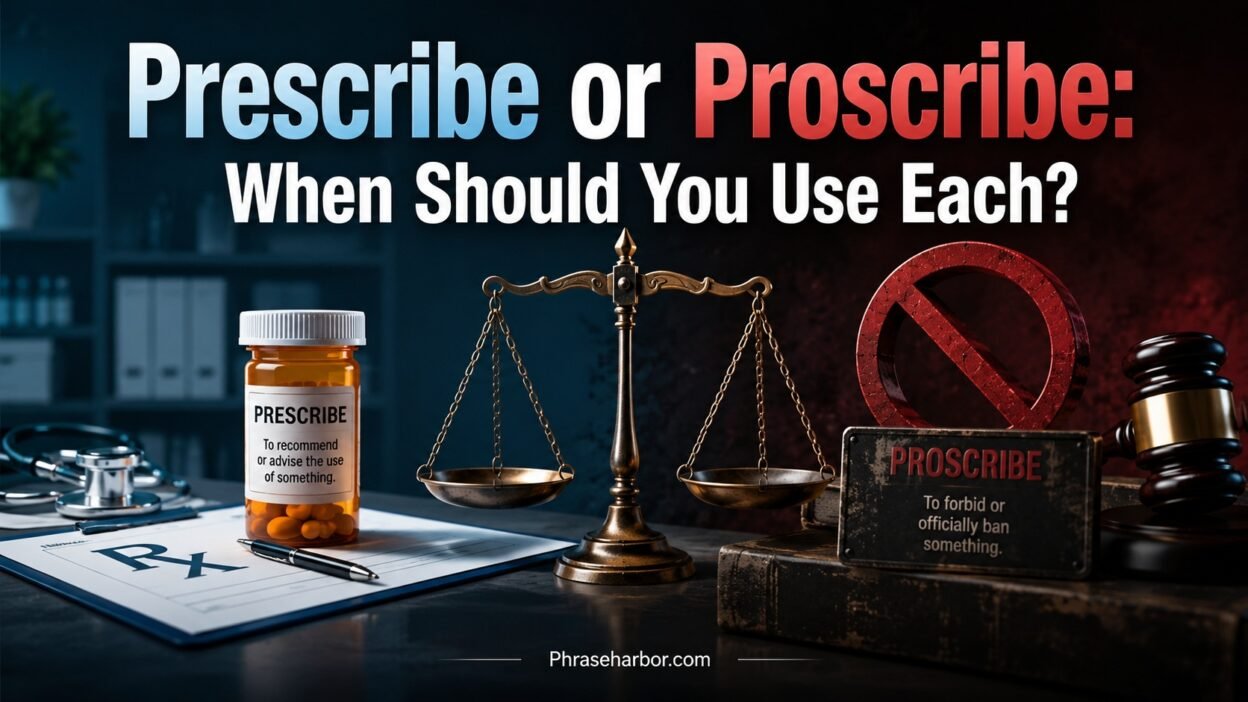
When Prescribe or Proscribe appears in a sentence, the two verbs can seem similar and alike, leaving students, writers, and professionals confused. The correct word depends on the meaning: prescribe means to recommend or give an instruction, especially in medicine, while proscribe means to forbid or ban something.
Their opposite meanings can change the message completely. For example, a doctor prescribed medication because it was recommended for the patient; saying the doctor proscribed it means it was officially banned. This common mistake can make formal writing and academic discussions unclear.
The exact difference becomes easier to distinguish when you consider law, medical contexts, legal documents, an academic paper, or a business report. Their roots and origins explain their different uses, while style guides, regional notes, and American and British usage tendencies can provide extra guidance.
Quick Answer
Prescribe means to recommend, authorize, specify, or officially order something, especially medicine, treatments, rules, or procedures.
Proscribe means to forbid, ban, prohibit, or officially condemn something, usually through laws, regulations, or formal authority.
| Word | Meaning | Simple Memory Trick |
| Prescribe | Recommend or officially order | Think prescription |
| Proscribe | Officially ban or forbid | Think prohibit |
In short:
- A doctor prescribes medicine.
- A government proscribes illegal activities.
- Schools may prescribe a reading list.
- Laws may proscribe discrimination.
Comparison Overview
| Feature | Prescribe | Proscribe |
| Meaning | Recommend, order, specify | Ban, forbid, prohibit |
| Tone | Positive or neutral | Restrictive or negative |
| Common Context | Medicine, education, workplace policies | Law, government, legal writing |
| Part of Speech | Verb | Verb |
| Common Usage | Very common | Less common |
| Easy Memory Trick | Prescription | Prohibit |
| Example | The doctor prescribed antibiotics. | The law proscribes insider trading. |
Main Differences Between Prescribe or Proscribe
Although only two letters separate these words, their meanings point in opposite directions.
Prescribe tells people what they should do.
Someone with authority recommends or officially directs a particular action.
Examples include:
- Doctors prescribe medication.
- Teachers prescribe required textbooks.
- Employers prescribe workplace procedures.
- Safety manuals prescribe emergency protocols.
Proscribe tells people what they must not do.
An authority officially forbids or bans an action or behavior.
Examples include:
- Governments proscribe terrorist organizations.
- Laws proscribe bribery.
- Schools proscribe bullying.
- Companies proscribe insider trading.
Side-by-Side Difference
| Prescribe | Proscribe |
| Recommends | Prohibits |
| Allows | Forbids |
| Directs action | Prevents action |
| Positive instruction | Negative restriction |
A simple way to remember them is this:
Prescribe tells you what to do. Proscribe tells you what not to do.
What Does Prescribe Mean?
Prescribe means to officially recommend, authorize, direct, or order a specific action.
Most people first encounter this word in healthcare because doctors prescribe medicines. However, its meaning extends far beyond medicine.
Someone who prescribes has authority to establish rules, standards, treatments, or instructions.
Common meanings of prescribe
- Recommend medicine
- Specify procedures
- Establish rules
- Direct a course of action
- Set official standards
Medical Example
A physician examines a patient with pneumonia and prescribes antibiotics for ten days.
Here, the doctor isn’t merely suggesting medicine. They are formally authorizing a treatment plan.
Educational Example
A university may prescribe required reading before students attend lectures.
Workplace Example
A company’s employee handbook may prescribe acceptable dress codes.
Everyday Examples
- The doctor prescribed rest after surgery.
- The instructor prescribed weekly practice sessions.
- Company policy prescribes regular cybersecurity training.
- The recipe prescribes baking for forty-five minutes.
What Does Proscribe Mean?
Proscribe means to officially forbid, outlaw, ban, or condemn something.
Unlike prescribe, this word usually appears in legal, governmental, historical, or academic writing.
It describes actions that authorities declare unacceptable.
Common meanings of proscribe
- Ban
- Forbid
- Outlaw
- Prohibit
- Officially condemn
Legal Example
Many countries proscribe human trafficking.
The law does not recommend avoiding trafficking. It makes the activity illegal.
Government Example
A government may proscribe organizations involved in terrorism.
Workplace Example
A company may proscribe harassment or discrimination.
Everyday Examples
- School rules proscribe cheating.
- Federal law proscribes insider trading.
- The organization proscribes conflicts of interest.
- Company policy proscribes sharing confidential information.
Where Did These Words Come From?
One reason people confuse these words is their shared Latin heritage.
Both originate from the Latin verb scribere, meaning to write.
| Word | Latin Root | Original Meaning |
| Prescribe | praescribere | Write before, set down beforehand |
| Proscribe | proscribere | Publish as forbidden |
Originally, Roman officials literally wrote official instructions and prohibitions.
Over time:
- Prescribe became associated with writing instructions or recommendations.
- Proscribe became associated with publishing lists of people or activities that were banned.
Although their roots overlap, their meanings evolved in opposite directions.
When Should You Use Prescribe?
Use prescribe whenever someone with authority recommends or officially directs an action.
Common situations
Medicine
The most familiar use.
Examples:
- Doctors prescribe antibiotics.
- Dentists prescribe pain medication.
- Psychiatrists prescribe antidepressants.
Education
Teachers and universities prescribe:
- Reading lists
- Course materials
- Assignments
- Curriculum standards
Business
Organizations prescribe:
- Safety procedures
- Ethical guidelines
- Workplace standards
- Employee responsibilities
Government
Governments prescribe:
- Building regulations
- Tax filing procedures
- Environmental standards
When Should You Use Proscribe?
Use proscribe whenever an authority officially forbids something.
Common situations
Law
Laws often proscribe:
- Fraud
- Bribery
- Theft
- Insider trading
Government
Governments proscribe:
- Terrorist organizations
- Illegal substances
- Dangerous practices
Schools
Schools proscribe:
- Bullying
- Plagiarism
- Vandalism
- Academic dishonesty
Businesses
Companies proscribe:
- Workplace harassment
- Data theft
- Discrimination
- Unauthorized access
Prescribe vs. Proscribe in Real Life
Let’s compare realistic situations.
| Situation | Correct Word | Why |
| A doctor gives medicine | Prescribe | Treatment is recommended |
| A government bans smoking indoors | Proscribe | Smoking is forbidden |
| A teacher assigns reading | Prescribe | Reading is required |
| A company bans bribery | Proscribe | Conduct is prohibited |
| A nutritionist recommends a diet | Prescribe | Advice is given |
| A law bans child labor | Proscribe | Activity becomes illegal |
Why Do People Confuse Prescribe and Proscribe?
Several factors contribute to the confusion.
Similar spelling
Only two letters differ.
- prescribe
- proscribe
At first glance, they appear almost identical.
Similar pronunciation
Both words begin with the same sound and end with “-scribe.”
Shared Latin root
Their common origin makes them look related.
Opposite meanings
Ironically, despite their similar appearance, they often function as opposites.
That makes mistakes even easier to make.
Memory Tricks You’ll Actually Remember
Think of a prescription
Whenever you hear prescribe, picture a doctor handing you a prescription.
Prescription → Prescribe
Think of prohibition
Whenever you hear proscribe, think about prohibition.
Prohibit → Proscribe
The Letter Trick
Pre comes before.
Someone gives instructions before you act.
Pro reminds many writers of prohibit.
That makes remembering much easier.
One-Sentence Reminder
Doctors prescribe medicine. Laws proscribe crimes
Common Mistakes Writers Make
These mistakes appear surprisingly often.
Incorrect Example
The doctor proscribed antibiotics.
The doctor prescribed antibiotics.
The doctor recommended treatment rather than banning it.
Incorrect Example
The law prescribes bribery.
The law proscribes bribery.
The law forbids bribery.
Incorrect Example
School rules prescribe cheating.
School rules proscribe cheating.
Rules prohibit cheating.
Incorrect Example
My professor proscribed three textbooks.
My professor prescribed three textbooks.
The professor assigned required reading.
Case Study: A Single Letter Changes Everything
Imagine a hospital report that reads:
“The physician proscribed insulin.”
That sentence carries an alarming meaning.
It suggests the physician banned insulin.
Now compare it with:
“The physician prescribed insulin.”
The second sentence accurately states that the doctor recommended insulin treatment.
One misplaced prefix completely changes the message.
That’s why editors pay close attention to these words.
Synonyms for Prescribe
Depending on context, you may also use:
- Recommend
- Specify
- Direct
- Order
- Stipulate
- Dictate
- Authorize
- Establish
- Instruct
- Require
Example
The safety manual stipulates protective equipment before entering the laboratory.
Read More: Spatter or Splatter: What’s the Difference?
Synonyms for Proscribe
Common alternatives include:
- Ban
- Forbid
- Outlaw
- Prohibit
- Bar
- Disallow
- Restrict
- Exclude
- Criminalize
- Suppress
Example
The regulation prohibits smoking inside public buildings.
Can Prescribe and Proscribe Ever Mean the Same Thing?
No.
Although the words share similar spelling and history, they are not interchangeable.
Replacing one with the other changes the meaning entirely.
Compare these sentences.
| Sentence | Meaning |
| Doctors prescribe vaccines. | Doctors recommend vaccines. |
| Governments proscribe dangerous substances. | Governments ban dangerous substances. |
Switching the verbs would make each sentence incorrect.
Examples in Different Contexts
Healthcare
Doctors prescribe medication based on a patient’s diagnosis.
Hospitals also prescribe rehabilitation plans after surgery.
Education
Universities prescribe mandatory coursework before graduation.
Teachers prescribe reading assignments each semester.
Government
Legislatures proscribe corruption through criminal statutes.
Many countries also proscribe human trafficking.
Workplace
Organizations prescribe ethical standards for employees.
The same organizations proscribe harassment and discrimination.
Quote Worth Remembering
“Precision in language creates precision in thought.”
That principle perfectly explains why understanding prescribe and proscribe matters.
Choosing the correct word prevents confusion and strengthens your writing.
FAQs:
Is prescribe the opposite of proscribe?
Not exactly. Prescribe usually means to recommend, authorize, or give an instruction, while proscribe means to forbid or officially ban something. Their meanings can seem opposite in some situations, but they aren’t direct grammatical opposites.
What does prescribe mean?
Prescribe means to officially recommend or order something. A doctor may prescribe medication for a patient, while a rule or authority may prescribe a specific action or procedure.
What does proscribe mean?
Proscribe means to officially forbid or ban something. It often appears in formal writing, legal contexts, and discussions about rules, practices, or activities that aren’t allowed.
How can I remember the difference between prescribe and proscribe?
A useful memory trick is to connect prescribe with a doctor who prescribes medicine. Think of proscribe as something being prohibited or banned. This quick association can help you choose the right word.
Is prescribe or proscribe more common?
Prescribe is generally more common in everyday English, especially in medical contexts. Proscribe is less common and tends to appear in formal, legal, academic, or official writing.
Conclusion:
Understanding prescribe vs proscribe becomes much easier when you focus on their meanings rather than their similar spelling. Prescribe usually means to recommend, order, or give an instruction, while proscribe means to forbid or ban something. When you pause over these words, check whether the sentence describes something being recommended or prohibited. This simple habit can help you avoid common mistakes and make your English clearer and more precise.