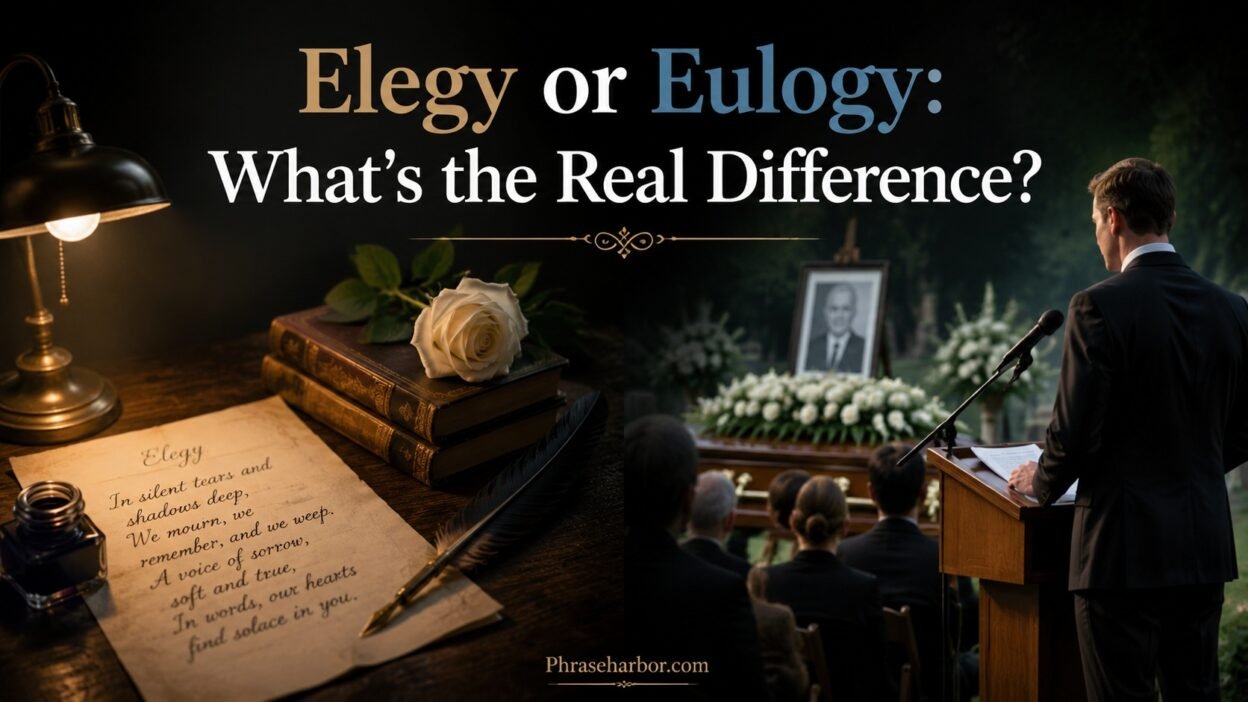
Elegy or Eulogy can confuse English learners, students, and writers because both are connected to death, grief, remembrance, and honoring a person who has passed away or died.
An elegy is often a poem, song, or piece of writing that expresses grief and sorrow while mourning someone’s death, whereas a eulogy is usually a speech that praises and remembers a person during a funeral or memorial service. Both show respect and honor, but their purpose, form, and typical setting are different.
From my experience with writing, literature, and grammar, the easiest way to remember the difference is to focus on each term and what it aims to express. An elegy centers on mourning, grief, and sorrow, while a eulogy focuses on honoring someone’s life and sharing praise at memorial events.
Quick Answer
The difference between elegy and eulogy comes down to form and purpose.
- An elegy is a poem or literary composition that expresses sorrow, remembrance, or reflection after a loss.
- A eulogy is a speech that praises and celebrates the life of someone who has died, usually during a funeral or memorial service.
While both honor the deceased, an elegy belongs to literature, whereas a eulogy belongs to public speaking.
Comparison Overview
| Feature | Elegy | Eulogy |
| Definition | A poem or literary work expressing grief or reflection | A speech honoring someone who has died |
| Form | Written | Spoken |
| Purpose | Reflect on loss and mourning | Celebrate a person’s life and achievements |
| Common Setting | Books, poetry collections, literature classes | Funerals, memorial services, celebrations of life |
| Audience | Readers | Listeners |
| Main Focus | Grief, memory, reflection | Tribute, appreciation, remembrance |
| Emotional Tone | Thoughtful, reflective, sometimes melancholy | Warm, respectful, often uplifting |
| Can It Be Published? | Yes | Sometimes, if written after delivery |
Main Differences Between Elegy and Eulogy
At first glance, both words seem interchangeable because they deal with death and remembrance. However, they serve different purposes and appear in different settings.
An Elegy Is Written While a Eulogy Is Spoken
The biggest distinction lies in how each one is presented.
An elegy exists as written literature. Most elegies take the form of poems, although modern literature also includes prose elegies. Writers use them to explore grief, memory, love, and the passage of time.
A eulogy, by contrast, is spoken aloud. Family members, close friends, religious leaders, or colleagues usually deliver it during a funeral or memorial service.
Their Goals Are Different
Although both honor someone who has died, they approach remembrance from different angles.
An elegy focuses on the emotions surrounding loss. It explores sadness, longing, acceptance, or hope through artistic language.
A eulogy focuses on the person rather than the grief. It highlights their personality, accomplishments, values, and the memories they leave behind.
Their Audiences Differ
An elegy speaks to readers who appreciate literature and reflection.
A eulogy addresses people gathered to remember a loved one. It creates comfort, connection, and shared remembrance.
They Can Sometimes Overlap
Occasionally, someone reads an elegy during a funeral. Even then, the poem remains an elegy because of its literary form. Reading it aloud doesn’t transform it into a eulogy.
Likewise, writing down a funeral speech doesn’t make it an elegy. Its purpose remains to honor a person’s life through spoken tribute.
What Is an Elegy?
Definition
An elegy is a poem or literary work that expresses sorrow, remembrance, or thoughtful reflection after the loss of someone or something meaningful. Although many elegies mourn the death of a person, they may also lament lost youth, fading traditions, broken relationships, or the passage of time.
The word elegy comes from the Greek word elegeia, which originally referred to a poem written in a specific meter. Over centuries, the meaning shifted from a poetic structure to a theme of mourning and remembrance.
Today, an elegy doesn’t have to follow a particular poetic form. What matters is its emotional focus.
Key Characteristics of an Elegy
An elegy often includes several defining features.
- It is usually written as poetry.
- It expresses grief or deep reflection.
- It honors someone or something that has been lost.
- It explores emotions rather than simply recounting events.
- It often moves from sorrow toward acceptance or hope.
Unlike ordinary poems, elegies invite readers to reflect on life’s impermanence. They encourage emotional connection instead of simply telling a story.
Common Themes Found in Elegies
Many elegies explore universal human experiences.
- Death and mourning
- Memory
- Love that continues after loss
- Nature as a symbol of healing
- The passage of time
- Hope after grief
- Legacy and remembrance
These themes make elegies timeless because every generation experiences loss in one form or another.
Structure of a Traditional Elegy
Although modern poets experiment freely, many classic elegies follow a recognizable emotional journey.
| Stage | Purpose |
| Expression of grief | Introduces the sense of loss |
| Reflection | Considers memories, life, or mortality |
| Resolution | Finds comfort, acceptance, or hope |
This progression helps readers experience not only sadness but also emotional healing.
Examples of Elegy in Sentences
Here are several examples that show how the word is used correctly.
- The poet wrote an elegy for his late mentor.
- Her latest collection includes a moving elegy about childhood memories.
- Students analyzed the famous elegy during literature class.
- The author transformed personal grief into a powerful elegy that touched thousands of readers.
Famous Elegies in Literature
Some of history’s greatest poems belong to the elegiac tradition.
Thomas Gray’s Elegy Written in a Country Churchyard reflects on mortality and the forgotten lives of ordinary people.
Walt Whitman’s When Lilacs Last in the Dooryard Bloom’d mourns President Abraham Lincoln while exploring national grief.
W. H. Auden’s Funeral Blues captures heartbreak through simple yet unforgettable language.
These works demonstrate that an elegy does much more than describe sadness. It transforms emotion into lasting art.
“An elegy doesn’t simply mourn death. It preserves memory through language.”
When Should You Use the Word “Elegy”?
Choose elegy whenever you’re referring to a literary work about grief or remembrance.
For example:
- Literary criticism
- Poetry analysis
- Creative writing
- School assignments about poems
- Discussions of classic literature
If you’re talking about a poem, reflective writing, or artistic expression of loss, elegy is almost always the correct word.
Common Misunderstandings About Elegies
Many people assume every poem about death is an elegy. That’s not always true.
A poem may mention death without exploring mourning or remembrance. Likewise, not every elegy centers on a deceased person. Writers sometimes compose elegies for lost innocence, destroyed landscapes, fading cultures, or significant life changes.
This broader meaning makes the elegy one of literature’s most flexible and emotionally rich forms.
What Is a Eulogy?
A eulogy is a speech that honors and celebrates the life of someone who has passed away. Unlike an elegy, which belongs to literature, a eulogy belongs to public speaking and personal remembrance.
Most eulogies are delivered during funerals, memorial services, or celebrations of life. Instead of focusing only on grief, they highlight the person’s character, accomplishments, relationships, values, and the memories they leave behind.
While sadness naturally plays a role, a thoughtful eulogy also brings comfort, gratitude, and even moments of laughter by recalling meaningful stories.
What Is a Eulogy?
Definition
A eulogy is a speech that praises and honors someone who has died. It is usually delivered during a funeral, memorial service, or celebration of life. The speaker shares memories, highlights the person’s character, and reflects on the impact they had on family, friends, and the community.
The word eulogy comes from the Greek words eu, meaning “good,” and logos, meaning “speech” or “words.” Together, they literally mean “good words” spoken about someone.
Unlike an elegy, a eulogy isn’t a work of literature. Its primary purpose is to comfort those who are grieving while celebrating the life of the deceased.
Key Characteristics of a Eulogy
Most meaningful eulogies share several important qualities.
- They are spoken aloud.
- They focus on a specific person.
- They celebrate the person’s life rather than dwelling only on death.
- They include personal stories and memories.
- They offer comfort and encouragement to those attending.
- They end with a message of gratitude, hope, or farewell.
A good eulogy doesn’t try to list every achievement. Instead, it paints a picture of who the person truly was.
Typical Structure of a Eulogy
Although every speech is unique, many follow a similar structure.
| Section | Purpose |
| Introduction | Welcome attendees and introduce your relationship with the deceased. |
| Life Story | Share important milestones and accomplishments. |
| Personal Memories | Tell meaningful stories that reveal the person’s character. |
| Legacy | Explain how the person influenced others. |
| Closing | Offer gratitude, hope, or a final farewell. |
This structure keeps the speech organized while allowing room for heartfelt memories.
Examples of “Eulogy” in Sentences
These examples show how to use the word correctly.
- Her daughter delivered a heartfelt eulogy at the memorial service.
- He spent several days preparing a eulogy for his lifelong friend.
- The minister concluded the ceremony with a moving eulogy.
- Everyone smiled through tears as they listened to the touching eulogy.
What Makes a Great Eulogy?
The most memorable eulogies aren’t perfect speeches. They’re honest and personal.
A great eulogy usually includes:
- Authentic memories
- A balance of humor and emotion
- Specific examples instead of general praise
- Appreciation for the person’s influence
- A hopeful ending
For example, instead of saying:
“She was a wonderful grandmother.”
You might say:
“Every Saturday morning, Grandma filled the kitchen with the smell of homemade pancakes. Long before breakfast was ready, the whole family had gathered around the table simply because she made every house feel like home.”
Specific memories create lasting emotional connections.
When Should You Use the Word “Eulogy”?
Use eulogy whenever you’re referring to a speech given in honor of someone who has died.
Common situations include:
- Funeral services
- Memorial ceremonies
- Celebration of life events
- Religious services
- Public tributes
If someone is speaking directly to an audience to honor a person’s life, eulogy is the correct term.
When Should You Use “Elegy”?
Knowing the definition is helpful. Knowing when to use the word is even more important.
Choose elegy whenever you’re talking about a written work that reflects on loss or remembrance.
Use “Elegy” in Literary Contexts
Most often, you’ll encounter the word in literature.
Examples include:
- Poetry collections
- Literature textbooks
- Literary criticism
- Creative writing
- University courses
Correct:
- The professor assigned an elegy by Walt Whitman.
- She published an elegy after losing her father.
Incorrect:
- He gave an elegy at the funeral.
In this case, eulogy is the correct word because he delivered a speech.
Use “Elegy” When Discussing Reflection
Not every elegy mourns a person’s death.
Modern writers also compose elegies about:
- Lost childhood
- Environmental destruction
- Cultural traditions
- Broken relationships
- Historic tragedies
For instance, a poet may write an elegy for a disappearing forest or a forgotten hometown. The focus remains thoughtful reflection rather than public tribute.
Examples
- The novel ends with an elegy for a fading way of life.
- Her poem serves as an elegy for the city she once called home.
- Students examined how the poet transformed grief into an unforgettable elegy.
When Should You Use “Eulogy”?
Choose eulogy whenever you’re referring to spoken words that honor someone’s life.
Unlike an elegy, a eulogy almost always centers on one individual.
Use “Eulogy” at Funeral and Memorial Services
The most common setting is a funeral.
Family members, close friends, coworkers, or religious leaders often deliver the speech.
Its purpose is to:
- Celebrate the person’s life.
- Share meaningful memories.
- Comfort grieving loved ones.
- Preserve the person’s legacy.
Examples
- His brother delivered the eulogy during the funeral.
- She practiced her eulogy several times before the memorial.
- The eulogy made everyone laugh and cry at the same time.
A Eulogy Doesn’t Have to Be Sad
Many people assume a eulogy should be serious from beginning to end.
In reality, the best speeches often include moments of gentle humor.
A funny childhood memory or an amusing family tradition can remind everyone of the joy the person brought to others.
The goal isn’t to avoid grief. It’s to celebrate a life that mattered.
Read More: Whole Day or All Day: What’s the Difference?
Can an Elegy Be Read as a Eulogy?
This question causes plenty of confusion.
The short answer is yes, but only in certain situations.
Someone may choose to read a famous elegy during a funeral because its message captures the emotions of the occasion. The reading becomes part of the ceremony.
However, the poem itself remains an elegy.
Likewise, a eulogy that has been written down doesn’t become an elegy simply because it exists on paper.
The distinction depends on purpose, not format.
Think of it this way.
- A poem read aloud is still a poem.
- A speech printed in a booklet is still a speech.
The same principle applies here.
A Simple Comparison
| Situation | Elegy or Eulogy? | Why? |
| A poem read during a funeral | Elegy | It is still a literary work. |
| A funeral speech printed afterward | Eulogy | Its purpose is to honor someone’s life through speech. |
| A published poem about grief | Elegy | It expresses reflection through literature. |
| A memorial address given by a family member | Eulogy | It is spoken before an audience. |
Understanding this difference helps you choose the correct word with confidence.
Famous Examples of Elegies
Throughout history, many poets have written unforgettable elegies. These works continue to inspire readers because they explore grief with honesty and beauty.
Elegy Written in a Country Churchyard by Thomas Gray
Published in 1751, this poem reflects on mortality and the quiet lives of ordinary people buried in a rural churchyard.
Rather than praising famous figures, Gray reminds readers that every life holds value.
One of its most famous lines is:
“The paths of glory lead but to the grave.”
The poem remains one of the best-known elegies in English literature.
When Lilacs Last in the Dooryard Bloom’d by Walt Whitman
Whitman wrote this elegy after the assassination of President Abraham Lincoln in 1865.
Instead of focusing only on Lincoln, the poem explores national grief, healing, and renewal through powerful natural imagery.
It stands as one of the greatest American elegies ever written.
Funeral Blues by W. H. Auden
This twentieth-century poem expresses overwhelming personal loss.
Its emotional honesty and memorable language have made it popular at funerals and memorial services around the world.
Many readers recognize it from the film Four Weddings and a Funeral, where it gained renewed popularity.
Why These Elegies Matter
Although each poem differs in style, they share common qualities.
- They transform grief into art.
- They preserve memory.
- They encourage reflection.
- They remind readers that loss is a universal human experience.
Great elegies continue speaking to new generations because emotions like love, remembrance, and hope never become outdated.
What Makes a Good Eulogy?
Writing a eulogy can feel overwhelming. Many people worry about finding the perfect words.
The truth is that authenticity matters far more than perfection.
A meaningful eulogy should sound sincere, not rehearsed.
Share Personal Stories
Stories help listeners remember the individual rather than a list of accomplishments.
Instead of saying someone was generous, describe a moment when they quietly helped a neighbor or supported a friend through a difficult time.
Specific details create lasting memories.
Celebrate the Person’s Character
Think about qualities that made the person unique.
These might include:
- Kindness
- Humor
- Courage
- Patience
- Wisdom
- Generosity
- Optimism
Support each quality with a real example.
Balance Emotion With Hope
Grief naturally fills the room during a funeral.
A thoughtful eulogy acknowledges that sadness while also celebrating a life well lived.
Many memorable speeches leave listeners with gratitude rather than despair.
Keep It Genuine
You don’t need dramatic language.
Simple, heartfelt words often leave the strongest impression.
Imagine speaking directly to someone who loved the person just as much as you did.
That honesty will always matter more than elaborate vocabulary.
FAQs:
What is an elegy?
An elegy is a poem, song, or piece of writing that expresses grief, sorrow, and mourning, often after someone has died. It focuses on loss and remembrance.
What is a eulogy?
A eulogy is a speech or piece of writing that praises and remembers a person who has died. It’s commonly given at a funeral or memorial service.
What is the main difference between an elegy and a eulogy?
The main difference is their purpose. An elegy mainly expresses grief and sorrow, while a eulogy mainly honors and praises the deceased person.
Can an elegy be a speech?
An elegy is traditionally a poem or piece of writing about grief and loss. Although the term can have broader literary uses, a funeral speech is usually called a eulogy.
Is a eulogy always given at a funeral?
No. A eulogy can also be delivered at a memorial service or another event honoring someone who has died. The important point is that it remembers and praises the person.
Conclusion:
Understanding Elegy or Eulogy becomes easier when you remember their main purposes. An elegy expresses grief, sorrow, and mourning, while a eulogy honors, praises, and remembers a person who has died. Although both are connected with death and remembrance, they are used in different contexts.
If you’re writing about loss, studying literature, preparing a funeral speech, or improving your English vocabulary, choosing the right word makes your meaning clearer. Keep the basic distinction in mind: an elegy focuses on grief, while a eulogy focuses on praise and remembrance.