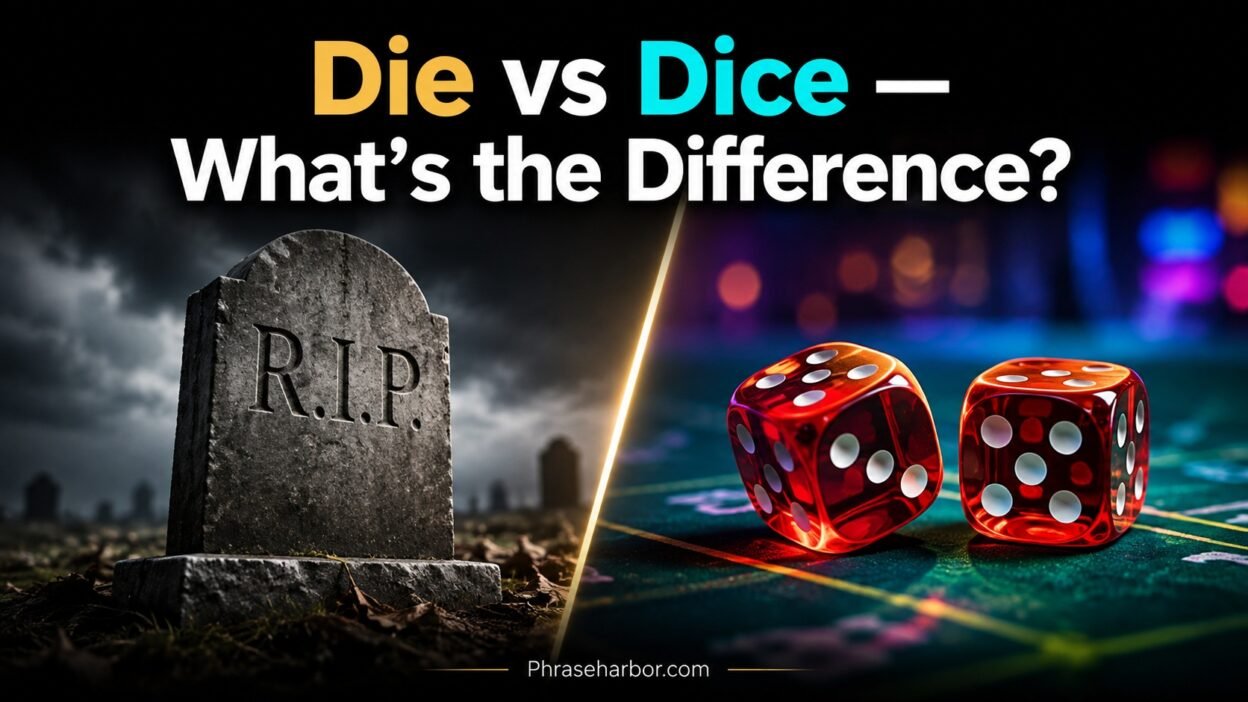
Die vs dice is a common English-language question, especially when talking about board games, gambling games, role-playing games, or anything involving numbered cubes. The confusion usually comes from one simple fact: die and dice are traditionally different grammatical forms of the same gaming object. If you have one, you have a die. If you have more than one, you have dice.
However, modern English has made the situation slightly less tidy. You may hear someone say “a dice” or see “one dice” in casual gaming conversations. While that usage exists, traditional English still treats die as the singular form and dice as the plural. The words also have other meanings. Die can mean to stop living or refer to a manufacturing tool, while dice can describe the act of cutting food into small pieces.
Understanding these differences helps you choose the right word based on context. Whether you’re writing game instructions, explaining grammar, or simply wondering whether to say “roll the die” or “roll the dice,” the distinction becomes easy once you see how each word works.
Quick Answer
The simplest answer to “What is the difference between die and dice?” is this:
- Die is traditionally the singular form when referring to one gaming object.
- Dice is traditionally the plural form when referring to two or more gaming objects.
- One die is the traditional form.
- Two dice is the traditional plural form.
- Dice is also commonly used as a singular noun in informal modern English.
- Die can also be a verb meaning to stop living.
- Dice can be a verb meaning to cut something into small pieces.
- Die can also refer to a specialized manufacturing tool.
For example:
I rolled one die, but my friend rolled two dice.
That’s the traditional distinction in one sentence.
Comparison Overview
The following table provides a quick look at the main differences between die and dice.
| Feature | Die | Dice |
| Traditional gaming meaning | One gaming object | Two or more gaming objects |
| Traditional number | Singular | Plural |
| Example | “Roll one die.” | “Roll two dice.” |
| Modern singular usage | Standard | Common in informal speech |
| Gaming pronunciation | /daɪ/ | /daɪs/ |
| Verb meaning | Stop living | Cut into small pieces |
| Manufacturing meaning | A tool for shaping or cutting | Dies is normally the plural in this technical sense |
| Common phrase | “one die” | “a pair of dice” |
| Related gaming notation | d4, d6, d8, d10, d12, d20 | Multiple dice may be described as 2d6, 3d8, etc. |
The important point is that die and dice aren’t simply two interchangeable spellings. They have different grammatical roles and meanings.
Main Differences Between Die vs Dice
The biggest difference between die and dice involves number. Traditional English uses die for one gaming object and dice for more than one.
Die Is Traditionally Singular
When you’re talking about a single numbered gaming object, die is the traditional word.
For example:
- “Roll the die.”
- “The die landed on six.”
- “I need one die for this game.”
- “The red die fell off the table.”
If there is only one object, die is the clearest traditional choice.
Think of it like other irregular English forms. We say one mouse and two mice. Similarly, traditional English uses one die and two dice.
Dice Is Traditionally Plural
When you’re talking about two or more gaming objects, use dice.
For example:
- “Roll the dice.”
- “She rolled two dice.”
- “The dice landed on different numbers.”
- “We need three dice for this game.”
The word doesn’t take a regular -s ending to become plural. You don’t normally say “two dies” when referring to gaming objects.
Instead:
One die → two dice
That’s the traditional pattern.
Modern English Sometimes Uses Dice as Singular
Here’s where things get interesting.
In modern everyday English, particularly in gaming communities, people sometimes use dice as both singular and plural. You might hear:
“I bought a new dice.”
or:
“Roll the dice.”
The second sentence doesn’t necessarily tell you whether the speaker means one or several objects.
This singular use has become familiar enough that many speakers don’t notice anything unusual about it. Still, if you’re writing formal, educational, or grammar-focused content, “one die” remains the safest and clearest traditional form.
So the practical rule is simple:
Use “die” for one and “dice” for more than one when you want traditional grammatical precision.
What Does Die Mean?
The word die has several meanings in English. Context determines which meaning the reader understands.
Die as a Gaming Noun
In games, a die is a small object marked with numbers, symbols, or other values that players roll to produce a random result.
A standard six-sided die has six numbered faces:
- 1
- 2
- 3
- 4
- 5
- 6
If you pick up just one of these objects, you have a die.
For example:
“The player rolled the die and got a five.”
The word die doesn’t require the object to have exactly six sides. Modern games use many shapes.
You can have:
- four-sided die (d4)
- six-sided die (d6)
- eight-sided die (d8)
- ten-sided die (d10)
- twelve-sided die (d12)
- twenty-sided die (d20)
So die refers to one gaming object regardless of how many faces it has.
Die as a Verb
Die also has a completely different meaning as a verb. It means to stop living.
For example:
- “Plants die without enough water.”
- “The battery will eventually die.”
- “The character appears to die at the end of the story.”
This meaning has nothing to do with games.
That distinction becomes especially important because the word die can look unusual when used in a sentence. You need to examine the surrounding words to understand the intended meaning.
Die as a Manufacturing Tool
In manufacturing, a die is a tool used to cut, shape, press, form, or otherwise process material.
For example, a metalworking die can help shape a piece of metal into a specific form. Dies can also be used in processes involving wire, plastic, sheet metal, and other materials.
This creates another important distinction:
One manufacturing die → multiple dies
Notice that the plural here is dies, not dice.
That’s because the manufacturing meaning is different from the traditional gaming meaning.
What Does Dice Mean?
Dice also has more than one use.
Dice as the Plural of Die
The most familiar meaning is the traditional plural of die.
For example:
“The player rolled two dice.”
Here, dice refers to two gaming objects.
You can also use it with larger quantities:
- two dice
- three dice
- four dice
- a set of dice
- a handful of dice
The number doesn’t change the word. The plural remains dice.
Dice as a Singular Gaming Noun
Modern English sometimes treats dice as a singular gaming noun.
This is particularly noticeable in casual conversation. A player may say:
“I need another dice.”
Traditional grammar would usually recommend:
“I need another die.”
The modern form isn’t mysterious. It reflects a broader tendency in English for irregular plurals to become reinterpreted as ordinary nouns.
For formal writing, however, sticking with one die avoids confusion.
Dice as a Verb
Dice can also function as a verb. In this case, it has nothing to do with board games.
To dice something means to cut it into small pieces, usually roughly cube-shaped pieces.
For example:
- “Dice the onions.”
- “She diced the tomatoes.”
- “Dice the potatoes before adding them to the pan.”
- “The chef diced the vegetables into small cubes.”
Here, dice has a completely different grammatical function.
Die vs Dice in Grammar
Grammar is where the die vs dice question becomes most important.
Traditional English treats the words as an irregular singular-plural pair:
one die → two dice
This pattern is similar to other irregular forms:
| Singular | Plural |
| mouse | mice |
| goose | geese |
| tooth | teeth |
| foot | feet |
| die | dice |
You wouldn’t normally say “two mouse” or “two tooth.” In the same way, traditional English doesn’t use “two die” for gaming objects.
Is Die Singular?
Yes. When referring to a single gaming object, die is the traditional singular form.
Example:
“The player rolled one die.”
Is Dice Plural?
Traditionally, yes.
Example:
“The player rolled two dice.”
However, modern English sometimes uses dice as a singular noun. That usage is especially common in casual gaming contexts.
Is “A Dice” Correct?
If you’re following traditional grammar, “a die” is preferable.
Compare:
- Traditional: “I bought a die.”
- Modern informal: “I bought a dice.”
The first version is the better choice when you’re writing carefully.
Die vs Dice Pronunciation
The pronunciation difference is small but noticeable.
| Word | Pronunciation | Similar Sound |
| die | /daɪ/ | sky, fly, try |
| dice | /daɪs/ | nice, rice, price |
Both words begin with the same /daɪ/ sound.
The main difference comes at the end. Dice has an s sound that die doesn’t have.
Say them slowly:
die → “dye”
dice → “dyes”
The pronunciation won’t tell you every grammatical detail, but it can help learners distinguish the words when speaking.
Read More: Tear vs Tare — When to Use Each Word
Die vs Dice in Board Games
Board games provide some of the clearest examples of the difference.
Imagine a game that uses a single six-sided object. The instructions might say:
“Roll the die and move your piece four spaces.”
Now imagine the game requires two objects:
“Roll the dice and add the numbers together.”
The distinction becomes even more obvious in games that use several different types of dice.
Common Gaming Terms
You’ll often encounter:
- six-sided die
- twenty-sided die
- pair of dice
- set of dice
- roll the dice
- roll one die
- roll two dice
- dice roll
- dice game
The phrase “dice roll” is especially common. It can refer to the act or result of rolling one or more gaming objects.
Die vs Dice in Tabletop Role-Playing Games
Tabletop role-playing games use a particularly clear notation system.
A d20, for example, means a twenty-sided die.
Other common forms include:
| Notation | Meaning |
| d4 | Four-sided die |
| d6 | Six-sided die |
| d8 | Eight-sided die |
| d10 | Ten-sided die |
| d12 | Twelve-sided die |
| d20 | Twenty-sided die |
You may also see combinations such as 2d6. That generally means two six-sided dice.
Likewise, 3d8 means three eight-sided dice.
This terminology reinforces the traditional distinction: the singular object is a die, while multiple objects are dice.
Why Is the Plural of Die Dice?
The plural dice comes from the historical development of the English language rather than from the modern rule of simply adding -s.
English contains many irregular plurals that developed from older forms. Die → dice is one of them.
The same general pattern appears in words such as:
- man → men
- woman → women
- mouse → mice
- goose → geese
- foot → feet
These forms don’t follow the regular rule of adding -s or -es.
Historically, die and dice developed through older forms associated with gaming and chance. Over centuries, the plural became established as dice.
You don’t need to memorize the entire history to use the words correctly. The practical rule remains much easier:
One die. More than one dice.
Die vs Dice vs Dies
The word dies deserves special attention because it can look like a possible plural of die.
It isn’t the usual plural for a gaming die.
Instead, dies has other grammatical uses.
Gaming Meaning
For gaming objects:
one die → two dice
Not:
one die → two dies
Manufacturing Meaning
For manufacturing tools:
one die → multiple dies
For example:
“The factory uses several dies to shape the metal.”
Verb Meaning
Dies can also be the third-person singular form of the verb die.
For example:
“A plant dies without water.”
So these three forms can represent different meanings:
| Word | Example | Meaning |
| die | “Roll the die.” | One gaming object |
| dice | “Roll the dice.” | Multiple gaming objects |
| dies | “The machine uses dies.” | Multiple manufacturing tools |
| dies | “The plant dies.” | Verb form of “die” |
This is one of the clearest reasons to pay attention to context.
Die vs Dice vs Dicing
The words also connect through different grammatical forms.
Die
As a verb:
“The flowers may die without water.”
Dice
As a noun:
“The player rolled two dice.”
Dice
As a verb:
“Please dice the carrots.”
Dicing
As a gerund or present participle:
“She is dicing the vegetables.”
The spelling may look related, but the meanings depend heavily on the sentence.
“Roll the Die” vs “Roll the Dice”
Both phrases can be correct.
Roll the Die
Use roll the die when you’re referring specifically to one gaming object.
“Roll the die and move your token.”
Roll the Dice
Use roll the dice when referring to multiple gaming objects.
“Roll the dice and add the results.”
However, roll the dice has another important use. It works as an idiom meaning to take a risk when the outcome is uncertain.
For example:
“Leaving his stable job to start a company was a roll of the dice.”
In this sentence, the phrase doesn’t necessarily refer to physically throwing gaming objects. It describes a risky decision.
The metaphor works because rolling dice produces an uncertain result.
FAQs:
What is the difference between die and dice?
A die is a single small cube used in games, while dice is the plural form used for two or more dice.
Can I say “one dice”?
In standard English, one die is the traditional singular form. You would normally say one die and two dice.
Why is the singular form called die?
The word die has long been used as the singular form of dice. Although dice is common in everyday speech, die remains the standard singular form in formal usage.
Is dice ever used as a singular noun?
Yes, informal English sometimes uses dice for one game cube. However, die is generally the preferred singular form, especially in formal writing and grammar guides.
How can I remember the difference between die and dice?
Remember it like one die, many dice. If you are talking about a single game piece, use die; if you mean more than one, use dice.
Conclusion:
Understanding Die vs Dice is easy once you know the number involved. Die traditionally refers to one gaming cube, while dice refers to two or more. Using the correct form can make your writing clearer, especially when describing games, probability, or specific game pieces.