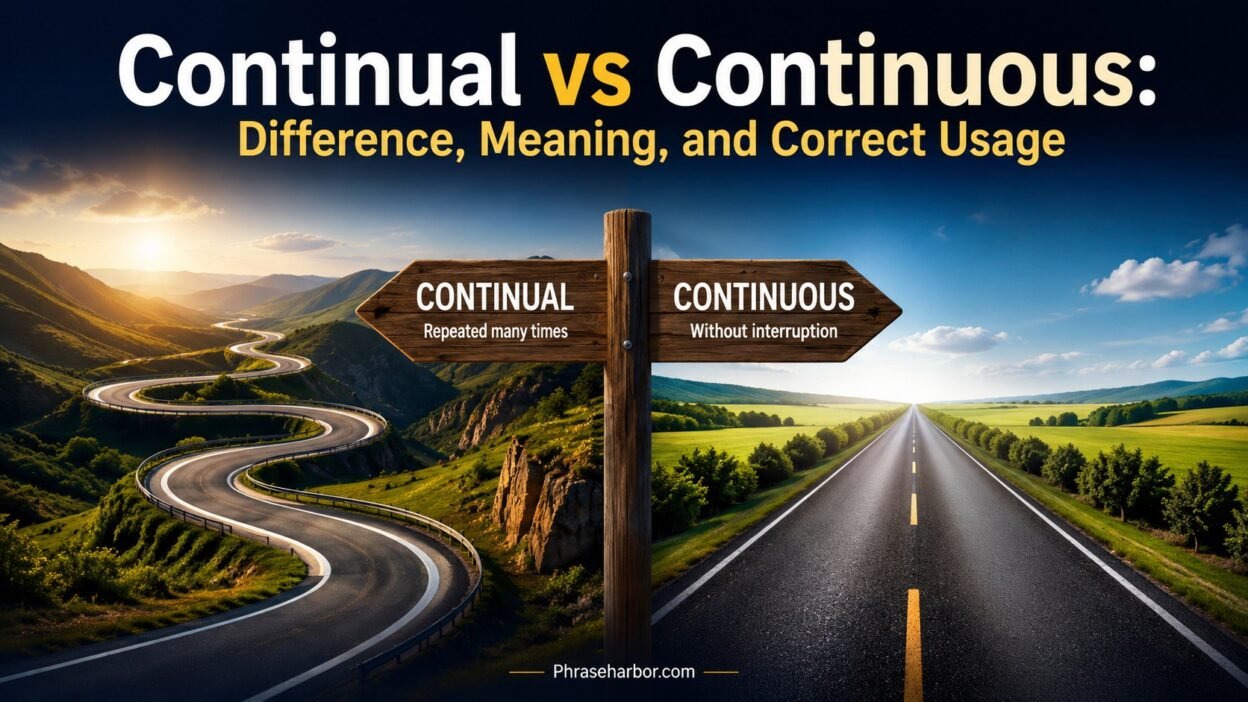
The words continual and continuous look almost identical. Both come from the same family of words and both describe something that carries on over time. That similarity makes them easy to confuse, especially when you’re writing quickly.
However, the two words traditionally emphasize different ideas. Continual usually describes something that happens repeatedly, while continuous usually describes something that continues without interruption.
That distinction becomes much easier when you picture what is happening. A meeting with continual interruptions has interruptions that happen again and again. A machine making a continuous noise produces that noise without stopping.
Quick Answer
The simplest way to remember the difference between continual and continuous is this:
- Continual usually means happening repeatedly, often with breaks between occurrences.
- Continuous usually means happening without stopping or interruption.
Simple examples
The continual interruptions made it difficult to finish the meeting.
The interruptions happened several times. There were periods between them when nobody interrupted.
The continuous noise made it difficult to sleep.
The noise continued without a meaningful break.
A useful memory trick is:
Continual = again and again
Continuous = without a break
This isn’t an absolute rule for every sentence. English usage has some overlap between the words. Still, it provides a reliable starting point when you need to decide between them.
Comparison Overview
| Feature | Continual | Continuous |
| Basic meaning | Repeated over time | Continuing without interruption |
| Main idea | Repetition | Unbroken duration |
| Breaks | Usually possible or expected | Usually absent |
| Typical pattern | Event → break → event | Event → event → event |
| Common examples | continual interruptions, continual complaints | continuous rain, continuous noise |
| Common tone | Can suggest annoyance or inconvenience | Usually neutral |
| Can overlap with the other word? | Yes | Yes |
| Best memory aid | Again and again | Without a break |
The key difference is how the activity continues.
Imagine someone knocking on your door every few minutes. The knocking is continual because it keeps happening repeatedly.
Now imagine a fire alarm that keeps sounding for ten minutes without stopping. Its sound is continuous.
The distinction becomes clearer when you stop thinking about the words themselves and focus on the pattern of the action.
Main Differences Between Continual and Continuous
Continual Means Repeated Again and Again
Continual generally describes something that happens repeatedly over a period of time.
The activity doesn’t necessarily happen every second. Instead, it keeps returning.
For example:
The continual interruptions disrupted the presentation.
The speaker wasn’t interrupted every moment. Instead, different interruptions occurred throughout the presentation.
Other examples include:
- continual questions
- continual complaints
- continual delays
- continual changes
- continual requests
- continual interruptions
- continual arguments
- continual attempts
The important idea is recurrence.
You can think of continual events as a series of separate occurrences:
Event → pause → event → pause → event
The pauses don’t have to last long. They simply separate one occurrence from another.
Continuous Means Without Interruption
Continuous usually describes something that carries on without a break.
For example:
The continuous rain caused flooding in several areas.
The emphasis isn’t on separate episodes of rain. Instead, the rain continued for an extended period without stopping.
Other examples include:
- continuous noise
- continuous flow
- continuous service
- continuous production
- continuous employment
- continuous operation
- continuous movement
- continuous communication
The basic pattern looks like this:
Start → ongoing activity → no meaningful break → end
That’s why continuous is often the better choice when you’re describing an uninterrupted process.
The Difference Is About Pattern, Not Simply Duration
One common mistake is assuming that the longer something lasts, the more likely it is to be continuous.
Duration alone doesn’t determine the choice.
Consider these two sentences:
She received continual updates throughout the day.
She received continuous updates throughout the day.
The first sentence suggests that updates arrived repeatedly. The second can suggest an uninterrupted stream of updates.
Both sentences can make sense. The writer’s intended meaning determines which one works better.
What Does Continual Mean?
Continual means occurring repeatedly over a period of time.
The word often describes actions, events, problems, or situations that keep happening.
For example:
The company faced continual requests for technical support.
The requests didn’t necessarily arrive every second. They kept coming back repeatedly.
This makes continual particularly useful for situations involving recurring events.
Common Uses of Continual
You’ll frequently see continual with words that describe repeated experiences:
- continual interruptions
- continual criticism
- continual improvement
- continual change
- continual pressure
- continual discussion
- continual demands
- continual attempts
- continual delays
- continual problems
Some of these expressions carry a negative tone.
For example:
The continual complaints exhausted the customer-service team.
The repeated complaints become tiring.
However, continual doesn’t always have a negative meaning.
Consider:
The organization made continual improvements to its website.
Here, continual simply describes repeated improvements over time.
The word can therefore be neutral, positive, or negative depending on the noun and surrounding context.
Why Continual Often Sounds Negative
The negative association comes from the kinds of situations people commonly describe as continual.
People frequently talk about:
- continual interruptions
- continual arguments
- continual delays
- continual problems
- continual complaints
These situations involve repetition that becomes noticeable or troublesome.
That doesn’t make negativity part of the strict definition. It’s a common connotation rather than an unavoidable meaning.
Compare:
The continual interruptions annoyed everyone.
with:
The continual improvements strengthened the product.
The grammatical function remains the same. The surrounding context creates the emotional tone.
What Does Continuous Mean?
Continuous usually means continuing without interruption or without a break.
For example:
The pump provides a continuous flow of water.
The water doesn’t repeatedly stop and restart. It moves as one ongoing flow.
This meaning appears in everyday English as well as technical, scientific, mathematical, and professional contexts.
Common Uses of Continuous
Examples include:
- continuous rain
- continuous noise
- continuous movement
- continuous flow
- continuous service
- continuous supply
- continuous operation
- continuous production
- continuous monitoring
- continuous employment
The word can also describe something physically connected rather than separated into individual pieces.
For example:
Draw a continuous line from one point to the other.
A continuous line has no gaps.
Continuous in Technical and Professional Language
The word continuous becomes especially important when precision matters.
In manufacturing, continuous production can describe a process designed to operate without regular interruptions.
In engineering, a continuous flow describes movement that doesn’t break into separate episodes.
In mathematics, continuous has a specialized meaning related to functions and changes without jumps or breaks.
In grammar, the continuous tense describes an action that is in progress.
For example:
She is studying.
They were working.
That grammatical use is related to the broader idea of an ongoing action.
Continual vs Continuous Examples
The quickest way to understand the distinction is to compare examples.
| Sentence | Why it works |
| The continual interruptions frustrated the speaker. | The interruptions happened repeatedly. |
| The continuous noise disturbed the residents. | The noise continued without a break. |
| We faced continual delays during construction. | Delays occurred repeatedly. |
| The machine requires continuous power. | Power needs to remain uninterrupted. |
| He made continual requests for assistance. | He made requests repeatedly. |
| The system provides continuous monitoring. | Monitoring operates without interruption. |
| The company made continual improvements. | Improvements occurred repeatedly over time. |
| The river created a continuous flow of water. | The flow remained unbroken. |
Notice how the nouns often provide a clue.
Interruptions are naturally separate events. That makes continual interruptions a natural phrase.
Noise can exist as one uninterrupted stream. That makes continuous noise natural when the sound never stops.
Continual vs Continuous: Real-World Case Studies
Case Study: Workplace Interruptions
Imagine an employee trying to complete a report.
Every 15 minutes, someone asks a question. Then a colleague calls. Later, another person interrupts the employee with a request.
The interruptions are separate events.
The natural description is:
The employee faced continual interruptions while writing the report.
Calling them continuous interruptions would create a different image. It could suggest that the interruptions themselves formed an uninterrupted stream.
Case Study: Factory Operations
Now consider a factory that operates its machinery around the clock.
If the production system runs without stopping, you might describe it as:
The factory maintains continuous production.
The focus is uninterrupted operation.
If the factory repeatedly changes its production methods over the years, you could instead write:
The factory made continual improvements to its production process.
The improvements happen repeatedly. They aren’t one uninterrupted action.
Case Study: Weather
Consider rainfall.
If rain starts, stops, and starts again throughout the day:
The area experienced continual rain showers.
If rain falls steadily for several hours:
The area experienced continuous rain.
The exact wording can change the mental picture.
The first suggests repeated periods of rainfall. The second suggests one sustained period.
Continual vs Continuous: Why Context Matters
English isn’t a collection of mathematical formulas. Words often have overlapping meanings.
That matters here because continual and continuous are not perfectly separated categories.
The traditional distinction remains useful:
- continual → repeated occurrences
- continuous → uninterrupted activity
However, reputable dictionaries acknowledge that continual can also mean continuing without interruption.
This means you shouldn’t treat the traditional distinction as an inflexible grammar law.
Instead, use it as a precision tool.
If you want readers to understand that something keeps happening with breaks, continual is often clearer.
If you want readers to understand that something never stops, continuous is usually clearer.
When Continual and Continuous Can Both Work
Some expressions naturally allow both words.
Change is a good example.
The industry experienced continual change.
This emphasizes repeated changes over time.
The industry experienced continuous change.
This emphasizes change as an ongoing, uninterrupted process.
Neither sentence automatically fails because of the adjective.
The difference lies in the picture each sentence creates.
Continual Improvement vs Continuous Improvement
This pair deserves special attention because both expressions appear frequently in business writing.
Continual improvement emphasizes repeated improvements.
For example:
The team made continual improvements to the customer-support process.
The company introduced one improvement, then another, then another.
Continuous improvement can emphasize an ongoing process of improvement.
For example:
The company uses continuous improvement to refine its manufacturing process.
The focus is the ongoing nature of the process rather than a series of isolated improvements.
Both phrases are established English expressions. The best choice depends on the meaning you’re trying to emphasize.
Read More: Die vs Dice — What’s the Difference?
Common Mistakes With Continual and Continuous
Mistake: Assuming They Are Exact Synonyms
Although the words overlap, treating them as completely interchangeable can weaken precision.
Compare:
The continual alarm annoyed the staff.
This suggests the alarm kept sounding repeatedly.
The continuous alarm annoyed the staff.
This suggests the alarm sounded without stopping.
If the distinction matters, the adjective changes the reader’s interpretation.
Mistake: Thinking Continual Always Means Negative
That’s too restrictive.
Consider:
The continual development of new technology has changed the industry.
There’s nothing inherently negative about the development.
The same applies to:
- continual learning
- continual growth
- continual improvement
- continual innovation
- continual development
The negative association comes from frequent collocations rather than from the word’s basic meaning.
Mistake: Assuming Continuous Always Means Literally Every Second
Continuous means without interruption in the relevant context. It doesn’t necessarily mean that something must be measurable every fraction of a second.
For example:
The service operates continuously throughout the year.
The practical meaning is that the service remains available without a scheduled interruption.
Context determines what counts as a meaningful break.
Mistake: Following the Traditional Rule Too Rigidly
Some grammar explanations present continual and continuous as though they never overlap.
Modern dictionary evidence paints a more nuanced picture.
The traditional distinction is still useful because it makes writing more precise. However, it doesn’t mean every use outside that distinction is automatically wrong.
Good writing considers meaning, context, audience, and established usage.
Continual vs Continuous in Professional Writing
Precision matters even more in business, technical, and academic writing.
Suppose a company says:
Our system provides continual monitoring.
Readers may understand that the system checks conditions repeatedly.
If the system actually monitors data without interruption, this might be clearer:
Our system provides continuous monitoring.
The second version removes ambiguity.
Likewise:
The company experienced continual supply disruptions.
This suggests repeated disruptions.
But:
The company requires a continuous supply of electricity.
This means the electricity supply must remain uninterrupted.
Professional writers should therefore choose the word that reflects the operational reality.
FAQs:
Is continual the same as continuous?
Not exactly.
Continual usually emphasizes something happening repeatedly. Continuous usually emphasizes something continuing without interruption.
However, the meanings can overlap in modern English. Dictionaries recognize this overlap.
Does continual mean without stopping?
It can.
Although continual traditionally emphasizes repeated occurrences, modern dictionaries also recognize a meaning close to continuous.
If you specifically mean that something never stops, continuous is usually the clearer choice.
Is continual always negative?
No.
Continual often appears with negative situations such as continual complaints or continual interruptions. However, it can describe neutral or positive situations too.
For example:
The company pursued continual improvement.
Is continuous stronger than continual?
Not necessarily.
The words don’t primarily differ by intensity. They differ by the pattern of continuation.
Continual usually emphasizes repetition.
Continuous usually emphasizes an unbroken span.
Can continual and continuous be used interchangeably?
Sometimes.
Modern usage permits some overlap. Still, replacing one with the other can change the nuance.
When precision matters, use continual for repeated events and continuous for uninterrupted activity.
Conclusion:
The continual vs continuous distinction becomes simple once you focus on the pattern rather than the spelling. Continual usually means repeatedly or again and again. The action can have breaks between occurrences. Continuous usually means without interruption or without a break. The action forms one ongoing stretch.