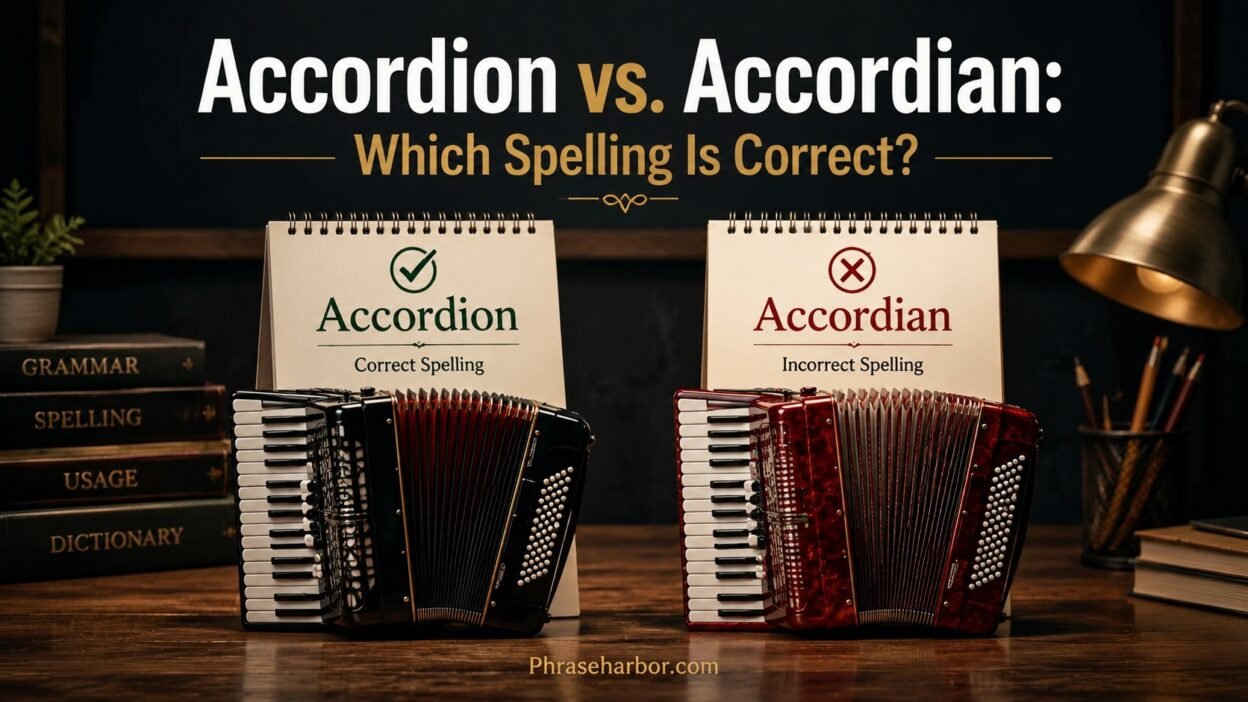
If you’ve ever typed “accordion vs. accordian” into a search engine, you’re not alone. The two spellings look almost identical, and they sound nearly the same when spoken. That makes the extra “a” in accordian an easy mistake to make.
However, there is a clear answer when you’re referring to the musical instrument: accordion is the standard English spelling. Accordian is generally a misspelling of accordion.
The difference comes down to just two letters, yet that small difference matters in formal writing, schoolwork, product descriptions, dictionaries, and professional communication. Once you understand where the spelling comes from and how the word is structured, it’s much easier to remember.
Quick Answer
Accordion is the correct standard spelling.
Accordian is a common misspelling when referring to the musical instrument.
The correct spelling is:
A-C-C-O-R-D-I-O-N
The incorrect form usually appears as:
A-C-C-O-R-D-I-A-N
The easiest way to spot the difference is to focus on the final part of the word:
- Correct: accordi-on
- Incorrect: accordi-an
The standard word ends in “-ion,” not “-ian.”
| Spelling | Correct standard spelling? | Meaning |
| accordion | Yes | A musical instrument and related descriptive uses |
| accordian | No, generally | Common misspelling of accordion |
Therefore, if you’re writing about someone playing an accordion, buying an accordion, or listening to accordion music, accordion is the spelling you should use.
Comparison Overview
The difference between accordion vs. accordian is primarily a spelling issue rather than a difference in meaning.
There aren’t two standard English words with separate definitions here. Instead, one is the accepted spelling and the other commonly appears because writers misremember the final letters.
| Feature | Accordion | Accordian |
| Standard spelling | Yes | No |
| Refers to the musical instrument | Yes | Intended meaning, but misspelled |
| Appears in major English dictionaries | Yes | Not normally listed as the standard word |
| Ends with | -ion | -ian |
| Common in formal writing | Yes | No |
| Used for related words such as accordionist | Yes | No |
| Recommended spelling | Use it | Avoid it |
Accordion
Accordion is the established English spelling. It refers most commonly to a portable musical instrument with bellows that force air through reeds.
The instrument can have piano-style keys or buttons depending on its design. Players expand and compress the bellows while operating the keyboard or buttons to produce different notes and chords.
The word can also describe something that folds or expands in a similar manner.
For example:
The restaurant installed an accordion door between the dining room and patio.
Here, accordion doesn’t refer to music. It describes the folding movement or structure.
Accordian
Accordian is generally a spelling error when the writer means accordion.
The mistake is understandable because English spelling doesn’t always map neatly onto pronunciation. Someone who hears the word may remember an ending that sounds like “-ian” rather than the written “-ion.”
Still, familiarity doesn’t make the spelling standard.
A misspelling can become extremely common without becoming the preferred dictionary form. That’s exactly why checking the word rather than relying on memory can prevent the mistake.
Main Differences Between Accordion vs. Accordian
The biggest difference between accordion vs. accordian is simple: accordion is the standard spelling while accordian is generally a misspelling.
That distinction affects everything else.
The spelling is different
The correct word contains:
A C C O R D I O N
The incorrect form contains:
A C C O R D I A N
The letters O and A create the entire spelling difference at the end.
This can seem trivial. Yet spelling matters when you’re writing a product listing, publishing an article, submitting an assignment, or communicating professionally.
The dictionary form is “accordion”
When deciding between competing spellings, a reliable dictionary is a useful reference point.
That gives writers a straightforward rule:
When you mean the instrument, spell it accordion.
The meaning does not change
Someone who writes accordian usually means exactly the same thing as someone who writes accordion. The problem is not normally a difference in definition.
For example:
- “He plays the accordion.”
- “He plays the accordian.”
Both sentences clearly indicate the writer means the musical instrument. Only the first sentence uses the standard spelling.
The pronunciation can encourage the mistake
The spelling problem becomes easier to understand when you say the word aloud.
The ending isn’t pronounced in a way that strongly signals whether you should write -ion or -ian. English has many words where pronunciation provides only limited clues about spelling.
That creates a trap:
- You hear the word.
- You remember its sound.
- You reconstruct the spelling from memory.
- Your brain inserts a before the final consonant.
- You end up with accordian.
The solution isn’t to rely on pronunciation. Instead, remember the written pattern “accordion.”
What Does Accordion Mean?
The primary meaning of accordion relates to a musical instrument.
An accordion is a portable instrument that produces sound when air passes through reeds. The player controls the airflow by expanding and compressing the bellows while using buttons or keys to select notes and chords.
How an accordion produces sound
The basic principle is relatively straightforward.
When the player moves the bellows, air flows through the instrument. That airflow causes metal reeds to vibrate. The vibration creates the sound.
The player controls which reeds receive air by pressing keys or buttons.
A typical accordion therefore combines three important actions:
- Bellows movement controls airflow.
- Keys or buttons select notes.
- Bass controls provide bass notes and chords on many instruments.
Different accordion designs use different keyboard systems. A piano accordion has a piano-style keyboard on the right-hand side. Button accordions use buttons instead.
Accordion as a descriptive word
The word accordion has also moved beyond music.
Anything that folds or expands in a manner resembling accordion bellows can receive the adjective accordion.
Examples include:
- accordion door
- accordion partition
- accordion folder
- accordion window
- accordion-style mechanism
- accordion fold
The common idea is movement through repeated folds or sections.
An accordion folder, for example, expands into multiple compartments. Its structure resembles the repeated folds of an instrument’s bellows.
Accordion as a verb
English can also use accordion as a verb.
In this sense, something accordions when it folds, collapses, or compresses into a shorter or more compact form.
For example:
The metal barrier accordioned during the impact.
This usage is less common than the noun referring to the instrument. Still, it demonstrates how a familiar noun can develop additional grammatical functions.
Why Do People Spell Accordion as “Accordian”?
The popularity of accordian isn’t random. Several features of English make the error easy to understand.
Pronunciation doesn’t reveal the spelling
English contains many words where identical or similar sounds can correspond to different spellings.
Think about words such as:
- nation
- musician
- physician
- occasion
- decision
The sounds around their endings don’t always tell you exactly which letters belong on the page.
Accordion creates a similar problem. Someone who knows the word primarily through speech may have trouble reconstructing its written form.
The word begins with “accord”
The first part of the word can also create confusion.
The English word accord is spelled:
A-C-C-O-R-D
From there, a writer may mentally construct accordian because “-ian” is a familiar English ending.
However, the standard word developed with the ending represented by -ion.
“-ian” is a familiar English pattern
The spelling -ian appears in many English words:
- Canadian
- musician
- historian
- technician
- politician
Because the pattern is so familiar, writers may unconsciously apply it to accordion.
The problem is that spelling patterns don’t always transfer from one word to another. English spelling contains historical layers and borrowed words that don’t follow a single neat formula.
How to Spell Accordion Correctly
The most useful memory technique is to focus on the final four letters:
I-O-N
Don’t think of the word as accord + ian. Think of it as:
accord + ion
That small mental change can make the correct spelling easier to retrieve.
A simple spelling breakdown
Try dividing the word visually:
ac-cord-i-on
You don’t need to pronounce each piece separately. The goal is simply to make the spelling pattern easier to recognize.
Another useful technique is to connect the spelling with a familiar phrase:
accordion → “I-O-N” at the end
Once you’ve seen the correct spelling repeatedly, the pattern becomes automatic.
Correct and incorrect examples
| Incorrect | Correct |
| accordian | accordion |
| accordians | accordions |
| accordian player | accordion player |
| accordian music | accordion music |
| accordianist | accordionist |
Notice that the correction affects related words as well.
If the base word is accordion, then someone who plays one is an accordionist.
Correct Examples of “Accordion” in a Sentence
Seeing the word in context is often more useful than memorizing a definition.
Musical instrument
Maria began learning the accordion when she was eight.
Here, accordion functions as a noun.
The band used an accordion to give the song a traditional folk sound.
Again, the word identifies the instrument.
Describing a folding structure
The theater uses an accordion partition to divide the rehearsal space.
Here, accordion describes a structure with repeated folding sections.
We installed an accordion door between the kitchen and dining area.
The word describes how the door folds or moves.
As a verb
The barrier accordioned after the vehicle struck it.
In this sentence, accordioned describes the physical collapse or folding of the barrier.
Related word: accordionist
The accordionist performed a lively folk tune.
An accordionist is a person who plays the accordion.
This form reinforces the correct base spelling:
accordion → accordionist
Not:
accordian → accordianist
Common Mistakes With “Accordion”
The accordion vs. accordian confusion is only one of several mistakes writers can make.
Mistake: Adding an “a” before the final “n”
The most common problem is:
accordian
The correction is:
accordion
The simplest fix is to remember that the standard word ends in -ion.
Mistake: Treating the two spellings as equal variants
Because accordian appears frequently online, some writers assume it must be an accepted alternative.
Frequency doesn’t automatically establish standard spelling.
People misspell words every day. Search results can contain those mistakes because users search with incorrect spellings, websites publish errors, or names preserve unusual spellings.
For formal English, use accordion.
Mistake: Changing the spelling of related words
Some writers learn the correct spelling of accordion but then accidentally create forms such as accordianist.
The correct related noun is:
accordionist
That word follows the standard base spelling.
Mistake: Assuming every unusual spelling is an error
There is an important exception to keep in mind.
A company, band, product, username, or person’s name may deliberately use an unusual spelling. If you’re reproducing a proper name, preserve the official spelling.
That doesn’t make accordian the standard spelling of the musical instrument. It simply means proper names follow their own naming conventions.
Read More: Fair vs. Good: What’s the Difference?
A Real-World Usage Case Study: How the Spelling Holds Up
Consider a writer preparing a product description for a musical instrument.
The first draft says:
This accordian features 120 bass buttons and a lightweight design.
The writer has communicated the intended meaning. However, the spelling creates a credibility problem.
The corrected version says:
This accordion features 120 bass buttons and a lightweight design.
The second version uses the standard dictionary spelling and looks appropriate for an instrument retailer, catalog, review, or educational publication.
Now consider a different situation.
A writer describes a folding partition:
The office has an accordion partition that can divide the room.
That sentence is also correct. The word has moved beyond the instrument itself and now describes a structure based on the instrument’s characteristic folding design.
This illustrates an important point: learning the correct spelling gives you access to the word’s broader uses as well.
The History and Origin of the Word “Accordion”
The history of accordion helps explain why the word looks unusual.
The modern accordion emerged in Europe during the 19th century. One important milestone occurred in 1829, when Cyrill Demian received a patent in Vienna for an instrument known as an accordion.
According to Britannica’s history of the accordion, the instrument developed from earlier free-reed instruments and underwent significant changes as makers refined its keyboard systems and construction.
The name is connected with the musical concept of accord or harmony. The word entered English in the 19th century as the instrument spread.
The historical path matters because it reminds us that English spelling doesn’t always arise from modern pronunciation alone.
Many English words entered the language from other languages. Their spellings often preserve traces of those origins.
Accordion vs. Accordian Pronunciation
Another reason people search for accordion vs. accordian is that the two spellings don’t immediately look different when spoken.
The standard word is pronounced roughly like:
uh-KOR-dee-un
The exact pronunciation can vary by accent and region.
The important point is that pronunciation doesn’t provide a reliable way to decide between -ion and -ian.
That’s why visual memory works better here.
When you see:
accordion
notice the sequence:
D-I-O-N
When you see:
accordian
the A in the final syllable signals the common misspelling.
Does British English spell it “accordian”?
No.
British and American English may differ in pronunciation for many words. The standard spelling remains accordion.
You don’t need to switch to accordian when writing for a British audience.
Accordion vs. Accordian in Formal Writing
The correct choice becomes especially important in professional contexts.
Use accordion when writing:
- Academic assignments
- News articles
- Product descriptions
- Music reviews
- Educational materials
- Business documents
- Website content
- Technical documentation
- Museum descriptions
- Encyclopedic articles
A spelling mistake in an important heading can make the entire page look less trustworthy.
For example, compare:
Accordian Buying Guide
with:
Accordion Buying Guide
The second heading immediately looks more polished because it uses the recognized spelling.
What about casual messages?
The same spelling rule applies.
Even if you’re texting a friend, accordion remains the correct spelling. The difference is that a casual typo usually matters less because the context makes the meaning obvious.
Correct spelling isn’t restricted to formal writing. Formal writing simply makes mistakes more visible.
FAQs:
Is “accordian” a correct spelling?
No, not as the standard spelling of the musical instrument. The accepted English spelling is accordion.
If Accordian appears as part of a specific proper name, reproduce that name exactly as officially written.
Is it accordion or accordian?
It is accordion.
The word ends with -ion, not -ian.
How do you spell accordion?
Spell it:
A-C-C-O-R-D-I-O-N
A useful memory cue is “accordion ends in I-O-N.”
Why do people spell accordion as accordian?
The mistake likely comes from pronunciation and familiar English spelling patterns. The ending can sound ambiguous, while -ian appears in many other English words.
What is an accordion?
An accordion is a portable musical instrument that uses bellows to move air through reeds. It may have piano-style keys or buttons depending on its design.
Conclusion:
The answer to accordion vs. accordian is simple: accordion is the correct standard spelling, while accordian is generally a misspelling. The correct word ends with “-ion,” which makes A-C-C-O-R-D-I-O-N the spelling to remember.
Although the mistake is common, it usually comes from pronunciation and the familiar “-ian” spelling pattern found in many English words. Once you remember “accordion ends in I-O-N,” the difference becomes much easier to spot.