If you’ve ever paused over apposed vs opposed, you’re not alone. The two words look almost identical, sound similar, and both can describe relationships between two things. Yet they don’t mean the same thing.
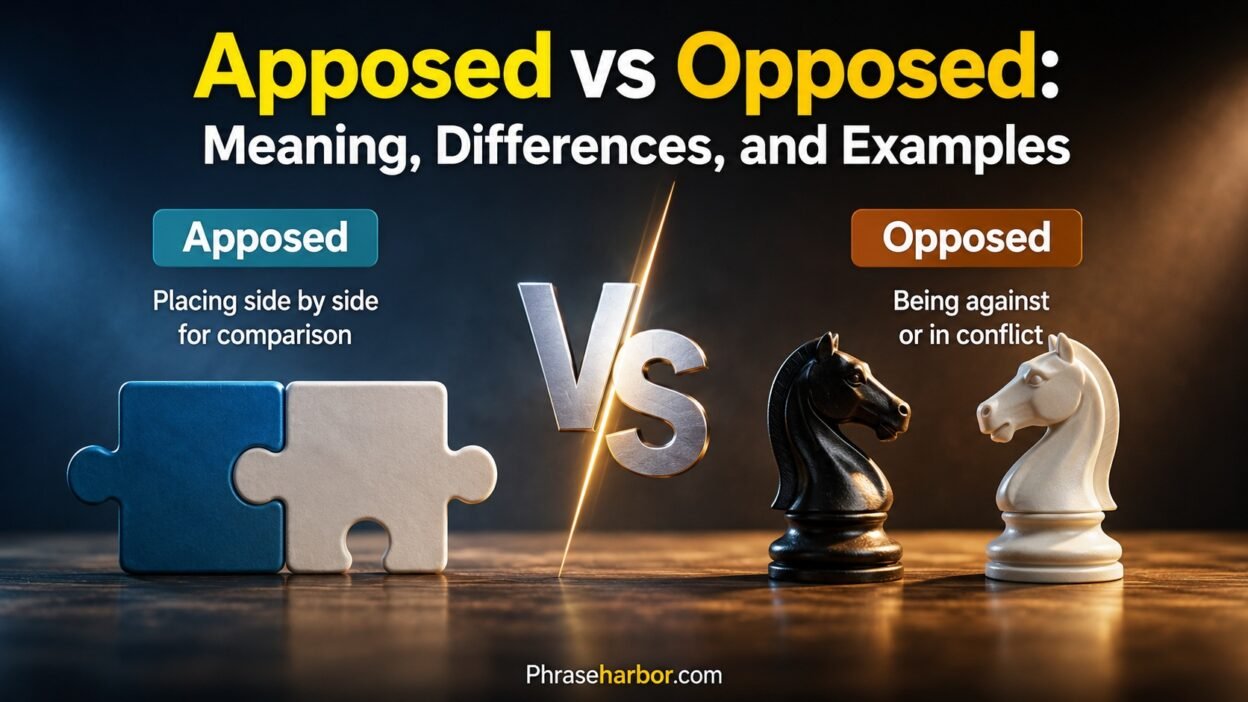
The key difference is simple once you separate position from opposition. Apposed describes things placed next to, against, or in close relation to each other. Opposed usually describes disagreement, resistance, contrast, or something being set against something else.
That small spelling difference can change the meaning of an entire sentence. In technical writing, apposed may describe two surfaces that touch. In everyday English, opposed is the natural choice when someone disagrees with a proposal.
Quick Answer
Apposed and opposed are different words with different meanings.
- Apposed means placed next to, close to, or against something else. It comes from the verb appose.
- Opposed means against, resisting, disagreeing with, or contrary to something. It comes from the verb oppose.
- Opposed to usually expresses disagreement or resistance.
- As opposed to usually means rather than and introduces a contrast.
- Apposite is another separate word. It means relevant or appropriate.
Simple examples
The two surfaces were apposed along their edges.
Here, apposed describes physical positioning.
The residents were opposed to the proposed development.
Here, opposed describes disagreement.
A useful memory trick is:
Apposed = placed together.
Opposed = against or in contrast.
Comparison Overview
| Word or phrase | Meaning | Typical use | Example |
| Apposed | Placed next to or against | Technical, scientific, positional | The surfaces were apposed. |
| Opposed | Against, resisting, contrary | Everyday and formal English | They opposed the proposal. |
| Opposed to | Against or resistant to | Opinions, policies, actions | She is opposed to the plan. |
| As opposed to | Rather than; in contrast with | Comparing alternatives | We chose tea as opposed to coffee. |
| Appose | To place next to or against | Specialized or formal writing | The structures appose one another. |
| Oppose | To resist, disagree with, or act against | General English | They oppose the measure. |
| Apposite | Relevant, appropriate, well suited | Formal vocabulary | That was an apposite example. |
The most important distinction is between apposed and opposed themselves.
If you’re describing where things are positioned, apposed may be appropriate.
If you’re describing disagreement, resistance, or conflict, opposed is generally the right word.
Main Differences Between Apposed vs Opposed
The difference between apposed vs opposed becomes clearer when you look at what each word tells the reader.
Apposed Describes Position or Proximity
Apposed is the past tense and past participle of appose.
To appose something means to place it next to, near, or against another thing. The emphasis is on physical or structural relationship, rather than disagreement.
For example:
The two tissue surfaces were apposed after the procedure.
The sentence doesn’t say that the tissues resisted each other. It says they were brought into close contact or positioned against each other.
The word often appears in specialized contexts where precise descriptions of position matter.
Opposed Describes Resistance or Contrast
Opposed comes from the verb oppose.
To oppose something means to resist it, disagree with it, challenge it, or act against it. The word can also describe things that are contrary to one another or positioned opposite each other.
For example:
The committee was opposed to the proposed changes.
The committee isn’t simply sitting beside the changes. Its members disagree with them or resist them.
That difference is crucial.
The Easiest Test
Ask yourself:
Am I describing placement or disagreement?
If you’re describing placement, consider apposed.
If you’re describing resistance or disagreement, use opposed.
If you’re comparing alternatives, as opposed to is often the appropriate expression.
What Does Apposed Mean?
Apposed means placed next to, close to, or against something else.
It comes from appose, a relatively uncommon verb. Because apposed appears far less often than opposed in ordinary conversation, many readers initially assume it’s a spelling mistake.
It isn’t.
The word has a legitimate meaning, although its use is much more specialized.
Apposed in Plain English
Think of two surfaces being brought together.
They might be:
- next to one another
- touching one another
- positioned directly against one another
- closely aligned
- placed in juxtaposition
In such cases, apposed can describe their relationship.
For example:
The edges were carefully apposed before the material was secured.
The important idea is alignment or contact.
There’s no argument involved.
Apposed in Technical Writing
You are more likely to encounter apposed in technical, scientific, anatomical, or other specialized writing than in casual conversation.
Specialist language often needs to distinguish between different kinds of relationships. Saying that two structures are apposed can communicate that they have been positioned against or alongside one another without implying that they are in conflict.
For example:
The two layers remained closely apposed.
That wording focuses on physical arrangement.
Using opposed could suggest something quite different.
Examples of Apposed
Here are several examples that show how the word works:
- The two surfaces were apposed along their entire length.
- The structures became closely apposed after movement.
- The edges were apposed before the final closure.
- The two layers remained apposed throughout the process.
- The adjacent structures were positioned in an apposed relationship.
In each example, the central idea is proximity or positioning.
What Does Opposed Mean?
Opposed has a much broader role in everyday English.
It commonly means against something, especially in the sense of disagreement, resistance, or conflict.
It can describe people, groups, ideas, policies, actions, positions, or even physical arrangements.
Opposed as Disagreement
Consider this sentence:
Many residents were opposed to the proposal.
The residents disagree with the proposal. They may campaign against it, criticize it, vote against it, or simply believe it should not happen.
The word therefore describes a stance.
Compare that with:
The two surfaces were apposed.
That sentence describes position.
These aren’t interchangeable meanings.
Opposed as a Contrary Position
Opposed can also describe ideas or positions that conflict.
For example:
The two political philosophies are fundamentally opposed.
The sentence doesn’t necessarily describe two people actively fighting. Instead, their underlying principles conflict.
Similarly:
The evidence appears to support two opposed interpretations.
Here, the interpretations contradict or conflict with each other.
Opposed in Physical Relationships
The word can also have a positional sense.
For example:
The two teams stood at opposed ends of the field.
In this kind of use, opposed describes a relationship involving opposite positions.
That’s why context matters. Opposed isn’t restricted to arguments or politics.
Opposed To vs As Opposed To
One of the most useful distinctions to understand is the difference between opposed to and as opposed to.
They contain the same words, but they don’t necessarily perform the same job.
What Does “Opposed To” Mean?
Opposed to generally means against or resistant to something.
The structure commonly appears after a form of be:
She is opposed to the proposal.
They are opposed to raising the fee.
He is strongly opposed to the idea.
The word following to can be a noun or a gerund.
For example:
They are opposed to the proposal.
They are opposed to changing the policy.
This is important because to here functions as a preposition. That’s why a gerund such as changing naturally follows it.
What Does “As Opposed To” Mean?
As opposed to generally means rather than or in contrast with.
For example:
We chose the digital version as opposed to the printed version.
The speaker isn’t necessarily saying that the digital version is actively resisting the printed version.
The sentence simply contrasts two options.
Another example:
The study focused on long-term outcomes as opposed to short-term effects.
The phrase creates a comparison.
Opposed To vs As Opposed To
| Expression | Main meaning | Example |
| opposed to | Against or resistant to | They are opposed to the proposal. |
| as opposed to | Rather than; in contrast with | We selected option A as opposed to option B. |
A useful substitution test is:
Can you replace the phrase with “against”?
If yes, opposed to may be correct.
Can you replace it with “rather than”?
If yes, as opposed to may be correct.
Apposed vs Opposed Examples
Examples make the distinction easier to remember because the words can look almost interchangeable at first glance.
Examples Using Apposed
The two surfaces were apposed after the adjustment.
The surfaces were positioned against one another.
The edges were carefully apposed.
The edges were brought together or aligned.
The structures remained apposed throughout the observation period.
The structures stayed in close positional contact.
Examples Using Opposed
The board was opposed to the proposed changes.
The board disagreed with the changes.
Several groups were opposed to the new regulation.
The groups resisted or disagreed with the regulation.
Her views are directly opposed to his.
Their views conflict.
The two proposals represent opposed approaches.
The approaches differ fundamentally.
Examples Using As Opposed To
The company emphasized prevention as opposed to reaction.
The company favored one approach rather than another.
He works remotely as opposed to commuting every day.
The phrase establishes a contrast.
The researchers examined actual behavior as opposed to reported behavior.
The two categories are being contrasted.
Appose vs Oppose: Understanding the Root Verbs
To fully understand apposed vs opposed, it helps to look at the verbs behind them.
Appose
Appose means to place or bring something next to or against something else.
Its use is relatively uncommon in general conversation.
You might encounter it in specialized writing where physical relationships need precise wording.
Example:
The two surfaces were apposed.
That sentence can be rewritten more simply as:
The two surfaces were placed against each other.
The specialized term is useful when the context demands precision.
Oppose
Oppose is far more common.
It means to resist, disagree with, challenge, or act against something.
Examples include:
- oppose a proposal
- oppose a law
- oppose a decision
- oppose an argument
- oppose an opponent
- oppose a plan
For example:
The organization opposes the proposed legislation.
That means the organization takes a position against it.
Why the Difference Matters
The verbs may share a historical connection involving the idea of placing things in relation to one another, but modern English gives them distinct meanings.
Appose focuses on placement.
Oppose focuses primarily on resistance or conflict.
That’s the distinction worth remembering.
Apposed vs Opposed in Different Contexts
Context often determines which word sounds natural.
Everyday English
In everyday writing and conversation, opposed is much more common.
You might say:
I’m opposed to the plan.
You normally wouldn’t say:
I’m apposed to the plan.
That second sentence changes the intended meaning and will usually look like a spelling error.
Academic Writing
Academic writing may use opposed when discussing competing theories, interpretations, or viewpoints.
For example:
The researchers presented two opposed interpretations of the findings.
Apposed can appear when the subject concerns physical or structural relationships.
Scientific and Technical Writing
Technical fields sometimes require vocabulary that distinguishes subtle physical relationships.
In such contexts, apposed can be useful because it describes structures positioned next to or against one another without suggesting disagreement.
The word’s relative rarity isn’t a reason to avoid it when it accurately describes the relationship.
Anatomy and Medicine
Specialized anatomical writing can use positional language very precisely.
When two structures are apposed, the word describes their spatial relationship. It doesn’t mean they disagree or resist one another.
That’s a good example of why replacing unfamiliar technical vocabulary with a more familiar word can sometimes introduce an error.
Read More: Leotard vs Tights: What’s the Difference?
Common Mistakes With Apposed and Opposed
Using Apposed When You Mean Against
Incorrect:
The employees were apposed to the new policy.
If the employees disagree with the policy, the correct word is:
The employees were opposed to the new policy.
The issue involves an opinion or position, not physical placement.
Assuming Apposed Is a Misspelling
Incorrect assumption:
“Apposed” must be a typo for “opposed.”
Not necessarily.
Apposed is a real word. It simply has a narrower and more specialized meaning.
When you see it in technical writing, look at the surrounding sentence before assuming the writer made an error.
Treating Opposed as Only a Political Term
Opposed appears in political writing frequently, but its use extends far beyond politics.
You can be:
- opposed to a business decision
- opposed to a medical procedure
- opposed to a change
- opposed to an argument
- opposed to a proposed design
The underlying idea is resistance or disagreement.
Confusing Opposed To With As Opposed To
These expressions are particularly easy to mix up.
She is opposed to the plan.
She disagrees with it.
She chose the existing plan as opposed to the alternative.
She chose one option rather than another.
The first expresses opposition. The second expresses contrast.
Apposite vs Apposed: Another Common Confusion
There’s another word that often enters this vocabulary mix: apposite.
It looks similar to apposed, but its meaning is completely different.
What Does Apposite Mean?
Apposite means relevant, appropriate, or especially suitable to the matter being discussed.
For example:
The author provided an apposite example.
The example was relevant and well suited to the point.
You could replace apposite with words such as:
- relevant
- appropriate
- pertinent
- fitting
- suitable
Apposed vs Apposite
| Word | Meaning |
| Apposed | Positioned next to or against something |
| Apposite | Relevant or appropriate |
| Opposed | Against, resistant, contrary, or contrasting |
These three words may look like linguistic cousins, but they perform very different jobs in modern English.
FAQs:
Is “apposed” a real word?
Yes. Apposed is a legitimate word and the past tense or past participle of appose. It describes things placed next to, near, or against one another.
Is apposed the same as opposed?
No.
Apposed generally describes position or proximity.
Opposed generally describes resistance, disagreement, conflict, or contrast.
What does apposed mean in anatomy?
In anatomical or medical contexts, apposed can describe structures that are positioned closely together or against one another. The emphasis is spatial rather than argumentative.
Should I write “opposed to” or “apposed to”?
If you mean against or resistant to, use opposed to.
She is opposed to the proposal.
If you’re describing physical placement, apposed may be appropriate depending on the sentence.
What does “as opposed to” mean?
As opposed to means rather than or in contrast with.
We selected the online option as opposed to the paper form.
It doesn’t necessarily mean that one option actively resists the other.
Conclusion:
The difference between apposed vs opposed comes down to one central idea: position versus opposition. Apposed describes things that are placed next to, close to, or against one another. You’ll encounter it most often in technical or specialized contexts. Opposed describes disagreement, resistance, contradiction, or opposing positions. It’s the ordinary choice when someone or something is against a proposal, idea, policy, or action.