Have you ever wondered whether a letter and an alphabet mean the same thing? Although these terms relate closely to written language, they describe two different things. Understanding the difference between a letter and an alphabet helps you explain spelling, teach children to read, and use English more accurately.
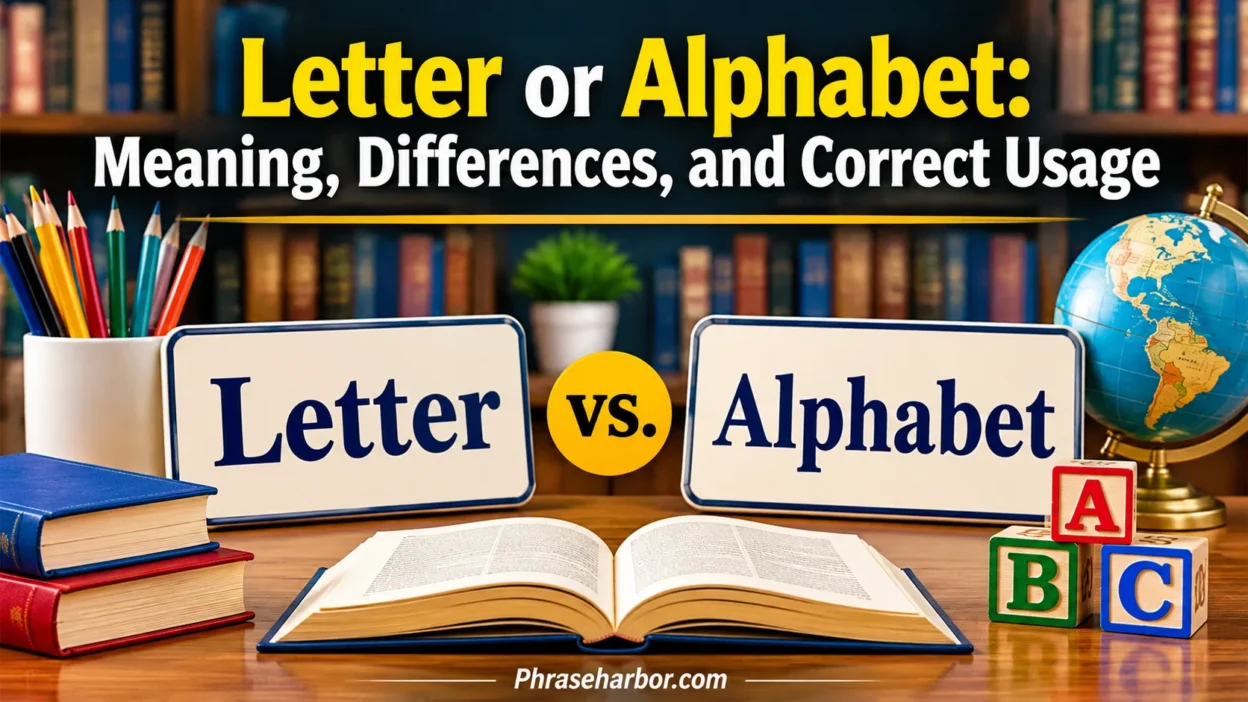
A letter is an individual written symbol, such as A, B, or C. An alphabet is an organized set of letters used to write a language. For example, the English alphabet contains 26 letters, starting with A and ending with Z.
The distinction seems simple, but it becomes more interesting when you consider uppercase and lowercase forms, speech sounds, and the writing systems used by other languages. A letter doesn’t always represent just one sound, and not every writing system uses an alphabet.
This guide explains the meaning of letter and alphabet, their main differences, practical examples, common mistakes, and the situations in which you should use each word.
Quick Answer:
A letter is one written symbol in a writing system, while an alphabet is an organized set of letters used to write a language. For example, A is a letter, but A through Z make up the 26-letter English alphabet.
Here is the difference at a glance:
- Letter: An individual symbol, such as M, R, or T.
- Alphabet: The complete, ordered set of letters used in a language, such as the English alphabet.
- Letters form words: The letters C, A, and T combine to spell cat.
- The alphabet organizes letters: The English alphabet follows the familiar order from A to Z.
Remember this simple rule: A letter is one member of an alphabet, while an alphabet is the complete set.
Comparison Overview: Letter vs. Alphabet
Although letter and alphabet belong to the same subject, they serve different purposes. A letter identifies an individual written symbol, whereas an alphabet refers to the larger collection of letters.
The following table highlights their key differences.
| Feature | Letter | Alphabet |
| Meaning | An individual written symbol | An organized set of letters |
| Scope | One unit | A complete collection |
| English example | A, B, or Z | A through Z |
| Number | One letter at a time | 26 standard letters in English |
| Main function | Helps represent written language | Provides an ordered set of letters for writing |
| Relationship to words | Individual letters combine to spell words | Supplies the letters used to spell words |
| Common expression | Write the letter B | Learn the English alphabet |
| Alphabetical order | Refers to a letter’s position when relevant | Provides the sequence used for ordering letters and words |
| Uppercase and lowercase | A and a are different forms of the same letter | Both forms belong to the same alphabet letter |
| Usage example | The word dog begins with D | The English alphabet starts with A |
For example, imagine a child learning to recognize the letter F. The child is learning one part of the English alphabet. When the child learns all 26 letters and their conventional order, the child is learning the alphabet as a whole.
This distinction applies beyond elementary education. Writers, editors, teachers, and language learners use the same concepts when discussing spelling, pronunciation, and written communication.
Main Differences Between Letter and Alphabet
The difference between a letter and an alphabet becomes clearer when you examine their meanings, structures, functions, and everyday uses.
Meaning and Definition of Letter vs. Alphabet
The most important difference lies in what each word represents.
A letter is an individual written symbol that belongs to a writing system. In the English alphabet, examples include A, D, G, and X. Each letter has a conventional name and written form.
An alphabet, by contrast, is an organized collection of letters used to write a language. The English alphabet contains 26 standard letters arranged in a familiar sequence.
Consider the word sun. It contains three letters: S, U, and N. Each letter contributes to the spelling of the word, but none of those individual letters is the entire alphabet.
Here is another way to understand the distinction:
- A letter is like one ingredient in a recipe.
- An alphabet is like the complete collection of ingredients available for writing words.
- A word is the result of combining letters in a particular arrangement.
The comparison isn’t perfect, but it illustrates why the terms aren’t interchangeable.
Individual Symbol vs. Complete Set
A letter represents one unit within a writing system. An alphabet contains the collection of letters that writers use to form written words.
For instance, C is a letter in English. It can appear in words such as cat, city, and music. The English alphabet, however, contains C along with 25 other standard letters.
This difference also explains why the following sentences have different meanings:
- “My child can recognize the letter B.”
- “My child has learned the English alphabet.”
The first sentence describes recognizing one particular letter. The second refers to learning the larger set of letters.
You can think of an alphabet as a collection and a letter as one item within that collection. Similar relationships appear in other areas of life: a single page belongs to a book, just as an individual letter belongs to an alphabet.
Number and Structure
The standard modern English alphabet contains 26 letters. These letters include five commonly recognized vowel letters—A, E, I, O, and U—and 21 other letters traditionally classified as consonant letters.
The letter Y can function as a vowel in words such as gym and myth. Its role depends on how it functions in a particular word.
Here is the English alphabet in its conventional order:
A, B, C, D, E, F, G, H, I, J, K, L, M, N, O, P, Q, R, S, T, U, V, W, X, Y, Z
Each item is a letter. Together, these 26 letters form the English alphabet.
However, the number 26 doesn’t apply to every language. Different languages use different alphabets, and some use writing systems that aren’t alphabets in the strict linguistic sense.
For example, the modern Greek alphabet contains 24 letters. Spanish uses the Latin alphabet with additional language-specific spelling conventions, including the letter ñ. The letter ñ is part of the Spanish alphabet, but Spanish doesn’t count every possible letter combination as a separate letter.
These differences show why you should identify the language before stating how many letters its alphabet contains.
Function in Written Language
Letters and alphabets work together, but they serve different roles.
An alphabet provides the letters available for writing. Writers combine those letters to represent words, names, sentences, and other forms of written communication.
For example, consider the word book:
- B begins the word.
- O appears twice.
- K completes the spelling.
- All four letters combine to form one written word.
The English alphabet makes these letters available for use. Their particular arrangement creates the word book.
However, letters don’t always correspond directly to individual speech sounds. The word ship, for example, contains four letters: S, H, I, and P. Yet its opening sound is represented by the two-letter combination sh.
This is one reason the distinction between letters and sounds matters. Letters belong to written language, while sounds belong to spoken language.
Usage in Everyday English
In everyday conversation, letter usually refers to an individual alphabet symbol when the topic involves spelling or reading. Alphabet refers to the entire set or the process of learning its order.
Here are some natural examples:
| Situation | Correct expression | Why it works |
| Teaching one symbol | Learn the letter A. | A refers to one letter. |
| Teaching all 26 letters | Learn the English alphabet. | The sentence refers to the complete set. |
| Correcting spelling | Change the first letter of the word. | One position in the word needs attention. |
| Organizing names | Arrange the names alphabetically. | The names follow alphabetical order. |
| Discussing language | The Greek alphabet has 24 letters. | Alphabet refers to the organized set. |
The word letter also has another common meaning: a written or typed message sent to someone. For example, “She wrote a letter to her grandmother.”
That meaning is unrelated to counting alphabet symbols, although both meanings involve written communication.
Read More: And vs. Or: Meaning, Differences, and Correct Usage
What Is a Letter?
A letter is a written symbol used as part of a writing system. In English, letters help represent the words people read and write every day.
Letters appear in names, signs, books, messages, school assignments, and digital text. Their forms may change depending on capitalization, handwriting, or font, but their identity generally remains the same.
Definition of a Letter
In the linguistic sense, a letter is a conventional symbol belonging to an alphabet or another letter-based writing system.
For example, A, B, and C are letters of the English alphabet. They have recognizable written forms and conventional names.
Letters serve several important purposes:
- Spelling: Letters combine in established patterns to spell words.
- Reading: Recognizing letters helps readers identify written words.
- Writing: Letters provide the basic symbols used to produce written text.
- Organization: Letters help arrange words in dictionaries, indexes, and alphabetical lists.
- Identification: Letters distinguish names, abbreviations, labels, and other written elements.
Suppose you’re filling out a form that asks for your first initial. You might write J if your first name begins with that letter. You aren’t writing the alphabet; you’re selecting one letter from it.
A letter’s shape can vary without changing its identity. For example, a handwritten lowercase a may look different from a printed lowercase a. Both represent the same letter.
Examples of Letters
The English alphabet contains 26 letters, each with uppercase and lowercase forms. Writers choose between these forms according to spelling and capitalization rules.
| Uppercase | Lowercase | Example word |
| A | a | Apple |
| B | b | Book |
| C | c | Cat |
| D | d | Dog |
| E | e | Elephant |
| F | f | Flower |
| G | g | Garden |
| H | h | House |
| M | m | Moon |
| R | r | River |
| S | s | School |
| Z | z | Zebra |
These examples demonstrate how individual letters appear in familiar words.
Notice that the uppercase and lowercase forms don’t count as separate letters in the English alphabet. A and a represent the same alphabet letter, although their shapes and uses differ.
Capital letters commonly appear at the beginning of sentences and in proper nouns. Lowercase letters appear in most other positions, depending on the word and the applicable writing rules.
Different Meanings of the Word Letter
The word letter has two particularly common meanings in English. Context usually makes the intended meaning clear.
The first meaning is a written symbol.
Examples include:
- “The letter P begins the word pen.”
- “Please write your initials in capital letters.”
- “The teacher asked us to identify the missing letter.”
The second meaning is a written or typed message.
Examples include:
- “I received a letter from my friend.”
- “She wrote a letter to the school principal.”
- “The company sent an official letter confirming the appointment.”
These meanings are related to writing, but they describe different things. In “the letter P,” the word identifies a symbol. In “a letter from my friend,” it identifies a message.
When comparing letter with alphabet, the first meaning is the relevant one. The second meaning is worth recognizing because readers may encounter it frequently.
What Is an Alphabet?
An alphabet is an organized set of letters used to write a language. Its letters generally follow an established order, which helps people learn, recognize, and arrange them.
The English alphabet is one familiar example. Other languages use different alphabets, while some rely on writing systems that organize symbols in other ways.
Definition of an Alphabet
An alphabet is a writing system based on a set of letters used to represent the sounds of a language, often with symbols corresponding broadly to consonants and vowels.
In practice, the relationship between letters and sounds can be complicated. Some letters represent different sounds in different words, and several letters may work together to represent one sound.
Nevertheless, the central idea remains straightforward: an alphabet is a system of letters, not a single letter.
The English alphabet has a conventional order, beginning with A and ending with Z. This order helps people arrange words and locate information.
For example, a dictionary generally places apple before banana because A comes before B. Alphabetical order makes large collections of words easier to navigate.
The alphabet also supports early reading instruction. Children often learn to recognize individual letters before progressing to more advanced spelling and reading skills.
The English Alphabet
The modern English alphabet contains 26 letters. Its conventional order is familiar to English speakers, although learning the alphabet involves more than memorizing the sequence.
Readers also need to recognize different letter shapes, understand common spelling patterns, and connect written words with spoken language.
The alphabet contains the following letters:
| Category | Letters |
| Vowel letters | A, E, I, O, U |
| Other letters commonly classified as consonants | B, C, D, F, G, H, J, K, L, M, N, P, Q, R, S, T, V, W, X, Z |
| Letter that can function as a vowel or consonant, depending on its use | Y |
The vowel and consonant categories above describe the letters, not a complete classification of English speech sounds. The letter Y, for instance, represents a consonant sound in yes but participates in vowel spellings in words such as happy.
The English alphabet also includes uppercase and lowercase forms:
- Uppercase: A, B, C
- Lowercase: a, b, c
Although these forms look different, each uppercase and lowercase pair represents the same alphabet letter. Therefore, counting both forms separately would not change the standard total of 26 letters.
FAQs:
Is a Letter the Same as an Alphabet?
No. A letter is an individual written symbol, while an alphabet is an organized set of letters.
For example, A is a letter, but the 26 standard letters from A to Z make up the English alphabet.
How Many Letters Are in the English Alphabet?
The standard modern English alphabet contains 26 letters, from A to Z.
Each letter has uppercase and lowercase forms. These forms don’t count as separate alphabet letters.
Is A a Letter or an Alphabet?
A is a letter, specifically the first letter of the standard English alphabet.
The alphabet consists of all 26 letters arranged in their conventional order.
What Is the Difference Between Letters and Sounds?
Letters are written symbols, while sounds are elements of spoken language.
For example, the spelling sh contains two letters but usually represents one consonant phoneme. The K in knee is written but silent in standard pronunciation.
Are Uppercase and Lowercase Letters Counted Separately?
No. Uppercase and lowercase forms represent the same letter in the English alphabet.
For example, A and a are different written forms of the same alphabet letter. Their use depends on capitalization rules and context.
Conclusion:
The difference between a letter and an alphabet comes down to one simple distinction: a letter is an individual written symbol, while an alphabet is an organized collection of letters. In English, A, M, and Z are individual letters. Together with the other 23 standard letters, they form the 26-letter English alphabet. Understanding this difference helps you discuss spelling, reading, pronunciation, and alphabetical order more accurately.