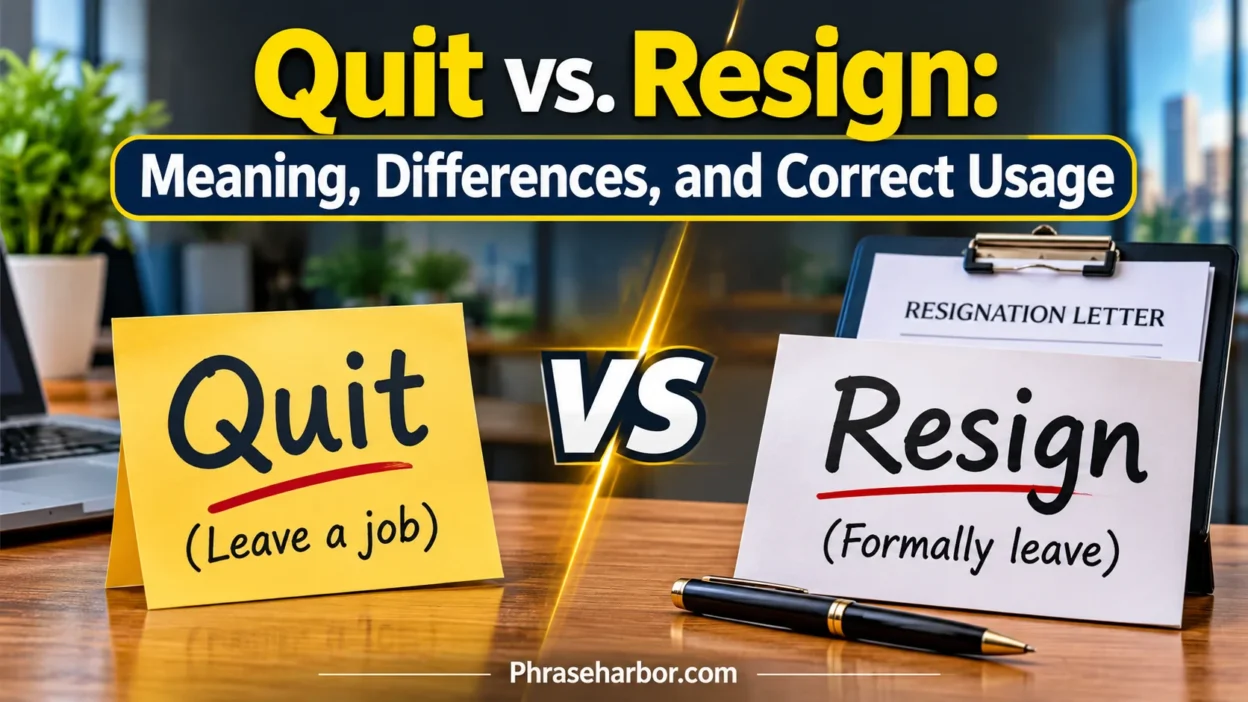
Choosing between quit and resign might seem simple, but the two words carry slightly different tones. Both can describe leaving a job voluntarily. However, they don’t always fit the same situations.
For example, you might tell a friend, “I quit my job yesterday.” In a formal letter to your employer, you’d more likely write, “I am resigning from my position, effective November 15.” Both sentences communicate a departure, but the second sounds more official.
The difference extends beyond workplace conversations. You can quit smoking, quit a game, or quit trying to solve a problem. By contrast, you typically resign from a job, an official position, or a leadership role.
Understanding these distinctions helps you choose the right word for emails, conversations, resignation letters, and everyday writing. Let’s explore the meanings, grammatical patterns, examples, and common mistakes associated with quit vs. resign.
Quick Answer:
Quit means to stop doing something or leave a job, activity, or commitment. Resign means to formally give up a job, office, or position. Both words can describe voluntarily leaving employment, but resign generally sounds more formal.
| Example | Meaning |
| I quit my job last Friday. | A direct, everyday statement about leaving employment. |
| I resigned from my position last Friday. | A more formal statement about leaving a position. |
| She quit smoking last year. | She stopped smoking. |
| The director resigned from the board. | The director formally gave up a board position. |
| He quit the competition halfway through. | He stopped participating in the competition. |
The easiest rule to remember: Use quit for stopping an activity or leaving something in everyday language. Use resign when you want to describe formally giving up a job or position.
However, context matters. Saying “I quit my job” isn’t grammatically wrong or automatically unprofessional. Likewise, saying “I resigned from my job” doesn’t guarantee that you gave notice or left on good terms.
Comparison Overview: Quit vs. Resign
The main difference between quit and resign involves their meaning, formality, and range of use. Both verbs can describe leaving employment, but quit applies to many more activities.
| Feature | Quit | Resign |
| Basic meaning | Stop doing something or leave a job or activity | Formally give up a job, office, or position |
| Part of speech | Verb; also a noun in informal usage | Verb |
| Tone | Usually direct and conversational | Usually formal or official |
| Workplace use | Common in everyday speech | Common in formal notices and announcements |
| Other uses | Habits, games, activities, attempts, and jobs | Jobs, offices, leadership roles, and appointments |
| Common construction | Quit a job; quit smoking; quit trying | Resign from a job; resign as chair |
| Does it require notice? | No, not from the word alone | No, not from the word alone |
| Does it mean being fired? | No | No |
| Example | He quit his job in October. | He resigned as department head in October. |
One important distinction is that resign has a narrower meaning than quit. You can quit an activity without holding an official position. Resigning, however, generally involves giving up a role, appointment, or position.
Neither word specifies every detail of a departure. To explain whether someone gave advance notice, left immediately, or reached an agreement with an employer, you need additional information.
What Does Quit Mean?
Definition of Quit
Quit is a verb that means to stop an activity, abandon an effort, or leave a job or situation. Its meaning depends on what follows it.
In everyday American English, people frequently use quit when discussing employment, personal habits, hobbies, and unfinished tasks. The word is direct and easy to understand.
Consider these examples:
- Employment: “Megan quit her job at the restaurant.”
- Habits: “Daniel quit smoking two years ago.”
- Activities: “We quit playing when the rain started.”
- Efforts: “Don’t quit trying just because the first attempt failed.”
- School: “He quit college to pursue a business opportunity.”
Each sentence describes stopping something or walking away from a commitment. The specific meaning comes from the surrounding words.
When you use quit to discuss employment, you generally communicate that someone chose to leave. However, the word alone doesn’t explain why the person left or whether the decision was planned.
Examples of Quit in Sentences
The best way to understand quit is to examine how it works in different situations.
| Sentence | Explanation |
| I quit my job yesterday. | The speaker left their employment. |
| She quit the team after the season. | She stopped participating in the team. |
| They quit arguing and started listening. | They stopped arguing. |
| He quit drinking soda. | He stopped consuming soda. |
| The company quit offering that service. | The company stopped providing the service. |
| We quit looking after an hour. | We stopped searching. |
Notice that quit doesn’t always describe an official decision. It can simply mean that an activity ended because someone stopped participating.
For example, “We quit looking” describes the end of a search. It doesn’t suggest that anyone submitted a formal notice.
Common Expressions With Quit
Several everyday expressions use quit naturally. Learning these phrases helps you recognize when the word fits.
- Quit a job: Leave a position of employment.
- Quit smoking: Stop smoking.
- Quit trying: Stop making an effort.
- Quit school: Stop attending school or leave an educational program.
- Quit doing something: Stop performing a particular action.
- Quit cold turkey: Stop a habit or substance use abruptly rather than gradually reducing it.
- Quit complaining: Stop expressing dissatisfaction repeatedly.
- Quit the game: Stop playing or participating in a game.
For example, a manager might tell an employee, “Don’t quit before you’ve explored your options.” Here, quit refers to leaving a job, but the sentence doesn’t require a formal workplace context.
Similarly, “She quit cold turkey” means she stopped a habit abruptly. Depending on the substance involved, suddenly stopping can carry medical risks, so this expression shouldn’t be treated as health advice.
Is Quit Formal or Informal?
Quit is standard English, not an incorrect or inherently unprofessional word. Its tone depends on the situation and the way you use it.
In casual conversation, “I quit my job” sounds natural. Friends, family members, and coworkers commonly use this expression.
In formal writing, however, resign often communicates the same decision with a more official tone. Compare these examples:
- Casual: “I’m quitting my job at the end of the month.”
- Professional: “I will be resigning from my position effective November 30.”
- Direct but professional: “I am resigning from my position, effective November 30.”
The final example is often the clearest choice for a formal notice. It avoids unnecessary wording while communicating the decision.
Still, there’s no rule requiring you to avoid quit in every workplace conversation. The word works perfectly well when you need a straightforward explanation rather than an official statement.
What Does Resign Mean?
Definition of Resign
Resign means to formally give up a job, office, or position. People commonly use it when employees, executives, public officials, or organizational leaders leave their roles.
Unlike quit, resign usually focuses on the position someone is leaving rather than the activity they are stopping.
Consider these examples:
- “The manager resigned from her position.”
- “He resigned as president of the organization.”
- “The board member resigned after five years of service.”
- “She resigned from her teaching job to relocate.”
- “The official announced his decision to resign.”
Each example describes someone giving up a role. The word sounds appropriate in professional announcements, official correspondence, and news reports.
However, resign doesn’t automatically mean that someone left voluntarily under ideal circumstances. A person might resign after disagreements, pressure from leadership, or an investigation. The circumstances require separate explanation.
Examples of Resign in Sentences
The verb resign frequently appears in formal and organizational contexts.
| Sentence | Explanation |
| She resigned from her position last week. | She formally left her job or role. |
| He resigned as chairman. | He gave up his chairman position. |
| The employee submitted a letter of resignation. | The employee formally communicated an intention to leave. |
| The governor resigned from office. | The governor gave up the official position. |
| She resigned after accepting another offer. | She left her current role after securing another opportunity. |
| The director announced plans to resign. | The director communicated an intention to leave the position. |
Pay attention to the difference between resigned and plans to resign. The first describes a departure as an accomplished event. The second describes an intention or future plan.
That distinction matters when writing workplace announcements or reporting personnel changes. An announced intention doesn’t necessarily mean the person has already left.
Read More: Pick Up or Pickup: Meaning, Differences, and Correct Usage
Common Expressions With Resign
Several expressions commonly accompany resign.
- Resign from a job: Formally leave employment.
- Resign from a position: Give up a particular role.
- Resign as manager: Give up the role of manager.
- Resign from the board: Leave a board membership.
- Submit a resignation: Formally communicate a decision to leave.
- Offer one’s resignation: Present a resignation for consideration or acceptance, depending on the circumstances.
For example, “She resigned from the board” is natural because board membership is an official role.
Likewise, “He resigned as treasurer” identifies the position he gave up. You don’t need to repeat the word position because the title already makes the role clear.
Is Resign More Formal Than Quit?
Yes. Resign generally sounds more formal than quit when both words describe leaving a job.
Employers and employees often use resign in written notices, personnel announcements, and official records. Meanwhile, quit appears frequently in ordinary conversation.
Compare the following statements:
- “I quit my job because I found something better.”
- “I resigned from my position after accepting another offer.”
Both sentences communicate a voluntary departure. The second sounds more formal, but neither sentence provides enough information to establish whether the employee gave notice.
Formal language also doesn’t necessarily mean polite language. Someone can resign abruptly or write an angry resignation letter. The word describes leaving a position, not the manner in which the person handles the departure.
Main Differences Between Quit and Resign
Difference in Meaning
The most important difference between quit and resign is the range of situations each word describes.
Quit can mean stopping an activity, abandoning an effort, or leaving employment. Resign generally means giving up a formal position or office.
For example, you can say:
- “I quit my job.”
- “I quit smoking.”
- “I quit playing chess.”
- “I quit trying to fix the computer.”
All four sentences use quit naturally.
However, you wouldn’t ordinarily say “I resigned smoking” or “I resigned playing chess.” Those constructions don’t express the intended meaning in standard American English.
You could say “I resigned from the chess club” if you held a membership or official position and wanted to give it up. Even then, left the chess club might sound more natural if you simply mean you stopped participating.
The key is to identify what someone is leaving. When the object is a habit or activity, quit is usually the appropriate choice. When it’s a formal role, resign often fits better.
Difference in Formality and Tone
The words can communicate the same basic event while creating different impressions.
| Situation | Natural wording | Reason |
| Talking to a friend | “I quit my job.” | Direct and conversational |
| Writing a resignation letter | “I am resigning from my position.” | Formal and conventional |
| Reporting an executive’s departure | “The CEO resigned.” | Suitable for official reporting |
| Discussing a personal habit | “She quit smoking.” | Correct for stopping a habit |
| Discussing an unsuccessful effort | “He quit trying.” | Correct for abandoning an attempt |
The distinction isn’t about one word being correct and the other incorrect. Instead, the best choice depends on your audience and purpose.
If you’re telling a friend why you won’t return to work, quit may be the clearest option. If you’re notifying your employer in writing, resign usually fits the occasion better.
Difference in Workplace Usage
In workplace settings, quit often describes the employee’s decision in everyday language. Resign often describes the formal act of leaving a position.
Imagine an employee named Jordan who accepts another job and plans to leave in two weeks.
Jordan might tell a friend:
“I quit my job. I found a better opportunity.”
In a letter to the employer, Jordan might write:
“I am resigning from my position, with my last working day scheduled for November 15.”
Both statements describe the same decision. The difference lies in their tone and level of detail.
However, you shouldn’t assume that every person who quits leaves immediately. Jordan’s example shows that someone can use quit while planning a departure in advance.
Likewise, someone who resigns might provide notice, negotiate a departure date, or leave sooner if the employer agrees. The word itself doesn’t settle those details.
Difference in Grammar and Sentence Structure
Both words function as verbs, but they follow different grammatical patterns.
Common patterns with quit:
- Quit + noun: “She quit her job.”
- Quit + verb ending in -ing: “He quit playing tennis.”
- Quit + adverbial phrase: “They quit after lunch.”
- Quit + object: “The company quit the project.”
Common patterns with resign:
- Resign from + position: “She resigned from her position.”
- Resign as + title: “He resigned as treasurer.”
- Resign from + organization: “They resigned from the committee.”
- Resign + adverbial phrase: “The director resigned yesterday.”
These patterns help you avoid awkward or incorrect constructions.
For example, write “She resigned from her position,” not “She resigned her position from.” In ordinary contemporary American English, the first construction is the more widely useful pattern for this meaning.
Also, remember that quit has irregular verb forms:
| Verb form | Quit | Resign |
| Base form | quit | resign |
| Simple past | quit | resigned |
| Past participle | quit | resigned |
| Present participle | quitting | resigning |
| Third-person singular | quits | resigns |
Examples:
- Present: “She quits whenever the work becomes difficult.”
- Past: “She quit her job last month.”
- Present perfect: “She has quit smoking.”
- Present: “He resigns from the committee today.”
- Past: “He resigned yesterday.”
- Present perfect: “He has resigned from his position.”
A common spelling mistake is writing quitted when quit is intended. Although quitted appears in some varieties and specialized uses of English, quit is the standard past-tense form in everyday American English.
FAQs:
Neither word is always better. Quit works well in everyday conversation, while resign is usually preferable for formal workplace communication.
For example, you can tell a friend, “I quit my job.” When writing to your employer, “I am resigning from my position” sounds more conventional.
Not exactly. Both words can describe leaving a job voluntarily, but quit has a broader meaning.
You can quit a job, quit smoking, or quit trying. You generally resign from a job, office, or formal position.
Generally, yes, when you’re formally communicating a departure from employment. Resign is common in resignation letters, official announcements, and professional correspondence.
However, quit is also standard English. Using it in a workplace conversation doesn’t automatically make you sound unprofessional.
No. Quitting ordinarily means that you chose to leave a job or stop an activity. Being fired means your employer terminated your employment.
If you left voluntarily, quit or resign may be appropriate. If your employer dismissed you, fired or terminated is generally more accurate.
Yes, the word resign doesn’t inherently require advance notice. Someone can resign effective immediately or specify a future departure date.
However, employment agreements, workplace policies, and applicable laws may affect your obligations. Check the relevant requirements before deciding when to leave.
Conclusion:
The difference between quit vs. resign comes down to meaning, tone, and context. Both words can describe voluntarily leaving a job, but they aren’t interchangeable in every situation. Use quit when talking about leaving a job, stopping a habit, or abandoning an activity. Choose resign when describing the formal departure from a job, leadership role, or official position. When you’re writing a professional resignation letter, resign is usually the clearest choice. For everyday conversations, quit often sounds more natural.
Latest Post:
- Months or Month’s: Meaning, Difference, and Correct Usage
- I’ll Be Forever Grateful vs. I’ll Forever Be Grateful: Meaning and Correct Usage
- Vagrant vs. Hobo: Meaning, Differences, and Correct Usage
- Align To or Align With: Meaning, and Correct Usage
- Moment vs. Momment: Meaning, Spelling, and Correct Usage