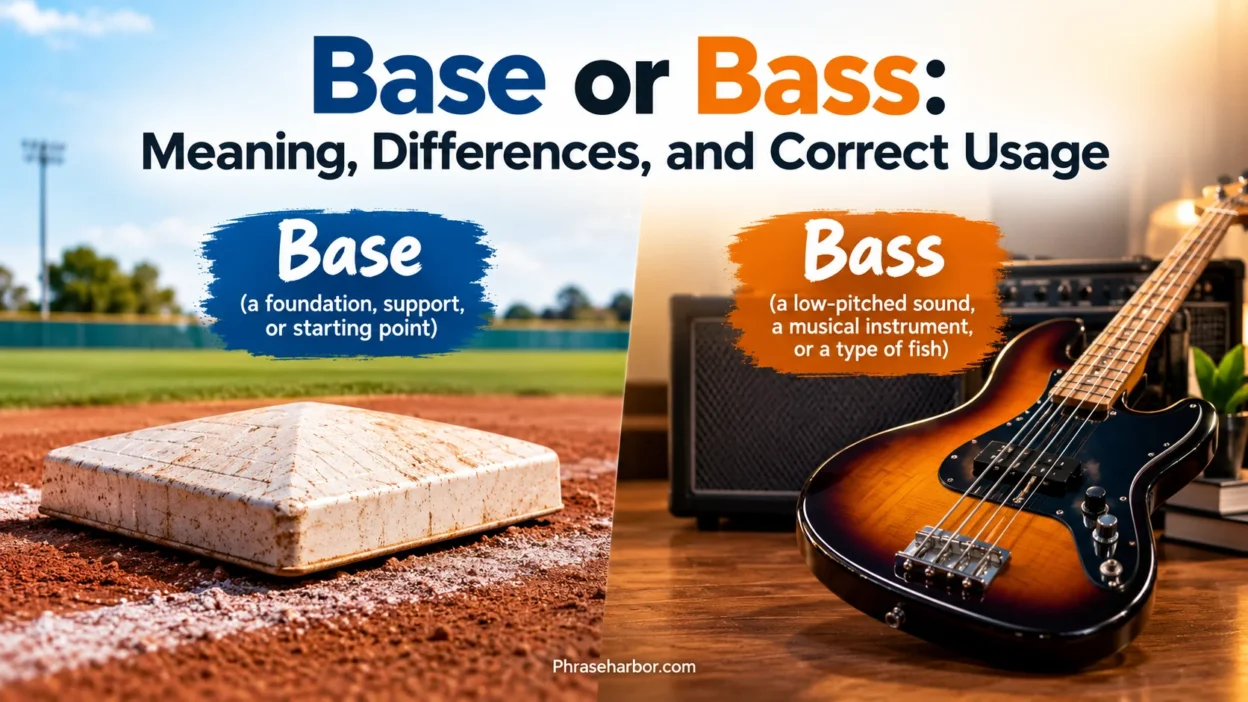
The words base and bass confuse many English learners, writers, and speakers because they sound exactly the same when spoken, although their spelling differences and meanings are important. These two words may look similar at a glance, but they have completely different meanings and uses in English. Understanding the difference between base and bass helps you avoid common writing mistakes, awkward sentences, and misunderstandings.
The word base means a foundation, starting point, or support for something. For example, a building stands on a strong base, while an argument needs a logical base. In contrast, bass can describe a deep sound or low sound in music, especially the musical sound produced by a bass guitar or another musical instrument. It can also mean a type of fish or fish species found in freshwater, saltwater, lakes, and oceans.
Although these are commonly confused words, their contextual meaning, lexical meaning, and usage make the word distinction easier to understand.To clearly understand base vs bass meaning, pay attention to context, pronunciation, and word choice. Base has a consistent pronunciation, but bass has two different ways of being pronounced, depending on meaning: the musical term rhymes with class, while the fish name rhymes with case.
Quick Answer
Base refers to a foundation, starting point, central location, or underlying principle. You can use it as a noun or a verb.
- Example: The company established its main base in Chicago.
- Example: The researcher will base the conclusion on the available evidence.
Bass commonly refers to low musical sounds, musical instruments, a low singing voice, or a type of fish. It can function as a noun or an adjective.
- Example: The song has a powerful bass line.
- Example: We caught a large bass in the lake.
Here’s the easiest way to remember the distinction: base means a foundation or starting point, while bass usually refers to music, low sounds, or fish.
One important detail concerns pronunciation. Musical bass rhymes with base, but bass referring to the fish rhymes with mass. The sentence’s meaning helps you identify the correct word and pronunciation.
Comparison Overview
The following table highlights the essential differences between base and bass.
| Feature | Base | Bass |
| Main meaning | Foundation, bottom, starting point, or support | Low musical sound, musical instrument, low voice, or fish |
| Part of speech | Noun or verb | Noun or adjective |
| Common contexts | Science, mathematics, sports, business, and everyday language | Music, audio equipment, singing, and fishing |
| Pronunciation | Rhymes with face | Rhymes with face in music; rhymes with mass for the fish |
| Example | The team returned to its home base. | The bass guitar sounded excellent. |
| Common expression | Base of operations | Bass guitar |
| Common mistake | Writing bass when you mean a foundation | Writing base when you mean a musical instrument |
Although these words differ by only one letter, they serve distinct purposes. The right choice depends on what you want to communicate.
For instance, a musician might return to a home base after a performance and then play a bass guitar. Both words belong in the same sentence, but they describe entirely different things.
What Does Base Mean?
The word base refers to something that supports, anchors, or serves as the starting point for something else. You can use it when discussing physical structures, locations, mathematical systems, scientific concepts, or ideas.
As a noun, base often identifies the bottom or foundation of an object. As a verb, it describes establishing something on a particular fact, principle, location, or set of evidence.
Base as a Noun
When base functions as a noun, it identifies a foundation, starting point, or central location. The exact meaning depends on the context.
Consider these examples:
- Building: The statue has a wide stone base.
- Military: The soldiers returned to their military base.
- Business: The company expanded its customer base.
- Sports: The runner reached first base safely.
- Science: The solution contains a chemical base.
- Mathematics: The number system uses base ten.
Notice how the same word works across several fields. A building’s base supports its structure, while a customer base represents the group of people who buy from a business.
In mathematics, base has a more specialized meaning. The decimal system uses ten digits, from zero through nine, so mathematicians call it a base-ten system. Binary notation uses base two, which relies on just two digits: zero and one.
Base as a Verb
The word base also functions as a verb when you describe the foundation for a decision, argument, or action.
For example:
- The editor will base the article on reliable evidence.
- We based our decision on customer feedback.
- The company bases its prices on production costs.
- Her argument is based on several scientific studies.
The expression based on is especially common in professional and academic writing. It tells readers which information supports a conclusion or decision.
Compare these sentences:
- The report discusses recent sales figures.
- The report is based on recent sales figures.
The first sentence identifies the report’s subject. The second explains the information that supports the report.
Common Uses of Base in Everyday Language
You encounter base in many ordinary expressions. Learning these combinations helps you recognize the correct spelling quickly.
| Expression | Meaning | Example |
| Base of operations | A central location for activities | The warehouse serves as our base of operations. |
| Home base | A home location or central point | After traveling, she returned to her home base. |
| Customer base | The people who buy from a business | The new service attracted a larger customer base. |
| Knowledge base | A collection of organized information | The support team updated its knowledge base. |
| Base rate | A starting or underlying rate in a particular system | The bank reviewed its base rate. |
| Base layer | The bottom or foundational layer | Apply the base layer before painting. |
| Based on | Founded on or developed using something | The movie is based on a true story. |
These expressions appear in business, education, technology, construction, and everyday conversation. In each case, base carries the idea of a foundation, reference point, or underlying support.
Base in Science and Mathematics
Scientific and mathematical uses of base deserve special attention because the word has precise meanings in these fields.
In chemistry, a base is a substance that accepts hydrogen ions or donates an electron pair, depending on the chemical theory being used. Under the Brønsted–Lowry definition, a base accepts a proton. Under the Lewis definition, it donates an electron pair.
For example, ammonia can act as a Brønsted–Lowry base by accepting a proton. Sodium hydroxide is another familiar example of a base.
In mathematics, a base may describe the bottom side of a geometric figure, the number that gets raised to an exponent, or the number system used to represent values.
Consider the expression 23=8. The number 2 is the base, while 3 is the exponent. In a triangle, the base is the side chosen as the reference for calculating its area.
These meanings share a useful connection: the base provides a starting point or reference for understanding something else.
Read More: Antithesis vs. Juxtaposition: Meaning, Differences, and Examples
Base in Sports
Baseball provides one of the clearest examples of the word’s everyday use. The sport has four bases: first base, second base, third base, and home plate, which serves as the scoring destination.
A player must navigate these bases to score a run. Writing bass in this context would be incorrect because the word refers to neither music nor fish.
For example:
- The runner slid safely into second base.
- The batter hit the ball toward first base.
- The team practiced its strategy around the bases.
The same spelling applies when base describes a home location or the starting point for a sports activity.
What Does Bass Mean?
Bass has several established meanings, most commonly involving low-pitched sounds, musical instruments, and certain fish. The context tells you which meaning applies.
Unlike base, which centers on foundations and starting points, bass often appears in conversations about sound, musical performance, audio technology, and fishing.
Bass in Music
In music, bass refers to the lower range of musical pitches or to musical parts and instruments that produce those pitches.
A bass line often supports a song’s harmony and rhythm. In many styles, it works closely with the drums to create a strong rhythmic foundation.
For example:
- The bass line gives the song a deeper sound.
- She plays bass in a jazz band.
- The producer increased the bass during mixing.
- The singer performed the low bass notes beautifully.
Here, bass may refer to the sound itself, the musical part, or the person performing it. The word remains the same because the meaning comes from the surrounding context.
Bass as a Musical Instrument
Several instruments belong to the bass family. Each plays an important role in musical arrangements.
Common bass instruments
A fretted string instrument commonly used in rock, pop, funk, jazz, and many other genres. Most standard electric bass guitars have four strings, although five-string and six-string versions are also common.
The largest and lowest-pitched standard string instrument in the modern symphony orchestra. Musicians also use it in jazz, folk, and other styles.
An electronic instrument or synthesizer patch designed to produce low-frequency tones. Producers often use it in electronic dance music, hip-hop, and film soundtracks.
If you’re writing about any of these instruments, use bass, never base. For example, bass guitar is the correct spelling, even though it sounds like base guitar when spoken.
Bass as a Singing Voice
In vocal music, bass describes the lowest standard adult male voice type. Bass singers often perform deep notes in choirs, operas, and other musical settings.
The term can also describe a particular vocal part in a composition. A choir might divide singers into soprano, alto, tenor, and bass sections.
For example:
- The choir’s bass section sang the final chord.
- His bass voice gave the performance a rich, deep quality.
- The composer wrote a demanding passage for the bass singers.
A bass voice isn’t simply any low sound. Vocal classification considers factors such as vocal range, tone quality, and how the voice functions in musical performance.
Bass in Audio Equipment
When someone says a speaker has strong bass, they’re usually talking about its ability to reproduce low-frequency sounds.
Bass plays a major role in how music feels. Deep kick drums, low synthesizer notes, and rumbling cinematic effects can add weight and impact to a recording.
Audio professionals often distinguish bass from midrange and treble frequencies. These categories describe broad portions of the audible frequency spectrum rather than rigid divisions that apply identically to every system.
For example:
- These headphones produce deep bass without overwhelming the vocals.
- The sound engineer reduced the bass to improve clarity.
- The car’s subwoofer delivers powerful bass during music playback.
A subwoofer is a speaker designed primarily to reproduce low-frequency sounds. It can improve bass reproduction, although the final sound also depends on the recording, room acoustics, speaker placement, and audio settings.
Remember that the correct word is bass when discussing low-frequency sound. The spelling base doesn’t describe this audio characteristic.
Bass as a Type of Fish
The word bass also names several types of fish. Different species carry this common name, including largemouth bass, smallmouth bass, and striped bass.
These fish appear in different habitats. Largemouth and smallmouth bass are freshwater fish commonly associated with lakes, rivers, and reservoirs. Striped bass can live in marine environments, and some populations also enter freshwater.
Examples include:
- We caught a largemouth bass in the lake.
- The fisherman released the smallmouth bass.
- Striped bass are popular among many recreational anglers.
Fish-related bass has a different pronunciation from musical bass. That distinction is useful when reading aloud, but the spelling remains identical.
A quick way to remember the difference is to connect the fish with fishing and the musical meaning with low sounds. Neither meaning uses the spelling base.
Main Differences Between Base or Bass
The most important difference between base and bass is their meaning. Although they look and sometimes sound alike, you can’t use them interchangeably without changing the meaning of a sentence.
FAQs:
What is the difference between base and bass?
Base refers to a foundation, starting point, or support. Bass refers to a low-pitched sound, a musical instrument, or a type of fish. Although the words look and sound similar in some contexts, their meanings and usage differ.
Is base or bass the correct spelling?
Both base and bass are correct spellings, but they serve different purposes. Use base when discussing a foundation or starting point. Use bass when referring to low musical sounds, a bass guitar, or a type of fish.
How do you pronounce base and bass?
Base rhymes with “case.” Bass has two common pronunciations: the musical term rhymes with “class,” while the fish name rhymes with “case.” The correct pronunciation depends on the meaning.
Is bass a type of fish or a musical instrument?
Bass can refer to both. In music, it describes a low-pitched sound or an instrument that produces low notes. In nature, a bass is a type of fish that lives in freshwater or saltwater environments, depending on the species.
How can I remember when to use base or bass?
Think of base as the bottom or foundation of something, such as a building’s base. Associate bass with music or fishing. Checking the context of your sentence will help you choose the correct word and avoid common spelling mistakes.
Conclusion:
Understanding base or bass becomes easier when you focus on meaning and context. Use base for a foundation, starting point, or support. Choose bass when discussing low musical sounds, bass instruments, or a type of fish. Remember that bass also has two pronunciations, depending on its meaning. With these distinctions in mind, you can choose the correct word, improve your vocabulary, and communicate more clearly in writing and conversation.