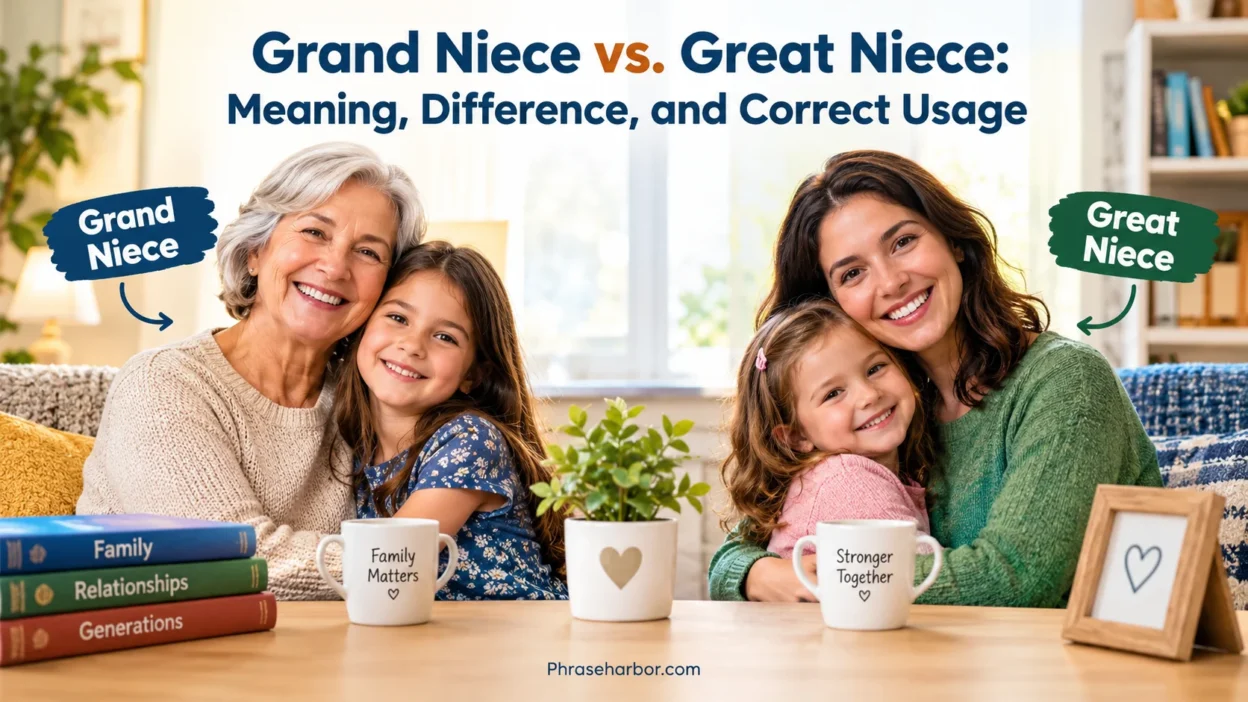
Have you ever wondered whether to write grand niece or great niece when describing someone in your family? Both expressions appear in English, and many people use them interchangeably. However, their spelling, traditional usage, and interpretation in some family trees can cause confusion.
Understanding the relationship is easier than it might seem. If your niece has a daughter, you can generally call that girl your grandniece or great-niece. Both terms describe the same family relationship in common English usage. The main differences involve spelling conventions, personal preference, and certain genealogical traditions.
Whether you’re writing a family biography, updating a family tree, preparing a birthday card, or simply trying to understand your relatives, knowing how these expressions work will help you choose the right wording. Let’s explore their meanings, compare their usage, and look at practical examples.
Quick Answer:
Grand niece and great niece generally refer to the same person: the daughter of your niece or nephew. Both expressions are accepted in English, although their spelling conventions differ.
- Grandniece: A common closed spelling of the term, also written as grand-niece or grand niece.
- Great-niece: A widely used alternative, traditionally written with a hyphen.
- Meaning: Both terms generally describe the daughter of your sibling’s child.
- Male equivalent: Grandnephew or great-nephew.
- Best choice: Use grandniece or great-niece consistently. If you’re documenting a family tree, follow the terminology used by your chosen genealogical system.
For example, suppose your sister has a daughter named Sarah, and Sarah has a daughter named Emma. Emma is your grandniece or great-niece. Sarah is your niece, while Emma is one generation younger than Sarah.
Comparison Overview
Although grand niece and great niece can describe the same relationship, their written forms and usage patterns differ slightly. The following table summarizes the main points.
| Feature | Grand Niece | Great Niece |
| Common dictionary form | Grandniece | Great-niece |
| Alternative spelling | Grand-niece or grand niece | Great niece |
| Meaning | Daughter of your niece or nephew | Daughter of your niece or nephew |
| Grammatical status | Accepted English usage | Accepted English usage |
| Everyday use | Common in family discussions and genealogy | Common in conversation and writing |
| Male equivalent | Grandnephew | Great-nephew |
| Relationship to you | One generation below your niece or nephew | One generation below your niece or nephew |
| Main distinction | Uses the prefix grand- | Uses the prefix great- |
The important point is that the two expressions usually identify the same family relationship. Neither is inherently incorrect in ordinary English.
However, family-history resources sometimes use specific conventions for generational relationships. If you’re working with a genealogy chart or a formal family record, check the terminology used throughout that document rather than assuming every system treats the terms identically.
What Does Grand Niece Mean?
Definition of Grand Niece
A grandniece is the daughter of your niece or nephew. She belongs to your extended family and is one generation below your niece or nephew.
To understand the relationship, start with your own generation. Your brother’s or sister’s daughter is your niece. When that niece has a daughter, the younger girl becomes your grandniece.
For example, imagine that you have a brother named David. David has a daughter named Olivia, and Olivia has a daughter named Mia. Olivia is your niece, while Mia is your grandniece.
This relationship works the same way if your nephew has a daughter. The child’s gender determines whether you call her a grandniece or him a grandnephew.
The word combines grand- with niece to describe a more distant generation in the family. It doesn’t mean that the girl is your granddaughter. A granddaughter is the daughter of your own son or daughter, which is a different relationship.
Is Grand Niece One Word or Two?
You may encounter three written forms: grandniece, grand-niece, and grand niece. These variations can make it difficult to decide which spelling to use.
- Grandniece: The closed compound spelling.
- Grand-niece: A hyphenated form.
- Grand niece: An open compound spelling.
The closed form grandniece is a clear choice for general American English writing. It keeps the word compact and makes the relationship easy to identify. The hyphenated and open forms also appear in English usage, so seeing them doesn’t automatically mean the writer has made a grammatical error.
For a blog post, family newsletter, or personal letter, choose one form and use it consistently. If a publication has a house style, follow that guide.
For example:
- Correct: “My grandniece is visiting next weekend.”
- Also used: “My grand-niece is visiting next weekend.”
- Also encountered: “My grand niece is visiting next weekend.”
When writing for a broad American audience, grandniece is a practical choice because it clearly identifies the relationship in one word.
Grand Niece in Example Sentences
Seeing the term in context makes its meaning easier to remember.
- “My grandniece is celebrating her sixth birthday this Saturday.”
- “I bought a picture book for my grandniece.”
- “My brother’s granddaughter is my grandniece.”
- “She invited all her nieces, nephews, grandnieces, and grandnephews to the family reunion.”
- “The old photograph shows my grandmother holding her youngest grandniece.”
In each example, the word describes a girl or woman who is the daughter of the speaker’s niece or nephew. It doesn’t refer to a direct granddaughter or an ordinary niece.
What Does Great Niece Mean?
Definition of Great Niece
A great-niece is the daughter of your niece or nephew. In common English usage, the term generally describes the same relationship as grandniece.
Suppose your sister has a son named Michael. Michael has a daughter named Ava. Ava is your great-niece because she is the daughter of your nephew.
The relationship remains the same regardless of whether the parent is your niece or nephew. If your niece has a daughter, that girl is your great-niece. If your nephew has a daughter, she is your great-niece as well.
The word great-niece follows a familiar English naming pattern for extended family relationships. You may already know terms such as great-grandmother, great-grandfather, and great-nephew. However, the word great doesn’t always work in precisely the same way across every family term or genealogical convention.
For everyday conversation, you can generally use great-niece and grandniece without changing the person or relationship you mean.
Is Great Niece One Word or Two?
The most familiar written form is great-niece, with a hyphen between great and niece. You may also see great niece without a hyphen.
The hyphen helps readers recognize the expression as a single family relationship. It also follows a common convention used in compounds such as great-grandmother and great-grandson.
Consider these examples:
- “My great-niece is learning to ride a bicycle.”
- “We invited our great-niece to the family dinner.”
- “His great-niece inherited her love of music from her family.”
The hyphenated form is a sensible default for American English. Still, an open form doesn’t necessarily make a sentence incomprehensible or incorrect in every editorial context.
Consistency matters more than switching between different spellings without a reason. If you begin an article with great-niece, continue using that form unless you have a clear reason to adopt another spelling.
Read More: Message vs. Messege: Which Spelling Is Correct?
Great Niece in Example Sentences
Here are several examples showing how great-niece works naturally in everyday writing.
- “My great-niece starts kindergarten this fall.”
- “I sent a birthday card to my great-niece in Chicago.”
- “Her great-niece loves hearing stories about their ancestors.”
- “He proudly introduced his great-niece to the family at Thanksgiving.”
- “The family photograph includes two great-nieces and three great-nephews.”
Notice that the term doesn’t change according to the speaker’s gender. A man and a woman can both have a great-niece. The relationship depends on the family connection, not whether the relative speaking is male or female.
Main Differences Between Grand Niece and Great Niece
The distinction between grandniece and great-niece is less dramatic than the wording suggests. In ordinary English, both names generally identify the daughter of your niece or nephew. The differences mainly concern spelling, terminology, and the conventions used by individual families or genealogists.
Meaning and Family Relationship
In common usage, the two expressions describe the same relationship.
Imagine that you have a daughter named Rachel. Rachel has a son named Noah, who later has a daughter named Lily. Lily is your great-granddaughter because she descends directly through your daughter and grandson.
Now imagine that your sister has a daughter named Rachel, and that Rachel has a daughter named Lily. Lily is your grandniece or great-niece because she descends through your niece rather than your own child.
That distinction is crucial. The relationship depends on the line of descent, not simply on how many generations separate two people.
A grandniece or great-niece belongs to your extended family through your sibling’s descendants. A great-granddaughter belongs to your direct line through your own children and grandchildren.
Spelling and Hyphenation
The written forms provide the clearest visible difference.
| Term | Example | Writing note |
| Grandniece | “My grandniece called me.” | Closed compound |
| Grand-niece | “My grand-niece called me.” | Hyphenated variant |
| Grand niece | “My grand niece called me.” | Open variant |
| Great-niece | “My great-niece called me.” | Common hyphenated form |
| Great niece | “My great niece called me.” | Open variant |
If you’re writing a polished American English article, grandniece and great-niece are convenient choices. The first uses one word, while the second uses a hyphen.
Don’t assume the number of words changes the family relationship. In this case, the spelling variation doesn’t usually change the meaning.
Usage in Everyday English
In conversation, people often use whichever expression feels familiar. One family may call a younger relative a grandniece, while another may prefer great-niece.
For example, a woman might say, “My grandniece is coming to visit,” while her brother says, “Our great-niece is coming to visit.” Both may be talking about the same child.
Neither speaker needs to correct the other simply because they chose a different accepted term. If the meaning is clear, both expressions work.
However, if you’re writing for a genealogy society, a historical archive, or a family research project, check whether the organization follows a specific naming system. Precision becomes more important when readers need to trace several generations.
The Male Equivalent
The male equivalents follow the same general pattern.
- Grandniece: A female relative who is the daughter of your niece or nephew.
- Grandnephew: A male relative who is the son of your niece or nephew.
- Great-niece: A female relative who is the daughter of your niece or nephew.
- Great-nephew: A male relative who is the son of your niece or nephew.
For example, if your nephew has a son named Ethan, Ethan is your grandnephew or great-nephew. If your nephew has a daughter named Emma, Emma is your grandniece or great-niece.
These words identify the child’s relationship to you. They don’t describe the relationship between the child and the child’s own parent, who is simply that child’s mother or father.
How Is a Grand Niece or Great Niece Related to You?
Understanding the Family Relationship
The easiest way to understand the relationship is to follow the family line one generation at a time.
- Your brother’s or sister’s daughter is your niece.
- Your brother’s or sister’s son is your nephew.
- Your niece’s or nephew’s daughter is your grandniece or great-niece.
- Your niece’s or nephew’s son is your grandnephew or great-nephew.
This pattern applies regardless of whether the relationship comes through your brother or sister. It also applies whether the parent is your niece or nephew.
The term identifies a family connection rather than an age difference. Your grandniece could be a baby, a teenager, or an adult. The label stays the same as she grows older.
A Simple Family Tree Example
Consider the following fictional family:
Generation 1: Margaret and her brother, Robert.
Generation 2: Robert has a daughter named Sarah. Sarah is Margaret’s niece.
Generation 3: Sarah has a daughter named Emma. Emma is Margaret’s grandniece or great-niece.
The relationships look like this:
| Person | Relationship to Margaret |
| Robert | Brother |
| Sarah | Niece |
| Emma | Grandniece or great-niece |
This simple example shows why the terms exist. They allow Margaret to describe Emma’s place in the extended family without explaining the entire family tree every time she mentions her.
Grand Niece vs. Granddaughter
One of the most common mistakes is confusing a grandniece with a granddaughter. Although both relatives belong to a younger generation, their relationships to you are different.
A granddaughter is the daughter of your son or daughter. A grandniece is the daughter of your niece or nephew.
For example, if your son has a daughter named Sophie, Sophie is your granddaughter. If your sister’s daughter has a daughter named Sophie, that girl is your grandniece or great-niece.
| Relationship | How the person is related to you |
| Niece | Daughter of your brother or sister |
| Grandniece | Daughter of your niece or nephew |
| Granddaughter | Daughter of your son or daughter |
| Great-granddaughter | Daughter of your grandchild |
These labels matter because they distinguish your direct descendants from relatives connected through your siblings. That difference becomes especially useful when documenting family history or describing relationships to people who don’t know your family.
FAQs:
Is Grand Niece Correct English?
Yes. Grand niece is used in English, and the closed form grandniece and hyphenated form grand-niece are also encountered. For consistent American English writing, grandniece is a practical spelling choice.
Is Great Niece or Grand Niece More Common in American English?
Both expressions are used in American English. Great-niece is a familiar form, while grandniece is also established. Without a defined corpus and time period, it’s best not to claim that one is universally more common in every context.
Are Grandniece and Great-Niece the Same Thing?
In common English usage, yes. Both generally refer to the daughter of your niece or nephew. Some genealogical traditions may apply more specific conventions, so check the system you’re using when documenting a family tree.
Should Grandniece Be Hyphenated?
The closed form grandniece is a practical choice. You may also encounter grand-niece and grand niece. Follow your publication’s style guide if it specifies a preferred spelling.
What Is the Male Equivalent of a Grandniece?
The male equivalent is grandnephew. Great-nephew is another common term for the son of your niece or nephew.
Conclusion:
The difference between grand niece and great niece is mainly a matter of terminology and spelling. In common English usage, both expressions refer to the daughter of your niece or nephew. For everyday American English, grandniece and great-niece are clear, practical choices. Use one form consistently in your writing and follow any specific terminology required by a genealogical project.
Most importantly, don’t confuse a grandniece with a granddaughter. A grandniece is related to you through your sibling’s descendants, while a granddaughter is the daughter of your own child. Once you understand that distinction, identifying the correct family relationship becomes straightforward.