Language becomes much more vivid when you can turn an ordinary idea into a picture. Instead of saying that someone runs very fast, you might say they run like the wind. Rather than saying that someone is extremely busy, you could call them a busy bee.
Both examples use figurative language, but they don’t work in exactly the same way. A simile makes a comparison openly, often with words such as like or as. A metaphor makes a more direct comparison by describing one thing as another.
Understanding the difference between simile vs. metaphor can make reading easier and writing much more expressive. Once you know what to look for, these figures of speech become surprisingly easy to identify.
Quick Answer
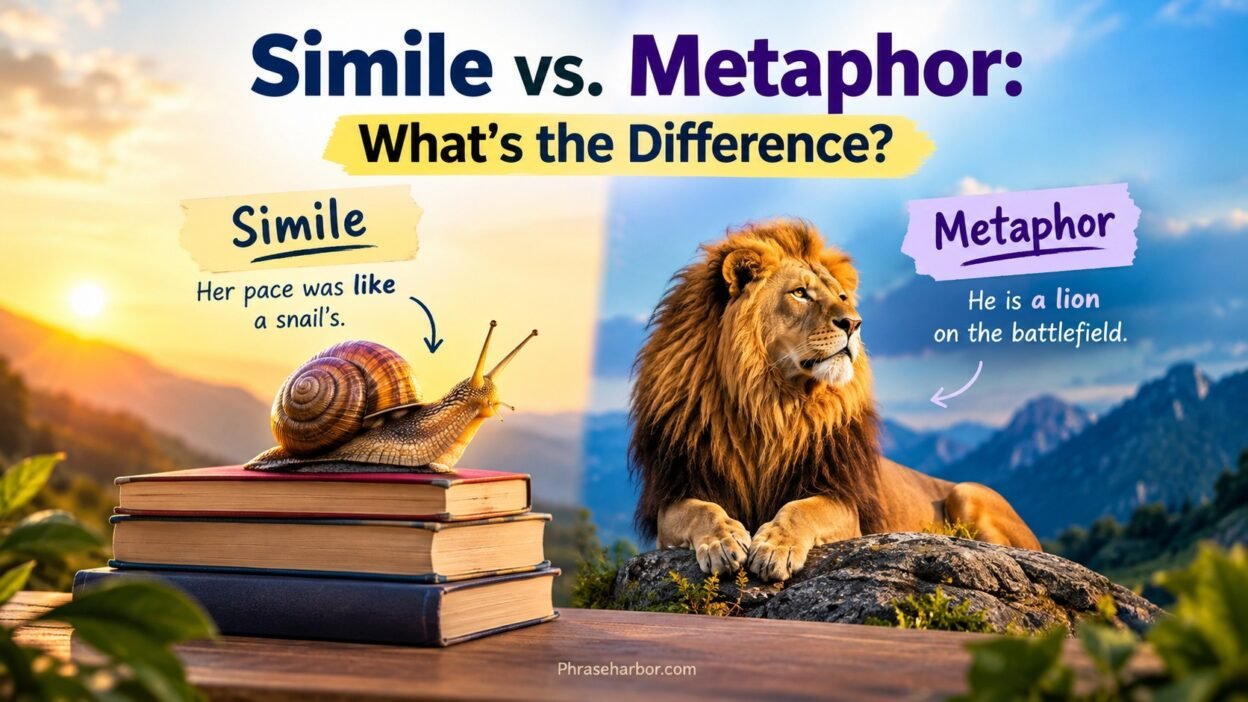
A simile compares two different things explicitly, usually with like, as, as if, or as though. For example, “Her smile is like sunshine.”
A metaphor makes a direct or implied comparison by saying that one thing is another. For example, “Her smile is sunshine.”
The easiest way to remember the difference is:
Simile says something is like something else. Metaphor says something is something else.
| Simile | Metaphor |
| Makes an explicit comparison | Makes a direct or implied comparison |
| Often uses like or as | Often uses is, was, or another verb |
| “He is like a lion.” | “He is a lion.” |
| The comparison is clearly signaled | The comparison is more direct |
| Often easier for beginners to identify | Can require more interpretation |
Both forms can create strong imagery. The difference lies mainly in how the comparison is expressed.
Comparison Overview
The terms simile and metaphor describe two closely related ways of comparing things. Both help readers connect an unfamiliar idea with something familiar.
A simile puts the comparison on the table. It tells you that two things resemble each other in some way.
A metaphor takes a bolder approach. It presents one thing in terms of another, allowing the reader to understand the shared quality from context.
| Feature | Simile | Metaphor |
| Main purpose | Compare two things | Describe one thing through another |
| Common words | like, as, as if, as though | Often is, was, becomes, or implied wording |
| Comparison | Explicit | Direct or implied |
| Example | “The baby slept like a log.” | “The baby was a little log.” |
| Common effect | Clear imagery | Stronger or more compact imagery |
| Common in | Everyday speech, stories, poetry | Literature, speeches, everyday expressions |
Neither device is automatically better. Writers choose between them based on the effect they want.
Main Differences Between Simile vs. Metaphor
The central difference between a simile vs. metaphor comes down to the way each one creates a comparison.
A simile tells you that two things are similar. A metaphor presents the comparison more directly.
Consider these two sentences:
- Simile: “The lake was like a mirror.”
- Metaphor: “The lake was a mirror.”
The lake isn’t literally a mirror in either sentence. The comparison highlights its smooth, reflective surface.
The simile signals that comparison clearly. The metaphor makes the image feel more immediate.
Explicit vs. Direct Comparison
A simile usually contains a clear comparison marker.
For example:
“The old house looked like a haunted castle.”
The word like tells you that the house resembles a haunted castle.
A metaphor removes that comparison marker:
“The old house was a haunted castle.”
The second sentence creates a stronger image because it treats the house as the castle within the figurative description.
Simile vs. Metaphor in Grammar
Grammar can provide a useful clue, although it isn’t a perfect test.
Similes commonly follow patterns such as:
- like + noun
- as + adjective + as
- as if + clause
- as though + clause
Examples include:
- “The fabric feels like silk.”
- “He is as quiet as a mouse.”
- “She looked as if she had seen a ghost.”
Metaphors often use forms such as:
- “Life is a journey.”
- “Her voice was music.”
- “The office became a battlefield.”
However, don’t classify a sentence by one word alone. Like can have literal meanings, and as can serve several grammatical functions.
What Is a Simile?
A simile is a figure of speech that explicitly compares two different things.
The comparison usually focuses on a particular shared quality. That quality might involve appearance, speed, sound, temperature, emotion, size, behavior, or another characteristic.
For example:
“The snow was as white as paper.”
Snow and paper aren’t identical. The sentence compares their whiteness.
Another example is:
“He moved like a shadow.”
The person isn’t literally a shadow. The comparison suggests that he moved quietly, smoothly, or unnoticed.
A good simile gives readers something concrete to picture. Instead of explaining an abstract quality at length, you can connect it to a familiar image.
Examples of Similes
Here are several straightforward examples:
| Simile | What It Suggests |
| “She sings like an angel.” | Her singing sounds beautiful. |
| “He runs like the wind.” | He runs very quickly. |
| “The water was as cold as ice.” | The water was extremely cold. |
| “Her skin felt like silk.” | Her skin felt smooth and soft. |
| “The baby slept like a log.” | The baby slept very deeply. |
| “His face turned as red as a tomato.” | His face became noticeably red. |
The comparison works because readers already understand the qualities associated with the second thing.
Common Simile Patterns
Several structures appear frequently in English.
Like + noun is one of the simplest:
“The clouds looked like cotton.”
The sentence compares the appearance of clouds with cotton.
Another common structure is as + adjective + as:
“The hallway was as dark as night.”
The adjective dark identifies the shared quality.
Similes can also use as if and as though:
“He stared at the screen as if it were a treasure map.”
These structures create a comparison without using like.
Not Every “Like” Is a Simile
This distinction matters.
Consider:
“I like chocolate.”
There is no comparison here. Like functions as a verb meaning to enjoy.
Now consider:
“The baby’s cheeks were like apples.”
This sentence creates a comparison. Therefore, it works as a simile.
Context determines the function.
What Is a Metaphor?
A metaphor describes one thing by presenting it as another thing.
The comparison isn’t meant literally. Instead, it transfers qualities from one concept to another.
For example:
“Time is a thief.”
Time isn’t literally a person who steals possessions. The metaphor suggests that time takes moments from us without allowing us to recover them.
Metaphors can make abstract ideas easier to understand. Concepts such as time, love, fear, stress, success, and failure can feel vague. A well-chosen metaphor gives those ideas a concrete shape.
Examples of Metaphors
| Metaphor | Meaning |
| “Time is a thief.” | Time takes moments away. |
| “Her voice was music.” | Her voice sounded especially pleasant. |
| “The classroom was a zoo.” | The classroom was noisy or chaotic. |
| “He has a heart of stone.” | He seems emotionally cold or unfeeling. |
| “Life is a journey.” | Life involves movement, experiences, and changes. |
| “The city never sleeps.” | The city remains active at almost all hours. |
The metaphor doesn’t simply decorate the sentence. It shapes how the reader understands the subject.
Common Metaphor Patterns
One common pattern uses is or was:
“The world is a stage.”
The world isn’t literally a theater stage. The metaphor encourages the reader to think about people as performers playing different roles.
Another pattern uses a metaphorical noun:
“She is a ray of sunshine.”
The person isn’t physically made of sunlight. The phrase suggests that she brings happiness or warmth.
Metaphors can also appear through verbs:
“The news crushed him.”
The news didn’t physically crush his body. The verb creates a metaphor for intense emotional pain.
Simile vs. Metaphor Examples Side by Side
Comparing similar sentences makes the distinction much easier.
| Simile | Metaphor | Shared Idea |
| “He is like a lion.” | “He is a lion.” | He is brave or powerful. |
| “She sings like an angel.” | “She is an angel.” | She is kind or wonderful. |
| “The room was like an oven.” | “The room was an oven.” | The room was extremely hot. |
| “His words cut like a knife.” | “His words were knives.” | His words caused emotional pain. |
| “The child moved like a tornado.” | “The child was a tornado.” | The child was energetic or chaotic. |
Notice the pattern. The simile makes the relationship explicit. The metaphor compresses the comparison into a more direct image.
Read More: Antithesis vs. Juxtaposition: Meaning, Examples, and How to Use Each
How to Tell If a Sentence Is a Simile or Metaphor
When you’re unsure, don’t panic. A simple three-step approach usually works.
Look for Comparison Words
First, check whether the sentence uses words such as:
- like
- as
- as if
- as though
If the sentence uses one of these to compare two things, it may be a simile.
For example:
“The baby’s laugh sounded like bells.”
That’s a simile because like connects the two images.
Ask What Is Being Compared
Next, identify the two things involved.
In:
“The road was a ribbon.”
the sentence compares a road with a ribbon.
The road doesn’t literally become a ribbon. The metaphor emphasizes its long, narrow appearance.
Check Whether the Comparison Is Literal
Finally, ask whether the sentence makes literal sense.
“The water is as cold as ice.”
This is a figurative comparison if the water isn’t actually ice.
Likewise:
“My brother is a rock.”
The sentence probably doesn’t mean that your brother is a geological object. It likely describes him as dependable, strong, or emotionally steady.
Simile vs. Metaphor With the Same Comparison
The same idea can often appear as either a simile or metaphor.
Consider a hardworking child.
Simile:
“The child was as busy as a bee.”
Metaphor:
“The child was a busy bee.”
Both sentences suggest that the child is active and constantly doing something.
However, the metaphor feels more compact. The child becomes the image itself.
Another pair:
Simile: “Her smile was like sunshine.”
Metaphor: “Her smile was sunshine.”
The simile creates a clear resemblance. The metaphor gives the image greater force.
Simile vs. Metaphor in Everyday Language
You don’t need to read poetry to encounter figurative language. People use similes and metaphors every day.
You might hear:
- “I’m as hungry as a horse.”
- “He’s a night owl.”
- “That test was a nightmare.”
- “She eats like a bird.”
- “My inbox is a battlefield.”
- “The baby is like a little hurricane.”
These expressions help people communicate quickly.
Imagine explaining that a friend talks continuously and rarely pauses. You could give a long description. Instead, you might say:
“He’s a nonstop radio.”
The metaphor instantly creates an image.
Similes and Metaphors About Emotions
Figurative comparisons work particularly well with emotions.
Examples include:
- “My heart felt like a stone.”
- “Fear was a shadow following him.”
- “She was as nervous as a cat.”
- “Anger boiled inside him.”
- “Hope was a tiny light in the darkness.”
These expressions give physical shape to feelings that readers can’t see.
Simile vs. Metaphor in Literature and Writing
Writers use figurative comparisons to create imagery, tone, and emotional depth.
A literal sentence tells the reader information:
“The storm was powerful.”
A figurative version creates a picture:
“The storm was a roaring beast.”
The second sentence encourages the reader to imagine the storm as something alive and dangerous.
Similes can create equally vivid imagery:
“The rain fell like silver threads.”
Here, the comparison helps readers visualize the appearance of falling rain.
Similes in Literature
Similes can slow down a description and draw attention to a particular quality.
A writer might describe a character’s movements:
“She moved like a cat across the floor.”
The reader can infer qualities such as quietness, balance, and controlled movement.
Similes work especially well when the comparison is familiar enough to understand but specific enough to add something new.
Metaphors in Literature
Metaphors often carry deeper symbolic meaning.
For example:
“The abandoned house was a scar on the hillside.”
The house isn’t literally a scar. The metaphor suggests damage, memory, and something that remains visible after an unpleasant event.
A metaphor can therefore do more than describe appearance. It can influence the emotional meaning of an entire scene.
Types of Metaphors
Metaphors don’t all work in exactly the same way. Some common categories help explain their different forms.
Direct Metaphor
A direct metaphor openly identifies one thing with another.
“The classroom is a zoo.”
The classroom isn’t literally a zoo. The comparison suggests noise, disorder, or uncontrolled activity.
Implied Metaphor
An implied metaphor doesn’t directly state the comparison.
Consider:
“The manager barked orders at the staff.”
The sentence doesn’t say the manager is a dog. However, the verb barked transfers an animal-like quality to the manager’s speech.
This form can feel more subtle because the reader must recognize the comparison independently.
Extended Metaphor
An extended metaphor continues a comparison across multiple sentences or an entire passage.
For example, a writer might describe a difficult career as climbing a mountain. The writer could then refer to obstacles as steep slopes, achievements as peaks, and setbacks as falls.
The comparison remains connected throughout the passage.
Dead Metaphor
A dead metaphor is an expression whose figurative origin has become so familiar that people may no longer notice it.
Examples include:
- The foot of a mountain
- The hands of a clock
- The mouth of a river
- The leg of a table
People normally use these phrases without consciously imagining the human body parts involved.
FAQs:
What Is the Main Difference Between a Simile and a Metaphor?
A simile makes an explicit comparison, commonly using like or as. A metaphor makes a direct or implied comparison by describing one thing as another.
Is a Simile Always a Comparison Using “Like” or “As”?
No. Like and as are common markers, but similes can also use structures such as as if and as though. The important feature is the explicit comparison.
Can a Metaphor Use the Word “Like”?
Yes, but the presence of like doesn’t automatically determine whether a sentence is a simile. The grammatical role and meaning of the word matter.
For example, “I like apples” isn’t a simile because like means enjoy.
Is “As Busy as a Bee” a Simile?
Yes. “As busy as a bee” is a simile because it explicitly compares someone’s activity level with that of a bee.
Is “Time Is Money” a Metaphor?
Yes. “Time is money” is a metaphor. It treats time as money figuratively to emphasize its value and limited nature.
Conclusion:
The difference between simile vs. metaphor becomes much easier once you focus on how the comparison works Both forms can create vivid images. Both can explain difficult ideas. Both appear in everyday speech, literature, advertising, poetry, education, and ordinary conversation.
The simplest rule to remember is this: a simile compares, while a metaphor identifies one thing with another for figurative effect. When you spot the comparison and understand the quality being transferred, identifying the difference becomes almost second nature.