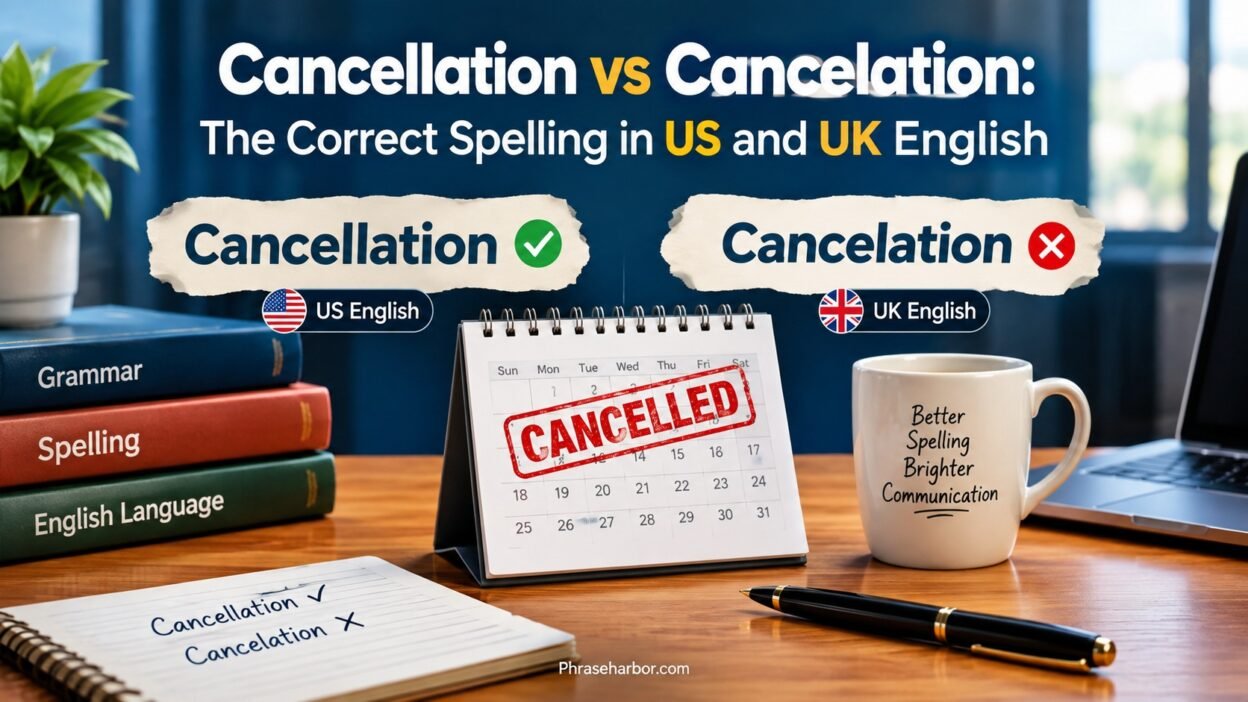
Cancellation vs Cancelation can confuse English learners, but the standard spelling is cancellation in formal writing, emails, reports, and documents. The difference between Cancellation and Cancelation is mainly about spelling and language usage, making this a common question for writers, students, and editors who ask which is correct.
The correct choice is Cancellation, which is the accepted form in both American English and British English, while Cancelation is a rare variant and informal variant. Since both forms look almost identical, people can become confused and make a mix-up.
The truth is that cancellation is the preferred, widely accepted, and correct spelling for professional communication and everyday writing. For example, a client email about flight cancelations may trigger a red squiggle under the word, followed by a reply asking about the spelling. This common spelling question can also appear in articles and formal documents.
Quick Answer
Cancellation is the standard and much more common spelling in both US and UK English. Cancelation is an accepted variant, but it occurs much less often.
If you want the safest spelling for general writing, use cancellation.
Here’s the basic difference:
| Spelling | Status | US English | UK English | General recommendation |
| Cancellation | Standard and widely used | Very common | Very common | Preferred |
| Cancelation | Recognized variant | Less common | Uncommon | Use only when a specific style calls for it |
Both words carry the same meaning. For example:
- The cancellation of the flight caused major delays.
- The cancelation of the flight caused major delays.
The meaning doesn’t change. However, the first sentence will look more familiar to most English readers.
Comparison Overview
The easiest way to understand cancellation vs cancelation is to separate spelling from meaning. They don’t represent two different concepts. Instead, they are two spellings of the same noun.
| Feature | Cancellation | Cancelation |
| Meaning | The act of canceling something | The act of canceling something |
| Number of Ls | Two | One |
| Common in US English | Yes | Less common |
| Common in UK English | Yes | Much less common |
| Formal writing | Widely accepted | Recognized but less familiar |
| Business writing | Very common | Uncommon |
| Meaning difference | None | None |
| Safest general choice | Yes | Usually no |
The important point is that cancelation isn’t simply a typo. It has a documented history as a spelling variant. Still, frequency matters when you’re choosing a form for a broad audience.
Think of it like two roads leading to the same destination. Both spellings point to the same meaning, but cancellation is the road more readers are accustomed to taking.
Main Differences Between Cancellation vs Cancelation
The main difference isn’t meaning. It’s spelling frequency and usage preference.
Cancellation uses two Ls before the ending -ation:
cancel + lation → cancellation
Cancelation uses only one L:
cancel + ation → cancelation
The one-L form can look logical because the base word is cancel. Yet English spelling doesn’t always follow a simple letter-by-letter formula when suffixes are added.
The same issue appears with other forms of cancel. American English commonly uses canceled and canceling, while British English generally uses cancelled and cancelling.
That can make the spelling of cancellation seem as though it should follow the same US/UK split. In actual usage, however, cancellation remains extremely well established in both varieties.
The Meaning Is the Same
There is no standard semantic distinction between cancellation and cancelation.
Both can describe stopping, withdrawing, or calling off something that had been planned, arranged, ordered, or scheduled.
For example:
- The cancellation of the concert disappointed thousands of fans.
- The customer requested cancellation of the subscription.
- We received a cancellation notice yesterday.
- The airline announced the cancellation of several flights.
Replacing cancellation with cancelation doesn’t create a different meaning.
The issue is simply which spelling fits the writing context and audience.
Why Cancellation Is More Familiar
Cancellation has become the dominant spelling in modern general English.
You’ll encounter it in common expressions such as cancellation policy, cancellation fee, cancellation notice, and flight cancellation.
These phrases have become standard parts of business, travel, customer service, and everyday communication.
That familiarity gives cancellation an important practical advantage. Even when cancelation is technically recognized, readers may pause because the one-L spelling looks unusual.
What Does Cancellation Mean?
Cancellation means the act of canceling something.
The verb cancel means to stop something that had been planned, arranged, ordered, or scheduled. The noun cancellation names that action or its result.
For example, imagine that you book a hotel room for Friday. Later, your plans change and you contact the hotel to call off the reservation.
You have made a cancellation.
The word appears in many areas of everyday life.
Common Uses of Cancellation
You can have a:
- flight cancellation
- event cancellation
- appointment cancellation
- reservation cancellation
- subscription cancellation
- order cancellation
- contract cancellation
- class cancellation
- meeting cancellation
- service cancellation
- cancellation request
- cancellation fee
Each phrase refers to stopping something that was previously arranged or expected.
Consider these examples:
The airline sent an email about the flight cancellation.
The doctor’s office received my appointment cancellation.
The company allows subscription cancellation at any time.
A cancellation fee may apply if you cancel within 24 hours.
The word works naturally in all of these situations.
What Does Cancelation Mean?
Cancelation has the same basic meaning as cancellation.
It refers to the act of canceling something or the state resulting from that action.
For example:
The cancelation of the event surprised the audience.
Grammatically, this sentence works. The spelling is not inherently meaningless or impossible.
The problem is familiarity. Many readers expect cancellation, especially in polished professional writing.
As a result, using cancelation can sometimes make a sentence look like it contains a spelling mistake even when the form is recognized.
That’s why writers who want the broadest possible acceptance usually choose cancellation.
Cancellation vs Cancelation in US English
American English creates much of the confusion surrounding these spellings.
American English often drops the second L when adding certain endings to words such as cancel.
For example:
- canceled
- canceling
British English commonly retains the doubled consonant:
- cancelled
- cancelling
You might therefore expect American English to prefer cancelation while British English prefers cancellation.
The reality is less tidy.
Cancellation is widely used in American English despite the common American spellings canceled and canceling. Cancelation does occur in American writing, but it is much less common.
This makes cancellation a useful default even for US audiences.
American Examples
These sentences fit ordinary American English:
- The airline announced the cancellation of the flight.
- I received a cancellation email from the hotel.
- There is no cancellation fee after the first 24 hours.
- The cancellation policy appears on the company’s website.
For the related verb forms, American English normally uses:
- cancel
- canceled
- canceling
So you might write:
The company canceled the event after heavy rain.
But:
The cancellation of the event was announced that morning.
Notice the different spelling patterns. That’s perfectly normal.
Cancellation vs Cancelation in UK English
British English strongly favors cancellation.
British spelling commonly retains the doubled L in related forms:
- cancel
- cancelled
- cancelling
- cancellation
For example:
The cancellation of the train service caused widespread disruption.
And:
The event was cancelled because of severe weather.
This creates a consistent visual pattern in British English.
However, the key point remains that cancellation isn’t exclusively British. American writers use it extensively too.
Why UK Writers Usually Choose Cancellation
British English generally treats the doubled consonant as part of the established spelling pattern for these forms.
The spelling appears naturally in formal notices, newspapers, business correspondence, academic writing, and everyday communication.
If you’re writing specifically for a UK audience, cancellation is therefore the natural choice.
Why Does Cancellation Have Two Ls?
The two-L spelling can seem strange if you focus only on the base word cancel.
The word cancel already ends in l, so adding an ending that begins with a vowel might appear to produce cancelation naturally.
However, English spelling reflects more than a simple mathematical formula. Historical usage, pronunciation, morphology, and regional conventions all influence spelling.
The doubled L in cancellation has become firmly established in standard English.
That’s why you should treat cancellation as a complete established spelling rather than trying to construct it from scratch every time.
Cancellation, Cancelled, and Cancelling
These related forms make the spelling easier to see:
| Form | Common US spelling | Common UK spelling |
| Verb | cancel | cancel |
| Past tense | canceled | cancelled |
| Present participle | canceling | cancelling |
| Noun | cancellation | cancellation |
The table reveals something important.
The US/UK distinction is clear for canceled/cancelled and canceling/cancelling. It isn’t nearly as straightforward for cancellation/cancelation.
That is why saying “one L is always American and two Ls are always British” would be misleading.
Why Is Cancelation Spelled With One L?
The one-L form follows a straightforward visual pattern:
cancel + ation = cancelation
Some dictionaries and language references recognize this form as a variant.
Its existence also reflects a broader tendency in English to simplify doubled consonants in certain contexts.
However, recognition doesn’t mean equal popularity.
A spelling can be legitimate while remaining relatively uncommon. Cancelation is a good example.
If you encounter it in published material, that doesn’t automatically mean the writer made a spelling error. Context matters.
Is Cancelation a Misspelling?
Not necessarily.
Cancelation is a recognized variant spelling. However, calling it “correct” without explaining its limited usage can mislead readers because cancellation is much more widespread.
A useful distinction is:
- Incorrect: a form that doesn’t belong to standard English.
- Variant: an alternative form that has recognized usage.
- Preferred: the form most widely accepted or expected in a particular context.
Cancelation fits the second category. Cancellation is the practical default for most modern writing.
Read More: Piece of Mind or Peace of Mind: Which Is Correct?
Cancellation vs Cancelation Examples
Seeing the words in complete sentences makes the distinction much easier.
Examples With Cancellation
- The cancellation of the match was announced two hours before kickoff.
- Please review our cancellation policy before booking.
- I received a cancellation notice from the airline.
- The hotel charges a cancellation fee for late changes.
- Her appointment cancellation opened a slot for another patient.
- The event cancellation affected hundreds of attendees.
- We requested cancellation of the order before it shipped.
Examples With Cancelation
- The cancelation of the meeting was unexpected.
- The company confirmed the cancelation by email.
- A cancelation fee may apply under the agreement.
These examples demonstrate an important fact: the sentence structure and meaning stay the same.
Only the spelling changes.
Cancellation in Common Expressions
Some combinations appear so often that their standard spelling is worth memorizing.
Cancellation Policy
A cancellation policy explains what happens when a customer cancels a reservation, appointment, service, or order.
Please read the cancellation policy before booking your room.
Cancellation Fee
A cancellation fee is a charge associated with canceling something under specified conditions.
The airline charged a cancellation fee after the deadline.
The exact fee depends on the company’s terms.
Cancellation Notice
A cancellation notice tells someone that an arrangement, service, event, or agreement has been canceled.
The tenant received a cancellation notice before the service ended.
Flight Cancellation
A flight cancellation occurs when an airline does not operate a scheduled flight.
Passengers received messages about the flight cancellation early in the morning.
Subscription Cancellation
A subscription cancellation refers to ending a recurring service.
The app makes subscription cancellation available through the account settings.
Event Cancellation
An event cancellation means that a planned event will no longer take place.
The event cancellation was announced because of dangerous weather conditions.
Across these expressions, cancellation is the spelling most readers will expect.
Cancellation vs Cancelation in Formal Writing
Formal writing rewards clarity and consistency.
If you’re preparing a business document, academic paper, customer notice, policy, or professional email, cancellation is generally the safer choice because it is widely recognized.
That doesn’t mean every appearance of cancelation represents poor writing. It means that the less familiar spelling may distract some readers.
Business Emails
Use cancellation in phrases such as:
Your cancellation request has been received.
Academic Writing
An academic paper might discuss:
The cancellation of the scheduled experiment affected the study timeline.
Customer Service
A company might write:
You can request cancellation of your membership at any time.
Legal or Contractual Writing
Contracts often use established terminology repeatedly. If a contract defines a specific term as cancellation, that spelling should remain consistent throughout the document.
Consistency matters more than switching between variants simply to follow different spelling habits.
Common Spelling Mistakes With Cancel
The confusion doesn’t stop with cancellation.
The word cancel creates several common US/UK spelling differences.
| Form | US English | UK English |
| Base verb | cancel | cancel |
| Past tense | canceled | cancelled |
| -ing form | canceling | cancelling |
| Noun | cancellation | cancellation |
Canceled vs Cancelled
This is a genuine regional spelling difference.
American English usually writes:
The airline canceled the flight.
British English usually writes:
The airline cancelled the flight.
Both forms are standard within their respective varieties.
Canceling vs Cancelling
The same pattern appears with the -ing form.
American English:
The customer is canceling the reservation.
British English:
The customer is cancelling the reservation.
However, neither distinction changes the noun cancellation into an exclusively American or British form.
How to Remember the Correct Spelling
A simple memory trick can save you from repeatedly checking the dictionary.
When you’re unsure, remember:
Cancellation is the common default.
If you’re writing for a general audience, cancellation will usually be the safest choice.
You can also remember the common phrase cancellation policy. It’s one of the places where the spelling appears frequently.
Another useful approach is to separate the noun from the related verb forms:
- canceled — common US spelling
- cancelled — common UK spelling
- canceling — common US spelling
- cancelling — common UK spelling
- cancellation — widely used in both
That distinction prevents an overly simple “one L equals US, two Ls equals UK” rule.
FAQs:
1. Is Cancellation or Cancelation correct?
Cancellation is the standard spelling. It is widely accepted in both American and British English, while cancelation is a rare variant.
2. Why does Cancellation have two L’s?
The spelling cancellation keeps the double L from cancel before adding the suffix -ation. This is the standard form used in modern English.
3. Is Cancelation ever acceptable?
Cancelation can be found in some dictionaries and written sources as a variant, but cancellation is generally the preferred choice, especially in formal and professional writing.
4. Do American and British English use Cancellation?
Yes. Cancellation is the standard spelling in both American English and British English. The spelling does not normally change between these varieties.
5. Which spelling should I use in emails and formal documents?
Use cancellation in emails, reports, articles, applications, and other formal documents. It is the familiar standard spelling and helps you avoid unnecessary spelling confusion.
Conclusion:
When choosing between Cancellation vs Cancelation, cancellation is the standard spelling to use. It is accepted in both American and British English and is the safer choice for everyday, academic, and professional writing. Although cancelation appears as a rare variant, using cancellation keeps your writing clear, consistent, and easy for readers to recognize.