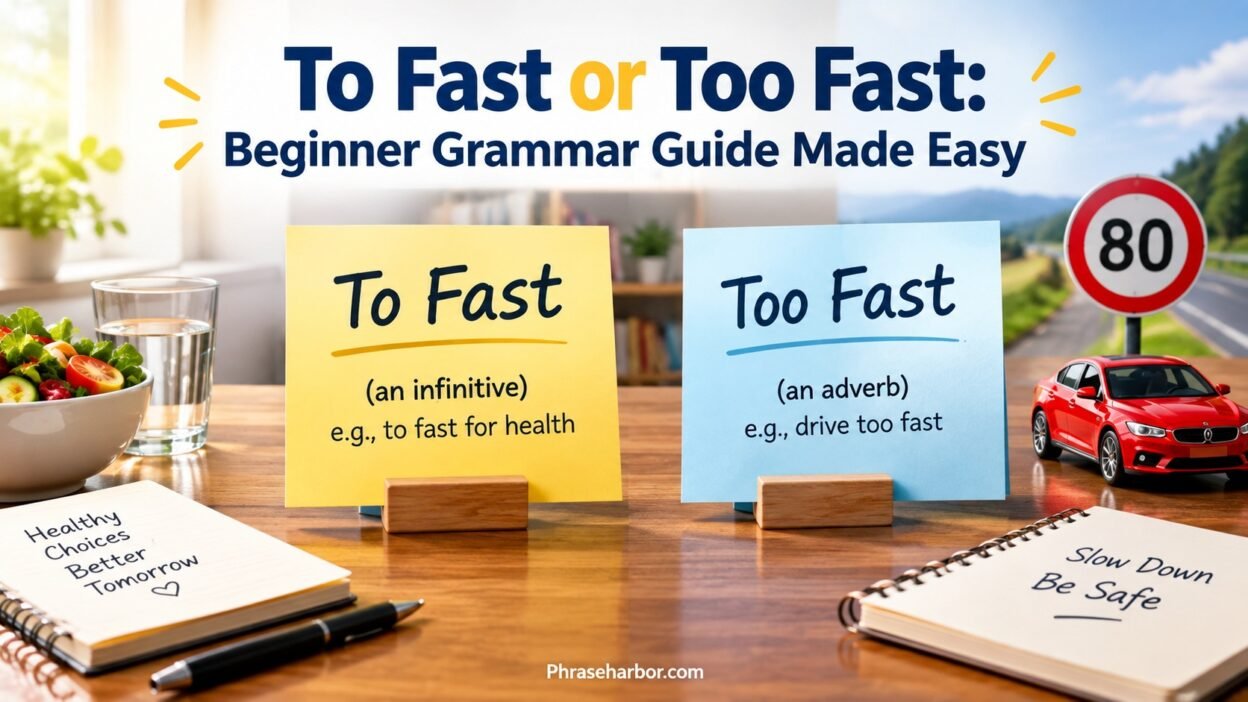
If you’ve ever typed “to fast” when you meant “too fast,” you’re not alone. This tiny spelling difference causes a surprisingly common grammar mistake. The words to and too sound alike in everyday speech, yet they perform completely different jobs in a sentence.
The confusion becomes even more interesting because “to fast” can actually be grammatically correct. In that phrase, fast works as a verb that means to deliberately avoid eating. Meanwhile, too fast describes something moving, happening, speaking, or progressing at an excessive speed.
That means the right choice depends entirely on what you want to say. Are you talking about speed, or are you talking about fasting? Once you identify the intended meaning, the difference becomes much easier to understand.
Whether you’re writing an email, checking a sentence, preparing an article, or simply trying to improve your everyday English, this guide will help you tell to fast vs. too fast apart without guesswork.
Quick Answer
“Too fast” is correct when you mean that something happens at a speed that is greater than appropriate, comfortable, safe, or desired.
For example:
- You’re driving too fast.
- She talks too fast.
- The video is playing too fast.
- He runs too fast for me to keep up.
“To fast” is correct when fast functions as a verb meaning to abstain from food.
For example:
- I decided to fast tomorrow.
- She plans to fast during the day.
- They chose to fast for religious reasons.
So, the easiest rule is:
Too fast = excessive speed or pace.
To fast = to abstain from food.
If you mean that someone is moving at an excessive speed, write too fast, not to fast.
Comparison Overview
The easiest way to understand to fast or too fast is to compare the grammatical jobs each phrase performs. Although the phrases sound similar, their meanings are completely different.
| Expression | Meaning | Grammar | Example |
| to fast | To abstain from food | Infinitive verb phrase | I decided to fast tomorrow. |
| too fast | At an excessive speed or pace | Adverbial phrase | You’re driving too fast. |
| fast | At high speed | Adverb | She runs fast. |
| very fast | At a high speed | Adverbial phrase | The train moves very fast. |
| two | The number 2 | Number | I have two apples. |
The important distinction is that to introduces the verb fast in to fast. In contrast, too modifies fast in too fast.
That one grammatical difference changes the entire meaning.
Main Differences Between To Fast or Too Fast
The main difference between to fast and too fast comes down to the meaning of fast and the function of to or too.
“To Fast” Means to Abstain From Food
In to fast, the word fast acts as a verb. It means deliberately going without food for a period of time.
For example:
- I want to fast tomorrow.
- She decided to fast during the day.
- They plan to fast for religious reasons.
- He chose to fast before the ceremony.
Here, to isn’t describing excessive speed. Instead, it introduces the base form of the verb fast.
You can think of the construction in the same way as other infinitives:
- to eat
- to sleep
- to walk
- to study
- to fast
The word to connects naturally with a verb in its base form.
“Too Fast” Means Excessive Speed
In too fast, the word too means more than is appropriate, desirable, necessary, or manageable.
For example:
- You’re driving too fast.
- He speaks too fast.
- The children are running too fast.
- This machine is moving too fast.
Here, fast usually works as an adverb. It tells you about the speed of an action.
The word too adds the idea of excess. Someone doesn’t merely speak fast. They speak faster than the listener can comfortably follow.
That’s an important distinction.
The Meaning Changes With One Letter
Consider these two sentences:
I want to fast tomorrow.
You’re walking too fast.
They sound similar when spoken quickly. However, they describe completely unrelated situations.
The first sentence concerns not eating. The second concerns speed.
This is why spelling matters even when two words sound alike.
What Does “To Fast” Mean?
To fast means to deliberately abstain from food. The verb fast has a long history in English and commonly appears in religious, cultural, and personal contexts.
When you put to before it, you create an infinitive phrase.
For example:
- I hope to fast tomorrow.
- She wants to fast during the day.
- They decided to fast together.
- He plans to fast for a religious observance.
Notice what happens if you replace fast with another verb:
- I want to study.
- I want to sleep.
- I want to travel.
- I want to fast.
The grammar follows the same pattern.
Common Structures With “To Fast”
You’ll often see to fast after verbs that express plans, choices, intentions, or desires.
| Pattern | Example |
| want + to fast | I want to fast tomorrow. |
| decide + to fast | She decided to fast. |
| plan + to fast | They plan to fast during the day. |
| choose + to fast | He chose to fast. |
| hope + to fast | I hope to fast this week. |
| prepare + to fast | They prepared to fast for the observance. |
The key is simple: if fast means deliberately avoiding food, to fast can be perfectly correct.
What Does “Too Fast” Mean?
Too fast means at a speed or pace that exceeds what is appropriate for the situation.
The phrase can describe physical movement, speech, reading, work, technology, or the pace of an event.
For example:
- You’re driving too fast.
- She talks too fast for beginners.
- This lesson is moving too fast.
- He reads too fast and misses details.
- The water is flowing too fast.
The exact problem depends on the context.
A car can move too fast for a road. A speaker can talk too fast for an audience. A teacher can explain something too fast for a beginner.
“Too” Adds the Idea of Excess
Compare these sentences:
She runs fast.
She runs very fast.
She runs too fast.
Each sentence gives a slightly different message.
She runs fast simply describes her speed.
She runs very fast emphasizes that her speed is high.
She runs too fast suggests that her speed exceeds some useful or acceptable level.
That last word makes a major difference.
To vs. Too: The Core Grammar Rule
The words to and too look and sound similar, but they have different grammatical functions.
How “To” Works
To commonly functions as a preposition or as part of an infinitive.
Examples include:
- We went to school.
- Give the book to Sarah.
- I want to learn.
- They decided to leave.
In to fast, to introduces the base verb fast.
How “Too” Works
Too is an adverb. It commonly has two major meanings.
The first meaning involves excess:
- This bag is too heavy.
- You’re talking too loudly.
- The car is moving too fast.
The second meaning means “also”:
- I want to come too.
- She likes coffee too.
When too appears before fast, it expresses excessive speed or pace.
To, Too, and Two: Don’t Mix Them Up
English has several commonly confused words that sound alike. To, too, and two are classic examples.
To
Use to for direction, relationships, or infinitives.
- I went to work.
- Give it to me.
- I want to eat.
Too
Use too for excess or to mean “also.”
- That’s too expensive.
- You’re moving too fast.
- I want one too.
Two
Use two when referring to the number 2.
- I have two dogs.
- She bought two books.
- We waited two hours.
A quick memory trick can help:
Two = a number.
Too = more than enough or also.
To = direction or an infinitive marker.
When Should You Use “To Fast”?
Use to fast when fast means deliberately abstaining from food.
The phrase often appears after another verb.
For example:
- I decided to fast.
- She wants to fast tomorrow.
- They plan to fast during the day.
- He chose to fast for religious reasons.
Here’s a useful test. Replace fast with eat.
If the sentence still follows the same grammatical structure, you’re probably dealing with an infinitive.
For example:
I decided to fast.
Compare:
I decided to eat.
Both sentences use to + base verb.
The meaning changes, but the grammatical structure remains intact.
When Should You Use “Too Fast”?
Use too fast when you want to describe excessive speed or pace.
For example:
- You’re driving too fast.
- She walks too fast.
- He speaks too fast.
- The train is moving too fast.
- The story develops too fast.
The phrase isn’t limited to physical movement.
You can use it for almost anything involving pace.
Too Fast Can Describe Speech
A person might speak clearly yet still speak too fast.
For example:
The teacher explains the material too fast for new students.
Here, too fast doesn’t necessarily mean the teacher speaks unusually quickly in an absolute sense. It means the pace is too quick for that particular audience.
Too Fast Can Describe Reading
You might also say:
He reads too fast and misses important details.
The problem isn’t necessarily that reading quickly is always bad. The issue is that the speed causes mistakes or missed information in that situation.
“Fast” Can Have Several Grammatical Roles
One reason to fast vs. too fast can confuse learners is that fast has several grammatical uses.
Fast as an Adverb
As an adverb, fast describes speed.
- She runs fast.
- He drives fast.
- The horse moves fast.
Fast as an Adjective
As an adjective, fast can describe something capable of high speed.
- That’s a fast car.
- We bought a fast computer.
- He owns a fast motorcycle.
Fast as a Verb
As a verb, fast means to abstain from food.
- They fast during the observance.
- She fasts regularly.
- He decided to fast.
This is the grammatical key behind the phrase to fast.
When fast means abstaining from food, it’s a verb. When fast describes speed, it commonly acts as an adjective or adverb depending on the sentence.
Too Fast vs. Very Fast
Many learners understand very fast but struggle to see why too fast has a different meaning.
Compare these examples:
| Phrase | Meaning | Example |
| fast | At high speed | She runs fast. |
| very fast | At a notably high speed | She runs very fast. |
| too fast | Faster than appropriate | She runs too fast for me. |
| so fast | To such a high degree or speed | She runs so fast. |
The important word is too.
When someone says, “The car is very fast,” they may simply admire its speed.
When someone says, “The car is too fast,” they suggest that its speed creates a problem in the situation.
That’s why too often carries an implied limit.
Read More: Shown vs Showed: What’s the Difference? Easy Examples
Common “To Fast” and “Too Fast” Mistakes
These mistakes usually happen because to and too sound almost identical.
Mistake: “You Are Driving to Fast”
Incorrect:
You are driving to fast.
Correct:
You are driving too fast.
The sentence concerns excessive driving speed. Therefore, too is the correct word.
Mistake: “He Talks To Fast”
Incorrect:
He talks to fast.
Correct:
He talks too fast.
The sentence says his speaking pace is excessive.
Mistake: “I Want Too Fast”
Incorrect if the intended meaning is abstaining from food:
I want too fast.
Correct:
I want to fast.
Here, fast functions as a verb. The infinitive requires to.
Mistake: “She Decided Too Fast”
This sentence can actually be grammatically correct, but it means something different.
She decided too fast.
Here, too fast means she made the decision excessively quickly.
Compare that with:
She decided to fast.
Now the meaning changes completely. She decided to abstain from food.
This is an excellent example of why you shouldn’t choose to or too simply by looking at the word fast. You must examine the entire sentence.
To Fast or Too Fast in Different Contexts
Driving and Transportation
When discussing excessive speed, use too fast.
You’re driving too fast.
The bus is going too fast.
That motorcycle is moving too fast.
The phrase indicates that the speed has crossed an appropriate limit for the situation.
Speaking and Reading
Use too fast when someone’s pace makes communication or comprehension difficult.
You’re speaking too fast.
He reads too fast.
The instructor moved through the lesson too fast.
In each case, fast relates to pace rather than fasting.
Fasting
Use to fast when the verb means abstaining from food.
I plan to fast tomorrow.
She decided to fast during the observance.
They chose to fast together.
Here, to forms an infinitive with the verb fast.
Everyday Conversation
The context usually tells you which phrase makes sense.
Imagine someone sitting in a car and saying:
You’re going too fast.
Nobody would interpret that as a comment about fasting. The context clearly concerns speed.
Now imagine someone saying:
I decided to fast tomorrow.
The surrounding verb decided signals an infinitive construction. The meaning clearly concerns abstaining from food.
Context is your best guide.
Is “To Fast” Ever Correct?
Yes. To fast is completely grammatical when fast functions as a verb meaning to abstain from food.
Examples include:
- I want to fast tomorrow.
- She decided to fast.
- They plan to fast during the day.
- He hopes to fast this week.
The mistake occurs when someone writes to fast while actually intending to describe excessive speed.
For example:
The driver was going to fast.
If the intended meaning is excessive speed, the correct version is:
The driver was going too fast.
However, punctuation and context can sometimes change interpretation.
Consider:
The driver was going to fast.
Without context, a reader may initially see going to as an infinitive construction. That’s one reason too fast should be spelled carefully when discussing speed.
FAQs:
Is “to fast” grammatically correct?
Yes. To fast is grammatically correct when fast functions as a verb meaning to abstain from food.
For example:
She decided to fast tomorrow.
The word to introduces the base verb fast.
Is “too fast” grammatically correct?
Yes. Too fast is correct when you mean that something happens at an excessive speed or pace.
For example:
You’re driving too fast.
The word too modifies fast and indicates excess.
Is “to fast” the same as “too fast”?
No. They have different meanings.
To fast means to abstain from food.
Too fast means faster than appropriate, desired, safe, or manageable in a particular context.
How do I remember “to fast” vs. “too fast”?
Use this simple rule:
Too = more than enough.
Therefore, too fast means faster than necessary or appropriate.
Meanwhile, to fast contains the verb fast, meaning to abstain from food.
Should I say “driving to fast” or “driving too fast”?
Say driving too fast when you mean excessive speed.
Correct:
You’re driving too fast.
Incorrect for that meaning:
You’re driving to fast.
Conclusion:
When you’re unsure, look at the sentence around fast. If you’re talking about an action someone intends to perform, to fast may be the right choice. If you’re talking about speed that’s beyond an appropriate level, too fast is the form you need. Once you connect too with excess and to with the infinitive verb, this common grammar trap becomes much easier to avoid.