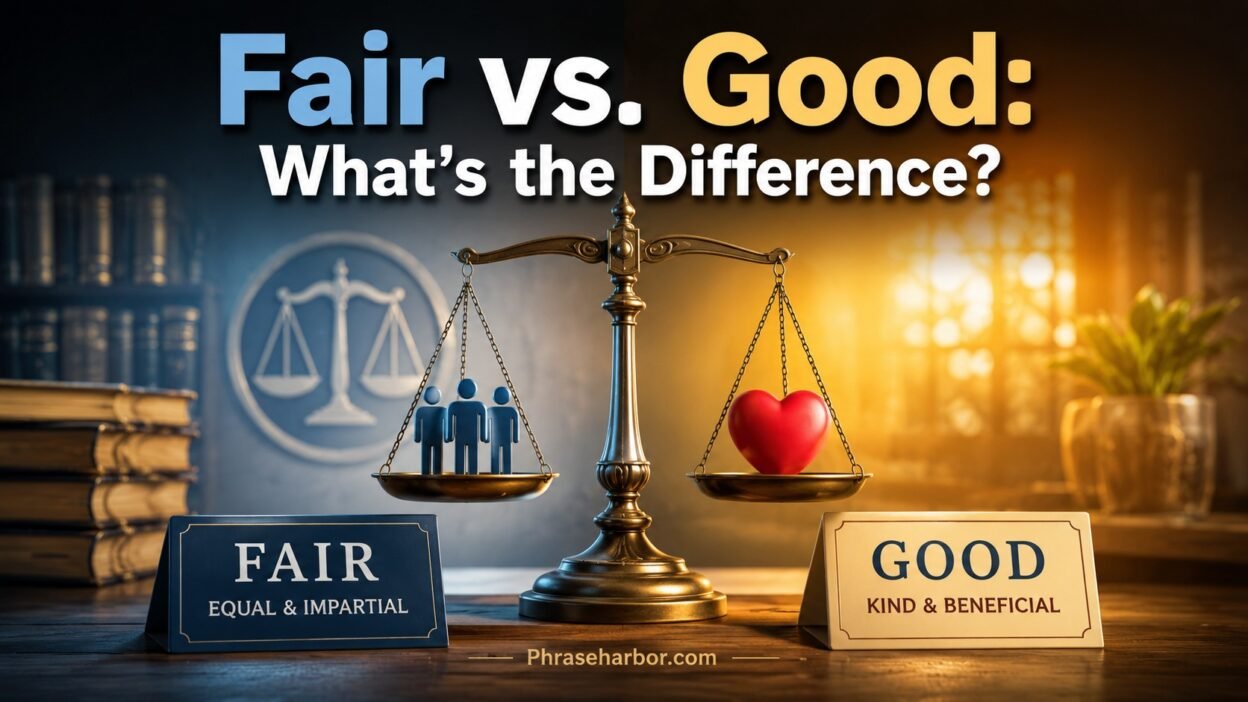
The words fair and good often appear close together when people describe quality, performance, condition, prices, or results. They can seem interchangeable at first. However, they don’t always communicate the same idea.
When someone says, “The service was fair,” they usually give a more restrained assessment than someone who says, “The service was good.” In a quality rating, fair generally sits below good. Yet “fair” has several other meanings that have nothing to do with quality. It can describe something as just, impartial, reasonable, or even light in color.
That difference matters because choosing between fair vs. good can change the message you send. Calling a used car “fair” suggests that it remains usable but has noticeable shortcomings. Calling the same car “good” creates a more favorable impression. Likewise, a “fair price” means a reasonable price while a “good price” usually suggests a particularly attractive deal.
Quick Answer
Fair and good are not exact synonyms.
When the words describe quality, good is generally better than fair. Fair usually means acceptable, adequate, or average. Good normally means satisfactory, solid, or clearly positive.
A simple quality scale looks like this:
Poor → Fair → Good → Very Good → Excellent
However, this scale only works when fair describes quality.
The word fair can also mean:
- Just or impartial: a fair decision
- Reasonable: a fair price
- Equitable: a fair distribution
- Considerable: a fair amount of time
- Light in color: fair hair
So the meaning depends heavily on context.
A useful rule is:
Fair usually means acceptable or reasonable, while good usually expresses a more positive judgment.
For example:
- “The restaurant was fair.” → It was acceptable but didn’t impress the speaker.
- “The restaurant was good.” → The speaker had a positive opinion of it.
- “The restaurant charged a fair price.” → The price seemed reasonable.
- “The restaurant offered a good price.” → The price seemed especially favorable.
Comparison Overview
The easiest way to understand fair vs. good is to compare their typical meanings side by side.
| Category | Fair | Good |
| Quality | Acceptable or average | Positive or satisfactory |
| Overall tone | Neutral or mildly positive | Clearly positive |
| Praise | Limited | Stronger |
| Performance | Adequate | Solid |
| Condition | Usable but may have noticeable flaws | Generally sound |
| Price | Reasonable or appropriate | Favorable or attractive |
| Justice | Just or impartial | Usually doesn’t express this meaning |
| Recommendation | Qualified | More positive |
| Typical quality position | Below good | Above fair |
The distinction becomes clearer when you imagine receiving feedback.
If your manager says, “You did a fair job,” you probably won’t hear it as enthusiastic praise. The comment suggests that you met some expectations but still have room to improve.
If the manager says, “You did a good job,” the message changes. You have received clear approval.
Neither word automatically describes something as excellent. Good still leaves room for improvement, while fair usually signals a more limited level of satisfaction.
Main Differences Between Fair vs. Good
The biggest difference between fair and good appears when both words describe quality. They communicate different levels of approval.
Fair Usually Means Acceptable
When fair describes quality, it often means something meets a reasonable standard without standing out.
Consider this sentence:
The laptop is in fair condition.
A reader might expect the laptop to work, but they may also expect visible wear, cosmetic damage, an older battery, or other shortcomings.
Now compare it with:
The laptop is in good condition.
That description creates a stronger impression. The laptop probably works well and has fewer significant problems.
The exact meaning still depends on context. A seller, marketplace, school, employer, or reviewer may define rating categories differently.
Good Usually Signals Stronger Approval
Good generally communicates a favorable judgment.
You might say:
- She gave a good presentation.
- The food was good.
- He achieved good results.
- The computer has good performance.
- The student made good progress.
In each case, the speaker expresses approval.
That doesn’t mean the subject is exceptional. A good presentation can still contain a few weak slides. A good meal can still have one disappointing dish. A good result can still fall short of the best possible result.
The important point is that good is normally more positive than fair.
Fair Often Sounds More Cautious
The emotional difference between these words can be subtle.
Imagine asking a friend:
“How was the movie?”
They answer:
“It was fair.”
That response sounds cautious. You probably wouldn’t expect a strong recommendation.
Now imagine:
“It was good.”
You’d likely assume they enjoyed it and might recommend it.
This difference makes fair useful when you want to acknowledge something without giving it strong praise.
Good Usually Gives a Stronger Recommendation
A product described as fair may be worth considering if the price is right. A product described as good usually sounds like a safer recommendation.
This distinction becomes especially important in reviews.
For example:
- Fair headphones: They work adequately but may have noticeable limitations.
- Good headphones: They provide a satisfying overall experience.
- Excellent headphones: They perform at a particularly high level.
The words create expectations even when no numerical score appears.
What Does “Fair” Mean?
The word fair has several meanings in modern English. Understanding them prevents one of the most common mistakes: assuming that fair always means “average.”
Fair as a Quality Rating
When fair describes quality, it generally means acceptable, adequate, or average.
Examples include:
- The house is in fair condition.
- His performance was fair.
- The service was fair.
- The product received a fair rating.
In these examples, the speaker isn’t necessarily saying something is bad. Instead, they’re limiting their praise.
A fair result may meet minimum expectations while falling short of a stronger standard.
Fair as Just or Impartial
This meaning is completely different.
Consider:
The referee made a fair decision.
Here, fair means just or impartial. It doesn’t mean the decision was “average.”
You might also hear:
- fair treatment
- fair competition
- a fair trial
- a fair opportunity
- a fair distribution
In these expressions, replacing fair with good usually changes the meaning.
For example, good competition can describe enjoyable or high-quality competition. Fair competition means competitors have an equitable opportunity and aren’t gaining an improper advantage.
Fair as Reasonable
Another common meaning appears when people discuss prices, offers, or agreements.
That’s a fair price.
This means the price seems reasonable or appropriate for what is being offered.
It doesn’t necessarily mean the price is cheap.
Suppose a used laptop normally sells for $700 and a seller asks $650. A buyer might call that a fair price because the amount seems reasonable.
A good price, however, may suggest a better bargain. Perhaps the seller offers the same laptop for $500.
That’s why fair price vs. good price deserves careful attention.
Fair as a Considerable Amount
In some expressions, fair can mean a reasonably large or substantial amount.
For example:
We spent a fair amount of time researching the issue.
Here, fair doesn’t mean mediocre quality. It means a considerable or reasonably substantial amount.
This use demonstrates why context matters so much when interpreting the word.
Fair as a Description of Color
Fair can also describe light coloring.
Examples include:
- fair hair
- fair skin
- fair complexion
This meaning has nothing to do with the quality scale from poor to excellent.
What Does “Good” Mean?
Good is one of the most flexible words in English. People use it to describe quality, performance, behavior, usefulness, results, experiences, and many other things.
Good as a Quality Judgment
When someone calls something good, they generally consider it satisfactory or desirable.
Examples:
- a good book
- a good restaurant
- a good product
- a good performance
- a good result
The word gives the reader a positive signal.
Good Doesn’t Mean Perfect
A common mistake is to treat good as if it means “excellent.”
It doesn’t.
Consider this scale:
Poor → Fair → Good → Very Good → Excellent
Good occupies a positive position, but stronger words remain available.
That distinction helps writers give accurate feedback. If a student’s work meets expectations and contains several strong ideas, good may fit. If the work is outstanding and unusually polished, excellent may communicate the result better.
Fair vs. Good in Common Contexts
Context can change how people interpret these words. The following examples show why a direct dictionary definition isn’t always enough.
Fair vs. Good Condition
Condition ratings appear frequently in descriptions of cars, electronics, furniture, clothing, houses, and other physical goods.
Fair condition generally suggests that an item remains usable but has noticeable wear, flaws, or limitations.
Good condition usually suggests that the item remains in sound overall shape with fewer significant problems.
For example:
| Description | Likely impression |
| Poor condition | Significant problems or heavy deterioration |
| Fair condition | Usable but noticeable wear or flaws |
| Good condition | Generally sound with moderate or minor wear |
| Excellent condition | Very little wear and unusually strong overall condition |
These descriptions aren’t universal grading standards. A marketplace may define its categories differently. Always check the specific platform’s condition guidelines when buying or selling something.
Fair vs. Good Performance
The difference becomes obvious in performance reviews.
His performance was fair.
This suggests that he achieved an acceptable result but didn’t perform especially well.
His performance was good.
This indicates stronger competence and a more favorable outcome.
The same distinction applies to:
- academic work
- athletic performance
- employee reviews
- presentations
- sales results
- customer service
If you want to praise someone clearly, good is usually the safer choice.
Fair vs. Good Service
Customer feedback often relies on these words.
Fair service suggests that the experience was acceptable but had shortcomings.
Good service suggests that the customer generally felt satisfied.
For example:
The staff were polite, but the wait was long. I’d describe the service as fair.
versus:
The staff were helpful and the food arrived quickly. The service was good.
The second statement gives a noticeably stronger endorsement.
Fair vs. Good Price
These phrases look similar but communicate different ideas.
Fair price means a price that seems reasonable based on the product, market, quality, or circumstances.
Good price often means a price that seems particularly favorable.
Consider a used phone:
- Market value: $600
- Seller’s price: $575 → potentially a fair price
- Seller’s price: $450 → potentially a good price
A fair price isn’t necessarily a bargain. That’s the key distinction.
Fair vs. Good Chance
Here, neither word describes quality.
You have a fair chance of winning.
This means you have a reasonable possibility.
You have a good chance of winning.
This usually suggests a relatively strong possibility.
The words therefore express different degrees of likelihood rather than different levels of quality.
Fair vs. Good Job
Workplace feedback makes the tonal difference especially clear.
You did a fair job.
This can sound like restrained approval. The person probably met some basic expectations.
You did a good job.
This communicates clearer praise.
Because feedback affects how people interpret their performance, choosing the right adjective matters. If the work genuinely deserves praise, good communicates that more clearly.
Read More: Leotard vs. Tights: A Complete Guide to Choosing the Right Dancewear
Fair vs. Good: Real Sentence Examples
Paired examples make the difference easier to remember.
Quality
- The hotel was fair.
- The hotel was good.
The first sounds like mild approval. The second sounds more positive.
Condition
- The bicycle is in fair condition.
- The bicycle is in good condition.
The first suggests more wear or limitations.
Performance
- Her test performance was fair.
- Her test performance was good.
The second suggests stronger results.
Price
- The seller offered a fair price.
- The seller offered a good price.
The first means reasonable. The second suggests a favorable deal.
Justice
- The decision was fair.
- The decision was good.
These sentences aren’t equivalent. Fair can mean just or impartial, while good gives a broad positive judgment.
Opportunity
- Everyone deserves a fair chance.
- He has a good chance of winning.
The first concerns equal opportunity. The second concerns probability.
Fair vs. Good on a Rating Scale
Many people understand the difference best when the words appear on a quality scale.
| Rating | General meaning | Typical reaction |
| Poor | Below an acceptable standard | Negative |
| Fair | Acceptable but limited | Neutral or cautious |
| Good | Solid and satisfactory | Positive |
| Very Good | Clearly above good | Strongly positive |
| Excellent | Outstanding | Very strongly positive |
This scale isn’t an official universal standard. Different companies and institutions can define their ratings differently.
Still, it provides a useful general framework for everyday English.
Why “Fair” Often Feels Less Positive
The word fair can imply that something has passed a basic threshold but hasn’t gone much further.
Imagine grading five versions of the same product:
- Poor: difficult to recommend
- Fair: usable but has clear shortcomings
- Good: dependable and satisfactory
- Very good: strong overall performance
- Excellent: outstanding performance
The gap between fair and good isn’t always dramatic. However, the tone and expectation change noticeably.
Common Mistakes With Fair and Good
Treating Fair and Good as Exact Synonyms
Although both can describe something acceptable, they don’t normally express the same degree of approval.
Calling a product good usually gives it a stronger endorsement.
Assuming Fair Always Means Bad
This interpretation goes too far.
Something described as fair may still be perfectly usable. It simply doesn’t receive the same level of praise as something described as good.
Assuming Fair Always Means Average
This is another common error.
Consider:
The company offered a fair contract.
Here, fair means reasonable or equitable, not average.
Likewise:
The judge gave everyone a fair hearing.
Again, the meaning concerns impartiality and justice.
Using Fair When You Want to Give Strong Praise
If you genuinely want someone to understand that their work was successful, fair may undersell your opinion.
Compare:
- Fair work
- Good work
- Very good work
- Excellent work
Each phrase carries a different level of praise.
Treating Rating Systems as Universal
A company might define fair condition differently from another company.
One marketplace could consider moderate cosmetic wear fair. Another might reserve fair for items with more serious defects.
For that reason, always read the rating criteria when a formal grading system matters.
FAQs:
Is fair better than good?
When both words describe quality, good generally ranks above fair. Fair usually indicates an acceptable or average level while good communicates stronger approval.
Is fair the same as good?
No. The words can overlap in some contexts, but they normally express different degrees of approval. Fair can also mean just, impartial, or reasonable.
What does fair mean in a rating?
In a quality rating, fair usually means acceptable, adequate, or average. It often suggests that something has noticeable limitations.
What does good mean in a rating?
Good generally indicates solid, satisfactory, or favorable quality. It normally represents a stronger evaluation than fair.
Is fair a positive word?
It depends on the context. When describing quality, fair is often neutral or mildly positive. When describing justice, fair can be strongly positive because it means just or impartial.
Conclusion:
The difference between fair vs. good becomes much easier once you separate quality from the other meanings of fair. When fair describes quality, it usually means acceptable, adequate, or average. It doesn’t necessarily mean bad. It simply offers less praise than good. When good describes quality, it generally communicates a positive and satisfactory result. It still doesn’t mean perfect or excellent.