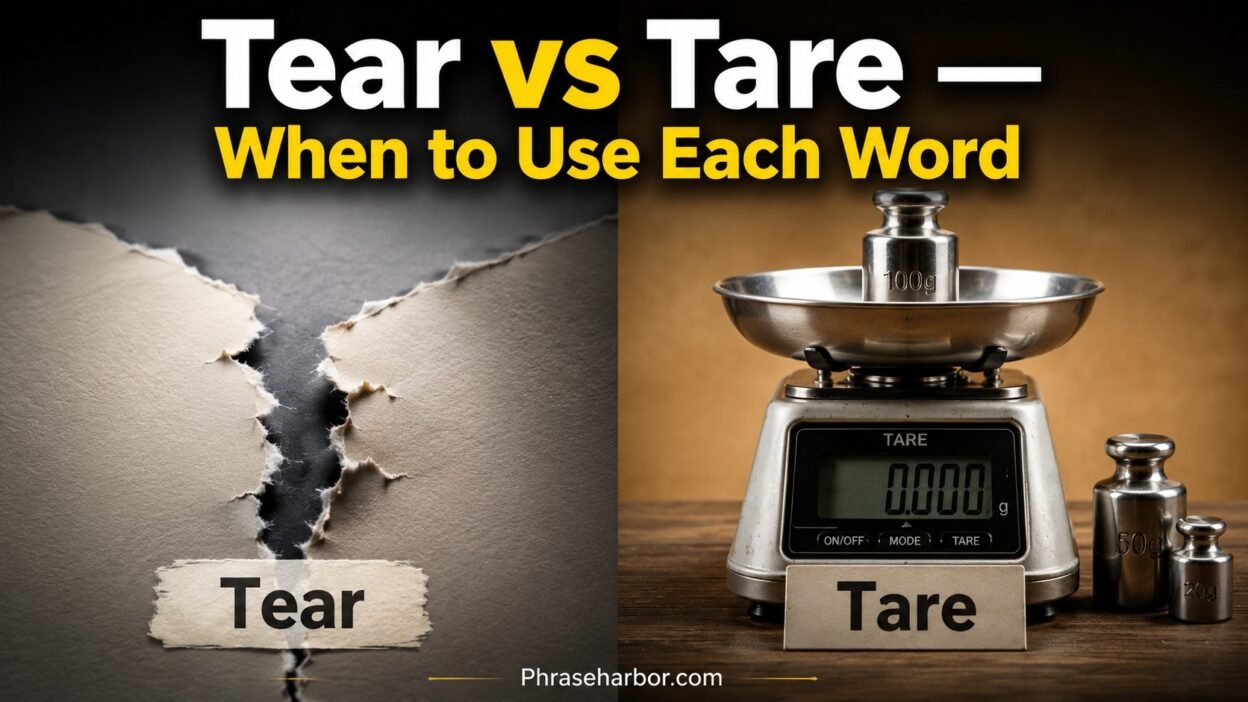
Tear vs Tare can be confusing because the words sound alike, but tear means ripping or crying, while tare relates to weight and containers. Tear works as a noun or verb and can describe a rip, ripping, or damage to paper and fabric caused by force.
It can also mean liquid from the eye during crying. In some contexts, tear may describe a rampage or erratic behavior. Knowing its pronunciation, spelling, grammar, and usage helps you choose the right word in writing.
Tare, however, is used when discussing weight, mass, packaging, containers, scales, and weighing goods. The weight of an empty container is subtracted from the gross weight to find the net weight. At a market or when adjusting a scale, understanding the meaning and uses of tare helps you select the correct word.
Quick Answer
Tear and tare are different words with different meanings.
- Tear means to rip, pull apart, or damage something.
- Tear can also mean a drop of liquid produced by the eye.
- Tare means the weight of an empty container or packaging.
- Tare can also mean to set a weighing scale to zero while accounting for the container’s weight.
Here are three quick examples:
Tear the paper into two pieces.
A tear rolled down her cheek.
Press the tare button before weighing the ingredients.
A useful memory trick is simple:
Tear = rip or cry. Tare = weigh.
Comparison Overview
| Feature | Tear | Tare |
| Main meaning | Rip or pull apart | Weight of a container |
| Another meaning | Liquid from the eye | Adjust a scale to exclude container weight |
| Part of speech | Noun and verb | Noun and verb |
| Common context | Everyday English, emotions, clothing, paper | Weighing, shipping, cooking, packaging |
| Pronunciation | “Tair” for rip; “teer” for eye liquid | “Tair” |
| Example | Don’t tear the page. | Check the tare weight. |
| Past tense as a verb | Tore | Tared |
| Past participle | Torn | Tared |
The biggest difference is the subject matter. Tear usually involves ripping or the eyes, while tare usually involves measurement and weight.
If you’re holding a sheet of paper and pulling it apart, you tear it. If you’re placing an empty bowl on a kitchen scale and pressing a button before adding flour, you tare the scale.
Main Differences Between Tear vs Tare
The easiest way to understand tear vs tare is to look at what each word actually describes.
Tear Means to Rip or Pull Something Apart
As a verb, tear means to pull something apart, split it, or damage it by force.
For example:
- Tear the paper along the dotted line.
- Be careful not to tear your shirt.
- She tore the envelope open.
- The child accidentally tore the page.
- Strong winds tore the sign from the wall.
The past tense is important here. The past tense of tear in this sense is tore, not “teared.”
The past participle is torn:
- The paper was torn.
- His jacket is torn.
- She has torn the wrapping paper.
This makes tear an irregular verb.
Tear Also Means a Drop From the Eye
Tear has another completely different meaning as a noun. It describes the liquid produced by your eyes.
For example:
- A tear appeared in her eye.
- One tear rolled down his cheek.
- He wiped away a tear.
- Her eyes filled with tears.
- The emotional speech brought tears to his eyes.
This meaning has nothing to do with ripping. The spelling happens to be the same, but the pronunciation changes.
When referring to eye liquid, tear is pronounced like “teer.”
That gives English learners an important distinction:
- Tear = rip → sounds like “tair”
- Tear = eye liquid → sounds like “teer”
Tare Refers to Weight
Tare has a much narrower meaning. It commonly appears when people measure the weight of an object, especially when that object contains something else.
The tare weight is the weight of the empty container or packaging.
For example, imagine a box containing coffee beans.
- Empty box: 1 kg
- Coffee beans: 9 kg
- Box plus beans: 10 kg
The tare weight is 1 kg.
The net weight is 9 kg.
The gross weight is 10 kg.
The relationship can be shown simply:
Gross weight − Tare weight = Net weight
So:
10 kg − 1 kg = 9 kg
This terminology matters in industries where products are bought, sold, shipped, or measured by weight.
Tare Can Also Be a Verb
Tare isn’t only a noun. It can also function as a verb.
When you tare a scale, you adjust the scale so it excludes the weight of the container.
For example, suppose you’re baking cookies and place an empty mixing bowl on a digital scale. The bowl weighs 800 grams. You don’t want those 800 grams included in your flour measurement.
You press the tare button.
The scale then displays zero, even though the bowl is still sitting on it.
Now you add flour. If the scale shows 500 grams, that measurement represents the flour rather than the combined weight of the bowl and flour.
That’s what tare means in this context.
What Does “Tear” Mean?
The word tear has several uses, so context matters.
Tear as a Verb
The most familiar verb meaning is to rip or pull something apart.
You might tear:
- Paper
- Cloth
- Plastic
- Cardboard
- A letter
- A page
- Wrapping paper
- A shirt
- A poster
Consider this sentence:
Please don’t tear the document.
Here, tear clearly means to damage or separate the document by pulling it apart.
The verb has several important forms:
| Form | Word | Example |
| Base form | tear | Don’t tear the paper. |
| Present participle | tearing | She is tearing the paper. |
| Past tense | tore | He tore the envelope. |
| Past participle | torn | The envelope was torn. |
A common mistake is writing teared when the intended meaning is “ripped.”
For standard English, say:
She tore the paper.
Not:
She teared the paper.
Tear as a Noun
When tear refers to eye liquid, it is a noun.
For example:
A tear fell from his eye.
You can use both singular and plural forms:
- a tear
- one tear
- several tears
- many tears
The word frequently appears in emotional writing.
Examples include:
- She fought back a tear.
- His eyes filled with tears.
- A single tear ran down her face.
- The story brought tears to his eyes.
However, tears aren’t produced only because of sadness. Your eyes naturally produce tears to keep them lubricated and protected. You can also tear up because of happiness, laughter, pain, irritation, wind, smoke, or other physical causes.
What Does “Tare” Mean?
Unlike tear, the word tare is strongly associated with weighing and measurement.
Tare as a Noun
A tare is the weight of a container or packaging that must be excluded when determining the weight of its contents.
This concept is especially useful when the container itself contributes to the total measurement.
Imagine a jar filled with honey.
The scale shows:
1.5 kg
But the empty jar weighs:
0.4 kg
The honey therefore weighs:
1.5 kg − 0.4 kg = 1.1 kg
The 0.4 kg is the tare weight.
This distinction becomes important in commercial transactions. A product may be packaged in a bottle, box, bag, drum, or other container. Measuring only the total weight doesn’t tell you how much of the actual product is present.
Tare as a Verb
As a verb, tare means to adjust a scale to account for the weight of a container.
A common example is a kitchen scale.
Suppose you want to measure 250 grams of sugar.
You put an empty bowl on the scale and press tare. The display goes back to zero. Then you add sugar until the scale reaches 250 grams.
You don’t have to calculate the bowl’s weight manually.
That small button can save a surprising amount of hassle.
Tear vs Tare Pronunciation
Pronunciation is one reason this pair causes confusion.
Tear Meaning “Rip”
When tear means to rip or pull apart, it is pronounced like “tair.”
Example:
Don’t tear the paper.
The pronunciation rhymes roughly with words such as care and fair.
Tear Meaning “Eye Liquid”
When tear refers to liquid produced by the eye, it is pronounced like “teer.”
Example:
A tear rolled down her cheek.
This pronunciation sounds like tier.
Tare
Tare is pronounced like the ripping sense of tear.
So:
- tear = rip → “tair”
- tear = eye liquid → “teer”
- tare = weighing term → “tair”
This is a classic example of why English spelling can be confusing. Two words can sound identical while having completely different spellings and meanings.
Tear vs Tare in Sentences
Seeing the words in context makes the distinction much easier.
Examples of Tear Meaning “Rip”
- Don’t tear the wrapping paper yet.
- The dog tore the old cushion.
- She tore the letter into small pieces.
- Be careful not to tear the fabric.
- The paper tore when I pulled it.
- He tore a page from the notebook.
Examples of Tear Meaning “Eye Liquid”
- A tear rolled down her cheek.
- His eyes filled with tears.
- She wiped away a tear.
- The smoke caused her eyes to tear.
- One tear appeared in the corner of his eye.
- The touching story brought tears to her eyes.
Examples of Tare
- The tare weight of the container is 200 grams.
- Press the tare button before adding the ingredients.
- The scale automatically records the tare.
- The package’s gross weight includes its tare.
- The operator tared the scale before weighing the product.
- Check the tare weight before calculating the net contents.
Read More: Attain vs Obtain: Definitions, Differences, Examples, and Tips
Tear vs Tare in Different Contexts
Context often tells you which word belongs in a sentence.
Everyday Conversation
You’ll encounter tear much more often in ordinary conversation.
Someone might say:
I accidentally tore my favorite shirt.
Or:
There was a tear in the paper.
The word tare is much less common in casual conversation unless you’re talking about measurements.
Cooking and Baking
Tare is particularly useful when working with a kitchen scale.
For example:
- Place your bowl on the scale.
- Press tare.
- Add flour.
- Read the flour’s weight.
- Add another ingredient.
- Tare again if necessary.
This allows you to measure ingredients without repeatedly calculating the weight of the bowl.
Meanwhile, tear can appear in cooking instructions when food or packaging needs to be ripped or separated.
For example:
Tear the lettuce into small pieces.
Here, tear means to pull the lettuce apart.
Shipping and Logistics
The word tare becomes especially important in shipping and freight.
A shipment can have:
- Tare weight — weight of the empty container or packaging.
- Net weight — weight of the actual contents.
- Gross weight — total weight including the container and contents.
For example:
| Measurement | Weight |
| Tare weight | 5 kg |
| Net contents | 45 kg |
| Gross weight | 50 kg |
The calculation is straightforward:
5 kg + 45 kg = 50 kg
Accurate weight records matter because shipping costs, inventory records, and commercial transactions can depend on measurements.
Manufacturing and Retail
Manufacturers may use tare measurements when products move through weighing systems.
Retail environments can also involve tare calculations, especially when products are weighed in containers or packaging.
The key idea remains the same: tare separates the container’s weight from the product’s weight.
Emotional Writing
In stories, poems, personal essays, and everyday conversation, tear often describes emotion.
For example:
A tear formed in her eye as she read the old letter.
The meaning becomes obvious from the context. Nobody is talking about a weighing scale.
Common Confusion: Tear vs Tare
Several mistakes appear repeatedly when people confuse these words.
“Tare the Paper” vs “Tear the Paper”
These sentences have completely different implications.
Tear the paper.
This means rip the paper.
Tare the paper.
This doesn’t normally make sense in ordinary English because tare relates to weighing.
If you’re giving someone instructions to rip a document, use tear.
“Tare Weight” vs “Tear Weight”
The correct technical expression is:
tare weight
For example:
The tare weight of the container is 750 grams.
Writing tear weight would change the word to one associated with ripping or eye liquid and would therefore be incorrect in this context.
“Tare Button” vs “Tear Button”
A weighing scale has a tare button.
When you press it, the scale accounts for the weight already sitting on the platform.
Therefore:
Press the tare button.
is correct.
Press the tear button.
would suggest a button related to ripping something, which isn’t what a weighing scale does.
Tear vs Tare vs Tier
There’s another word worth separating from this group: tier.
Although tier has a different spelling and meaning, its pronunciation can resemble the eye-related pronunciation of tear.
Tear
Can mean:
- To rip something.
- A drop of liquid from the eye.
Tare
Relates to:
- Container weight.
- Scale adjustment.
Tier
Means:
- A level.
- A row.
- A rank or category.
Examples:
The cake has three tiers.
The customer selected the premium tier.
The seats are arranged in several tiers.
So, don’t confuse tier with tare. A tier is a level, while a tare is related to weight.
FAQs:
Is it tear or tare when talking about ripping something?
Use tear when you mean to rip or pull something apart. For example, “Be careful not to tear the paper.”
What does tare mean?
Tare is the weight of an empty container or packaging. This weight is subtracted from the total weight to find the net weight of the goods.
Do tear and tare sound the same?
Yes, tare and tear meaning “to rip” usually have the same pronunciation. However, tear meaning liquid from the eye has a different pronunciation.
Can tear be used as both a noun and a verb?
Yes. As a verb, tear means to rip something apart. As a noun, it can mean a rip in something or a drop of liquid from the eye.
How can I remember the difference between tear and tare?
Think of tear as something connected with ripping or crying. Remember tare by linking it with weighing scales, containers, and weight.
Conclusion:
The difference between Tear vs Tare is simple once you understand their meanings and pronunciation. Tear relates to ripping or a liquid drop from the eye, while tare refers to the weight of an empty container that is removed when weighing goods. Paying attention to the context will help you choose the correct spelling every time.