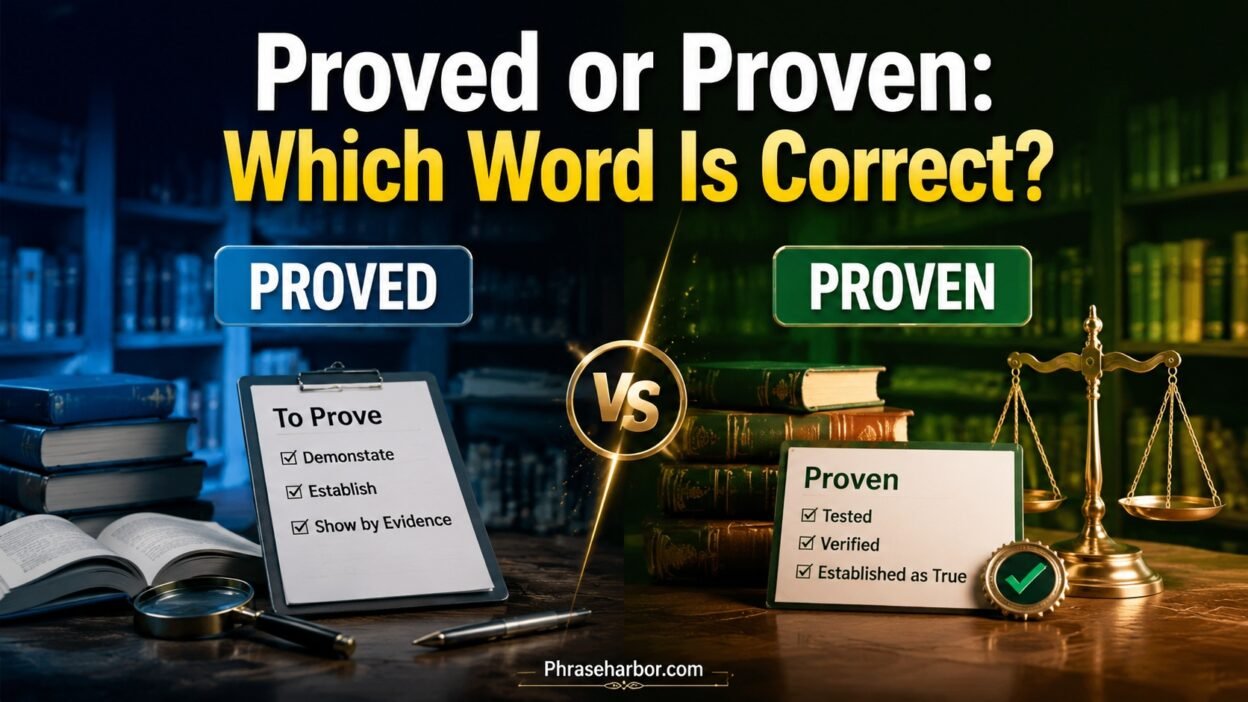
Proved or Proven: The Complete Guide to Using Each Correctly helps writers choose the right form with confidence in everyday and formal English. When I teach this distinction, I explain that Proved is the regular past tense and a common past participle of prove, while Proven often works as an adjective with strong adjectival force.
In She proved the claim, proved shows a completed past-action, while a proven method, proven technique, and proven record place proven before a noun. These examples make the grammatical role, semantic role, and sentence structure easier to understand. A useful adjective test is to check whether the word sits before a noun; if it does, proven often fits naturally.
When the form follows an auxiliary verb, compare has proved and has proven. In British English, British usage, and especially conservative British prose, writers often favor proved, while American English and American contexts readily accept proven. Both forms belong to standard English, but varieties of English, regional preferences, and usage preference can influence the preferred choice.
Quick Answer
Both proved and proven are correct, but they serve slightly different purposes.
- Proved is the simple past tense of prove.
- Proved is also an accepted past participle, especially in British English.
- Proven is a widely accepted past participle, particularly in American English.
- Proven is the preferred choice when the word comes before a noun, such as proven method or proven strategy.
| Word | Correct? | Most Common Use | Example |
| Proved | Yes | Simple past tense and past participle | She proved her point. |
| Proven | Yes | Past participle and adjective | The theory has been proven. |
The simplest rule is this:
- Use proved for actions completed in the past.
- Use proven when describing something with an established record of success or reliability.
Comparison Overview
Here’s a quick side-by-side comparison to help you understand proved or proven at a glance.
| Feature | Proved | Proven |
| Simple past tense | Yes | No |
| Past participle | Yes | Yes |
| Common in American English | Yes | Very common |
| Common in British English | Very common | Common |
| Used before nouns | Rare | Very common |
| Formal writing | Accepted | Accepted |
| Modern business writing | Less common | More common |
Example
Simple past
- She proved everyone wrong.
Present perfect
- Scientists have proved the theory.
- Scientists have proven the theory.
Both present perfect examples are grammatically correct. Your choice often depends on style and regional preference.
Main Differences Between Proved or Proven
Although both words come from the verb prove, they don’t always sound equally natural.
Proved Is the Traditional Verb Form
You use proved when describing something that happened in the past.
Examples:
- The lawyer proved the witness was mistaken.
- The student proved his answer with evidence.
- She proved her ability during the interview.
This is the form you’ll see in every variety of English.
Proven Is Common as a Past Participle
Proven usually appears after helping verbs like has, have, and had.
Examples:
- The treatment has proven effective.
- The company has proven its reliability.
- The new software has proven successful.
In American English, these sentences sound completely natural.
Proven Works Better as an Adjective
One major difference is adjective use.
Natural examples:
- a proven leader
- a proven technique
- a proven solution
- a proven business model
You rarely hear:
- a proved leader
- a proved strategy
That’s because proven has become the standard adjective.
What Does “Proved” Mean?
Proved is the simple past tense of the verb prove.
The verb prove means:
- to demonstrate that something is true
- to establish facts with evidence
- to show ability through actions
- to test or confirm something
Examples
- She proved her innocence.
- The evidence proved the claim false.
- He proved himself during training.
- They proved the machine could handle heavy workloads.
In each sentence, the action happened and finished in the past.
Common Situations Where You Use Proved
You often use proved when discussing:
- court cases
- scientific experiments
- academic research
- sports achievements
- personal accomplishments
For example:
The new evidence proved the suspect was elsewhere during the crime.
What Does “Proven” Mean?
Proven is an accepted past participle of prove. Over time, it also became a common adjective.
Today, you’ll see proven in newspapers, business reports, scientific writing, marketing, and everyday conversation.
Examples
- The vaccine has proven effective.
- This is a proven investment strategy.
- The company has proven its commitment to quality.
- She is a proven performer under pressure.
Notice that proven often emphasizes an established reputation rather than a single event.
When Should You Use Proved?
Choose proved when you’re talking about a completed action in the simple past tense.
Examples
- She proved everyone wrong.
- They proved the formula worked.
- He proved his honesty.
- The experiment proved the hypothesis.
Common Sentence Patterns
- Subject + proved + object
- Subject + proved + clause
Examples
- The evidence proved the witness lied.
- The report proved the system was outdated.
These structures are common in both formal and informal writing.
When Should You Use Proven?
Use proven when it functions as a past participle or adjective.
Examples
- The method has proven successful.
- The software has proven reliable.
- She is a proven leader.
- They adopted a proven approach.
Common Industries That Prefer Proven
Many professional fields favor proven because it conveys reliability.
These include:
- healthcare
- finance
- technology
- education
- engineering
- marketing
You’ll often see phrases such as:
- proven technology
- proven treatment
- proven process
- proven framework
- proven results
These expressions have become standard English.
Grammar Rule Explained
Understanding verb forms makes the difference much easier.
Simple Past
The simple past always uses proved.
Examples:
- She proved her point.
- The detective proved the case.
- The experiment proved successful.
Present Perfect
The present perfect uses has, have, or had.
Both forms are acceptable.
Examples:
- Scientists have proved the theory.
- Scientists have proven the theory.
Past Perfect
Again, either form works.
Examples:
- They had proved their case.
- They had proven their case.
American writers usually prefer proven, while British writers often choose proved.
Is Proven Grammatically Correct?
Yes. Proven is grammatically correct.
Older grammar books sometimes treated proved as the only proper past participle. Modern English has changed.
Today, major dictionaries recognize proven as standard English.
For example, respected dictionaries such as:
- Merriam-Webster
- Cambridge Dictionary
- Oxford English Dictionary
- Collins Dictionary
all list proven as an accepted form.
Language evolves. Words that were once considered informal often become fully accepted after years of widespread use. Proven is a perfect example.
“Usage determines acceptance.” That’s one of the defining characteristics of modern English.
Proved vs. Proven in American and British English
Regional preference explains much of the confusion.
| Usage | American English | British English |
| Simple past | proved | proved |
| Past participle | proven or proved | proved is more common |
| Adjective | proven | proven |
| Everyday writing | proven is frequent | proved appears more often |
American English
American English strongly favors proven, especially after helping verbs.
Examples:
- It has proven useful.
- The strategy has proven effective.
British English
British English traditionally prefers proved as the past participle.
Examples:
- It has proved useful.
- The experiment has proved successful.
Neither choice is incorrect.
Proved vs. Proven as an Adjective
This is where the distinction becomes much clearer.
Use proven before nouns.
Examples
- proven technique
- proven solution
- proven expert
- proven leader
- proven formula
- proven record
These phrases sound natural because proven functions as an adjective.
Compare the alternatives.
| Correct | Less Natural |
| proven method | proved method |
| proven results | proved results |
| proven leader | proved leader |
| proven technology | proved technology |
If you’re modifying a noun, proven is almost always the better choice.
Read More: Savor vs. Saver: Meaning, Differences, and Correct Usage
Common Mistakes to Avoid
Many writers mix the two forms without considering grammar.
Mistake One
She has proved reliable.
She has proven reliable.
While has proved is grammatically acceptable, American readers often find has proven more natural.
Mistake Two
a proved strategy
a proven strategy
Mistake Three
a proved solution
a proven solution
Mistake Four
Using proven as the simple past.
She proven her point.
She proved her point.
Everyday Examples
Seeing real examples makes the rule easier to remember.
At Work
- Our team proved the proposal would save money.
- The new system has proven reliable.
At School
- The student proved the theorem.
- Her research has proven valuable.
In Science
- Scientists proved the chemical reaction.
- Years of testing have proven the medicine safe.
In Business
- The company proved its financial strength.
- Investors prefer businesses with a proven record.
In Sports
- He proved himself during the championship.
- She has proven she performs well under pressure.
Proved vs. Proven Comparison Table
| Feature | Proved | Proven |
| Verb | Yes | Yes |
| Simple past | ||
| Past participle | ||
| Adjective | Rare | Very common |
| Business writing | Good | Preferred |
| Academic writing | Common | Common |
| Marketing | Rare | Very common |
Real-World Usage Examples
The distinction becomes clearer when you compare similar sentences.
| Sentence | Best Choice |
| She _____ everyone wrong yesterday. | proved |
| The treatment has _____ effective. | proven |
| This is a _____ system. | proven |
| They _____ the results through testing. | proved |
| Our process has _____ reliable over time. | proven |
Patterns like these appear every day in newspapers, academic journals, business reports, and professional writing.
Case Study: Why Businesses Prefer “Proven”
Imagine two companies promoting the same software.
Company A
Our software is a proved solution.
Company B
Our software is a proven solution.
Most readers instantly recognize the second sentence as more natural. That’s because proven solution has become a fixed expression in business English.
The same applies to phrases like:
- proven success
- proven performance
- proven technology
- proven process
- proven expertise
This doesn’t mean proved is wrong. It simply isn’t the idiomatic choice before nouns.
FAQs:
Is “proved” or “proven” correct?
Both proved and proven are correct. Proved is commonly used as the past tense and past participle of prove, while proven is especially common as an adjective, as in “a proven method.” Proven is also widely accepted as a past participle, particularly in American English.
Is “has proved” or “has proven” correct?
Both forms are correct. Has proved is more traditional in British English, while has proven is very common in American English. Your choice can depend on your audience, register, and preferred variety of English.
When should I use “proven” as an adjective?
Use proven when it describes a noun and means that something has already been shown to be reliable or effective. For example, “She used a proven technique” means the technique has a reliable record of success.
Is “proved” more formal than “proven”?
Not necessarily. Both forms are standard English. Proved may sound more traditional in some British contexts, while proven is very natural in American English and is widely used in formal writing.
How can I remember the difference between proved and proven?
A simple test is to look at the word’s position and function. Use proved naturally for a completed past action, such as “She proved the theory.” Use proven before a noun when it acts as an adjective, such as “a proven method.”
Conclusion:
Understanding Proved or Proven becomes easier when you focus on grammar, context, and regional usage instead of trying to memorize one strict rule. Proved works naturally for past actions and remains common as a past participle, while proven is especially useful as an adjective and is also widely accepted as a past participle. Both forms are correct, so the best choice depends on the sentence, your audience, and the variety of English you follow.
With regular practice, examples, and attention to sentence structure, choosing between proved and proven can become second nature. When in doubt, check whether you’re describing an action or modifying a noun, then choose the form that sounds natural and fits your writing style.