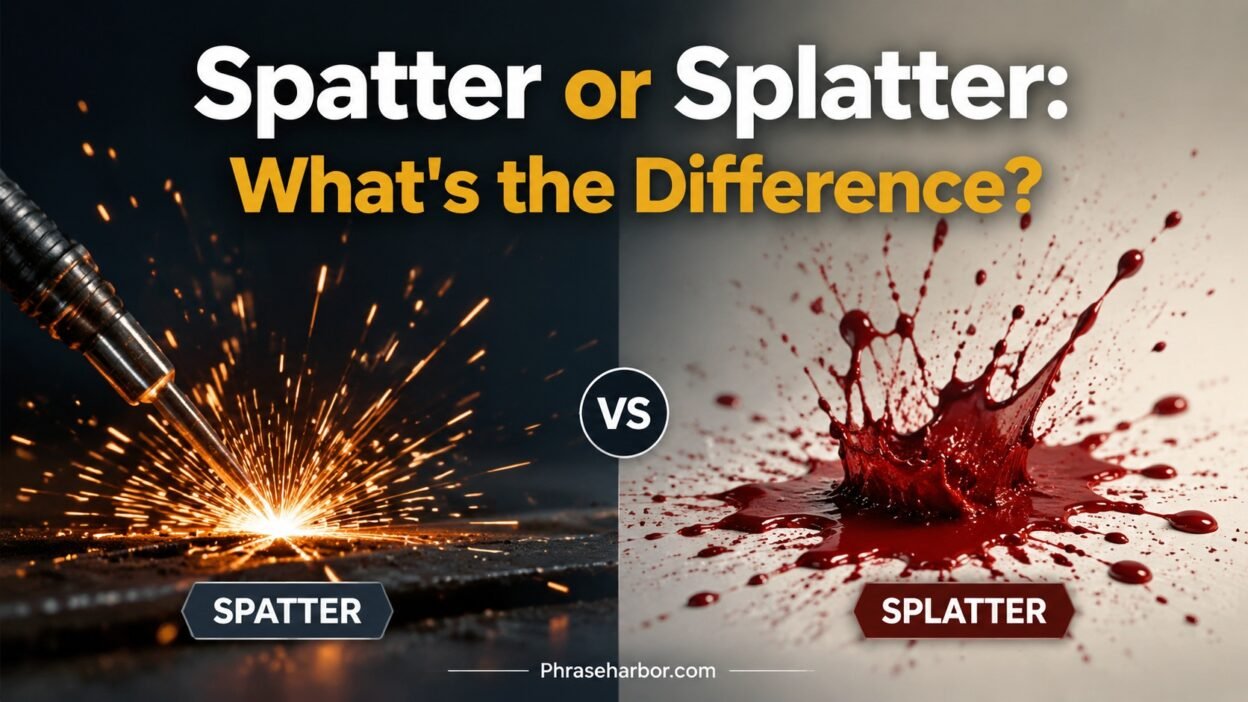
Spatter or Splatter shows a clear difference: spatter means small light drops, while splatter suggests larger, heavier drops and forceful impact. Both are similar words, but they create different images depending on the movement of a liquid or small particles across a surface in different directions.
For example, water may splash on a wall, paint may scatter across a canvas, and mud may land on clothes. During a late-night cooking session, I’d describe hot oil flying from a stove as spatter, especially when I see tiny oil spots. However, a bowl of sauce dropping and seeming to explode across the floor feels more like splatter.
A storm outside, rain hitting a window, or sauce bubbling in a chaotic kitchen can show these different kinds of patterns. In my experience, choosing the right word adds stronger imagery, emotional impact, and vivid detail to writing, storytelling, professional descriptions, and everyday conversation.
Quick Answer
Spatter usually describes small droplets scattered lightly or moderately across a surface. It often suggests fine sprays, tiny spots, or controlled scattering.
Splatter usually describes larger drops that hit with greater force and create a messier effect. It paints a stronger visual picture and often implies a louder or more dramatic impact.
While both words are correct in many situations, choosing the one that best matches the size and intensity of the action makes your writing more natural.
For example:
- Grease spattered across the stovetop.
- Thick mud splattered all over the truck.
- Rain spattered against the window.
- Tomato sauce splattered across the kitchen wall.
Comparison Overview
| Feature | Spatter | Splatter |
| Meaning | Small drops scattered | Larger drops scattered forcefully |
| Typical Size | Fine droplets | Bigger droplets |
| Force | Light to moderate | Moderate to strong |
| Mess Level | Usually light | Usually heavy |
| Tone | Neutral and precise | Dramatic and expressive |
| Common Examples | Paint mist, grease, rain | Mud, sauce, thick paint |
| Common in Technical Writing | Yes | Less often |
| Common in Creative Writing | Yes | Very common |
Main Differences Between Spatter and Splatter
Although many people use these words interchangeably, several practical differences separate them.
Droplet Size
The biggest distinction involves the size of the liquid droplets.
Spatter refers to smaller spots.
Example:
- Oil spattered onto the countertop.
- Paint spattered the artist’s shoes.
Splatter suggests larger blobs.
Example:
- Mud splattered across the windshield.
- Cake batter splattered onto the cabinets.
Amount of Force
Spatter often happens during normal movement.
Examples include:
- Rain hitting glass
- Frying bacon
- A paintbrush flicking tiny drops
Splatter usually results from greater force.
Examples include:
- A speeding car driving through a puddle
- A dropped bowl of soup
- Thick paint thrown against a wall
Visual Effect
Spatter creates a pattern of small dots.
Splatter creates an obvious, messy spread that immediately catches attention.
That difference explains why movie reviews often describe “blood splatter effects” instead of “blood spatter effects” when discussing dramatic visuals, even though forensic professionals generally prefer a different term.
Writing Style
Choose spatter when you want precision.
Choose splatter when you want vivid imagery.
Think of it this way:
Spatter describes. Splatter dramatizes.
What Does “Spatter” Mean?
The verb spatter means to scatter small drops of liquid or another substance over a surface.
As a noun, spatter refers to those scattered droplets themselves.
The word has appeared in English for centuries and has consistently referred to fine sprays or small spots rather than large splashes.
When to Use Spatter
Use spatter when describing:
- Small drops
- Fine sprays
- Light rain
- Grease from cooking
- Thin paint
- Small blood droplets
- Ink spots
These situations involve limited force and relatively small droplets.
Common Examples of Spatter
You might encounter spatter in everyday life more often than you realize.
Examples include:
- Bacon grease spattering from a frying pan
- Paint spattering during home renovation
- Rain spattering against windows
- Coffee spattering while stirring
- Ink spattering from an old fountain pen
Example Sentences
- Rain spattered softly against the roof.
- Paint spattered across the old newspaper.
- Tiny grease droplets spattered the stove.
- Water spattered over the sink.
- The artist spattered blue paint onto the canvas.
- Ink spattered across the page.
- Small waves spattered the rocks.
- The sprinkler spattered water over the flowers.
What Does “Splatter” Mean?
Splatter means to scatter larger drops of liquid or semi-liquid material in a forceful or messy way.
The action often produces an obvious visual impact.
Unlike spatter, splatter usually carries a sense of energy or even chaos.
When to Use Splatter
Choose splatter when describing:
- Thick mud
- Sauce
- Wet cement
- Cake batter
- Thick paint
- Puddles
- Chocolate syrup
These substances tend to create larger, more noticeable marks.
Common Examples
Examples include:
- Mud splattering over a truck
- Sauce splattering from a saucepan
- Wet concrete splattering onto shoes
- Thick paint splattering across artwork
Example Sentences
- Mud splattered over the side of the vehicle.
- The sauce splattered across the stove.
- Thick paint splattered onto the wall.
- Water splattered everywhere after the bucket fell.
- The balloon burst and juice splattered across the floor.
- Chocolate splattered onto the tablecloth.
- Wet cement splattered onto nearby bricks.
- A passing truck splattered everyone waiting at the bus stop.
Spatter vs. Splatter: Side-by-Side Comparison
| Category | Spatter | Splatter |
| Drop Size | Small | Large |
| Force | Gentle | Strong |
| Visual Effect | Fine spots | Messy spread |
| Typical Liquids | Water, grease, ink | Mud, sauce, paint |
| Common Tone | Precise | Dramatic |
| Best for Technical Writing | Yes | Sometimes |
| Best for Creative Writing | Yes | Excellent |
| Emotional Impact | Low | High |
Is Splatter Just a Stronger Form of Spatter?
In many cases, yes.
Most dictionaries define splatter using spatter and vice versa because their meanings overlap considerably.
However, native English speakers often make an informal distinction.
Think of them as existing on a scale.
| Intensity | Better Choice |
| Fine mist | Spatter |
| Small drops | Spatter |
| Medium drops | Either |
| Large messy drops | Splatter |
| Violent spray | Splatter |
That subtle difference helps readers picture exactly what happened.
Which Word Should You Use?
When deciding between the two, ask yourself one simple question:
How big and forceful are the droplets?
Choose Spatter If
- The droplets are tiny.
- The spray looks fine.
- The action isn’t dramatic.
- You’re writing technical content.
- Precision matters.
Choose Splatter If
- The liquid flies everywhere.
- The mess is obvious.
- The droplets are large.
- You’re telling a story.
- You want stronger imagery.
Quick Decision Guide
| Situation | Better Word |
| Frying bacon | Spatter |
| Rain on windows | Spatter |
| Paint mist | Spatter |
| Mud from tires | Splatter |
| Pasta sauce explosion | Splatter |
| Water balloon burst | Splatter |
Spatter and Splatter as Verbs and Nouns
One reason these words confuse writers is that each functions as both a noun and a verb.
Spatter as a Verb
Examples:
- Oil spattered the countertop.
- Rain spattered the sidewalk.
- The brush spattered paint.
Spatter as a Noun
Examples:
- The wall had grease spatter.
- Blood spatter covered the floor.
- Paint spatter decorated the artist’s jeans.
Splatter as a Verb
Examples:
- Mud splattered the windows.
- The truck splattered water everywhere.
- The child splattered paint across the paper.
Splatter as a Noun
Examples:
- Mud splatter covered the bumper.
- Sauce splatter stained the shirt.
- Paint splatter became part of the artwork.
Common Phrases and Expressions
Common Uses of Spatter
- Blood spatter
- Paint spatter
- Grease spatter
- Rain spatter
- Ink spatter
- Water spatter
Common Uses of Splatter
- Mud splatter
- Paint splatter
- Sauce splatter
- Splatter paint
- Splatter effect
- Splatter pattern
- Splatter art
These combinations appear frequently in books, articles, and everyday conversation.
Blood Spatter vs. Blood Splatter: Why Professionals Prefer “Blood Spatter”
One of the best-known examples involves forensic science.
Investigators and crime scene analysts almost always use the term blood spatter when discussing the patterns created by blood droplets at a crime scene.
The phrase became standard because it emphasizes the scientific study of droplet distribution rather than dramatic visual effects.
In entertainment, however, you may see blood splatter used to describe graphic movie scenes or horror effects because it sounds more dramatic.
Practical Difference
| Context | Preferred Term |
| Forensic science | Blood spatter |
| Crime scene investigation | Blood spatter |
| Horror movies | Blood splatter |
| Video game effects | Blood splatter |
Common Mistakes Writers Make
Many writers accidentally weaken their descriptions by treating these words as perfect synonyms.
Here are the most common mistakes.
Using Splatter for Tiny Droplets
Incorrect:
- Grease splattered lightly from the pan.
Better:
- Grease spattered from the pan.
Using Spatter for Large Messes
Incorrect:
- Thick mud spattered over the truck after driving through deep puddles.
Better:
- Thick mud splattered over the truck.
Ignoring Context
Technical writing values precision.
Creative writing values imagery.
Choosing the appropriate word improves both.
Read More: She Has or She Have: Which One Is Correct?
Memory Trick to Remember the Difference
Here’s a simple way to remember them.
Spatter = Small
Both spatter and small begin with the letter S.
Think:
Small Spots = Spatter
Splatter = Splash
Splatter begins with Spl, just like splash.
Imagine a large splash covering everything nearby.
Think:
Splash = Splatter
Once you connect these mental images, choosing the correct word becomes much easier.
Real-World Examples
| Situation | Best Choice | Reason |
| Frying bacon | Spatter | Tiny grease droplets |
| Spray painting | Spatter | Fine mist |
| Heavy mud from tires | Splatter | Large messy drops |
| Thick pancake batter | Splatter | Heavy blobs |
| Rain hitting leaves | Spatter | Small droplets |
| Exploding ketchup bottle | Splatter | Forceful mess |
| Ink from a pen | Spatter | Fine spots |
| Wet cement flying from machinery | Splatter | Thick material |
Case Study: Choosing the Right Word Changes the Image
Imagine reading these two sentences.
The chef dropped a spoon into the simmering soup, and the broth spattered onto the stovetop.
Now compare it with this one.
The chef knocked over the entire pot, and the soup splattered across the kitchen floor.
Both describe liquid moving outward. Yet the second sentence immediately creates a stronger picture because splattered suggests larger droplets, more force, and a much bigger mess.
That’s the power of choosing the right word.
Related Word Pairs People Also Confuse
Many English learners mix up similar action words. Understanding their differences can improve your vocabulary.
| Word Pair | Main Difference |
| Sprinkle vs. Splash | Light distribution vs. large movement |
| Splash vs. Splatter | One impact vs. scattered impact |
| Spray vs. Spatter | Continuous mist vs. scattered droplets |
| Speckle vs. Spatter | Tiny marks vs. liquid droplets |
| Scatter vs. Spatter | General movement vs. liquid movement |
Learning these distinctions helps your writing become more precise and descriptive.
FAQs:
Is spatter or splatter the correct word?
Both spatter and splatter are correct words. Spatter usually describes smaller, lighter drops scattered over an area, while splatter often suggests larger drops or a stronger, messier action.
What is the main difference between spatter and splatter?
The main difference is the level of force and the pattern of drops. Spatter often suggests a light scattering, while splatter creates a more dramatic image of liquid spreading forcefully.
Can spatter and splatter be used as verbs?
Yes. Both words can work as verbs. For example, you can say, “The paint spattered the wall” or “The sauce splattered across the floor.”
Can spatter and splatter be used as nouns?
Yes. Both can also function as nouns. You might refer to “paint spatter” on a surface or “sauce splatter” around a kitchen.
Which word should English learners use?
Choose spatter when you mean small, scattered drops and splatter when the action feels heavier, messier, or more forceful. When unsure, consider the image you want your reader to picture.
Conclusion:
Spatter and splatter are closely related, but they can create different impressions. Spatter generally works well for small, scattered drops, while splatter often suggests heavier drops and a more forceful or messy action. The easiest way to choose between them is to think about the pattern, force, and context. Whether you’re describing paint, water, oil, mud, or sauce, selecting the right word can make your writing clearer and more vivid.