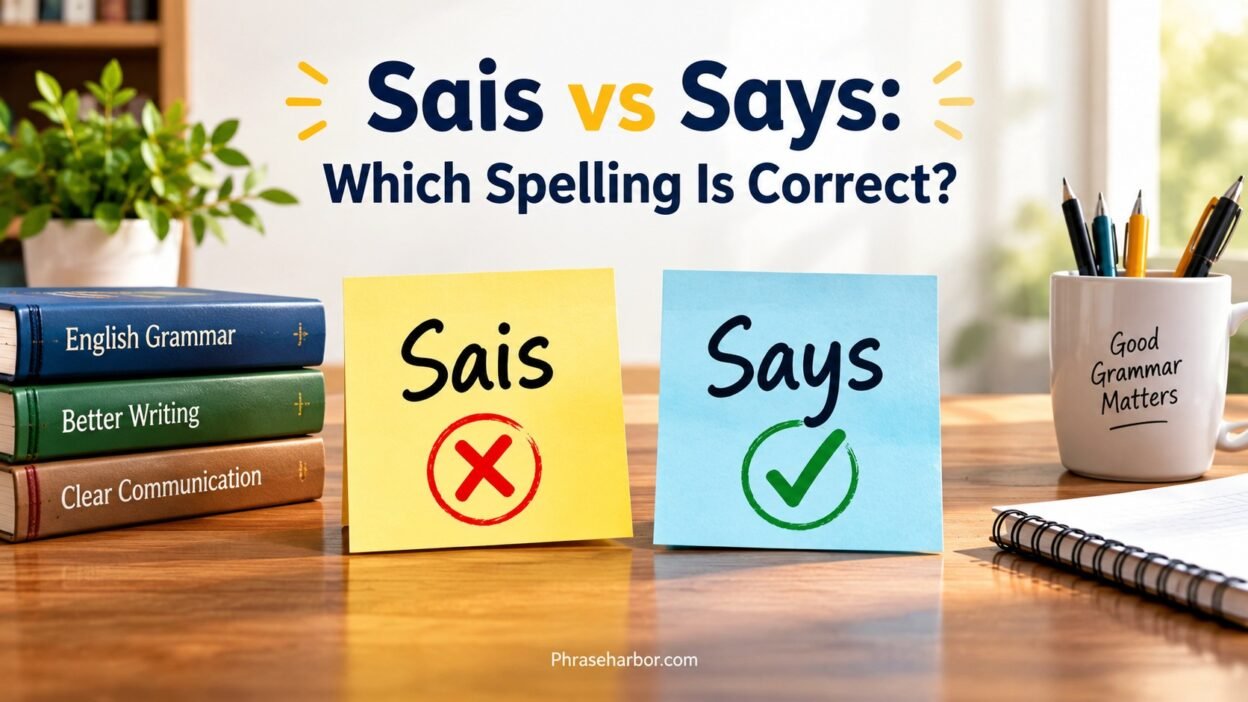
Sais and says can look like reasonable English words when you hear them, but sais is usually a misspelling. In standard English, says is the correct spelling and the third-person singular present form of say. The main difference becomes clear when you separate spelling, pronunciation, and grammar.
The letters a-y in says may make you expect a different sound, but it is commonly pronounced /sez/ in standard US English. This unusual relationship between spelling and sound is why the word can be confusing and why even native English speakers, writers, students, and bloggers may trip up on it.
From my experience helping with everyday language questions, this is a common spelling question because people often write what they hear instead of following familiar spelling rules. The phonetic variation can create confusion, but a simple guide is to remember that says is the form you should use in normal usage, whether you are writing emails, articles, school assignments, or professional communication.
Quick Answer: Sais vs Says
Says is the correct spelling when you mean the third-person singular present form of the verb say.
Correct: She says she is ready.
Incorrect: She sais she is ready.
The verb say changes to says when the subject is he, she, it, or another singular third-person noun.
For example:
- I say what I think.
- You say what you think.
- He says what he thinks.
- She says what she thinks.
- We say what we think.
- They say what they think.
The spelling sais isn’t the standard English spelling of this verb form.
The tricky part is pronunciation. Says is normally pronounced approximately like “sez”, not like sayz. Merriam-Webster gives /sez/ as the standard pronunciation.
Comparison Overview
The simplest way to understand sais vs says is to compare their spelling, grammar, pronunciation, and usage.
| Feature | Says | Sais |
| Standard English spelling of say | Yes | No |
| Third-person singular present form | Yes | No |
| Used in standard English writing | Yes | No, when intended to mean says |
| Pronunciation of the intended word | Usually /sez/ | Not the standard spelling of say |
| Example | She says hello. | She sais hello. |
| Correct in formal writing | Yes | No |
There is one important qualification. Saying that sais is incorrect for the verb say doesn’t mean that those four letters could never appear anywhere. A sequence of letters can occur in a proper name, foreign-language word, title, or other specialized context. The issue here is specifically whether sais is the correct English spelling of the verb form says.
For ordinary English writing, the choice is straightforward:
Use says.
Main Differences Between Sais vs Says
The biggest difference between sais vs says isn’t meaning. It is standard spelling and grammatical function.
Says Is the Standard English Spelling
Says is the third-person singular present-tense form of say.
The basic pattern looks like this:
- I say
- You say
- He says
- She says
- It says
- We say
- They say
Notice that says appears only with third-person singular subjects in the ordinary present tense.
Examples:
- James says the store is closed.
- My sister says she’ll call later.
- The sign says “No Parking.”
- The report says sales increased.
- The computer says the file is missing.
In each sentence, the subject is singular and third person.
Sais Is Not the Standard Spelling of Says
If you’re writing a sentence such as:
He sais that he is tired.
the correct version is:
He says that he is tired.
The mistake usually comes from trying to spell the word according to its sound.
That’s understandable. English has many words whose pronunciation doesn’t neatly reveal their spelling. Says is a particularly obvious example because its pronunciation is closer to sez than its written form suggests.
The Pronunciation Creates the Confusion
If someone says:
“She says she’s busy.”
you hear something close to:
“She sez she’s busy.”
You don’t hear the letters a-y.
That creates a natural temptation to write sais or sez. Neither spelling replaces says in standard English.
The important lesson is simple:
Don’t spell says based only on how it sounds.
What Does “Says” Mean?
Says comes from the verb say, which has several closely related uses.
At its most basic level, say means to express words verbally. However, English speakers also use it for statements, opinions, information, written messages, instructions, and claims.
Says for Spoken Words
You can use says when someone communicates something through speech.
Examples:
- Maria says she needs help.
- David says he’ll arrive at six.
- The teacher says the class is finished.
- My father says dinner is ready.
Here, a person is communicating something through speech.
Says for Opinions
Says can also introduce someone’s opinion or belief.
For example:
- She says the movie is excellent.
- He says the plan won’t work.
- The analyst says the company needs more time.
- My friend says this restaurant is worth visiting.
The person doesn’t necessarily state an objective fact. The verb simply identifies what that person says or claims.
Says for Written Information
One of the most useful points about says is that the subject doesn’t have to speak.
A sign can say something.
A label can say something.
A document can say something.
For example:
- The sign says “Keep Out.”
- The label says to store the product in a cool place.
- The email says the meeting starts at 10 a.m.
- The contract says payment is due within 30 days.
- The website says the store closes at 8 p.m.
Cambridge Dictionary includes this use of say for information contained in writing.
This distinction matters because learners sometimes think says only describes spoken language. It doesn’t.
Why Do People Write “Sais” Instead of “Says”?
The spelling error makes sense once you examine the pronunciation.
Says Doesn’t Sound Like “Say”
The base verb is:
say
In standard US English, say is pronounced approximately /seɪ/.
But when it becomes:
says
the pronunciation changes to approximately /sez/. Merriam-Webster lists /sez/ as the standard pronunciation.
That means the written relationship looks like this:
say → says
while the sound changes roughly like this:
/seɪ/ → /sez/
That’s unusual enough to cause spelling mistakes.
English Doesn’t Always Give You the Spelling From the Sound
English spelling reflects centuries of linguistic development. Pronunciation has changed over time while many established spellings have remained.
You can see similar spelling-pronunciation mismatches in words such as:
- said
- does
- have
- one
- two
- enough
This doesn’t mean every irregular spelling has the same historical explanation. It simply shows why English learners can’t always rely on pronunciation alone when spelling.
With says, the safest approach is to remember the grammatical form rather than trying to reconstruct its spelling from sound.
Says vs Say: Understanding the Grammar
The most useful way to avoid the sais vs says mistake is to understand when say becomes says.
Use “Say” With I, You, We, and They
In the present tense, use say with:
- I
- you
- we
- they
Examples:
- I say what I mean.
- You say that every time.
- We say hello when we arrive.
- They say the store is closed.
Use “Says” With He, She, It, and Singular Nouns
Use says with:
- he
- she
- it
- a singular person’s name
- a singular noun
Examples:
- He says he knows the answer.
- She says she’ll be there.
- It says the battery is low.
- Sarah says the meeting starts at noon.
- The newspaper says prices are rising.
This follows the standard subject-verb agreement pattern for the present tense.
A Simple Grammar Table
| Subject | Correct Verb | Example |
| I | say | I say what I think. |
| You | say | You say that often. |
| He | says | He says it’s true. |
| She | says | She says she’s ready. |
| It | says | It says “Open.” |
| We | say | We say hello. |
| They | say | They say it’s expensive. |
The pattern becomes much easier when you stop treating says as an isolated spelling problem.
Think of it as part of the verb’s grammatical pattern:
say → says → said → saying
Says vs Said: Don’t Confuse the Verb Forms
Another common problem involves says and said.
Both come from say, but they perform different grammatical roles.
Says Is Present Tense
Use says for a current statement or repeated action involving a third-person singular subject.
She says she likes coffee.
The sentence presents her statement in the present.
Said Is the Past Form
Use said when referring to something someone stated in the past.
She said she liked coffee.
Cambridge Dictionary lists said as the past form and past participle of say.
Compare these examples:
| Present | Past |
| He says he’s tired. | He said he was tired. |
| She says it’s expensive. | She said it was expensive. |
| The report says sales are increasing. | The report said sales were increasing. |
| My teacher says the test is difficult. | My teacher said the test was difficult. |
Neither sais nor sayed is the correct standard form when you mean these forms of say.
How to Pronounce “Says”
The standard US pronunciation of says is approximately:
/sez/
For an English learner, the easiest approximation is:
sez
So:
She says hello.
sounds roughly like:
She sez hello.
That pronunciation doesn’t change the spelling.
Why Isn’t It Spelled “Sez”?
Because English spelling doesn’t work as a purely phonetic system.
If every English word were spelled exactly according to its modern pronunciation, written English would look dramatically different from the form readers recognize today.
The established spelling says connects the word visually with its base form say. That connection helps readers recognize the grammatical relationship even though the vowel sound changes.
Is “Says” Ever Pronounced Differently?
Pronunciation can vary across accents and dialects. Merriam-Webster records /sez/ as the standard pronunciation and also notes a variant pronunciation.
For standard US English writing, however, the spelling remains says regardless of the speaker’s accent.
Read More: Full Proof vs Foolproof: Which Spelling Is Correct?
Examples of Says Used Correctly
Seeing the word in real sentences makes the rule easier to remember.
Everyday Conversation
- My brother says he’ll be home soon.
- She says she isn’t hungry.
- John says he knows the answer.
- The doctor says I should rest.
- My neighbor says the weather will improve.
Work and Business
- The manager says the office will close early.
- The report says revenue increased this quarter.
- The company says the product will launch next month.
- The client says the contract needs another review.
School and Education
- The teacher says the assignment is due Friday.
- The textbook says the experiment should take 20 minutes.
- The professor says the exam will cover three chapters.
Signs and Instructions
- The sign says “No Parking.”
- The label says “Keep Refrigerated.”
- The notice says visitors must sign in.
- The package says it contains fragile items.
Websites and Digital Messages
- The website says registration closes tomorrow.
- The app says an update is available.
- The error message says the password is incorrect.
These examples demonstrate an important point: says can describe both speech and information presented in writing.
Sais vs Says: Incorrect and Correct Examples
The fastest way to recognize the difference is to compare the two forms directly.
| Incorrect | Correct | Explanation |
| She sais she’s tired. | She says she’s tired. | Says is the correct third-person singular form. |
| He sais he’ll call. | He says he’ll call. | The subject he requires says. |
| The sign sais “Stop.” | The sign says “Stop.” | Written information can say something. |
| My teacher sais it’s important. | My teacher says it’s important. | A singular subject takes says. |
| The email sais the meeting is canceled. | The email says the meeting is canceled. | Says is the standard spelling. |
The correction isn’t merely a matter of style. In standard English, sais doesn’t replace says when you’re conjugating say.
Common Mistakes With Says
Spelling Says as Sais
This is the central mistake.
Someone hears /sez/ and tries to represent that sound with letters. The result might be sez or sais.
The solution is simple: memorize the written form says.
Using Say With a Singular Third-Person Subject
Another common error is:
She say she is busy.
The standard form is:
She says she is busy.
The subject she requires the third-person singular form.
The same rule applies to:
- he
- it
- Sarah
- the company
- the dog
- my teacher
- the report
For example:
The report says the project is delayed.
Not:
The report say the project is delayed.
Confusing Says With Said
Consider these two sentences:
He says he is ready.
He said he was ready.
The first uses present tense. The second refers to the past.
Learning the complete family helps:
| Verb form | Function | Example |
| say | Base/present form | I say hello. |
| says | Third-person singular present | She says hello. |
| said | Past tense/past participle | She said hello. |
| saying | Present participle/gerund | She is saying hello. |
Assuming Spelling Must Match Pronunciation
This mistake isn’t unique to says.
English has many words where the relationship between letters and sounds isn’t straightforward. Good spelling therefore requires more than simply writing what you hear.
Says provides a particularly useful reminder:
Pronunciation: /sez/
Spelling: says
A Simple Trick to Remember Says
A useful memory trick is to keep say and says together.
Think:
say → says
Then put both into one sentence:
She says what she wants to say.
This sentence gives you two forms of the same verb.
- says = third-person singular
- say = base form
You can also remember the full sequence:
say → says → said → saying
Don’t try to spell says by listening to its pronunciation. Instead, connect it visually to the base verb say.
FAQs:
1. Is “sais” a correct English word?
No. Sais is generally a misspelling when you mean the verb says. In standard English, says is the correct form.
2. Why is “says” pronounced differently from its spelling?
Says is commonly pronounced /sez/. Its pronunciation does not closely match what you might expect from its letters, which can make the word confusing.
3. When should I use “says”?
Use says as the third-person singular present form of say. For example: “She says that the meeting starts at nine.”
4. Is “sez” an alternative spelling of “says”?
No. Sez can represent the pronunciation in informal writing or pronunciation guides, but says is the standard spelling for normal English writing.
5. How can I remember “says” instead of “sais”?
Remember that the correct spelling is says, even though it sounds like /sez/. Pay attention to the spelling when writing emails, assignments, articles, and other formal text.
Conclusion:
Sais vs Says is easy to understand once you separate pronunciation from spelling. Says is the correct standard-English spelling, while sais is usually a misspelling. Although says sounds like /sez/, its written form remains says. Remembering this small difference can help you write more accurately and confidently.