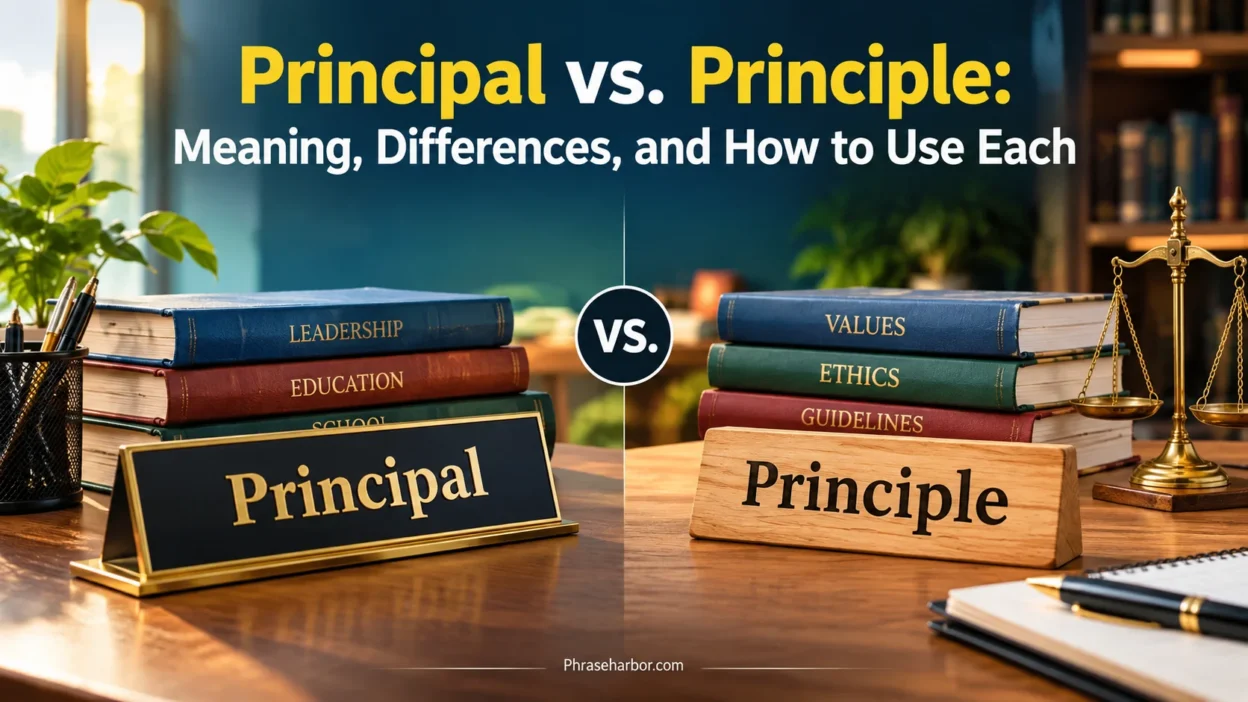
Principal vs. principle is one of those word pairs that can trip up even strong writers. The words look and sound almost identical, yet they carry very different meanings. One can describe a school administrator, an amount of money, or something most important. The other refers to a rule, belief, value, or fundamental idea.
The confusion becomes especially common because both words appear in formal writing. You might see principal in a financial report, school announcement, or business document. Meanwhile, principle often appears in discussions about ethics, science, law, leadership, or personal values.
The good news? You don’t need to memorize a complicated grammar rule. Once you understand what each word actually means, the difference becomes much easier to spot.
This guide explains principal vs. principle in detail, including their meanings, parts of speech, common contexts, financial usage, school-related usage, examples, common mistakes, and simple memory tricks.
Quick Answer
Principal usually means a person in charge, the original amount of money involved in a loan or investment, or something that is main or most important.
Principle means a fundamental rule, belief, value, standard, or idea that guides behavior or explains how something works.
The easiest distinction is:
Principal = person, money, or main.
Principle = rule, belief, or guiding idea.
Consider these examples:
- The principal welcomed the students on the first day of school.
- The bank calculated the interest based on the loan principal.
- Safety was the principal concern during the project.
- Honesty is an important principle in her life.
- The experiment demonstrates a basic scientific principle.
Notice how the context changes the word. A school administrator is a principal. A moral belief is a principle. An original loan amount is principal. Something that means “main” is also principal.
Comparison Overview
| Feature | Principal | Principle |
| Part of speech | Noun and adjective | Noun |
| Main meaning | Person in charge, money, or main/most important | Rule, belief, value, standard, or fundamental idea |
| School context | School administrator | Usually incorrect in this context |
| Financial context | Original amount of a loan or investment | Usually incorrect |
| Moral context | Usually incorrect | Personal or ethical belief |
| Meaning “main” | Yes | No |
| Plural form | Principals | Principles |
| Common phrase | School principal | Moral principle |
| Memory clue | Principal has pal | Principle relates to rules and beliefs |
Principal in One Sentence
Principal can refer to a person in authority, the original amount of money, or something that ranks first in importance.
Principle in One Sentence
Principle refers to a rule, belief, value, or fundamental idea that serves as a guide or foundation.
Main Differences Between Principal vs. Principle
The central difference between principal vs. principle comes down to meaning.
Principal has several distinct uses. It can identify a person, describe money, or work as an adjective meaning “main.” Principle, however, centers on the idea of a rule, belief, standard, or fundamental truth.
That difference becomes clearer when you separate their most common contexts.
Principal Refers to a Person
In education, a principal is the person who leads a school. The principal typically oversees staff, students, policies, discipline, operations, and communication with families.
For example:
- The principal announced the new attendance policy.
- Our principal met with the teachers after school.
- The students visited the principal’s office.
- The high school principal addressed the graduating class.
Here, principal is a noun because it names a person.
You wouldn’t write:
- The principle announced the new policy.
That spelling changes the word entirely. Principle doesn’t mean a school administrator.
Principal Refers to Money
The word principal also has an important financial meaning. In a loan, the principal is the original amount borrowed, excluding interest and certain additional charges.
Suppose you borrow $20,000 to purchase a car. The $20,000 represents the initial loan principal. As you make payments, part of each payment may go toward the principal while another part covers interest.
For example:
- Original loan: $20,000
- Principal paid: $5,000
- Remaining principal: $15,000
- Interest: calculated separately according to the loan terms
This distinction matters because principal and interest aren’t interchangeable.
Principal is the amount itself. Interest is the cost of borrowing that amount.
The same word appears in investing. Depending on the context, principal can refer to the original amount of money invested rather than the earnings generated from it.
Principal Means “Main” or “Most Important”
Principal can also function as an adjective. In this form, it means main, chief, primary, or most important.
For example:
- The principal reason for the delay was bad weather.
- Cost was the principal concern during the project.
- The principal objective is to improve customer safety.
- The principal cause of the problem was poor communication.
In each sentence, principal describes something that holds the greatest importance.
Try replacing it with main. If the sentence still makes sense, principal may be the appropriate word.
For example:
The principal reason = the main reason.
The principal concern = the main concern.
The principal objective = the main objective.
That substitution provides a useful shortcut when you’re unsure.
Principle Refers to a Rule or Belief
A principle is a fundamental rule, belief, value, or standard that guides someone’s actions or decisions.
For example:
- She refused to compromise her principles.
- Honesty is one of his strongest principles.
- The company operates according to strict ethical principles.
- Fairness should be a guiding principle in the workplace.
Here, principle describes something that influences how a person or organization behaves.
A principle doesn’t have to be religious or deeply philosophical. It can be a simple standard that someone follows consistently.
For instance, someone might have a personal principle of returning borrowed items promptly. Another person might follow the principle that customers should always receive clear information before making a purchase.
Principle Can Describe a Fundamental Idea
Principle has a broader meaning than personal morality. It can also refer to a basic idea or rule underlying a system.
You may encounter this use in:
- Science
- Mathematics
- Engineering
- Economics
- Business
- Law
- Education
- Design
- Technology
For example:
- The machine operates according to a basic engineering principle.
- The principle of supply and demand helps explain price changes.
- The design follows the principle of simplicity.
- The experiment demonstrates a well-established scientific principle.
In these examples, principle doesn’t mean someone’s personal moral belief. Instead, it describes an underlying rule or concept.
Principal vs. Principle in School Contexts
School-related writing creates one of the most common principal vs. principle mistakes.
When you’re talking about the head of a school, use principal.
Correct
The principal spoke to the parents about the new schedule.
Incorrect
The principle spoke to the parents about the new schedule.
The incorrect version changes the meaning because principle refers to a rule, belief, or fundamental idea.
A simple memory trick works especially well here:
The principal is your pal.
The word principal contains pal, which can remind you of the person who runs your school.
The mnemonic isn’t a grammar rule. It’s simply a quick memory aid.
More School Examples
- The principal called an emergency meeting.
- The principal reviewed the school’s disciplinary policy.
- Parents met with the principal after the event.
- The assistant principal handled the situation.
- The school principal welcomed the new students.
However, principle can still appear in school-related writing when the sentence discusses a rule or belief.
For example:
Respect is an important principle in our classroom.
The school context doesn’t automatically determine the word. Meaning determines the word.
Principal vs. Principle in Financial Writing
Financial writing provides another important distinction.
When discussing a loan, mortgage, or investment, principal refers to the original amount of money.
Imagine a borrower takes out a $300,000 mortgage. The loan’s principal begins at $300,000. As payments reduce the amount owed, the outstanding principal declines.
A simplified example looks like this:
| Financial Term | Meaning |
| Principal | Original amount borrowed |
| Interest | Cost charged for borrowing money |
| Principal payment | Portion of a payment that reduces the amount owed |
| Interest payment | Portion that covers accrued interest |
| Remaining principal | Amount of the original debt still outstanding |
This distinction is especially important when reading loan statements.
For example:
The borrower made a $2,000 payment, with $1,400 applied to principal and $600 applied to interest.
Here, principal clearly refers to the debt itself.
Writing principle would be incorrect:
The borrower made a payment toward the loan principle.
The correct form is:
The borrower made a payment toward the loan principal.
Read More: Dieing vs Dying: Which Spelling Is Correct?
Principal vs. Principle in Moral and Ethical Contexts
When you’re talking about values, ethics, or personal beliefs, principle is usually the correct choice.
For example:
- She acted according to her principles.
- Integrity is an important principle in leadership.
- He wouldn’t compromise his principles for money.
- The organization follows several ethical principles.
Here, principle represents a standard that guides conduct.
Principle vs. Personal Preference
A principle is often stronger than a simple preference.
Consider these two statements:
I prefer working in the morning.
This describes a preference.
I believe everyone should be treated fairly.
This expresses a principle.
The second statement represents a broader standard that can guide decisions across different situations.
Principal vs. Principle When Meaning “Main”
One of the most useful features of principal is its adjective meaning main or most important.
This usage appears frequently in formal and professional writing.
Common combinations include:
- principal reason
- principal cause
- principal objective
- principal concern
- principal issue
- principal purpose
- principal factor
- principal source
- principal investigator
For example:
The principal objective of the study was to examine consumer behavior.
You could replace principal with main:
The main objective of the study was to examine consumer behavior.
The meaning remains essentially the same.
However, don’t confuse this use with principle.
You wouldn’t write:
The principle objective of the study…
The correct form is:
The principal objective of the study…
Principal vs. Principle: Common Examples
Seeing the words side by side makes the distinction much easier.
Examples With Principal
- The principal greeted students at the entrance.
- The principal reason for the change was cost.
- The bank reduced the loan principal.
- Safety became the principal concern.
- The principal investigator presented the findings.
- The borrower paid an additional amount toward the principal.
Examples With Principle
- Honesty is an important principle.
- The company follows ethical principles.
- She refused to act against her principles.
- The experiment demonstrates a basic scientific principle.
- Fairness is a central principle of the organization.
- The design follows the principle of simplicity.
Principal vs. Principle in Real-World Situations
Context often gives you the answer before you consciously think about spelling.
Case Study: A School Announcement
Imagine a school sends this message:
The principal will meet with parents on Thursday.
The word refers to the school’s leader. Therefore, principal is correct.
Now change the sentence:
Respect is a core principle of the school.
This time, the word refers to a guiding value. Therefore, principle is correct.
The same school can use both words in completely different sentences.
Case Study: A Mortgage Statement
Consider a homeowner who checks a monthly mortgage statement.
The statement might show that part of the payment went toward principal while another part went toward interest.
Here, principal refers to the amount owed.
Now imagine a financial adviser says:
Transparency is a fundamental principle of responsible financial communication.
The meaning has shifted from money to a guiding standard. That’s why principle works.
Case Study: A Business Decision
A manager might say:
The principal concern is customer safety.
Here, principal means the main concern.
Later, the same manager might say:
Customer safety is one of our core principles.
Now principle means a guiding value.
These examples show why spelling alone isn’t enough. You need to identify the meaning first.
Common Mistakes With Principal and Principle
Mistake: “The School Principle”
Incorrect:
The school principle addressed the students.
Correct:
The school principal addressed the students.
The person leading the school is the principal.
Mistake: “Moral Principal”
Incorrect:
Honesty is an important moral principal.
Correct:
Honesty is an important moral principle.
A moral belief or standard is a principle.
Mistake: “Loan Principle”
Incorrect:
She made an extra payment toward the loan principle.
Correct:
She made an extra payment toward the loan principal.
The amount originally borrowed is the principal.
Mistake: “Principle Reason”
Incorrect:
The principle reason for the failure was poor planning.
Correct:
The principal reason for the failure was poor planning.
Here, principal means main.
Mistake: Assuming “Principle” Only Means Morality
Some writers associate principle exclusively with good behavior or ethics. That’s too narrow.
A principle can describe a scientific, mathematical, economic, engineering, or design concept.
For example:
The device works according to a basic physical principle.
No moral judgment appears in that sentence. Principle simply means a fundamental idea or rule.
Principal vs. Principle: Plural Forms
The plural forms also follow different patterns.
Principal → Principals
When referring to multiple people, the plural is principals.
The principals from several schools attended the meeting.
The plural can also refer to multiple important people or entities in a formal context.
Principle → Principles
When referring to multiple rules, beliefs, or standards, use principles.
The organization’s principles emphasize fairness and transparency.
These endings provide another useful clue:
| Singular | Plural | Meaning |
| Principal | Principals | People, amounts, or main things |
| Principle | Principles | Rules, beliefs, standards, or fundamental ideas |
FAQs:
Is the head of a school a principal or principle?
The correct word is principal.
A school principal is the person responsible for leading and managing a school. Principle means a rule, belief, standard, or fundamental idea.
Is it principal or principle amount?
The correct phrase is principal amount.
In financial contexts, principal refers to the original amount borrowed or invested, depending on the situation.
Is it moral principal or moral principle?
The correct phrase is moral principle.
A moral principle is a belief or standard about right and wrong behavior.
Does principal mean “main”?
Yes. Principal can function as an adjective meaning main, chief, or most important.
For example:
The principal reason for the change was cost.
You can replace principal with main without changing the basic meaning.
Can principal be a noun and an adjective?
Yes.
As a noun:
The principal spoke to the students.
As an adjective:
Safety was the principal concern.
It can also refer to money:
The borrower reduced the principal.
Conclusion:
The difference between principal vs. principle becomes much easier once you stop treating them as a spelling problem. Principal has three major uses: it can refer to a person in charge, especially a school administrator; it can describe the original amount of money in a loan or investment; and it can mean main or most important.