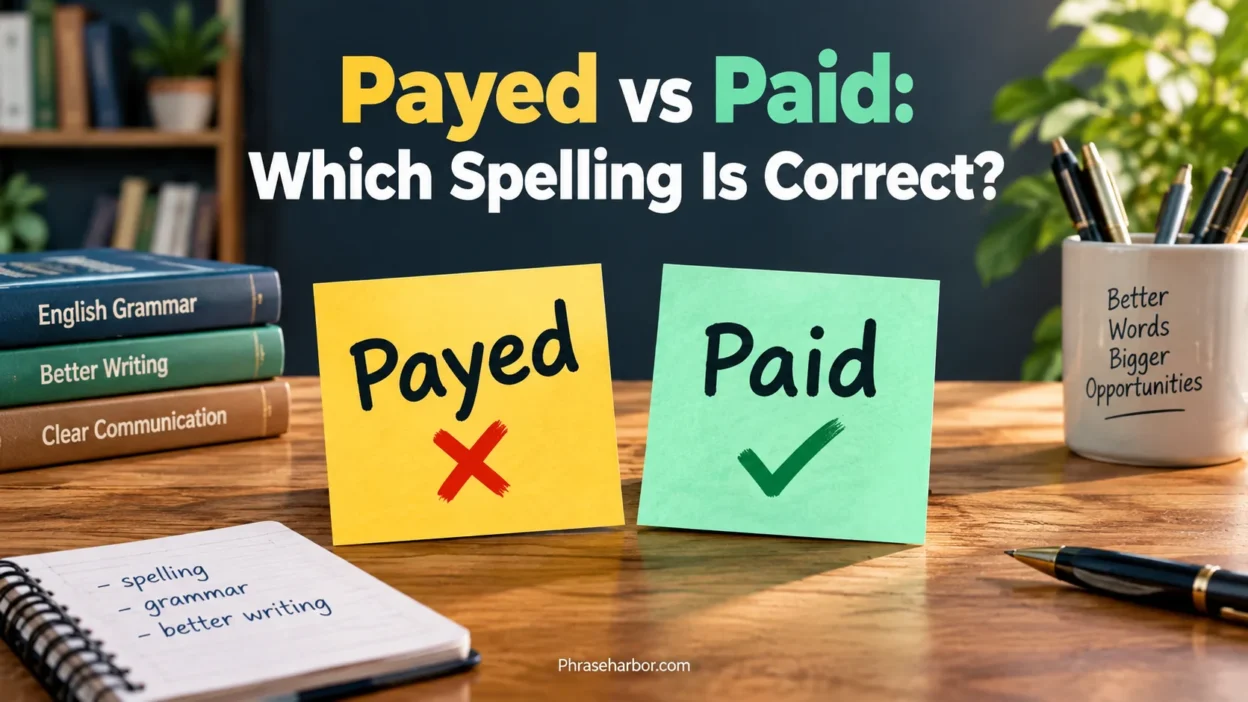
Payed vs Paid can seem confusing because English spelling has similar words, but paid is the correct past tense of pay in everyday English use. The two forms may sound almost identical, yet they have different uses. In examples such as “I paid the bill,” paid is the correct form, while people may accidentally type payed in writing, emails, invoices, school assignments, captions, and professional documents.
This mistake feels natural because many English verbs follow a predictable pattern: play becomes played, stay becomes stayed, and delay becomes delayed when you add -ed. However, pay is an irregular verb, so its correct past tense changes differently.
Understanding this difference helps you avoid a common grammar mistake and keep your writing polished, professional, and trustworthy. In this guide, the correct spelling, grammar rules, meanings, exceptions, and memory tricks make it easier to choose the right word confidently every time.
Quick Answer
Paid is the correct spelling in almost every ordinary use of the verb pay. It is the standard past tense and past participle of pay when you mean giving money, settling a debt, receiving wages, buying something, or using expressions such as paid attention and paid respect. Cambridge and Oxford both list paid as the past tense and past participle of pay.
Payed is a rare specialized form. It appears mainly in nautical contexts, particularly when pay means to let out a rope or chain or to coat part of a vessel with a protective substance.
| If you mean… | Use |
| Give someone money | paid |
| Settle a bill | paid |
| Receive wages | paid |
| Buy something | paid |
| Pay attention | paid |
| Pay respect | paid |
| Pay a debt | paid |
| Let out a rope or chain in a nautical context | payed can be correct |
| Coat a ship with tar, pitch, or another protective material | payed can be correct |
Simple rule: If money isn’t involved and you’re not describing a specialized nautical action, paid is almost certainly the spelling you need.
Comparison Overview
The difference between payed vs paid becomes much easier when you compare their grammatical roles and meanings side by side.
| Feature | Paid | Payed |
| Common in modern English | Yes | No |
| Ordinary past tense of pay | Yes | No |
| Past participle of ordinary pay | Yes | No |
| Financial payments | Yes | No |
| Bills and debts | Yes | No |
| Wages and salaries | Yes | No |
| Idioms such as “paid attention” | Yes | No |
| Nautical rope or chain usage | Sometimes | Yes, in specialized usage |
| Nautical waterproofing usage | No | Yes |
| Everyday writing | Standard | Usually incorrect |
| Pronunciation | /peɪd/ | Typically /peɪd/ |
Oxford lists the ordinary forms of pay as pay, paid, and paying. The past simple and past participle are both paid.
That means paid isn’t merely the more popular choice. It is the normal grammatical form for the everyday verb.
Main Differences Between Payed vs Paid
The biggest difference between payed vs paid is meaning. Although the words look nearly identical and are generally pronounced alike, they belong to different uses of the verb.
Paid Is the Standard Past Tense of Pay
When pay means giving money, paid is the correct past form.
For example:
- I paid the bill yesterday.
- She paid for the groceries.
- We paid the contractor.
- They paid their employees on Friday.
- He paid the registration fee.
- I finally paid my credit card balance.
The pattern is straightforward:
pay → paid → paid
The first paid represents the simple past, while the second represents the past participle.
For example:
I paid the invoice yesterday.
Here, paid is the simple past.
I have paid the invoice.
Here, paid is the past participle used with have.
Oxford gives the same verb pattern: pay for the base form, paid for both the past simple and past participle, and paying for the -ing form.
Paid Works With More Than Money
One reason learners sometimes hesitate over paid is that pay has many meanings. It isn’t limited to handing someone cash.
You can pay attention, pay respect, pay a visit, pay a compliment, or pay the price. These expressions still use paid in the past tense.
Consider these examples:
- She paid attention during the meeting.
- We paid our respects at the ceremony.
- He paid me a visit last weekend.
- They paid a high price for the mistake.
- The company paid tribute to its founder.
So the rule isn’t simply “use paid when money is involved.” A better rule is this:
Use paid for the ordinary meanings and expressions of the verb pay.
That includes both literal and figurative uses.
Payed Has Specialized Nautical Uses
Payed survives in certain specialized maritime meanings of pay.
One important use involves releasing or letting out rope or cable in a controlled way. Cambridge describes pay something out in this sense as releasing a piece of rope or cable in a controlled manner.
For example:
The sailors payed out the rope as the boat moved away from the dock.
Another specialized meaning involves coating parts of a ship with a waterproof substance such as pitch or tar. Dictionary.com identifies this nautical sense as payed in the past tense.
For example:
The shipwright payed the seams with tar.
These uses are highly specialized. Most people will never need payed in ordinary writing.
Paid: Meaning and Correct Usage
Paid covers nearly all everyday situations where you would use the verb pay.
Paid as the Past Tense of Pay
The most familiar use describes an action that happened in the past.
I paid for dinner last night.
She paid the electric bill before the deadline.
We paid $80 for the tickets.
The object can vary widely. You might pay a person, pay for an item, pay a bill, pay a fee, or pay an amount.
Cambridge defines pay in its ordinary financial sense as giving money for something you want to buy or for services provided. Its listed past forms are paid | paid.
Paid for Something
The construction paid for is extremely common.
Use it when you want to identify the product, service, or experience that someone purchased.
Examples:
- I paid for the meal.
- She paid for the new laptop.
- They paid for the repairs.
- We paid for the hotel in advance.
The expression can also have a figurative meaning.
He made a careless decision and eventually paid for it.
Here, no financial transaction necessarily takes place. The phrase means that someone suffered consequences because of an action. Cambridge also recognizes this figurative use of pay for something.
Paid Someone
You can also use paid when someone receives money.
The company paid its employees on Friday.
I paid the driver before leaving.
She paid the designer for the project.
The grammar changes slightly depending on the sentence, but the spelling remains paid.
Paid a Bill, Debt, or Fee
When you settle something you owe, use paid.
Common combinations include:
- paid the bill
- paid the rent
- paid the fee
- paid the debt
- paid the tax
- paid the fine
- paid the invoice
- paid the balance
- paid the deposit
For example:
We paid the invoice before the due date.
Not:
We payed the invoice before the due date.
That second version is a common spelling error.
Paid as a Past Participle
Paid also functions as a past participle.
You see it after auxiliary verbs such as have, has, and had.
Examples:
- I have paid the bill.
- She has already paid.
- They had paid before the service began.
- We have paid in full.
You also see it in passive constructions:
The invoice was paid yesterday.
The form doesn’t change to payed simply because the grammar changes.
Read More: Analyze or Analyse: Which Spelling Is Correct?
Payed: Meaning and Correct Usage
Although payed is rare, calling it completely nonexistent would be inaccurate.
It has legitimate specialized uses.
Payed in Nautical English
One established nautical meaning involves applying a protective coating to part of a ship.
Traditional shipbuilding and maritime language can use pay for covering seams, a ship’s bottom, or related surfaces with pitch, tar, or another substance. Dictionary.com lists this as a distinct nautical verb sense with payed as its past form.
For example:
The crew payed the seams with pitch to help keep water out.
This is not the same verb sense as ordinary financial pay.
Think of it as a specialized branch of the word rather than a spelling alternative you can freely substitute.
Payed Out a Rope or Chain
Another maritime use involves letting out rope or chain.
For example:
The crew payed out the anchor line.
The phrase describes gradually releasing the line rather than giving money to someone.
However, there’s an important detail here: paid out is also widely used for this rope-related meaning. Cambridge lists paid as the past form in its entry for pay something out, including the meaning “to release a piece of rope or cable in a controlled way.”
That means you may encounter both forms in maritime writing.
Payed Off and Nautical Movement
Specialized nautical terminology can also use pay in connection with a vessel falling away from the wind.
Historical and dictionary sources recognize this specialized sense. Dictionary.com, for example, records a nautical use in which paid or payed can refer to allowing a vessel to make leeway.
This is another reason a blanket statement such as “payed is never a word” isn’t quite accurate.
For ordinary modern English, however, that distinction rarely matters.
Why Is It Paid but Not Payed?
The confusion makes perfect sense at first glance.
Many English verbs form their past tense by adding -ed:
- walk → walked
- work → worked
- clean → cleaned
- open → opened
Following that pattern, pay → payed looks perfectly reasonable.
English doesn’t always play by that rule.
The ordinary verb pay has the irregular past form paid:
pay → paid
This pattern must simply be learned as part of the verb’s standard conjugation.
| Verb form | Correct form |
| Present | pay |
| Third-person singular | pays |
| Past tense | paid |
| Past participle | paid |
| Present participle | paying |
Oxford confirms this complete pattern in its current learner dictionary entry.
The spelling payed survives because English contains another specialized use of pay, particularly in nautical terminology.
Payed vs Paid in Common English Examples
The quickest way to master the distinction is to see the words in realistic sentences.
Correct Uses of Paid
- I paid the rent this morning.
- She paid for the tickets.
- We paid the restaurant bill.
- He paid his employees on time.
- They paid the outstanding debt.
- I paid attention to the instructions.
- She paid her respects to the family.
- The customer had already paid.
- The invoice was paid in full.
- Our membership has been paid for another year.
Specialized Uses of Payed
- The sailors payed out the rope.
- The crew payed out additional cable.
- The shipwright payed the seams with protective material.
- The crew payed the vessel’s seams before the voyage.
Incorrect Everyday Uses of Payed
These examples illustrate where writers commonly go wrong:
| Incorrect | Correct |
| I payed the bill. | I paid the bill. |
| She payed for dinner. | She paid for dinner. |
| He payed his employees. | He paid his employees. |
| We payed the fee. | We paid the fee. |
| They payed attention. | They paid attention. |
| I have payed the invoice. | I have paid the invoice. |
| She payed her debt. | She paid her debt. |
The mistake usually comes from treating pay like a regular verb. Once you remember pay → paid, the problem becomes much easier.
Paid in Common English Expressions
The word paid appears in dozens of established phrases.
Paid in Full
Paid in full means that an entire amount owed has been settled.
The loan has been paid in full.
Paid Off
Paid off can mean that a debt has been completely settled.
She finally paid off her student loan.
It can also describe an effort that produced a successful result:
All that practice paid off.
Cambridge recognizes both the financial and figurative meanings of paid off.
Paid Back
Paid back means returned money that someone previously gave or lent.
I paid back the money I borrowed.
It can also have a figurative meaning involving retaliation.
He embarrassed me, and I paid him back with a harmless joke.
Paid Attention
The correct phrase is paid attention.
The students paid attention during the lesson.
Payed attention is not the standard form.
Paid Respect
The expression paid respect or paid one’s respects uses paid because it comes from the ordinary and figurative verb pay.
The visitors paid their respects to the family.
This isn’t a nautical situation, so payed has no role here.
Payed vs Paid Pronunciation
In the uses that matter here, paid and payed are generally pronounced alike: /peɪd/. The spelling difference therefore doesn’t normally help you distinguish them when speaking.
That creates a classic homophone-style problem. You can hear the word correctly and still choose the wrong spelling when writing.
The solution is to identify the meaning and context.
Ask yourself:
“Am I talking about an ordinary payment or a specialized nautical action?”
If you’re talking about a restaurant bill, salary, debt, fee, purchase, attention, or respect, choose paid.
If you’re describing rope, cable, ship maintenance, or specialized sailing terminology, payed may be appropriate.
Pay, Paid, and Paying: Verb Forms
Understanding the complete verb pattern makes payed vs paid much easier.
| Verb form | Example |
| Pay | I pay the bill every month. |
| Pays | She pays the rent on time. |
| Paid | He paid the bill yesterday. |
| Paid | We have paid already. |
| Paying | They are paying now. |
Notice what doesn’t appear in the ordinary conjugation table: payed.
That’s because payed isn’t the normal past form of the everyday financial verb pay.
FAQs:
Is paid or payed correct?
Paid is the standard and correct form when you mean that someone gave money for something. For example, “I paid the bill yesterday.” Payed is used only in certain nautical contexts.
Is payed a real word?
Yes, payed is a real word, but it has a limited use. It can appear in specialized nautical language. For normal English writing, use paid.
Why is the past tense of pay paid?
Pay is an irregular verb, so it doesn’t follow the usual pattern of adding -ed. While verbs such as “play” become “played,” pay changes to paid in the past tense.
Can I use paid in British and American English?
Yes. Paid is the standard past tense and past participle of pay in both British English and American English. The spelling does not change between these varieties.
When should I use payed?
Use payed only when you’re referring to its specialized nautical meaning. In everyday writing, including emails, schoolwork, business documents, and social media posts, paid is the appropriate form.
Conclusion:
The difference between paid and payed becomes much easier once you remember one simple rule: paid is the normal past tense and past participle of pay. Use it when discussing money, bills, taxes, attention, or other everyday meanings of the verb. Payed has a narrow nautical use, so it rarely belongs in ordinary writing.
If you’re unsure which spelling to choose, paid is almost always the form you need in everyday English. Keeping this distinction in mind can help you avoid a common spelling mistake and make your writing clearer and more accurate.