The English words of and off look almost identical, but they serve very different purposes. A single extra letter changes their pronunciation, meaning, and grammatical function. Despite this small spelling difference, many writers and English learners mix them up in everyday communication.
You might write “a piece of cake” correctly but accidentally use “of” when describing someone taking their shoes off. These mistakes often happen because both words appear frequently in spoken and written English. However, understanding their meanings makes choosing the correct word much easier.
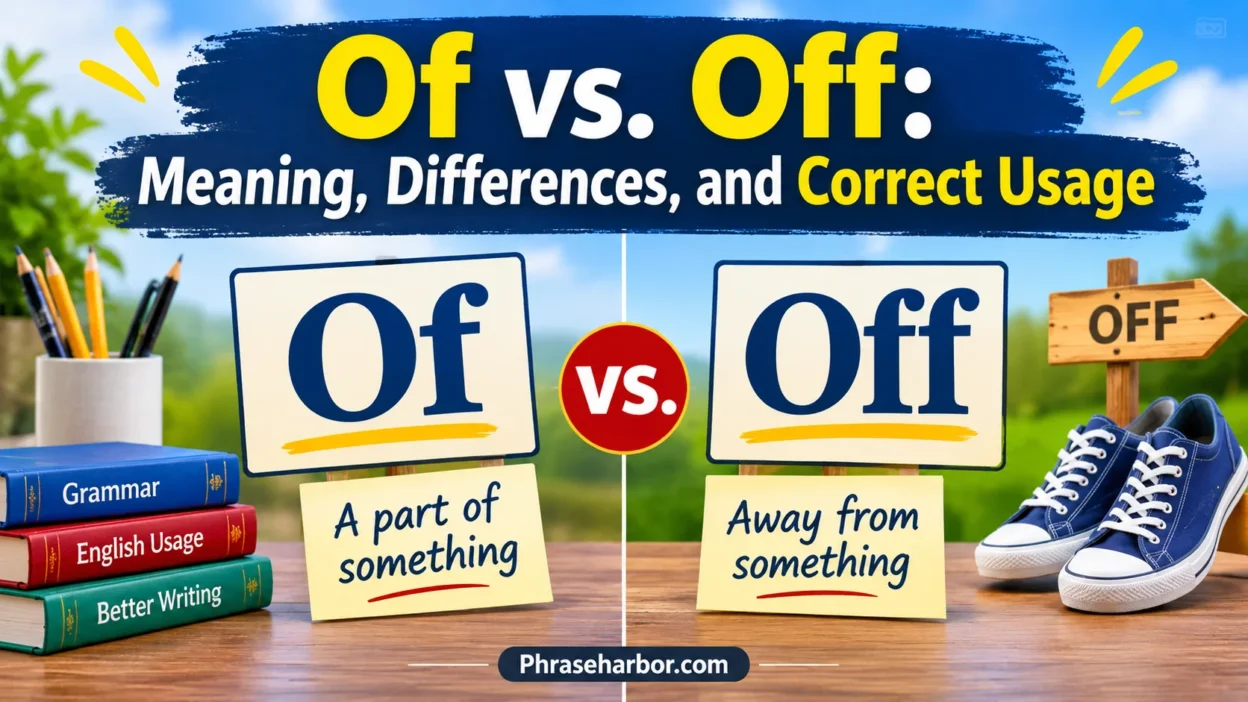
The main difference comes down to their purpose. Of expresses relationships, connections, possession, composition, and quantities. Off, on the other hand, generally describes separation, removal, disconnection, or movement away from something. For example, you might say “the cover of the book” to identify a relationship between two things. However, you would say “take the cover off the book” to describe removing it.
Quick Answer
Of is a preposition that expresses relationships between people, objects, places, quantities, and ideas. It commonly indicates possession, belonging, material, origin, and parts of a whole.
Off can function as a preposition, adverb, or adjective. It generally describes separation, removal, movement away, disconnection, or an inactive state.
Consider these examples:
- Of: She drank a glass of water.
- Off: Please turn off the television.
- Of: The handle of the door is broken.
- Off: He took his jacket off.
- Of: A group of students entered the classroom.
- Off: The cat jumped off the table.
Easy memory trick: Think of of as a word that connects things. Think of off as a word that separates things or describes something moving away.
Comparison Overview
Although these words share several letters, their grammatical functions and meanings differ considerably. The following table highlights their main distinctions.
| Feature | Of | Off |
| Part of speech | Primarily a preposition | Preposition, adverb, adjective |
| Main meaning | Relationship or connection | Separation or removal |
| Common use | Possession, quantity, composition, origin | Movement, disconnection, removal |
| Pronunciation | /əv/ or /ʌv/ | /ɔːf/ or /ɑːf/ |
| Final sound | Voiced /v/ | Voiceless /f/ |
| Example | A bottle of milk | Take off your shoes |
| Common expression | Of course | Off limits |
| Typical function | Connects related ideas | Indicates separation or a change of state |
The simplest way to distinguish these words is to examine what the sentence communicates.
For instance, “the color of the car” describes a relationship between the color and the vehicle. Meanwhile, “the paint came off the car” describes something being removed.
Remember: If you mean connection or belonging, you probably need of. If you mean separation or removal, off is usually the correct choice.
What Does Of Mean?
Of is a common English preposition that connects nouns, pronouns, and other elements to express relationships. It helps explain how different people, objects, places, quantities, and concepts relate to one another.
You will frequently encounter this word in everyday conversations, academic writing, professional communication, and descriptive sentences.
For example:
- The pages of the book are damaged.
- She is a friend of my sister.
- A cup of tea would be wonderful.
- The history of America is fascinating.
In these examples, of connects two related elements. It doesn’t describe something moving away or being removed.
Here are its most important uses.
Of to Show Possession or Belonging
One common function of of involves showing a relationship between an object and the person, place, or thing associated with it.
Although English often uses apostrophe-based possessives, of remains useful for expressing possession and association.
Examples:
- The roof of the house needs repairs.
- The name of the teacher appears on the document.
- The responsibilities of a manager can be demanding.
- The traditions of this community are fascinating.
- The future of the company looks promising.
Notice how of connects an object or idea with something it belongs to or relates to.
For example, “the roof of the house” identifies which roof you mean. Similarly, “the responsibilities of a manager” identifies the responsibilities associated with that position.
Important distinction: English often prefers the apostrophe-s construction for people and animals. For example, “Sarah’s book” sounds more natural than “the book of Sarah” in ordinary conversation.
Of to Show a Part or Portion
When you describe one part of something larger, of helps identify the relationship between the portion and the complete object.
This usage appears frequently in cooking, shopping, measurements, and everyday conversations.
Examples:
- A piece of chocolate
- A slice of bread
- A corner of the room
- The middle of the road
- A section of the report
- A part of the problem
Consider this sentence:
“She ate a piece of chocolate after dinner.”
The word of connects the individual piece with the larger quantity of chocolate.
Similarly, “the middle of the road” identifies a specific portion within a larger physical space.
Without of, these expressions would lose their intended grammatical relationship.
Of to Show Quantity or Amount
Another important use of of involves quantities, measurements, containers, and groups.
It frequently appears after words that describe amounts or collections.
Examples:
- Two liters of water
- A bottle of juice
- Three kilograms of rice
- A handful of almonds
- A group of tourists
- A collection of photographs
- A lot of people
This construction makes it easier to describe exactly what a quantity contains.
For instance, “a bottle of juice” identifies the liquid inside the container. Similarly, “a group of tourists” identifies the people who make up that group.
You will also see of in expressions involving percentages and fractions.
Examples:
- Half of the students passed.
- Twenty percent of the employees work remotely.
- Most of the information was accurate.
- One-third of the cake remained.
These examples demonstrate how of connects quantities with the things being measured or counted.
Of to Show Material or Composition
Use of when explaining what something consists of or identifying its material.
This construction commonly appears in product descriptions, everyday conversations, and descriptive writing.
Examples:
- The necklace is made of gold.
- The table is made of solid wood.
- The wall consists of several layers of stone.
- The sculpture is made of marble.
- The basket is filled with pieces of fabric.
The phrase made of deserves particular attention.
It generally describes the material from which an object is constructed when that material remains recognizable.
For example, a wooden chair is made of wood. A gold ring is made of gold.
Compare these expressions:
| Expression | Meaning |
| Made of wood | Constructed from wood |
| Made of glass | Constructed from glass |
| Made of metal | Constructed from metal |
| Made of cotton | Constructed from cotton |
You can also use made from when the original materials undergo a noticeable transformation.
For example, paper is made from wood pulp. The original wood doesn’t remain recognizable as a wooden object.
Of to Show Origin or Association
The preposition of can identify someone’s geographical origin, background, identity, or association with a particular group.
Examples:
- She is a citizen of Canada.
- The people of America have diverse backgrounds.
- He is a native of Chicago.
- The culture of Japan has influenced many artistic traditions.
- The residents of this neighborhood organized a community event.
In these sentences, of establishes a connection between people and their geographical or cultural identities.
It can also describe membership or association.
For example:
- A member of the committee
- A representative of the organization
- A graduate of the university
- A supporter of the team
These constructions help identify someone’s relationship with a particular institution or group.
Read More: Idiom vs. Proverb: Meaning, Examples, and Correct Usage
Of to Identify Characteristics or Qualities
Sometimes of introduces a quality, characteristic, or important feature associated with a person or thing.
Examples:
- She is a woman of great courage.
- His decision was of considerable importance.
- The project is of great value.
- They are people of strong character.
- Her actions were of particular interest.
These expressions often appear in formal writing, although they also work in everyday communication.
For example, describing someone as “a person of integrity” means that the individual demonstrates honesty and strong moral principles.
Similarly, saying something is “of great importance” emphasizes its significance.
Of in Common Expressions and Fixed Phrases
English contains many established expressions that require of. Learning these phrases can help you avoid spelling mistakes and improve your fluency.
Here are some frequently used examples:
| Expression | Meaning | Example |
| Of course | Certainly or naturally | Of course, I’ll help you. |
| Because of | For the reason that | We stayed home because of rain. |
| Instead of | In place of something | She drank tea instead of coffee. |
| Out of | From inside or beyond | He walked out of the room. |
| In front of | Ahead of something | The car stopped in front of the house. |
| In spite of | Despite something | They continued in spite of difficulties. |
| Regardless of | Without considering something | Everyone can participate regardless of age. |
| A lot of | A large quantity | We have a lot of work today. |
| Kind of | A type or degree | This is a kind of flower. |
| Full of | Containing a large amount | The box is full of toys. |
Pay particular attention to of course. Many people mistakenly write “off course” when they intend to express agreement or certainty.
The two expressions have different meanings, which becomes clearer when examining off.
What Does Off Mean?
Off is an English word that can function as a preposition, adverb, or adjective. Its meaning depends on how you use it in a sentence.
Unlike of, which primarily connects related ideas, off often communicates separation, removal, disconnection, or movement away from something.
Examples:
- Take your shoes off.
- The airplane took off.
- Please switch off the lights.
- The television is off.
- The island is located off the coast.
These sentences demonstrate that off has several grammatical uses.
Let’s examine its most important meanings.
Off to Show Separation or Removal
One of the most common uses of off involves describing something being removed from a surface or separated from another object.
Examples:
- Take your shoes off before entering.
- She wiped the dust off the table.
- He pulled the sticker off the window.
- The child took the lid off the container.
- Please remove the cover off the machine.
The last example illustrates an important usage distinction. In standard English, “remove the cover from the machine” is more natural than “remove the cover off the machine.”
However, “take the cover off the machine” is perfectly natural.
In each correct example, off indicates that something moves away from its previous position.
Off to Show Disconnection or Deactivation
Use off when describing a device, machine, or electrical system that has stopped operating.
This usage is especially common in modern conversations involving technology and household equipment.
Examples:
- Turn off the television.
- Switch off your phone during the meeting.
- The computer is off.
- Please turn off the kitchen lights.
- The air conditioner is off because of a power outage.
The word can also describe a connection that no longer exists.
For example:
“The internet went off during the online meeting.”
This sentence communicates an interruption in the internet connection.
Another example is “The alarm went off.” Interestingly, this phrasal expression usually means that the alarm started making noise rather than stopped operating.
Context determines the intended meaning.
Off to Show Movement Away
Off can describe someone or something moving away from a particular position, surface, or location.
Examples:
- The airplane took off at noon.
- The dog jumped off the sofa.
- She walked off the stage.
- The cyclist fell off his bicycle.
- The train pulled off the platform.
In these examples, the word communicates movement away from a starting point.
Some expressions involving movement have established meanings beyond their individual words.
For example, take off means to leave the ground when describing an aircraft.
It can also mean to remove clothing or accessories:
- The plane took off successfully.
- He took his jacket off.
The surrounding sentence tells you which meaning applies.
Off to Describe Something That Is Not Operating
As an adjective, off can describe a device, system, or service that isn’t operating.
Examples:
- The television is off.
- The heating system is off.
- The water supply is off.
- The machine remains off until further notice.
However, off has other adjective meanings too.
It can describe something unusual, incorrect, unpleasant, or different from normal.
Examples:
- Something seems off about his explanation.
- The milk smells off.
- I felt a little off this morning.
- The numbers in the report look off.
In these examples, off doesn’t mean disconnected or physically separated.
Instead, it suggests that something isn’t quite right.
For example, if milk smells off, it may have spoiled. If someone feels off, they might feel slightly unwell or unusual.
Frequently Asked Questions
What Is the Main Difference Between Of and Off?
Of expresses relationships such as possession, belonging, composition, quantity, and association. Off generally indicates separation, removal, movement away, or disconnection. For example, “a piece of cake” uses of to identify a portion, while “take the cake off the table” uses off to describe removal.
Is Of a Preposition or an Adverb?
Of is primarily a preposition in standard English. It introduces relationships between nouns, pronouns, and other sentence elements. Examples include “a bottle of water,” “the cover of the book,” and “a friend of mine.” It doesn’t normally function as an adverb.
Is Off a Preposition or an Adverb?
Off can function as a preposition, adverb, or adjective. For example, “jump off the chair” uses it as a preposition. “Take your shoes off” uses it as an adverb, while “the television is off” uses it as an adjective.
How Do You Pronounce Of and Off?
In standard American English, of generally sounds like /əv/ when unstressed, while off commonly sounds like /ɔːf/ or /ɑːf/, depending on the accent. The final /v/ in of is voiced, while the /f/ in off is voiceless. This difference helps distinguish the words when speaking.
Is It Of Course or Off Course?
Both expressions are correct, but they have different meanings. Of course means certainly or naturally. Off course describes something that has moved away from its intended direction. For example, “Of course, I’ll help you” expresses agreement, while “The plane went off course” describes a navigation problem.
Conclusion:
Understanding of vs. off becomes much easier when you focus on what each word communicates. Although their spellings differ by just one letter, their meanings and grammatical functions are quite distinct. Of primarily expresses relationships, possession, quantities, composition, origin, and association. You’ll find it in familiar phrases such as “a glass of water,” “the history of America,” and “of course.”