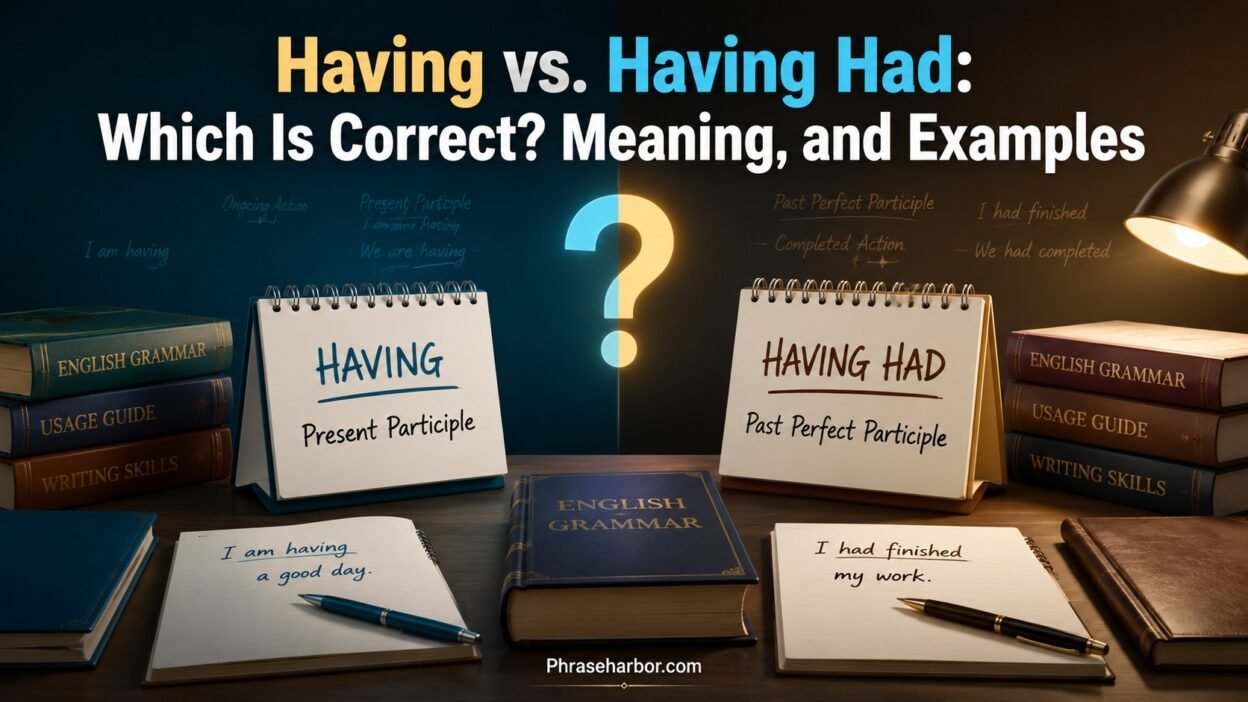
Having and having had look almost identical, but they don’t always communicate the same meaning. The difference becomes especially important when you want to show whether one action happened at the same time as another action or happened earlier.
Both sentences are grammatically possible. However, they create different relationships between the actions. In the first sentence, having breakfast can suggest an activity occurring around the same time as reading. In the second, having had breakfast clearly places breakfast before leaving.
The confusion often comes from treating having and having had as two different tenses. They aren’t. Having is the present participle of have, while having had is a perfect participial construction. The word had is the past participle of have.
Quick Answer
Having and having had are both correct, but you use them for different grammatical purposes.
Having is the present participle of have. Depending on the sentence, it can describe possession, an experience, a state, or an activity.
Examples:
- Having enough money makes life easier.
- Having lunch, she checked her phone.
- Having a reliable car is useful.
Having had consists of having + had, where had is the past participle of have. It forms a perfect participle and normally shows that the event or experience happened before the main action.
Examples:
- Having had breakfast, she left for work.
- Having had enough sleep, he felt refreshed.
- Having had several years of experience, she handled the situation confidently.
A simple rule helps:
Use “having” for the basic participial idea. Use “having had” when you need to show that having something happened before another action.
However, context matters. You shouldn’t automatically replace having with having had whenever you’re talking about the past.
Comparison Overview
The easiest way to understand having vs. having had is to compare their structures and meanings directly.
| Form | Grammatical role | Typical meaning | Example |
| having | Present participle | Possession, state, experience, or activity | Having enough time helps. |
| having + past participle | Perfect participle | An earlier completed action | Having finished dinner, we left. |
| having had | Perfect participle of have | An earlier experience, possession, or activity involving have | Having had dinner, we left. |
| had had | Past perfect | An earlier past event | We had had dinner before they arrived. |
| have/has been having | Present perfect continuous | An activity or situation continuing or recurring into the present | She has been having problems. |
| had been having | Past perfect continuous | An activity or situation continuing before a past point | She had been having problems before the meeting. |
The important point is that these forms don’t simply represent different versions of the same tense.
For example, having had isn’t the participial equivalent of the simple past had. Instead, it uses a perfect construction to establish a relationship between two events.
Main Differences Between Having vs. Having Had
The central difference involves structure and time relationship.
Having is the present participle of “have”
The word having is formed by adding -ing to have.
It can appear in several structures:
- Having a car is convenient.
- Having enough information helps us decide.
- Having lunch, he answered his phone.
- She enjoys having friends over.
The exact meaning depends on the surrounding words.
Notice something important: calling having the present participle doesn’t mean that it always describes something happening in the present.
Participles don’t work like ordinary finite verb tenses. Their time reference comes from the sentence and the larger context.
Having had creates a perfect participle
In having had, the first word is the participle having, while had is the past participle of have.
The structure is:
having + past participle
For the verb have, the past participle is had.
Therefore:
having + had = having had
For example:
Having had breakfast, Maria left the house.
The sentence presents two events:
- Maria had breakfast.
- Maria left the house.
The breakfast happened first. The perfect participle makes that sequence clear.
The difference is often about chronology
Compare these sentences:
Having dinner, James watched television.
and:
Having had dinner, James watched television.
The first sentence can suggest that the two activities overlap. James was eating dinner while watching television.
The second sentence says that dinner was already finished before he watched television.
That distinction is the heart of having vs. having had.
What Does “Having” Mean?
Having has several uses in English. Its meaning depends heavily on what comes after it.
Having + noun
When having comes before a noun, it can express possession, experience, a condition, or participation in an activity.
Examples include:
- Having enough money gives you more choices.
- Having a good teacher can change how you learn.
- Having a headache made it difficult to concentrate.
- Having breakfast before work helps me stay focused.
In these examples, having doesn’t necessarily describe something happening at one specific moment.
For example:
Having a driver’s license is useful.
This sentence refers to possessing a license. It isn’t describing an action that someone is actively performing.
Likewise:
Having experience in customer service is valuable.
Here, having experience describes possession of experience rather than a single completed event.
Having can describe an activity
English commonly uses have with activities:
- have breakfast
- have lunch
- have dinner
- have a shower
- have a conversation
- have a meeting
- have a discussion
- have a break
The -ing form can therefore describe participation in those activities.
For example:
Having lunch, we discussed the new project.
The sentence can suggest that lunch and the discussion occurred together.
However, if lunch had already finished, having had lunch may make the sequence clearer:
Having had lunch, we discussed the new project.
What Does “Having Had” Mean?
Having had is used when have itself needs a perfect participial form.
The construction generally shows that an experience, possession, activity, or condition involving have occurred before another action.
Consider:
Having had enough sleep, I felt ready for the exam.
There are two ideas:
- I had enough sleep.
- I felt ready for the exam.
The first happened before the second.
Another example:
Having had several years of experience, Sarah knew exactly what to do.
Sarah’s experience existed before the situation in which she used that experience.
This is different from:
Having several years of experience, Sarah applied for the position.
Here, having several years of experience describes a qualification or existing condition. It doesn’t necessarily present the experience as a completed event immediately before the application.
Understanding the Perfect Participle
The technical term behind having had is the perfect participle.
The general pattern is:
having + past participle
Examples include:
- having finished
- having eaten
- having arrived
- having completed
- having seen
- having forgotten
- having written
For the verb have, the past participle is had:
- having + had
- having had
This construction normally establishes that the participial action occurred before the action in the main clause.
Example: Having finished
Having finished the report, Daniel sent it to his manager.
Timeline:
finished report → sent report
Example: Having eaten
Having eaten dinner, they went for a walk.
Timeline:
ate dinner → went for a walk
Example: Having had
Having had dinner, they went for a walk.
Timeline:
had dinner → went for a walk
The difference between having eaten dinner and having had dinner is mostly lexical. Eat dinner focuses on eating, while have dinner uses the common expression for taking the meal.
Having vs. Having Had: Examples That Show the Difference
Paired examples are one of the best ways to understand this grammar point.
Example: Having breakfast vs. having had breakfast
Having breakfast, I read the newspaper.
This can suggest that breakfast and reading happened together.
Having had breakfast, I left for work.
Here, breakfast came first.
A simpler alternative to the second sentence is:
After breakfast, I left for work.
The alternative may sound more natural in everyday conversation.
Example: Having experience vs. having had experience
Having experience in marketing is useful.
This describes experience as a qualification.
Having had experience in marketing, she understood the campaign’s problems.
Here, the previous experience helps explain what happened afterward.
The second sentence places greater emphasis on the experience that existed before the later event.
Example: Having problems vs. having had problems
Having problems with the software can delay the project.
This refers generally to experiencing software problems.
Having had problems with the software before, we backed up everything.
The previous problems happened before the decision to create a backup.
That small change makes the chronology much clearer.
When Should You Use “Having”?
Use having when you don’t need to emphasize that the having occurred before another action.
Common situations include possession, conditions, experiences, and activities.
Use having for possession or a state
Examples:
- Having enough money gives you flexibility.
- Having a passport is essential for international travel.
- Having good communication skills helps at work.
These sentences don’t focus on one completed event.
Use having for an activity happening around another action
Example:
Having dinner, we talked about our plans.
The dinner and conversation can overlap.
Another example:
She listened to music while having a bath.
The two activities happen at the same time.
Use having when the broader context already makes the sequence obvious
Sometimes adding had doesn’t improve the sentence.
Compare:
Having lunch, we discussed the proposal.
with:
Having had lunch, we discussed the proposal.
If the intended meaning is simply that the discussion happened during lunch, the first sentence fits better.
If the discussion happened afterward, the second sentence can be more precise.
When Should You Use “Having Had”?
Use having had when you want to show that an experience or event involving have happened before the main action.
To show an earlier meal or activity
Having had breakfast, she went to the airport.
Breakfast came before going to the airport.
To show a previous experience
Having had several interviews, he knew what questions to expect.
The interviews happened before the later situation.
To show a previous problem
Having had problems with the system before, the team tested it carefully.
The previous problems influenced the later action.
To show a previous opportunity or period
Having had enough time to prepare, the students felt confident.
The preparation period came before the later feeling of confidence.
The construction is especially useful when the earlier event explains the result in the main clause.
Read More: Sorry for Bothering You vs. Sorry to Bother You: What’s the Difference?
Having vs. Having Had in Formal Writing
Neither form is automatically more correct or more sophisticated.
That’s worth emphasizing because writers sometimes assume that having had sounds more advanced.
It doesn’t.
Good writing chooses the construction that expresses the intended relationship clearly.
Compare:
Having had dinner, we returned to the office.
with:
After dinner, we returned to the office.
Both are grammatical. The second is shorter and may sound more natural.
Likewise:
Having had several years of experience, she managed the project successfully.
is perfectly reasonable when the writer wants a compact participial construction.
The best choice depends on clarity, rhythm, and context rather than formality alone.
Having Had vs. Had Had
This is one of the most confusing parts of the topic because had had looks unusual.
Yet it is completely grammatical.
Consider:
She had had breakfast before the meeting began.
The first had is the past-perfect auxiliary.
The second had is the past participle of have.
So the structure is:
had + had
The same verb appears twice because it performs two different grammatical jobs.
Having had
Having had breakfast, she went to work.
This is a perfect participial construction.
Had had
She had had breakfast before she went to work.
This is a past perfect construction.
The meanings are related, but the grammatical structures differ.
| Sentence | Structure | Function |
| Having had breakfast, she left. | having + had | Perfect participle |
| She had had breakfast before she left. | had + had | Past perfect |
| She was having breakfast when he arrived. | was + having | Past continuous |
| She has been having breakfast early lately. | has + been + having | Present perfect continuous |
Once you identify the grammatical role of each word, had had becomes much less mysterious.
Having Had vs. Have Been Having
Another common mistake involves confusing having had with have been having.
Consider:
I have been having problems with my computer.
This is present perfect continuous.
It describes a problem or activity that has continued or occurred repeatedly over a period connected to the present.
Now compare:
Having had problems with my computer before, I save my work frequently.
The second sentence uses a perfect participle. It refers to previous problems that influence a current decision.
The structures are completely different.
Have been having
have/has + been + having
Example:
She has been having trouble sleeping.
Having had
having + had
Example:
Having had trouble sleeping before, she changed her routine.
The first construction focuses on an ongoing or recent situation. The second focuses on an earlier experience.
FAQs:
Is “having had” grammatically correct?
Yes. Having had is a standard perfect participial construction. It combines having with the past participle had.
For example:
Having had enough time to prepare, she felt confident.
Is “having had” a tense?
No. Having had is not a finite verb tense such as the simple past or present perfect. It is a perfect participial construction.
Is “having” always present tense?
No.
Having is a present participle, but that doesn’t mean every sentence containing having refers to the present.
For example:
Having dinner, they watched the game.
The actual time reference comes from the larger sentence and context.
Is “having had” more formal than “having”?
Not necessarily.
The two forms perform different grammatical functions. You should choose based on meaning and chronology rather than formality.
Is “having had breakfast” correct?
Yes.
Having had breakfast, I went to work.
This means that breakfast happened before going to work.
Conclusion:
Understanding having vs. having had becomes much easier when you focus on meaning rather than memorizing tense names. Having is the present participle of have and can describe possession, a state, an experience, or an activity. Having had, on the other hand, is a perfect participial construction that usually shows an earlier experience or action before the main event.The key is chronology. If two activities happen together, having may be appropriate. If an experience or action happened first and you want to make that sequence clear, having had can do the job.