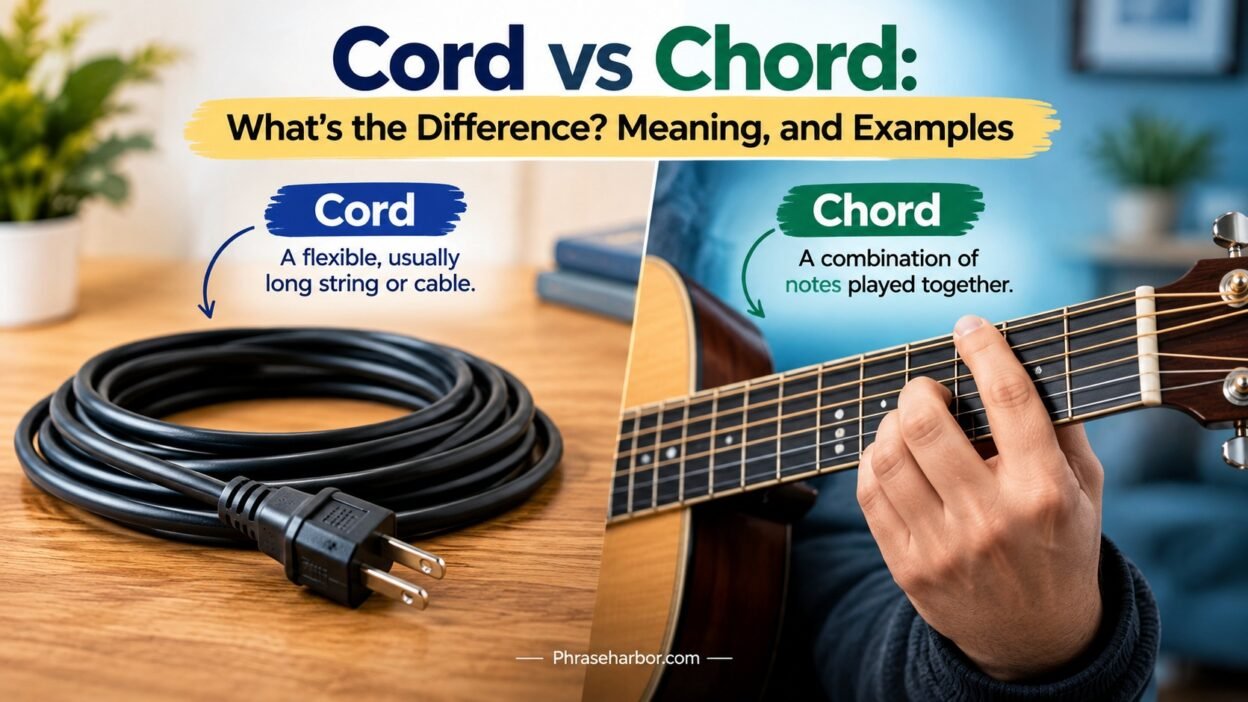
The short answer is that cord and chord are correct English words, but they have completely different meanings. Cord vs Chord can seem confusing because both words have the same sound, but their meanings, spellings, and uses in English are completely different.
They are homophones because their sound is exactly alike in spoken English, even though their spellings differ. A cord can mean a rope, cable, wire, string, or flexible string, while a chord can mean a group of musical notes in music or a straight line connecting two points on a curve in mathematics and geometry.
This difference is a common source of confusion for students, writers, musicians, and English learners, especially when pronunciation makes both choices sound the same.From my experience with writing, this is one of those spelling issues that becomes easier once you connect each word with its usual context.
Quick Answer
Cord and chord are homophones. They sound alike but have different spellings and meanings.
- Cord usually means a string, rope, cable, or cord-like structure.
- Chord usually means a combination of musical notes played together.
- Chord also has a mathematical meaning: a line segment connecting two points on a circle or curve.
- Cord can refer to anatomical structures such as the spinal cord and umbilical cord.
- Cord can also mean a standard quantity of firewood.
- Chord appears in the expression “strike a chord,” meaning to create a strong emotional or intellectual response.
The easiest memory trick
Think of H = harmony.
If you’re talking about musical harmony, you probably need chord.
If you’re talking about a cable, rope, string, body structure, or similar physical object, you probably need cord.
| Word | Main meaning | Example |
| Cord | String, rope, cable, or similar structure | “The lamp’s cord is damaged.” |
| Chord | Combination of musical notes | “She played a beautiful chord.” |
| Cord | Anatomical structure | “The spinal cord carries nerve signals.” |
| Chord | Line segment in geometry | “The diameter is a chord of the circle.” |
| Cord | Unit of firewood | “They bought a cord of wood.” |
| Chord | Figurative emotional connection | “The speech struck a chord with voters.” |
Comparison Overview
The clearest way to understand cord vs chord is to compare how each word works in real sentences.
| Feature | Cord | Chord |
| Pronunciation | Same | Same |
| Spelling | C-O-R-D | C-H-O-R-D |
| Most common meaning | String, rope, cable, or similar object | Musical combination of notes |
| Music | Usually refers to a physical cord only in general usage | A group of notes sounding together |
| Electricity | Power cord, extension cord | Incorrect in this context |
| Anatomy | Spinal cord, umbilical cord, vocal cords | Incorrect in these terms |
| Geometry | Not normally used | A line segment joining two points on a curve |
| Figurative expression | Not used in “strike a ___” | Strike a chord |
| Firewood | A cord of wood | Not used |
| Aeronautics | Not the standard term | Chord of an airfoil |
| Memory clue | Think cable or string | Think harmony |
The biggest trap is pronunciation. When you hear someone say either word, you can’t normally determine the spelling from the sound alone. Context has to do the heavy lifting.
That’s why spelling mistakes such as “vocal chord” and “extension chord” are common. The writer knows what the word sounds like but has to remember which meaning belongs to which spelling.
Main Differences Between Cord and Chord
At the heart of the cord vs chord difference lies one simple idea: cord usually describes something physical or cord-like, while chord commonly describes a musical or geometric relationship.
However, that rule isn’t perfect because both words have several meanings. Understanding those meanings gives you a much more reliable way to choose the correct spelling.
What Does Cord Mean?
Cord is a noun with several established meanings. Its most familiar meaning describes a flexible length of material made from strands, fibers, or similar material.
Think of something you can tie, pull, wrap, connect, or hang.
For example:
- “She tied the package with a piece of cord.”
- “The curtain cord snapped.”
- “The tent was secured with a strong cord.”
- “He used a cord to bundle the newspapers.”
Cord can describe something thinner than a rope or something designed for a particular purpose. The exact physical characteristics depend on the object being described.
Cord as an electrical cable
One of the most common modern uses appears in household and electronic contexts.
You might use:
- power cord
- extension cord
- electrical cord
- lamp cord
- computer power cord
For example:
“The extension cord isn’t long enough to reach the outlet.”
Here, cord refers to the flexible electrical cable connecting equipment to a power source.
Writing “extension chord” would change the meaning and produce a spelling error in this context.
Cord in anatomy
Medicine and biology also use cord for several structures that resemble a long bundle, strand, or cable.
Common examples include:
- spinal cord
- umbilical cord
- vocal cords
- spermatic cord
The spinal cord, for instance, forms part of the central nervous system and carries signals between the brain and much of the body.
The umbilical cord connects a developing fetus with the placenta during pregnancy.
Meanwhile, the vocal cords, more precisely called vocal folds, play a major role in producing sound.
These aren’t musical objects. Therefore, cord is the correct spelling.
What Does Chord Mean?
Chord has several meanings, but music is the one most people recognize first.
In music, a chord is a combination of musical notes that sound together.
You encounter chords everywhere in modern music:
- piano chords
- guitar chords
- major chords
- minor chords
- seventh chords
- chord progressions
- suspended chords
- power chords
For example:
“The guitarist played a G major chord.”
The word has nothing to do with a physical cable or piece of string.
A guitar itself has strings, while the guitarist uses those strings to produce individual notes and chords. That’s an important distinction.
Chord in geometry
Music isn’t the only field where chord has a technical meaning.
In geometry, a chord is a line segment whose endpoints lie on a curve.
When you’re studying circles, this definition becomes particularly useful.
Imagine a circle. Draw a straight line from one point on the circumference to another point on the circumference. That line segment is a chord.
A diameter is a special type of chord because it passes directly through the circle’s center.
Here’s the relationship:
- Radius: center to a point on the circle
- Diameter: straight line across the circle through its center
- Chord: line segment connecting two points on the circle
- Arc: curved portion of the circle’s circumference
Every diameter is a chord. Not every chord is a diameter.
That distinction matters in geometry problems because a chord can sit anywhere across a circle without passing through its center.
Chord in figurative language
The word chord also appears in the familiar expression “strike a chord.”
When something strikes a chord with you, it creates a strong emotional or intellectual reaction.
For example:
“The documentary struck a chord with young viewers.”
This doesn’t mean someone literally played a musical instrument. The expression draws on the musical idea of producing a meaningful sound or combination of notes.
You might also see:
- strike a chord
- strike a sympathetic chord
- touch a chord
These expressions often describe something that resonates with people’s feelings, memories, beliefs, or experiences.
Cord vs Chord in Music
Music provides one of the most important distinctions between these words.
When musicians talk about harmony, they use chord.
A chord can contain multiple notes that sound simultaneously. Different chord types create different musical qualities.
For example:
- A major chord often sounds bright or stable.
- A minor chord often creates a darker or more somber quality.
- A seventh chord adds another pitch to a basic triadic structure.
- A power chord commonly uses a root note and its fifth, sometimes with the octave doubled.
So if you’re writing about music, chord is almost always the word you want.
Chord vs string
This is where beginners sometimes stumble.
A guitar has strings. A guitarist can press different combinations of strings and frets to produce notes. Several notes played together can form a chord.
Therefore:
- guitar string = physical string
- guitar chord = musical combination of notes
Consider these examples:
Correct: “She learned her first guitar chord.”
Correct: “He replaced one of the guitar strings.”
Incorrect: “She learned her first guitar cord.”
The physical string and the musical chord belong to completely different concepts.
Power cord vs power chord
This pair is especially interesting because both expressions are correct, but they mean completely different things.
| Expression | Meaning |
| Power cord | Electrical cable that supplies power |
| Power chord | Musical chord commonly used in guitar-based music |
For example:
“The television’s power cord is damaged.”
But:
“The guitarist used a power chord during the chorus.”
One letter changes the meaning dramatically.
Cord vs Chord in Geometry
If music isn’t your area, you might encounter chord in mathematics instead.
A circle contains many possible chords. Any straight segment joining two points on the circumference qualifies.
Consider a circle with two points near the top. Connect those points with a straight line. You’ve created a chord.
Move the points farther apart and the chord becomes longer.
Place the points at opposite ends of the circle so the segment passes through the center. Now you’ve created a diameter, which is also the longest possible chord of that circle.
Chord, radius, and diameter
These terms are closely related but shouldn’t be mixed up.
| Geometric term | Definition |
| Radius | Segment from the center to the circle |
| Diameter | Chord passing through the center |
| Chord | Segment connecting two points on the circle |
| Arc | Curved portion of the circumference |
| Secant | A line that intersects a curve at two or more points |
A useful way to picture it is this:
Two points on a circle → connect them with a straight line → chord.
If that line passes through the center, you’ve got a diameter.
Cord vs Chord in Everyday Expressions
Everyday language contains several fixed expressions that make the difference easier to spot.
Common expressions with cord
You’ll often see cord in phrases involving physical objects or structures.
- extension cord
- power cord
- electrical cord
- telephone cord
- vocal cords
- spinal cord
- umbilical cord
- cord of wood
Examples:
“Unplug the power cord before cleaning the appliance.”
“The spinal cord is protected by the vertebral column.”
“They ordered a cord of firewood for winter.”
Common expressions with chord
Chord appears frequently in music, geometry, and figurative language.
- major chord
- minor chord
- guitar chord
- chord progression
- chord change
- chord of a circle
- strike a chord
- strike a sympathetic chord
Examples:
“The pianist moved from a minor chord to a major chord.”
“The campaign message struck a chord with many residents.”
“The segment is a chord of the circle.”
Once you recognize these common word partnerships, the spelling becomes much easier to predict.
Read More: Stalactite vs Stalagmite: What’s the Difference?
Cord: Common Meanings and Examples
Cord as a string or rope
The basic physical meaning is straightforward.
A cord can consist of twisted, braided, woven, or otherwise joined fibers or strands.
Examples:
- “The necklace was attached to a thin cord.”
- “He pulled the cord to open the curtain.”
- “The package was wrapped with cord.”
- “The climber carried several lengths of cord.”
The exact strength and construction vary depending on the purpose.
Cord as an electrical cable
Modern English uses cord extensively for electrical equipment.
A cord generally provides a flexible connection between an electrical device and a power source.
Examples:
- “The vacuum cleaner’s cord is tangled.”
- “Don’t use the damaged power cord.”
- “We need a longer extension cord.”
This meaning explains why power cord is so common while power chord is not.
Cord in anatomy
Anatomical structures often receive names based on their shape or function.
The spinal cord resembles a long cylindrical bundle of nervous tissue. The umbilical cord forms a flexible connection between the fetus and placenta.
Likewise, the vocal cords form structures involved in voice production.
These uses have nothing to do with musical harmony, so they take cord.
Cord as a measurement of firewood
Here’s a meaning many readers don’t encounter every day.
A cord is a traditional unit used to measure firewood. A full cord contains 128 cubic feet of stacked wood.
The conventional dimensions are:
4 feet × 4 feet × 8 feet = 128 cubic feet
The actual pieces of wood don’t need to form a perfect solid block because spaces naturally exist between pieces. The measurement refers to the stacked volume.
For example:
“The homeowner bought a cord of seasoned firewood.”
This is another case where cord has nothing to do with music.
Chord: Common Meanings and Examples
Chord in music
The musical meaning remains the most familiar.
A chord combines pitches into a harmonic unit. Chords help establish mood, tension, movement, and resolution within music.
A simple song might use only a few chords repeatedly. More complex compositions can use sophisticated chord changes and extended harmonies.
Examples:
- “The song begins with a C major chord.”
- “He practiced the chord progression for an hour.”
- “The pianist changed chords smoothly.”
- “She struggled with the barre chord at first.”
Cord vs Chord Examples in Sentences
The following examples show how context determines the correct word.
| Correct sentence | Explanation |
| “The lamp’s cord is too short.” | Electrical cable |
| “Tie the package with a cord.” | String or flexible material |
| “The doctor discussed the spinal cord.” | Anatomical structure |
| “They bought a cord of wood.” | Firewood measurement |
| “She played a beautiful chord.” | Musical notes |
| “The song uses a simple chord progression.” | Musical harmony |
| “The story struck a chord with readers.” | Emotional resonance |
| “The diameter is a chord of the circle.” | Geometry |
| “The airfoil’s chord affects its geometry.” | Aeronautics |
FAQs:
1. What is the difference between cord and chord?
Cord usually means a rope, cable, wire, or flexible string. Chord commonly refers to a group of musical notes played together or a straight line connecting two points on a curve in geometry.
2. Is it guitar cord or guitar chord?
The correct phrase is guitar chord when you mean a combination of musical notes played on a guitar. A guitar cord would only refer to a physical cable or cord associated with the guitar.
3. Is it extension cord or extension chord?
The correct term is extension cord. It means a flexible electrical cable used to extend the reach of a power connection. Extension chord is a spelling mistake in this context.
4. Are cord and chord homophones?
Yes. Cord and chord are homophones because they have the same pronunciation but different spellings and meanings. Their meanings depend on the context in which they appear.
5. How can I remember cord vs chord?
A simple memory trick is to connect cord with physical things such as ropes, cables, and wires. Think of chord in connection with music, where several musical notes form a chord.
Conclusion:
Although cord vs chord can be confusing because both words sound the same, their meanings are easy to separate once you remember their common uses. Cord refers to a physical rope, cable, wire, or string, while chord is mainly used for music and geometry.
When you’re writing, check the meaning before choosing the spelling. Use guitar chord for music and extension cord for an electrical cable. This small distinction can help you avoid common spelling mistakes and make your English clearer and more accurate.