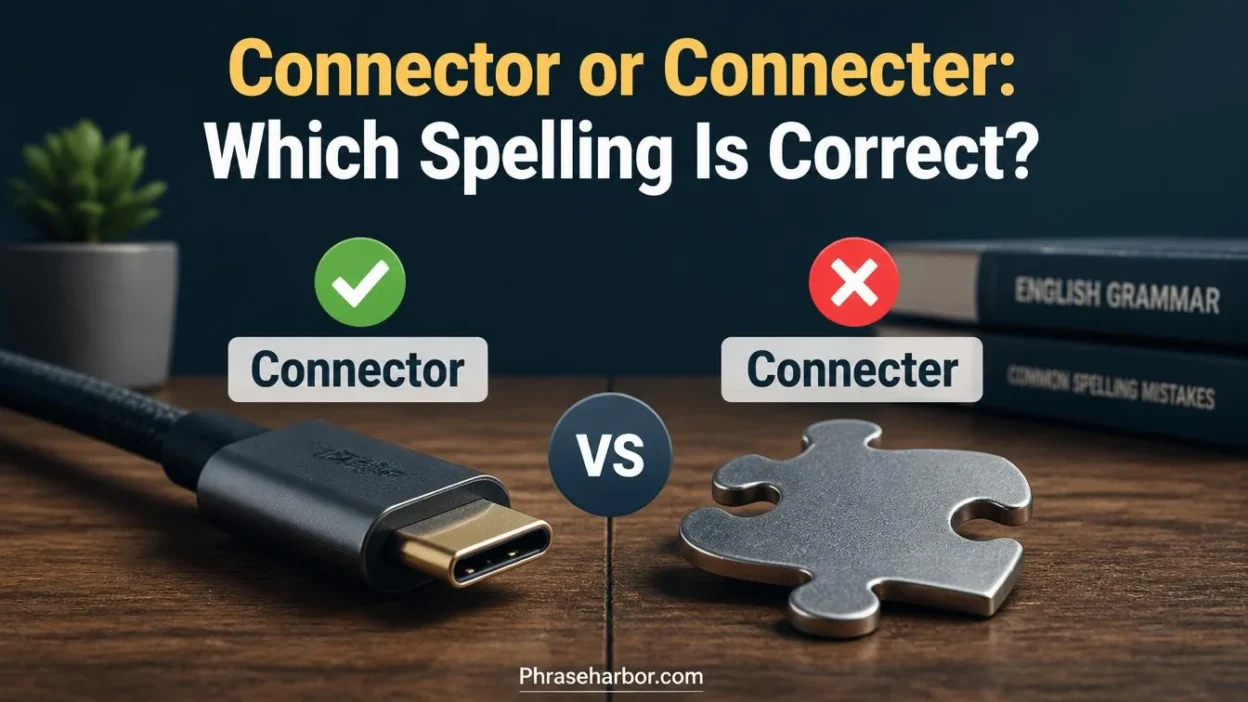
Have you ever wondered whether to write connector or connecter? Both spellings may look reasonable because they relate to the verb connect. However, only one is the standard choice for modern American English.
The correct spelling is connector. You’ll see it in technical manuals, electrical equipment descriptions, grammar lessons, and everyday writing. The word refers to a person or thing that connects two or more objects, ideas, or people.
Although connecter occasionally appears in written English, it remains uncommon. If you want your writing to look polished and professional, connector is the spelling to choose.
Understanding the difference is simple once you know how each word functions and why English uses the ending -or in this case. Let’s explore their meanings, spelling patterns, practical examples, and common mistakes.
Quick Answer:
Connector is the standard and preferred spelling in modern American English. It refers to a person, device, or component that connects things.
Connecter is a rare variant that most readers won’t expect in ordinary contemporary writing. For general, academic, professional, and technical purposes, use connector.
Consider these examples:
- Correct: The technician replaced the damaged USB connector.
- Correct: A good network connector helps people build professional relationships.
- Correct: The grammar lesson explains how each connector links ideas.
- Not recommended: The technician replaced the damaged USB connecter.
The key takeaway is straightforward: when you mean something or someone that connects, choose connector.
Comparison Overview
The following table summarizes the differences between connector and connecter.
| Feature | Connector | Connecter |
| Spelling status | Standard spelling | Rare variant |
| Part of speech | Noun | Noun in rare usage |
| Meaning | A person or thing that connects | Generally intended to convey the same meaning |
| Modern American English | Preferred | Generally avoided |
| Technical documents | Standard choice | Unusual |
| Everyday writing | Widely accepted | Rarely used |
| Best choice for your writing | Yes | No, unless reproducing a specific source |
The difference is primarily about conventional spelling, not meaning. Both forms are understandable in context, but connector is the established form you should use.
One important distinction: the fact that a spelling is rare doesn’t automatically make it impossible or meaningless. However, when two forms compete, standard usage and reader expectations matter. In this case, connector is the clear choice.
Main Differences Between Connector and Connecter
The main difference between connector and connecter is their accepted spelling in standard English. Both forms may suggest the same basic idea, but only connector is the conventional choice in modern writing.
Connector Is the Standard Spelling
The word connector appears across many fields, from electronics and engineering to grammar and business. Its meaning stays consistent: it identifies something or someone that establishes a connection.
For example, an electrical connector joins parts of a circuit. A grammatical connector links related ideas in a sentence. A professional connector brings people together who might benefit from knowing each other.
Here are a few natural examples:
- The mechanic checked every connector before starting the engine.
- This adapter has a connector that fits the charging cable.
- The writer used a transitional connector to link the two paragraphs.
- She became a valuable connector between local businesses and community groups.
In each sentence, connector names a person or thing that creates a link.
Connecter Is Rarely Used
Connecter follows a spelling pattern that might seem logical to English learners. After all, many nouns formed from verbs use the suffix -er, as in teacher from teach and builder from build.
However, English doesn’t form every noun with the same ending. Some established words use -or instead, including actor, operator, and connector.
You might encounter connecter in an older document, an unusual spelling choice, or a text that doesn’t follow modern conventions. That doesn’t make it the best option for your own writing.
If you’re writing an instruction manual, a school assignment, a product description, or a business email, use connector. It communicates your meaning without distracting readers with an unfamiliar spelling.
Do Connector and Connecter Have Different Meanings?
In ordinary use, the two spellings are generally intended to express the same meaning. The distinction isn’t comparable to the difference between affect and effect, which have different grammatical roles and meanings.
For example, someone writing connecter probably means a person or device that connects things. Readers may understand the intended meaning, but the spelling can look incorrect or inconsistent.
Practical rule: Don’t choose connecter to express a special technical meaning. Use connector unless you’re quoting a source or preserving the exact wording of a document.
What Does Connector Mean?
A connector is a noun that describes a person, object, or component that connects two or more things. Depending on the context, that connection can be physical, electrical, grammatical, digital, or social.
The word comes from connect, a verb meaning to join, link, or bring things together. The suffix -or helps form a noun that identifies a person or thing associated with an action.
For example, a cable connector joins a cable to a device. A sentence connector links ideas, while a social connector introduces people who share interests or goals.
The surrounding words usually make the intended meaning clear.
Connector in Technology and Electronics
In electronics, a connector is a component that joins electrical circuits or connects a cable to a device. It helps establish the physical contact needed to transfer electrical signals, power, or data.
Connectors come in many shapes and sizes. Their designs depend on the equipment, the type of connection, and the performance requirements.
Common examples include:
- USB connector: Connects compatible devices to transfer data or supply power.
- HDMI connector: Carries digital video and audio between compatible devices.
- Ethernet connector: Connects network cables to equipment such as routers, switches, and computers.
- Electrical wire connector: Joins wires or connects them to electrical components.
- Audio connector: Connects microphones, headphones, speakers, or other audio equipment.
Although these components perform different tasks, they share the same basic purpose: they create a connection between compatible parts.
A connector’s shape, size, pin arrangement, and electrical rating can affect whether it works safely and correctly. Two connectors may look similar but still be incompatible. For example, a cable that physically fits a port doesn’t necessarily support the required data speed or power level.
Example: “The technician inspected the power connector before replacing the faulty cable.”
Here, connector refers to the physical component that establishes the electrical connection.
Connector in Grammar
In grammar and writing, a connector is a word or phrase that links ideas, clauses, sentences, or sections of a text. These expressions help readers understand how one thought relates to another.
Writers also use the terms linking word, transition word, and connective. Their precise meanings can vary by grammatical framework, but they often describe related functions.
Consider these common examples:
| Connector | Function | Example |
| And | Adds information | Maya bought a notebook and a pen. |
| But | Shows contrast | The device is small but powerful. |
| Because | Gives a reason | We stayed inside because it rained. |
| However | Introduces contrast | The plan looked promising. However, it was expensive. |
| Therefore | Shows a result or conclusion | The road was closed; therefore, we took another route. |
| Although | Introduces a contrast or concession | Although it was late, they continued working. |
| For example | Introduces an illustration | Several connectors carry data. For example, USB-C supports data transfer. |
Connectors improve the flow of writing when they express a clear relationship between ideas. However, adding them mechanically can make a paragraph sound repetitive.
For instance, a paragraph that begins every sentence with however, therefore, or moreover may feel stiff. Choose the connector that matches the relationship you want to express, and leave it out when the relationship is already clear.
Example: “The first design was inexpensive. However, the revised model lasted longer.”
The word however connects the two statements by highlighting a contrast.
Read More: Heyday or Hayday: Which Spelling Is Correct?
Connector in Social and Professional Contexts
A connector can also describe someone who brings people together. This person may introduce colleagues, link businesses with potential customers, or help community members find useful resources.
Imagine a business owner who knows a reliable graphic designer, a marketing consultant, and several local shop owners. By introducing people who can help one another, the business owner acts as a connector.
In this context, the word describes a social role rather than a physical object.
Examples include:
- The conference organizer is a connector who helps entrepreneurs meet potential partners.
- Our community connector introduced the nonprofit to several local volunteers.
- He became a trusted connector between the design team and its clients.
The term is especially useful when describing networking, collaboration, and relationship-building. It emphasizes the ability to create useful connections rather than simply knowing many people.
Connector in Networks and Communication
The word connector also appears in computing and communication systems. Depending on the context, it may refer to a physical interface, a software component, or a service that links different systems.
For example, a physical network connector joins a cable to networking equipment. In software, a connector may allow one application to exchange information with another service.
A business platform might use a connector to import customer records from another system. An automation tool might use one to transfer information between a form and a spreadsheet.
These examples share the same underlying concept: a connector enables two separate things to interact or exchange something.
However, the exact meaning depends on the field. When writing technical documentation, define the type of connector if readers might confuse a physical component with a software integration.
What Does Connecter Mean?
Connecter is an uncommon spelling variant associated with the noun connector. It may appear in certain texts, but it isn’t the standard spelling readers generally expect in modern American English.
The spelling can seem reasonable because the suffix -er frequently turns verbs into nouns. Someone who teaches is a teacher, and someone who builds is a builder. By analogy, a person or object that connects might appear to be a connecter.
English spelling, however, doesn’t follow one universal rule for every noun formed from a verb. Established word forms often depend on historical development and conventional usage.
For that reason, it’s best not to assume that a plausible spelling is also the accepted one.
Is Connecter Always Wrong?
Calling connecter universally impossible would be too strong. Rare variants can occur in historical records, specialized sources, or individual writing.
Still, that doesn’t mean the two spellings are equally suitable for everyday use. If you’re writing for a modern American audience, connector is the safer and more recognizable form.
Consider these situations:
- School assignment: Use connector.
- Product listing: Use connector.
- Engineering report: Use connector.
- Business email: Use connector.
- Historical quotation: Preserve connecter if that is the exact spelling in the original text.
The final example is different because quotations should represent their sources accurately. If you reproduce an old document, changing its spelling without explanation may alter the original text.
Outside such cases, there’s little practical reason to choose connecter.
Why Connecter Can Look Correct
English spelling often encourages people to apply familiar patterns to unfamiliar words. That’s a useful strategy, but it doesn’t always produce standard spellings.
The suffix -er appears in many agent nouns, including runner, writer, and programmer. Meanwhile, -or appears in words such as editor, inventor, and operator.
Neither suffix works as a universal shortcut for predicting every noun. Some spellings must simply be learned as established word forms.
If you remember connector as the conventional noun derived from connect, you won’t need to reconsider the spelling each time you use it.
Why Is Connector the Preferred Spelling?
The preference for connector comes from established English usage. Although spelling patterns can help you predict how words are written, convention determines which form readers recognize as standard.
The Spelling Pattern Behind Connector
The word connector consists of the base verb connect and the noun-forming suffix -or. This combination produces a noun that identifies something or someone that connects.
– Connect + -or = connector
The spelling retains the final t from connect and adds -or. It doesn’t drop the final consonant or change the base word.
You can see a similar suffix in other English nouns:
| Verb | Related noun |
| Connect | Connector |
| Invent | Inventor |
| Operate | Operator |
| Educate | Educator |
| Inspect | Inspector |
| Direct | Director |
These examples demonstrate a familiar pattern, although they don’t establish a rule that applies to every English verb.
Why Isn’t It Connecter?
The spelling connecter applies the suffix -er instead. That ending is common in English, but its familiarity doesn’t make it the preferred spelling for every word.
Compare these examples:
- Teach → teacher
- Build → builder
- Drive → driver
- Connect → connector
Notice that the final example uses a different suffix from the first three. English contains many such variations, so learning the established form is often more reliable than trying to create a word by analogy.
A useful memory trick is to associate connector with familiar words such as operator and inspector. Each uses the ending -or.
Connector or Connecter: Examples in Sentences
Examples make the spelling difference easier to recognize. The following sentences show how connector works in everyday, professional, technical, and grammatical contexts.
Everyday Examples
- The phone charger has a damaged connector.
- Please check the connector before plugging in the cable.
- This adapter includes a connector for older devices.
- The loose connector caused the lamp to stop working.
- We need a stronger connector to join these two pieces.
FAQs:
Is Connector or Connecter Correct?
Connector is the standard spelling in modern American English. It refers to a person, device, or component that connects things. Connecter is a rare variant and generally isn’t recommended for ordinary writing.
Is Connecter Ever an Acceptable Spelling?
You may encounter connecter in unusual or historical sources. You can preserve it when quoting an original document, but connector is the preferred form for new writing.
Why Does Connector End in -or?
The word combines connect with the noun-forming suffix -or. English uses this ending in words such as operator, inventor, and inspector. The accepted spelling follows established usage rather than a universal rule for all verbs.
What Is a Connector in Electronics?
An electronic connector is a component that joins electrical circuits, wires, or devices. Depending on its design, it may carry power, signals, or data. USB, HDMI, and Ethernet connectors are familiar examples.
What Is a Connector in Grammar?
A grammatical connector is a word or phrase that links ideas, clauses, or sentences. Examples include and, but, because, however, and therefore. The appropriate choice depends on the relationship between the ideas.
Conclusion:
When choosing between connector and connecter, use connector. It’s the established spelling in modern American English and the standard choice for professional, academic, technical, and everyday writing. The word can describe an electrical component, a grammatical linking word, a software integration, or a person who brings people together. Although its meaning varies by context, its conventional spelling stays the same.