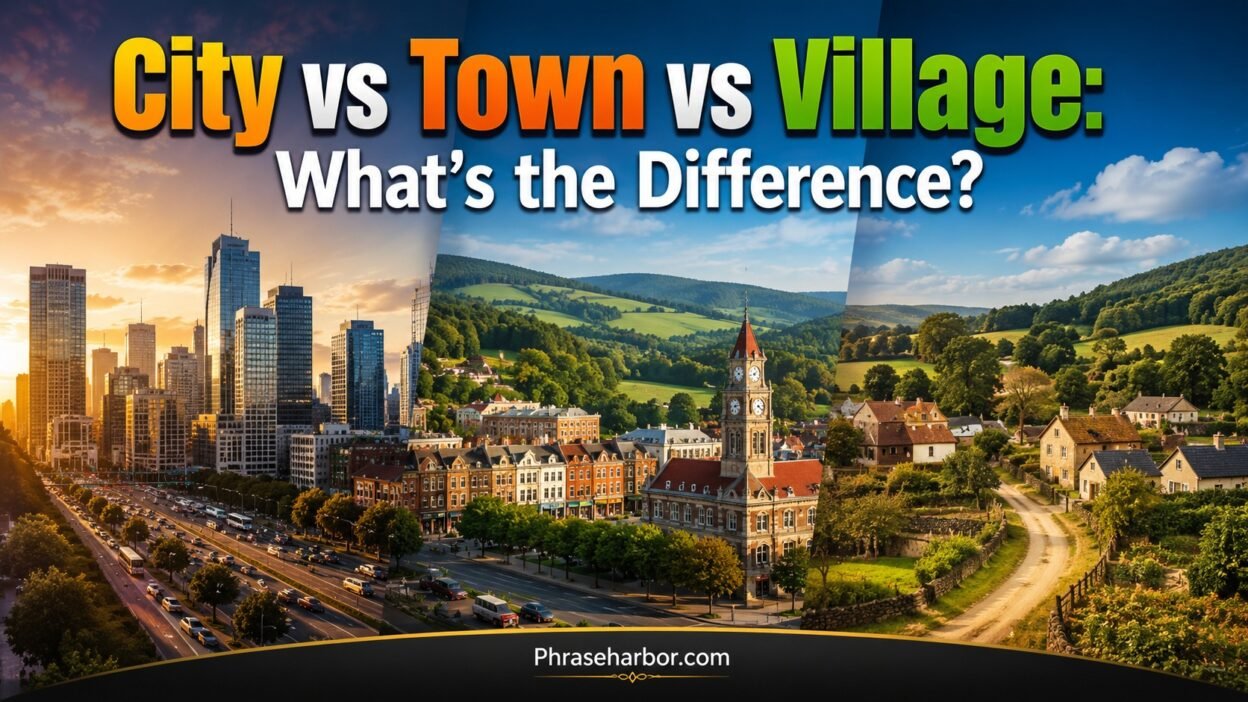
At first glance, city vs town vs village seems like a simple comparison. A city is usually bigger, a town sits somewhere in the middle, and a village is generally smaller. That basic idea works in everyday conversation, but the real distinction is more complicated. Population, density, infrastructure, economic activity, public services, administration, and legal status can all affect how a settlement is classified.
The biggest point to remember is that there is no single worldwide rule that defines every city, town, and village. The United Nations notes that countries use different criteria for urban and rural areas. In the United States, for example, the legal meaning of terms such as city, town, and village varies by state. Pakistan also uses officially notified urban areas and administrative classifications rather than relying on one universal population cutoff. (UNSD)
Quick Answer
The simplest way to understand city vs town vs village is to think about scale, density, services, and function.
- A city is generally a larger and more densely developed settlement with extensive infrastructure, specialized services, diverse employment, and complex administration.
- A town is usually smaller than a city and often acts as a commercial, administrative, or service center for its surrounding area.
- A village is generally a smaller settlement, often surrounded by rural land and offering fewer specialized services.
- Population alone doesn’t determine the classification.
- A settlement’s legal or administrative status can matter just as much as its physical size.
- Definitions vary significantly from one country or region to another.
The UN’s newer Degree of Urbanization framework provides a standardized international way to compare settlement types using population size, density, and geographic continuity. Under that framework, cities generally contain at least 50,000 inhabitants, while towns and semi-dense areas generally contain at least 5,000 inhabitants and meet density requirements. These are statistical criteria for international comparison, not a universal legal definition of every city or town. (population.un.org)
Comparison Overview
| Feature | City | Town | Village |
| Typical size | Large | Medium | Small |
| Population density | Usually high | Moderate | Usually low |
| Built-up development | Extensive | Moderate | Limited |
| Infrastructure | Extensive | Moderate | Basic to moderate |
| Healthcare | Hospitals and specialized facilities | Clinics and hospitals may be available | Usually basic or limited |
| Education | Schools, colleges, universities | Schools and sometimes colleges | Mostly primary and secondary schools |
| Transportation | Broad network | Moderate network | Often limited |
| Economy | Highly diverse | Locally diverse | Often locally focused |
| Land use | Mostly developed urban land | Urban and semi-rural mix | More rural surroundings |
| Government | Often complex | Local administration | Smaller local administration |
| Employment | Many sectors | Several sectors | Fewer local sectors |
| Connection to rural areas | Usually weaker | Often strong | Usually very strong |
This table describes common patterns rather than strict worldwide rules. A town in one country can be larger than a city in another. A village can also have modern roads, internet access, schools, and businesses. The label alone doesn’t tell the entire story.
Main Differences Between City vs Town vs Village
The clearest differences appear when you look beyond names. Population, density, infrastructure, services, economic activity, and administration give you a much better picture of what separates these settlements.
Population and Density
Population is one of the easiest factors to compare, but it isn’t enough by itself.
A city generally contains many more residents than a village. However, the number of people living within a settlement doesn’t automatically determine its legal status. Two places with similar populations can receive different classifications under different national systems.
Population density adds another important layer. Density measures how many people occupy a given area. A city can contain hundreds of thousands or millions of people within a relatively compact developed area. A village may have fewer residents spread across houses and roads surrounded by open land.
The distinction matters because 10,000 people living close together can create a very different settlement pattern from 10,000 people spread across a large rural area.
Size and Physical Development
Cities usually occupy larger continuously built-up areas. Their neighborhoods can extend for miles and include residential districts, shopping areas, industrial zones, offices, schools, hospitals, parks, and transportation hubs.
Towns tend to have a smaller physical footprint. You might find a central commercial street, residential neighborhoods, schools, local government offices, markets, and surrounding agricultural or open land.
Villages usually have a smaller built-up core. Houses, small shops, community facilities, religious buildings, schools, farms, and open land may exist close together.
However, physical size doesn’t always follow the city-town-village hierarchy. Administrative boundaries can include undeveloped land or rural areas. That’s why comparing a settlement’s official boundary with its actual built-up area can produce surprising results.
Infrastructure
Infrastructure is one of the most visible differences between settlement types.
A large city normally requires extensive systems to support its population. These can include:
- Major road networks
- Public transportation
- Water distribution
- Sewerage systems
- Waste management
- Electricity networks
- Telecommunications
- Hospitals
- Schools and universities
- Parks and public spaces
- Emergency services
Towns generally provide many of the same basic services on a smaller scale. A town may have paved roads, electricity, water systems, schools, healthcare facilities, banks, markets, and internet services.
Villages can also have modern infrastructure. The difference is often scale and availability, not whether infrastructure exists at all.
A village may have a paved main road and reliable mobile internet while still lacking a hospital, large shopping center, public transit system, or specialized government services.
Public Services
The size of a settlement often affects the range of services available locally.
Cities usually offer the widest selection. A major city might have general hospitals alongside specialist medical centers, universities, courts, museums, large libraries, government offices, and extensive public transportation.
Towns commonly provide essential services without the same degree of specialization.
Villages tend to have fewer services within the settlement itself. Residents may travel to the nearest town or city for specialized healthcare, higher education, major shopping, government paperwork, or certain professional services.
This creates an important relationship:
Village → nearby town → regional city
A village may depend on a nearby town for everyday services. That town may then depend on a larger city for highly specialized services.
What Is a City?
A city is generally a large, developed settlement with a high concentration of people, buildings, infrastructure, businesses, and public services.
Cities often function as economic and administrative centers for a much wider surrounding region. People may travel into a city from nearby towns and villages for employment, education, healthcare, shopping, government services, and entertainment.
Common Characteristics of a City
A city commonly has:
- Large population
- Higher population density
- Extensive road infrastructure
- Diverse employment
- Large commercial districts
- Hospitals and specialized healthcare
- Colleges and universities
- Public transportation
- Government institutions
- Industrial and business areas
- Cultural and entertainment venues
- More complex local administration
A city also tends to have a more diversified economy. Instead of relying heavily on one local industry, it may support finance, technology, manufacturing, retail, education, healthcare, tourism, transportation, construction, government, and professional services.
Why Cities Need More Infrastructure
The larger the concentration of people, the more complicated service delivery becomes.
A city cannot rely on a few roads, wells, schools, or small shops. Thousands or millions of residents require systems capable of handling huge daily flows of people, vehicles, water, electricity, waste, goods, and information.
That scale creates opportunities but also challenges.
Cities offer more choices, yet they also require more planning.
Traffic congestion, housing pressure, pollution, overcrowding, waste management, and infrastructure maintenance become major concerns as urban populations grow.
What Is a Town?
A town generally falls between a village and a city in terms of size and urban development. However, that doesn’t mean every town sits neatly between those two categories.
Many towns serve as local service and commercial centers. People from surrounding villages may visit a town to shop, attend school, visit a clinic, access banking services, conduct government business, or sell agricultural products.
Common Characteristics of a Town
A typical town may have:
- A central market
- Schools
- Clinics or hospitals
- Banks
- Restaurants
- Grocery stores
- Small businesses
- Local government offices
- Religious and community facilities
- Residential neighborhoods
- Roads connecting surrounding settlements
Towns often have a useful middle-ground role. They can provide many everyday services without the scale of a major city.
Towns and Their Surrounding Areas
A town rarely exists in isolation.
Imagine a rural region containing several villages. Farmers and residents from those villages might travel to the nearest town for weekly shopping, medical appointments, banking, education, or government services.
The town therefore becomes a service hub.
This relationship is one reason population size alone doesn’t fully explain the importance of a settlement. A relatively small town can have an important regional role if it serves a large surrounding rural population.
What Is a Village?
A village is generally a small settlement associated with rural surroundings. Villages can vary greatly in size, physical layout, infrastructure, and economic activity.
The traditional image of a village often includes farms, livestock, fields, and small homes. That’s still accurate for many rural communities, but it isn’t universal.
Modern villages can have:
- Paved roads
- Electricity
- Mobile networks
- Internet access
- Schools
- Small stores
- Mosques, churches, temples, or other community facilities
- Water systems
- Local businesses
- Transportation connections
So, village doesn’t automatically mean isolated or undeveloped.
The Role of Villages
Villages often maintain a close connection with surrounding land. Agriculture, livestock, fishing, forestry, crafts, local trade, or rural tourism can contribute to the economy depending on geography.
Some residents may work in agriculture while others commute to nearby towns or cities.
That distinction matters in modern rural life. A village’s location doesn’t dictate every resident’s occupation.
Read More: Alright vs All Right: What’s the Difference?
City vs Town vs Village: Economic Differences
Economic activity changes as settlement size and connectivity increase.
City Economy
Cities tend to have the most diverse economies. Common sectors include:
- Finance
- Technology
- Healthcare
- Education
- Manufacturing
- Retail
- Construction
- Tourism
- Transportation
- Government
- Professional services
Large cities can also attract businesses because they provide access to large labor markets and consumer markets.
Town Economy
Towns often have a more locally focused economy. Typical activities include:
- Retail
- Education
- Healthcare
- Construction
- Manufacturing
- Agriculture-related businesses
- Transportation
- Hospitality
- Local professional services
A town can also become highly specialized. For example, a town near a major tourist attraction may depend heavily on tourism.
Village Economy
Village economies often have stronger connections to local land and natural resources.
Depending on location, activities can include:
- Agriculture
- Livestock
- Fishing
- Forestry
- Handicrafts
- Small-scale trade
- Rural tourism
- Food production
However, rural economies are changing. Remote work, commuting, digital commerce, and improved transportation can connect village residents to urban economies.
Housing and Land Use Differences
Land use provides another useful way to understand city vs town vs village.
Cities generally have more intense land use. Apartment buildings, offices, stores, schools, roads, parking facilities, and industrial areas can occupy large portions of available land.
Towns often combine urban and semi-rural patterns. You may find detached homes beside shops, small businesses near farmland, or residential streets leading directly toward open countryside.
Villages generally have less intensive development. Homes may sit closer to fields, forests, hills, rivers, or other natural areas.
| Settlement | Typical Land Pattern |
| City | Dense buildings, roads, commercial areas, apartments |
| Town | Mixed residential, commercial, and open areas |
| Village | Smaller built-up area surrounded by rural land |
These are broad patterns. Modern development can blur the boundaries.
FAQs:
What is the difference between a city and a town?
A city is generally larger, denser, and more complex than a town. Cities usually provide a wider range of specialized services, employment opportunities, transportation options, healthcare, education, and government functions. However, the legal meaning of city and town varies between countries.
Is a town bigger than a village?
Generally, yes. A town usually has more residents, infrastructure, businesses, and services than a village. However, there is no worldwide population threshold that makes every town larger than every village.
Is a village always rural?
Usually, villages have strong connections to rural surroundings, but the word doesn’t automatically mean an isolated agricultural community. Modern villages can have substantial infrastructure, internet access, businesses, schools, and commuting populations.
Can a village become a city?
Yes. A village can grow through population increases, economic development, housing expansion, infrastructure investment, and improved transportation. However, becoming a city physically and receiving official city status are two different things.
What makes a place a city?
Depending on the country, city classification may involve population, density, infrastructure, economic function, administrative structure, historical status, or legal recognition. There is no single worldwide test.
Conclusion:
The easiest way to remember city vs town vs village is to think about scale and function, not just population. A city generally has the greatest concentration of people, buildings, infrastructure, businesses, transportation, and specialized services. It often serves as a major economic or administrative center.
A town is typically smaller and less dense. It often provides everyday services and commercial activity for its own residents as well as people from surrounding villages and rural communities. A village is generally smaller and more closely connected to rural surroundings. It may have fewer specialized services, but that doesn’t mean it lacks modern infrastructure or economic activity.