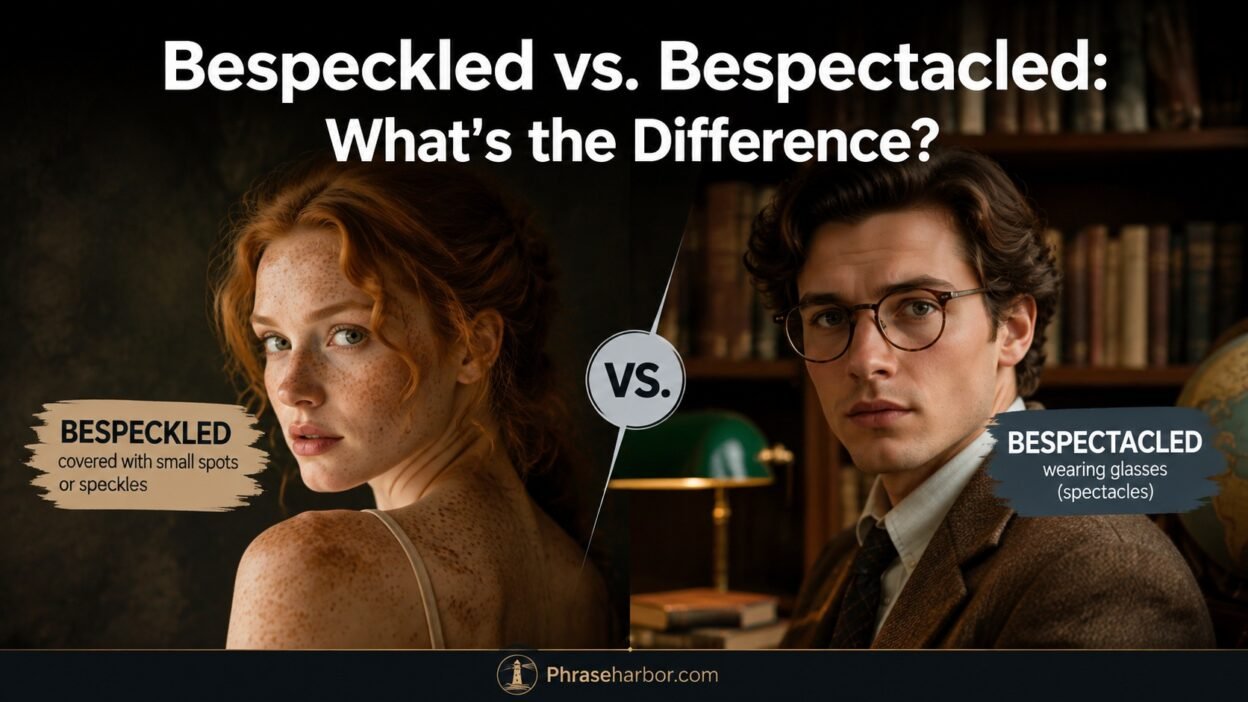
Bespeckled vs. Bespectacled often confused words in English; this guide makes the difference easy to understand with clarity. Many English learners, people, and US English users think these words look identical and sound similar, but their meaning and meanings are different.
This article offers a practical comparison to compare, distinguish, and differentiate each word with a clear description and explanation. Bespectacled describes someone, a person, individual, man, or fictional characters wearing spectacles, glasses, eyeglasses, or other eyewear, while Bespeckled refers to an object, item, cloth, pottery, bird, or a colorful pattern of speckles created when you speckle a surface.
At first glance, they seem alike, but every term relates to something different. I made the same common mistake while writing academic content, and that experience improved my confidence, accuracy, and communication.To master the usage, always check the context, related contexts, and usage rules before you choose the correct word.
Quick Answer
Here’s the simplest way to remember the difference.
| Word | Meaning | Used For |
| Bespeckled | Covered with tiny spots, flecks, or specks | Objects, clothing, animals, landscapes, surfaces |
| Bespectacled | Wearing glasses or spectacles | People |
Example:
- The bespectacled teacher smiled as she entered the classroom.
- The bird had bespeckled feathers.
- The bespeckled teacher smiled. (Incorrect unless the teacher is literally covered with spots.)
- The bespectacled bird perched on the branch. (Incorrect unless the bird is somehow wearing glasses.)
Quick takeaway: Think specks = spots and spectacles = glasses.
Comparison Overview
| Feature | Bespeckled | Bespectacled |
| Meaning | Covered with small spots or flecks | Wearing glasses |
| Part of Speech | Adjective | Adjective |
| Refers To | Objects, animals, clothing, landscapes | People |
| Root Word | Speck | Spectacles |
| Common Usage | Literary and descriptive writing | Everyday English, journalism, fiction |
| Modern Frequency | Less common | More common |
| Can Describe People? | Rarely and only if referring to spotted appearance | Yes |
Main Differences Between Bespeckled vs. Bespectacled
Although these words differ by only a few letters, they have completely separate meanings.
Bespectacled describes people who wear glasses.
If someone regularly wears spectacles or eyeglasses, you can describe them as bespectacled.
Examples
- The bespectacled scientist presented her research.
- A bespectacled librarian helped me locate the book.
- The detective interviewed the bespectacled witness.
This word often appears in novels, newspapers, biographies, and character descriptions because it provides a concise way to identify someone wearing glasses.
Bespeckled describes something covered with spots.
Bespeckled comes from the word speck, meaning a tiny spot or mark.
You can use it to describe:
- Birds
- Fabrics
- Stone
- Food
- Leaves
- Walls
- Paintings
Examples
- The eggs had bespeckled shells.
- Snow covered the bespeckled mountainside.
- She admired the bespeckled granite countertop.
Unlike bespectacled, this word almost never describes a person’s appearance unless you’re referring to actual spots or specks.
Bespeckled Meaning
Definition
Bespeckled means covered with or marked by tiny spots, flecks, dots, or specks.
It paints a visual picture of scattered markings rather than something smooth or solid in color.
Many writers use this word because it creates vivid imagery in just one adjective.
Where the Word Comes From
The word combines:
- be- (an Old English prefix meaning “covered with”)
- speck (a tiny spot or particle)
Together, they literally mean covered with specks.
When to Use Bespeckled
Use this adjective whenever something has noticeable tiny marks.
Common situations include:
- Bird feathers
- Animal fur
- Decorative stone
- Marble
- Granite
- Clothing patterns
- Leaves
- Mushrooms
- Eggshells
- Paint splatters
Example Sentences
- The owl’s bespeckled feathers blended into the forest.
- Autumn leaves formed a bespeckled carpet across the trail.
- Her dress featured a delicate bespeckled pattern.
- The granite island had a naturally bespeckled finish.
- Tiny stars created a bespeckled night sky.
Writing Tip: If you can replace the word with spotted without changing the meaning, bespeckled is probably the correct choice.
Bespectacled Meaning
Definition
Bespectacled means wearing spectacles or eyeglasses.
It’s an adjective used almost exclusively to describe people.
Origin
This word comes from:
- be-
- spectacles
The suffix simply creates an adjective meaning equipped with spectacles.
Although the word sounds formal, it remains common in newspapers, fiction, biographies, and descriptive writing.
When to Use Bespectacled
Use it when describing:
- Teachers
- Doctors
- Scientists
- Detectives
- Students
- Business professionals
- Historical figures
- Fictional characters
Example Sentences
- The bespectacled professor explained quantum mechanics.
- A bespectacled engineer reviewed the blueprints.
- The bespectacled child eagerly read every book in the library.
- Reporters surrounded the bespectacled economist after the conference.
- The novel introduced a quiet bespectacled detective.
Remember: If glasses are involved, bespectacled is the word you need.
Bespeckled vs. Bespectacled: Side-by-Side Comparison
| Category | Bespeckled | Bespectacled |
| Definition | Covered with tiny spots | Wearing glasses |
| Refers to | Objects and surfaces | People |
| Root | Speck | Spectacles |
| Common Context | Nature, fashion, design | Character descriptions |
| Visual Meaning | Spotted appearance | Eyewear |
| Everyday Usage | Less common | More common |
Why People Confuse Bespeckled and Bespectacled
Several factors make these words easy to mix up.
Nearly Identical Spelling
Only a few letters separate the two words.
Compare them:
- Bespeckled
- Bespectacled
Your eyes can easily skim over the difference.
Similar Pronunciation
Both words begin with “be” and share similar rhythms, making them sound alike during conversation.
Shared Prefix
The prefix be- appears in many English adjectives.
Examples include:
- Beloved
- Bewildered
- Bejeweled
- Bespattered
That similarity makes the endings even easier to overlook.
Spell Check Isn’t Always Enough
Spell-check software recognizes both words because both are legitimate English words. It won’t warn you if you’ve chosen the wrong one for your sentence.
Memory Trick to Remember the Difference
Simple memory tricks make these words much easier to remember.
Speck = Spot
If you see the word speck, think:
- Dust speck
- Paint speck
- Tiny spot
Therefore:
Bespeckled = Covered with spots
Spectacles = Glasses
The beginning of spectacles appears inside bespectacled.
Therefore:
Bespectacled = Wearing glasses
Easy Formula
- Speck → Spots
- Spectacles → Glasses
That’s all you need.
Common Mistakes to Avoid
Many writers make the same errors repeatedly.
Mistake One: Using Bespeckled for Someone Wearing Glasses
The bespeckled lawyer entered the courtroom.
The bespectacled lawyer entered the courtroom.
Mistake Two: Using Bespectacled for Objects
A bespectacled granite countertop.
A bespeckled granite countertop.
Mistake Three: Assuming They Are Synonyms
They aren’t.
Their meanings never overlap
Read More: Any Problem or Any Problems: Which One Is Correct?
Mistake Four: Choosing the Word Based on Spelling
Always choose the word based on meaning rather than appearance.
Real-World Usage Examples
Bespeckled in Nature
Nature writers often describe:
- Speckled bird eggs
- Granite cliffs
- Wild mushrooms
- Pebbled beaches
- Snow-covered mountains
Example:
The valley stretched beneath a bespeckled blanket of wildflowers.
Bespeckled in Interior Design
Design magazines frequently describe:
- Quartz countertops
- Marble flooring
- Stone fireplaces
- Decorative ceramics
Example:
The kitchen featured elegant bespeckled quartz surfaces.
Bespectacled in Fiction
Novelists use bespectacled to quickly establish a character.
Example:
A quiet bespectacled historian opened the ancient manuscript.
Bespectacled in Journalism
News articles regularly describe:
- Professors
- Witnesses
- Judges
- Scientists
- Economists
Example:
The bespectacled researcher unveiled the new findings.
Synonyms
Synonyms for Bespeckled
While none carry exactly the same nuance, these words are often suitable alternatives.
- Speckled
- Flecked
- Dappled
- Mottled
- Spotted
- Peppered
- Freckled (in certain contexts)
Synonyms for Bespectacled
Several phrases can replace bespectacled depending on the context.
- Wearing glasses
- Wearing spectacles
- Glasses-wearing
- Eyeglass-wearing
- Four-eyed (informal and often considered impolite)
Etymology
Understanding a word’s history often makes it easier to remember.
Bespeckled
The noun speck has existed in English for centuries. It refers to a tiny spot, particle, or mark. Over time, English speakers added the prefix be- to create an adjective meaning covered with specks.
Bespectacled
The word developed from spectacles, a term widely used before “glasses” became the more common everyday word. The adjective bespectacled emerged to describe people who wore them.
Both words follow similar English word-building patterns even though they describe different things.
Are Both Words Still Common Today?
Both words remain part of modern English, though they appear with different frequencies.
Bespectacled
You’ll often find this word in:
- Newspapers
- Novels
- Character profiles
- Academic writing
- Biographies
It’s still widely recognized by readers.
Bespeckled
This word appears less often because writers usually choose simpler alternatives like:
- Speckled
- Spotted
- Flecked
However, bespeckled remains perfectly correct and adds a slightly more literary tone.
FAQs:
Is Bespeckled the same as Bespectacled?
No. Bespeckled means covered with spots, specks, dots, or flecks, while Bespectacled describes a person wearing glasses, spectacles, or other eyewear. Although the words look similar, they have completely different meanings.
Which word should I use for someone wearing glasses?
Use Bespectacled whenever you are talking about a person, individual, or character who wears eyeglasses. Bespeckled should never describe someone’s eyewear unless you are referring to a spotted pattern on clothing or another object.
Can Bespeckled describe clothing or nature?
Yes. Bespeckled is commonly used for cloth, leaves, pottery, birds, or other surfaces that are covered with tiny specks, spots, or colorful patterns. It highlights texture or appearance rather than a person.
Why do people confuse Bespeckled and Bespectacled?
The two words have a similar spelling and pronunciation, which often causes confusion. Learning their meaning, reading examples, and paying attention to the context can help you remember the correct usage.
How can I remember the difference between Bespeckled and Bespectacled?
A simple memory trick is to connect spectacled with spectacles (glasses). Think of speckled as related to specks or tiny spots. This quick association makes choosing the correct word much easier in everyday writing and communication.
Conclusion:
Understanding Bespeckled vs. Bespectacled is easier once you remember that one describes spots and patterns, while the other refers to a person wearing glasses. Although the two words look alike, using the correct term improves grammar, clarity, accuracy, and overall writing quality. Whenever you are unsure, check the context, think about whether you are describing a spotted surface or someone with eyewear, and choose the word that best matches the situation. With regular practice and real-life examples, this commonly confused pair soon becomes easy to use correctly.