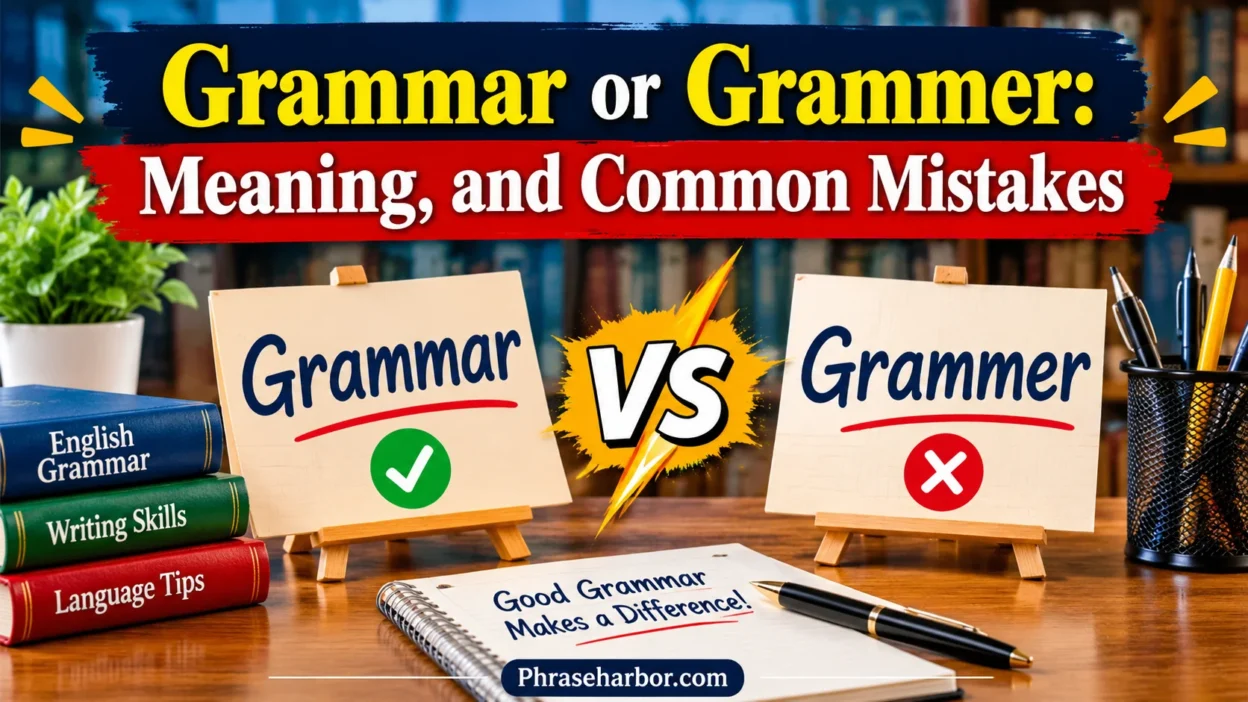
Grammar or Grammer confuses English writers because pronunciation can mislead them, but grammar is the only correct spelling in standard English. Many learners and beginners make this common spelling mistake when writing quickly or relying on pronunciation instead of English spelling. Both forms have almost identical spellings, but their final vowels, vowel sounds, and word ending create confusion.
The final sound may make the word seem as though it should end with -er rather than -ar. However, English pronunciation, spelling patterns, and pronunciation patterns do not always follow the same rules. The letter e might seem appropriate, but established spelling rules, language conventions, and standard spelling confirm the correct form.
Understanding grammar meaning also makes the distinction easier. Grammar refers to the rules of a language, including grammatical rules, language rules, sentence structure, sentence formation, and word usage. These language fundamentals help you create correct sentences, improve communication, and communicate clearly through writing and speaking.
Quick Answer:
Grammar is the correct spelling in standard English. Grammer is a misspelling when someone intends to refer to the rules and structure of a language.
Grammar describes how words work together to create meaningful sentences. It includes rules involving word order, verb tenses, sentence structure, agreement, and other language patterns.
Here’s a quick comparison:
| Word | Correct or Incorrect? | Meaning |
| Grammar | Correct | The rules and structure of a language |
| Grammer | Incorrect | A common misspelling of grammar |
Correct example: Good grammar makes your writing easier to understand.
Incorrect example: Good grammer makes your writing easier to understand.
Remember this simple rule: Grammar ends with A, not E.
Comparison Overview: Grammar vs. Grammer
Although grammar and grammer look similar, they don’t have the same standing in standard English. One is an established dictionary word, while the other is generally a spelling error.
The following table highlights their main differences.
| Comparison Point | Grammar | Grammer |
| Spelling | Correct | Incorrect |
| Part of speech | Noun | No standard grammatical role in this intended usage |
| Meaning | Rules governing language structure | No standard English meaning for the intended term |
| Pronunciation | /ˈɡræmər/ | Usually intended to sound like grammar |
| Dictionary status | Established English word | Not a standard spelling variant |
| Formal writing | Accepted | Avoid |
| Academic writing | Appropriate | Incorrect |
| Professional communication | Appropriate | Incorrect |
| Example | Grammar improves sentence clarity. | Grammer improves sentence clarity. |
The biggest difference is the final vowel. Grammar contains an a before its final r, while grammer replaces that letter with an e.
However, the difference isn’t merely cosmetic. When you’re discussing language rules, you should always use grammar.
What Does Grammar Mean?
Grammar refers to the system of rules and patterns that explains how people organize words into meaningful expressions. It helps speakers and writers communicate ideas clearly and consistently.
Every language has its own grammatical structure. English, Spanish, French, German, and Japanese all follow different grammatical patterns.
For example, English generally follows a subject-verb-object sentence structure:
- Subject: The student
- Verb: completed
- Object: the assignment
Together, these elements create the sentence: “The student completed the assignment.”
If you rearrange these words incorrectly, the sentence may become confusing or ungrammatical.
Grammar helps you understand how words relate to one another. It also allows readers to recognize relationships between actions, people, objects, and ideas.
Grammar Definition
In simple terms, grammar is the set of conventions and patterns that govern how a language works.
It covers several important areas, including:
- Nouns: Words that identify people, places, objects, or ideas.
- Pronouns: Words that replace nouns, such as he, she, they, and it.
- Verbs: Words that express actions, events, or states.
- Adjectives: Words that describe nouns and pronouns.
- Adverbs: Words that modify verbs, adjectives, or other adverbs.
- Prepositions: Words that express relationships involving time, place, direction, or other connections.
- Conjunctions: Words that connect words, phrases, and clauses.
- Sentence structure: The arrangement of words and phrases within sentences.
Consider these two examples:
Grammatically correct: She writes excellent articles.
Grammatically incorrect: She write excellent articles.
The second sentence contains a subject-verb agreement error. The singular subject she requires the verb writes in the simple present tense.
This small change demonstrates how grammar influences sentence correctness.
Examples of Grammar in Sentences
Grammar becomes easier to understand when you examine everyday sentences. Different grammatical rules influence how you construct and interpret them.
Here are several practical examples.
Subject-verb agreement
The subject and verb must agree in number and person.
- Correct: He plays basketball every weekend.
- Incorrect: He play basketball every weekend.
Verb tense
Verb tense tells readers when an action happens.
- Present: I study English every evening.
- Past: I studied English yesterday.
- Future: I will study English tomorrow.
Pronoun agreement
Pronouns should clearly refer to the nouns they replace.
- Correct: Sarah forgot her notebook.
- Incorrect: Sarah forgot their notebook.
The second example may be appropriate in a different context, such as when their refers to a person who uses they/them pronouns. Context determines the correct choice.
Word order
English usually follows a recognizable word order.
- Correct: The children played outside.
- Incorrect: Played outside the children.
Articles
Articles help identify whether you’re referring to something specific or general.
- Correct: I bought a book.
- Correct: The book was interesting.
- Incorrect: I bought an book.
These examples show why grammar matters in everyday communication. It helps readers understand your intended meaning without unnecessary effort.
Types of Grammar
Grammar isn’t limited to memorizing classroom rules. Linguists study language structure from several perspectives.
Understanding these approaches helps explain why grammar sometimes differs between formal writing and everyday conversation.
Prescriptive grammar
Prescriptive grammar describes how people should use language according to established standards and conventions.
For example, formal writing generally favors:
- She and I attended the meeting.
- He doesn’t know the answer.
- Between you and me, the proposal needs improvement.
Prescriptive rules often guide academic writing, professional communication, and edited publications.
Descriptive grammar
Descriptive grammar examines how people actually use language. Instead of labeling every informal expression incorrect, it studies real communication patterns.
For example, people frequently say “Who are you talking to?” Although some traditional grammar instruction discourages ending sentences with prepositions, this construction is widely accepted in modern English.
Descriptive grammar helps linguists understand language as people use it.
Traditional grammar
Traditional grammar focuses on familiar grammatical categories and sentence rules. It commonly teaches parts of speech, verb conjugations, punctuation-related conventions, and sentence construction.
Many school grammar lessons use this approach.
Functional grammar
Functional grammar examines how language communicates meaning in different situations.
For example, compare these sentences:
- Please close the window.
- Could you close the window?
- It’s getting cold in here.
All three can communicate a request, but they use different structures and levels of directness.
Functional grammar explores how speakers choose language to achieve particular communication goals.
What Does Grammer Mean?
The spelling grammer commonly appears when someone intends to write grammar. However, it isn’t the standard English spelling of the linguistic term.
People sometimes use it accidentally in school assignments, emails, online comments, and social media posts.
The mistake usually happens because the pronunciation of grammar doesn’t make its spelling immediately obvious.
For example, someone who hears the word without seeing it written might assume that its ending contains an e. That assumption can lead to the incorrect spelling.
Read More: Analogy vs. Allegory: Meaning, Differences, and Correct Usage
Is Grammer a Real Word?
In standard English, grammer isn’t an accepted alternative spelling of grammar.
If you’re referring to language rules, sentence structure, or correct word usage, you should write grammar.
However, there are situations where the exact letter sequence Grammer may appear legitimately.
For example:
- Grammer as a surname: Some people have Grammer as their family name.
- Business names: A company or organization may use Grammer as part of its official name.
- Usernames: Someone may intentionally choose Grammer as an online username.
- Branding: A business may adopt the spelling as a creative brand name.
These uses don’t make grammer a standard spelling of the English word grammar.
The distinction is important. A proper name can have its own spelling without changing the correct spelling of an ordinary dictionary word.
Why Do People Spell Grammar as Grammer?
Several factors explain why this particular spelling mistake appears so frequently.
Similar pronunciation
The most obvious reason involves pronunciation. In standard American English, grammar is pronounced /ˈɡræmər/.
The final syllable contains a reduced vowel sound. This sound doesn’t always help writers identify the correct letter.
Someone unfamiliar with the written form might choose e instead of a.
Confusion about English spelling patterns
English contains many words with similar endings but different spellings.
For example:
- Hammer
- Summer
- Dinner
- Grammar
- Camera
The endings of these words can create confusion when someone tries to spell an unfamiliar word using sound alone.
However, spelling depends on established word forms rather than pronunciation alone.
Typing mistakes
Fast typing can produce accidental spelling errors. Someone might type grammer without noticing the incorrect vowel.
This happens particularly often when writers focus on sentence meaning instead of proofreading individual words.
Incorrect exposure online
People sometimes encounter misspellings repeatedly in comments, discussion forums, social media posts, or poorly edited articles.
Repeated exposure can make an incorrect spelling appear familiar. Familiarity, however, doesn’t establish correctness.
Autocorrect and spelling suggestions
Spell-check tools usually identify common errors, but they aren’t perfect. Personal dictionaries, custom settings, and specialized names can affect suggestions.
Therefore, you shouldn’t rely entirely on automatic corrections.
Main Differences Between Grammar and Grammer
The difference between grammar and grammer becomes clearer when you examine their spelling, pronunciation, meaning, and usage.
Although the two forms look almost identical, they serve different purposes in written communication.
Grammar vs. Grammer: Spelling Differences
The spelling difference involves just one letter.
- Grammar: G-R-A-M-M-A-R
- Grammer: G-R-A-M-M-E-R
The correct word contains an a after the double m. The incorrect form replaces that letter with an e.
This distinction matters because English spelling follows established conventions. You can’t replace letters simply because another spelling seems more natural.
For example, these words have different meanings or spelling rules despite similar appearances:
| Correct Word | Common Misspelling |
| Grammar | Grammer |
| Separate | Seperate |
| Definitely | Definately |
| Receive | Recieve |
| Necessary | Neccessary |
| Accommodation | Accomodation |
The best way to avoid these errors is to learn the correct spelling rather than relying entirely on pronunciation.
Grammar vs. Grammer: Pronunciation Differences
In standard American English, grammar has the IPA pronunciation /ˈɡræmər/.
It contains two syllables:
- First syllable: gram
- Second syllable: mar
The stress falls on the first syllable.
The incorrect spelling grammer doesn’t have a separate standard pronunciation because it’s generally an attempt to spell the same word incorrectly.
Consequently, most people who write grammer intend to communicate the word grammar and pronounce it the same way.
This is why pronunciation alone won’t always help you identify the correct spelling.
Grammar vs. Grammer: Meaning and Usage Differences
Grammar has an established meaning in English. It refers to the patterns and rules that govern language structure.
You can use it in several contexts:
- “I’m studying English grammar.”
- “Her grammar has improved considerably.”
- “The teacher explained an important grammar rule.”
- “Good grammar makes professional communication clearer.”
On the other hand, grammer shouldn’t replace grammar in these sentences.
For instance:
| Incorrect Sentence | Correct Sentence |
| I need to improve my grammer. | I need to improve my grammar. |
| English grammer can be challenging. | English grammar can be challenging. |
| She teaches grammer at school. | She teaches grammar at school. |
| Your grammer needs improvement. | Your grammar needs improvement. |
| I bought a grammer textbook. | I bought a grammar textbook. |
The correction is straightforward: replace grammer with grammar whenever you mean the rules of language.
Grammar or Grammer: Examples of Correct and Incorrect Usage
Seeing the words in realistic situations makes the difference easier to remember.
Here are additional examples from everyday writing.
Example 1: Academic writing
Incorrect: The professor explained English grammer during the lecture.
Correct: The professor explained English grammar during the lecture.
Example 2: Professional communication
Incorrect: Please check the grammer before sending the report.
Correct: Please check the grammar before sending the report.
Example 3: Online publishing
Incorrect: This article covers basic grammer rules for beginners.
Correct: This article covers basic grammar rules for beginners.
Example 4: Classroom assignments
Incorrect: My teacher said that my grammer needs improvement.
Correct: My teacher said that my grammar needs improvement.
Example 5: Everyday conversation
Incorrect: I always struggle with English grammer.
Correct: I always struggle with English grammar.
Notice that every correction involves the same simple change. The intended word remains grammar regardless of the writing situation.
Frequently Asked Questions
1. Is it Grammar or Grammer?
Grammar is the correct spelling in standard English. Grammer is a common spelling mistake and is not accepted as the standard form. Use grammar when discussing language rules, sentence structure, and proper word usage.
2. Why Do People Spell Grammar as Grammer?
People often write grammer because its pronunciation can make the final vowel confusing. The ending sounds similar to an unstressed vowel, which leads some writers to choose the wrong letter. However, the correct spelling always uses -ar.
3. What Does Grammar Mean?
Grammar refers to the rules that govern how words are used and arranged in a language. It covers sentence structure, punctuation, verb forms, tenses, and other language conventions that help people communicate clearly.
4. Is Grammer Ever an Acceptable English Word?
No. Grammer is not the standard spelling of grammar. It may appear in informal messages, online searches, or writing mistakes, but you should avoid it in academic assignments, professional emails, and published content.
5. How Can I Remember the Correct Spelling of Grammar?
A simple way to remember grammar is to associate it with the ending -ar. Practice writing the word several times and include it in everyday sentences. Proofreading your work before submitting it can also help prevent this common spelling error.
Conclusion:
The difference between grammar or grammer is simple once you learn the correct spelling. Grammar is the only standard English form, while grammer is a misspelling. Although pronunciation can sometimes cause confusion, remembering the -ar ending will help you avoid this mistake.
Whether you are writing an academic assignment, preparing a professional email, or publishing an article, always use the correct spelling. A little attention to spelling and regular proofreading can make your writing clearer, more accurate, and more professional.