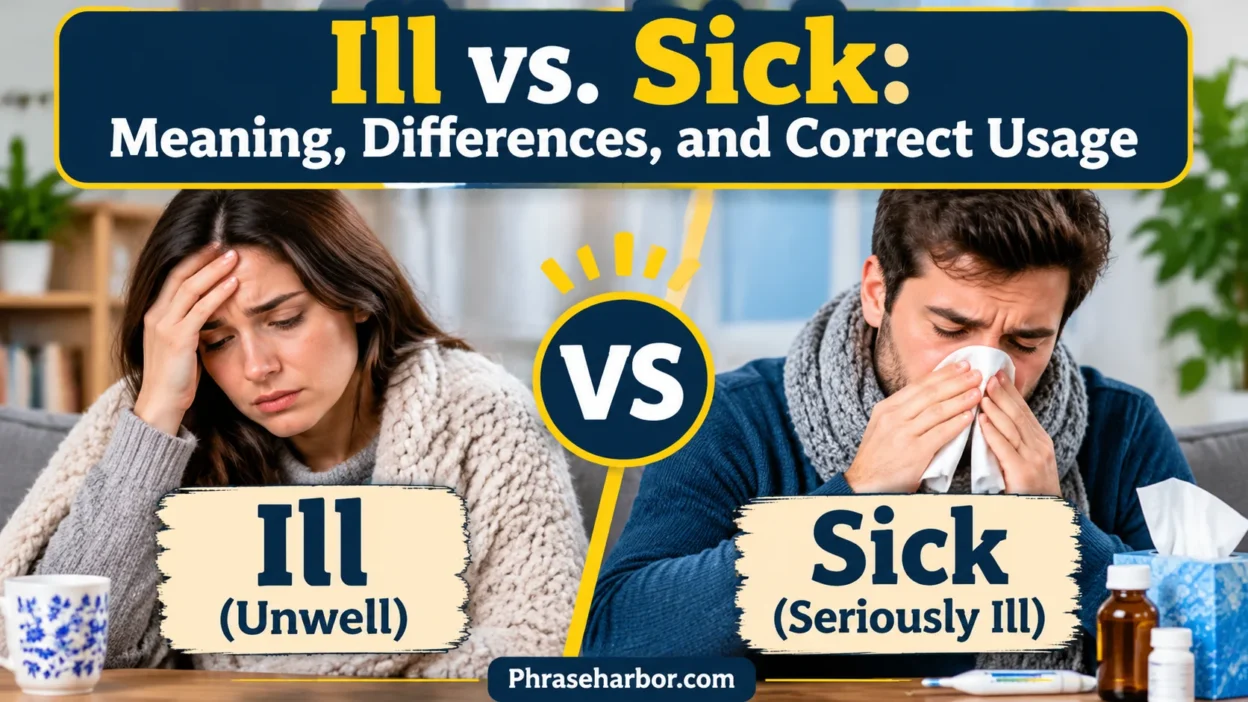
Have you ever wondered whether you should say “I feel ill” or “I feel sick”? Both expressions are correct, and both describe feeling unwell. However, they don’t always carry the same meaning or fit the same situations.
In American English, sick is a common choice in everyday conversations. You might say you’re sick when you catch a cold, develop a fever, or need to stay home from work. Ill also means unwell, but it often appears in more formal contexts and established expressions such as “seriously ill” and “critically ill.”
The distinction becomes more interesting when you consider nausea, grammar, regional differences, and common phrases. For example, “I’m sick” usually means you’re unwell in American English, while “I’m sick of this” means you’re tired of something. In British English, “be sick” can also mean to vomit. Understanding these differences will help you choose the right word in conversations, emails, school assignments, and professional writing.
Quick Answer:
Ill and sick both describe poor health, but American English uses them somewhat differently. Sick is more common in everyday speech, while ill often sounds more formal. Neither word automatically indicates how serious someone’s condition is.
| Expression | Meaning | Example |
| Ill | Experiencing an illness or poor health | She has been ill for several days. |
| Sick | Unwell or experiencing an illness | I’m sick and need to rest. |
| Feel sick | Feel unwell, sometimes with nausea | I feel sick after the long drive. |
| Seriously ill | Suffering from a serious illness | The patient is seriously ill. |
| Sick of something | Tired of or fed up with something | I’m sick of these delays. |
The easiest rule to remember: Use sick for most casual conversations in American English. Use ill when it fits the tone, meaning, or established expression. In many situations, either word works.
Comparison Overview
The difference between ill and sick depends on context rather than a strict division between mild and serious conditions. Both adjectives describe someone who isn’t healthy, but certain expressions favor one word over the other.
| Feature | Ill | Sick |
| Basic meaning | Unwell or suffering from an illness | Unwell or suffering from an illness |
| Everyday American English | Common, but often slightly more formal | Very common and conversational |
| Describing serious illness | Common in phrases such as “critically ill” | Also correct in many contexts |
| Describing nausea | Possible, especially in “feel ill” | Very common in “feel sick” |
| Before a noun | Common in established phrases such as “ill health” | Common in “sick child” and “sick patient” |
| Workplace expressions | Less common in everyday absence phrases | Common in “call in sick” and “sick leave” |
| British English | Often used for general poor health | Can also mean vomiting |
| Figurative meaning | Appears in expressions such as “ill feelings” | Appears in “sick of something” |
The table highlights common tendencies, not unbreakable rules. For instance, both “an ill child” and “a sick child” are grammatically correct, although the second often sounds more natural in everyday American conversation.
Main Differences Between Ill and Sick
Although ill and sick share the same basic meaning, their usage patterns reveal several important differences. Understanding these distinctions will help you write more naturally and avoid common mistakes.
Meaning and Definition of Ill
Ill is an adjective that describes someone experiencing an illness or a state of poor health. It can refer to a temporary condition, a long-term disease, or a serious medical problem.
For example, someone with a mild respiratory infection may be described as ill. The same adjective can describe a person receiving treatment for a severe condition. The surrounding details explain the seriousness, not the word alone.
Consider these examples:
- Mild illness: “I felt ill after eating too much.”
- Temporary illness: “She was ill last week but has recovered.”
- Long-term illness: “He lives with a chronic illness.”
- Serious illness: “The patient is critically ill.”
- Formal announcement: “The director is unable to attend because of ill health.”
In American English, ill often sounds a little more formal than sick. You might see it in medical reports, workplace announcements, news articles, and professional correspondence.
However, it isn’t reserved for formal writing. People also say “I feel ill” during ordinary conversations, especially when describing discomfort or a sudden change in health.
Meaning and Definition of Sick
Sick is an adjective that describes someone who is unwell. In everyday American English, it is one of the most common ways to talk about illness.
The word covers a wide range of conditions, from a minor cold to a serious disease. Depending on the situation, it can also describe nausea or the urge to vomit.
For example:
- General illness: “My brother is sick today.”
- Cold symptoms: “I’m sick with a bad cold.”
- Nausea: “The smell made me feel sick.”
- Work absence: “She called in sick this morning.”
- Long-term condition: “He is caring for a sick relative.”
Notice how the meaning changes slightly with context. In the first example, sick simply means unwell. In the third, it suggests a feeling of nausea.
The word also appears in expressions unrelated to physical illness. If you say, “I’m sick of waiting,” you mean you’re frustrated or tired of waiting.
This flexibility makes sick especially useful in everyday communication. Still, you should consider the audience and intended meaning before using it in formal writing.
Read More: By Hook or by Crook: Meaning, Origin, and Examples
Ill vs. Sick in Everyday American English
When Americans discuss ordinary health problems, they frequently use sick. It sounds natural in casual conversations with friends, family members, coworkers, and classmates.
For example, imagine waking up with a fever and a sore throat. You might tell a friend, “I’m sick, so I’m staying home today.” The sentence sounds direct and natural.
You could also say, “I’m ill, so I’m staying home today.” That sentence is correct, but some speakers may find it slightly more formal.
Here are several common comparisons:
| Everyday situation | Natural expression | Alternative |
| Staying home with a cold | I’m sick today. | I’m ill today. |
| Asking about someone’s health | Are you sick? | Are you ill? |
| Describing a recent illness | She got sick yesterday. | She became ill yesterday. |
| Explaining a work absence | I’m calling in sick. | I’m unable to work because I’m ill. |
| Describing a medical condition | He’s seriously ill. | He’s seriously sick. |
Both words can work in several of these examples. However, some expressions are more conventional than others.
For instance, “call in sick” is a standard American English expression. Saying “call in ill” would sound unusual to many American speakers.
The practical lesson is simple: learn common expressions as complete phrases rather than assuming every adjective can replace the other in every sentence.
Ill vs. Sick Before a Noun
Both ill and sick can appear before nouns, but their patterns differ.
The adjective sick commonly appears directly before a noun in everyday American English. Examples include “a sick child,” “a sick employee,” and “a sick animal.”
The adjective ill also modifies nouns, particularly in established expressions. However, it often appears in combinations that describe health conditions, formal medical situations, or broader states of well-being.
Compare these examples:
| With ill | With sick |
| Ill health | Sick child |
| An ill patient | A sick patient |
| Seriously ill people | Sick employees |
| A terminally ill person | Sick animals |
| Ill effects | Sick leave |
Some expressions favor one adjective because they have become established through repeated use. That doesn’t necessarily make the alternative grammatically impossible.
For example, “an ill patient” and “a sick patient” are both correct. The choice depends on the intended tone and the surrounding sentence.
Consider this sentence: “The hospital admitted several seriously ill patients overnight.” The phrase sounds natural because seriously ill is a familiar combination.
By contrast, “The school sent a notice to parents about a sick child” fits an everyday school announcement.
Remember: Grammar determines whether a construction works, while common usage helps determine whether it sounds natural.
Ill vs. Sick When Describing Symptoms
One of the most useful distinctions concerns nausea. Although both words can describe general illness, sick often refers specifically to feeling nauseated.
Imagine riding in a car along a winding mountain road. You begin to feel dizzy, your stomach turns, and you think you might vomit. In American English, “I feel sick” is a natural way to describe that experience.
You could also say, “I feel nauseated” or “I feel like I’m going to throw up.” These expressions communicate the symptom more precisely.
Consider the following examples:
- “The rough boat ride made me feel sick.”
- “She felt ill after skipping lunch.”
- “I felt sick to my stomach when I heard the news.”
- “He became ill with a respiratory infection.”
- “The medication made her nauseated.”
The phrase “sick to my stomach” usually describes nausea, although it can also express a strong emotional reaction.
Meanwhile, ill often describes a broader state of poor health. If someone says, “He has been ill for two weeks,” you know that he hasn’t been well, but you don’t know his specific symptoms.
Neither adjective identifies a particular disease. If you need to communicate symptoms accurately, use specific words such as nauseated, feverish, dizzy, or weak.
Ill vs. Sick in British and American English
Regional differences can make ill and sick confusing for English learners. Although the words overlap in both varieties, British and American English sometimes use them differently.
In American English, sick commonly describes general illness. An American speaker might say, “I’m sick,” whether they have a cold, a fever, or an upset stomach.
British English also uses sick to describe illness. However, “be sick” can mean to vomit, particularly in everyday conversation.
For example, a British speaker might say, “The child was sick during the journey,” meaning the child vomited. The same sentence in American English might suggest that the child felt unwell, depending on the context.
Compare these patterns:
| Situation | American English | British English |
| General illness | I’m sick. | I’m ill. / I’m sick. |
| Feeling nauseated | I feel sick. | I feel sick. |
| Vomiting | I threw up. / I vomited. | I was sick. / I vomited. |
| Missing work because of illness | I called in sick. | I called in sick. |
| Describing poor health | He’s ill. / He’s sick. | He’s ill. / He’s sick. |
These are common tendencies rather than strict rules. British speakers use sick to describe general illness, and American speakers understand that sick can refer to vomiting.
Context usually resolves the ambiguity. If you want to communicate clearly to an international audience, use a specific expression such as “felt nauseated” or “vomited” when that distinction matters.
Ill vs. Sick in Formal and Medical Writing
In professional and medical settings, ill frequently appears in phrases describing a person’s health status. Expressions such as “critically ill,” “seriously ill,” and “terminally ill” are widely recognized.
However, sick also appears in professional language. American workplaces use sick leave, sick days, and sick pay to describe absence policies and employee benefits.
The choice depends on the expression and the purpose of the document.
Examples in medical writing:
- “The patient is critically ill and requires intensive monitoring.”
- “The clinic provides care for people with chronic illnesses.”
- “The doctor evaluated the patient for signs of serious illness.”
Examples in workplace communication:
- “I’m taking a sick day today.”
- “Employees can request sick leave under the company’s policy.”
- “She informed her supervisor that she was too sick to work.”
A formal tone doesn’t automatically require ill. In fact, “sick leave” is the standard term in many official workplace documents.
Similarly, ill doesn’t automatically indicate a more severe condition. A person can feel mildly ill, while someone described as seriously sick may have a significant health problem.
When writing about health, prioritize clarity and accuracy over assumptions about formality. If the exact diagnosis or symptom matters, name it when appropriate rather than relying on a broad adjective.
FAQs:
Is Ill or Sick More Common in American English?
Sick is especially common in everyday American English. People frequently use it when talking about colds, fevers, stomach problems, and missing work.
Ill is also widely used, particularly in expressions such as “seriously ill,” “critically ill,” and “ill health.” Both words are correct.
Are Ill and Sick Interchangeable?
Often, yes. Both can describe someone who is unwell.
For example, “She is ill” and “She is sick” can communicate the same basic meaning. However, established expressions such as sick leave, call in sick, and ill effects don’t always allow a natural one-word substitution.
Does Sick Mean Vomiting in American English?
Not necessarily. In American English, sick usually means unwell when someone says, “I’m sick.”
The phrase can suggest nausea when the context involves an upset stomach, motion sickness, or the urge to vomit. If you mean actual vomiting, saying “I vomited” or “I threw up” is clearer.
Is Ill More Serious Than Sick?
No. Neither word automatically indicates severity.
Someone can feel mildly ill, and another person can be seriously sick. Expressions such as mildly, seriously, and critically provide more specific information about the condition.
Is It Correct to Say “I Am Ill”?
Yes. “I am ill” is grammatically correct American English.
It may sound slightly more formal than “I am sick” in everyday conversation. However, both sentences are natural and communicate that you aren’t feeling well.
Conclusion:
The difference between ill and sick is mainly about context, common usage, and established expressions. Both words describe poor health, and neither automatically tells you how serious someone’s condition is. In everyday American English, sick is often the more conversational choice. Ill frequently appears in formal descriptions and phrases such as “seriously ill,” “critically ill,” and “ill health.”