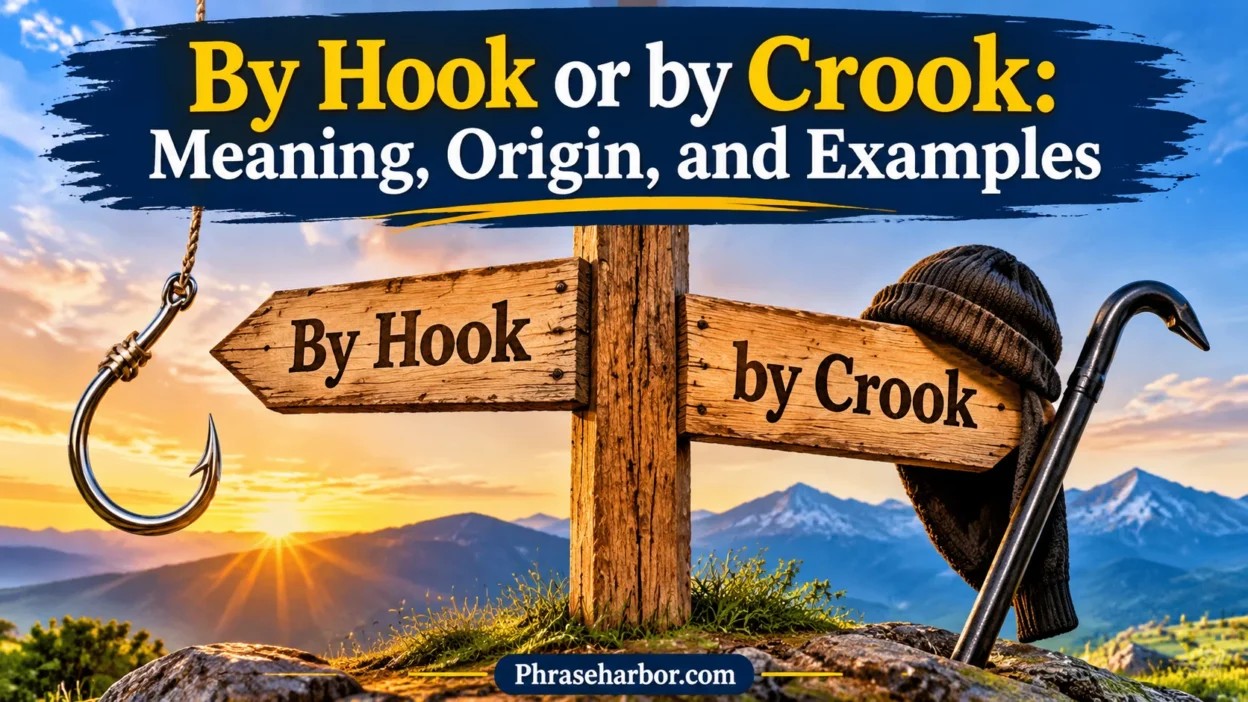
Have you ever wanted to achieve something so badly that you refused to let any obstacle stand in your way? Perhaps you wanted to pass a difficult exam, finish an important project, or win a competitive opportunity. In English, the expression “by hook or by crook” captures this determined attitude.
This familiar idiom describes achieving a goal by whatever means are available. Depending on the situation, it can express admirable persistence, ruthless ambition, or a willingness to bend the rules. That difference matters because the phrase doesn’t always praise the person using it.
For example, a student might say, “I’ll finish this assignment by hook or by crook.” The student could simply mean that they’ll work hard and find a solution. However, if a business owner says, “We’ll get that contract by hook or by crook,” the statement might suggest questionable tactics.
Understanding the expression requires more than memorizing its definition. You also need to know its historical background, grammatical role, common alternatives, and the situations in which it sounds natural. Let’s explore how to use this timeless idiom accurately and confidently.
Quick Answer
“By hook or by crook” means achieving something by any means possible. It emphasizes determination to reach a goal despite obstacles, sometimes suggesting that the person might use dishonest or unethical methods.
Example: “Maya was determined to complete her degree by hook or by crook.”
In this sentence, Maya refuses to give up on her education, regardless of the challenges she faces.
The expression is an idiom, usually written without hyphens. It can describe persistence, ambition, or questionable behavior depending on context.
Comparison Overview
The following table summarizes the expression’s meaning, grammatical role, tone, and everyday usage.
| Feature | Explanation |
| Idiom | By hook or by crook |
| Meaning | By any means possible |
| Grammatical role | Idiomatic adverbial phrase |
| Primary purpose | To emphasize determination to achieve a goal |
| Tone | Determined, emphatic, or potentially disapproving |
| Typical contexts | Work, education, personal goals, competition, and storytelling |
| Formality | Generally conversational; also used in written English |
| Standard spelling | By hook or by crook |
| Common synonym | By any means necessary |
| Example | “He planned to finish the job by hook or by crook.” |
One important distinction deserves attention: the expression describes the determination to achieve an outcome, not a specific method. The surrounding sentence reveals whether the person intends to work harder, overcome practical difficulties, or cross ethical boundaries.
Main Differences Between By Hook or by Crook and Similar Expressions
Although several English expressions communicate determination, they don’t all carry the same meaning or emotional weight.
| Expression | Main emphasis | Typical tone |
| By hook or by crook | Achieving a goal by whatever means are available | Determined, sometimes questionable |
| By any means necessary | Taking whatever measures are needed | Forceful and uncompromising |
| At all costs | Achieving something regardless of the sacrifices | Intense, potentially reckless |
| One way or another | Finding a way to accomplish something | Neutral and practical |
| Whatever it takes | Showing willingness to make the necessary effort or sacrifices | Motivated and determined |
| By fair means or foul | Winning or succeeding through fair or unfair methods | Strongly critical or dramatic |
Consider two statements: “I’ll finish this project one way or another” and “I’ll finish this project by hook or by crook.”
The first suggests that the speaker will find a solution. The second adds a stronger sense of determination and may imply that the speaker cares more about the outcome than the method.
That subtle difference makes the idiom particularly useful when discussing ambition, rivalry, and situations where success comes with ethical questions.
What Does By Hook or by Crook Mean?
The idiom by hook or by crook means finding a way to accomplish something, regardless of the difficulties or methods involved. It communicates a strong desire to reach a particular result.
Imagine a small business owner whose shop faces a difficult financial year. The owner might work longer hours, improve customer service, reduce expenses, and introduce new products. If the owner says they’ll keep the business running by hook or by crook, the expression emphasizes their determination to survive.
However, the idiom doesn’t tell you exactly what the owner will do. That depends on the context.
The Meaning of Achieving Something by Any Means Possible
At its heart, the expression emphasizes the desired result rather than the route taken to reach it.
A person using this idiom might overcome obstacles through hard work, creativity, persistence, negotiation, or unconventional solutions. In a more negative situation, the same phrase might suggest deception, manipulation, or rule-breaking.
Consider these examples:
- Positive: “I’ll save enough money for college by hook or by crook.” The speaker intends to find a way to afford an education.
- Neutral: “We need to get the equipment repaired by hook or by crook before Monday.” The statement emphasizes urgency.
- Negative: “He planned to win the election by hook or by crook.” The wording suggests that he might use unfair tactics.
Notice that none of these sentences identifies a particular method. Instead, each communicates a firm commitment to achieving a goal.
Does By Hook or by Crook Have a Negative Meaning?
The expression can carry a negative connotation, but it isn’t automatically negative.
When someone uses it to describe determination, listeners may interpret it as a colorful way of saying, “I’ll find a way.” However, when the desired outcome involves defeating competitors or gaining an advantage, the phrase can sound more threatening.
For example, a coach who says, “We’ll qualify for the championship by hook or by crook,” might simply be encouraging the team to work harder. If the coach encourages players to cheat, the same words take on a much darker meaning.
The key is the difference between determination and disregard for the rules. The idiom can suggest either attitude, so examine the surrounding circumstances before interpreting it.
What Does By Hook or by Crook Suggest About a Person?
The expression often reveals something about a person’s attitude toward success.
Depending on the situation, it may suggest:
- Persistence: The person refuses to abandon a goal.
- Resourcefulness: The person looks for different ways to solve a problem.
- Urgency: The person feels pressure to achieve a result quickly.
- Ambition: The person strongly desires a particular outcome.
- Ruthlessness: The person may prioritize success over fairness.
- Ethical flexibility: The person might consider methods others would reject.
These qualities aren’t interchangeable. Someone who studies late every night to pass an exam demonstrates persistence. Someone who steals examination answers to secure a passing grade demonstrates dishonesty.
Both situations might involve a determination to succeed, but only one relies on legitimate effort.
Read More: Quit vs. Resign: Meaning, Differences, and Correct Usage
Origin and History of By Hook or by Crook
The expression has a long history in English, although its exact origin remains uncertain. Understanding that distinction helps separate documented facts from popular explanations.
The Medieval History of the Expression
The phrase dates back to at least the late 14th century. Historical discussions of English idioms commonly connect it with Middle English usage, demonstrating that the expression existed centuries before modern business language and everyday slang.
Its age is important because it shows that the idiom isn’t a recent invention. English speakers have used it for generations to describe determination to accomplish something.
The expression also reflects a common feature of idioms: their meanings often become more abstract over time. Modern speakers generally use “by hook or by crook” without thinking about literal hooks, curved tools, or their historical uses.
Although its exact first use is difficult to establish with certainty, its long-standing presence in English is well recognized.
The Traditional Hook-and-Crook Theory
One popular explanation connects the expression with old-fashioned methods of collecting wood.
According to this theory, people could gather branches or deadwood using a hook or a crook. A hook could pull branches within reach, while a crook—a staff with a curved end—could help someone catch or retrieve objects.
The proposed connection is straightforward: people used whatever suitable tools they had available to obtain what they needed.
Over time, this practical image may have developed into a figurative expression for accomplishing a goal through any available means.
However, this explanation is a traditional theory, not a conclusively established account of the idiom’s origin. A plausible story isn’t the same as documented historical evidence.
Other Theories About the Phrase’s Origin
Another explanation links the expression to Hook Head and Crooke, two place names associated with Ireland. A popular story connects the wording with military activity during Oliver Cromwell’s campaign in Ireland in the 17th century.
According to the story, the phrase supposedly referred to gaining access through those locations or using them as part of a military strategy.
The main problem is chronology. The expression was already recorded centuries before Cromwell’s campaigns. Therefore, that story cannot convincingly explain the phrase’s original creation.
It might have contributed to later folklore surrounding the expression, but it doesn’t establish where the idiom began.
When researching idioms, chronology provides an essential test. If an expression existed before a famous event, that event cannot have originated the earlier wording.
How By Hook or by Crook Developed Its Modern Meaning
Today, most people use the phrase figuratively rather than literally.
A person who wants to finish a novel, obtain a promotion, or complete a difficult journey isn’t necessarily using physical tools. Instead, the person is expressing a willingness to pursue the objective through available options.
The phrase has also retained an element of uncertainty about those options. It can describe determined effort without implying misconduct, yet it can also suggest that ordinary limits won’t stop someone.
That flexibility helps explain why the idiom remains useful in modern conversations, news commentary, fiction, and discussions of competition.
How to Use By Hook or by Crook in a Sentence
The expression usually appears near the end of a sentence, after the action or goal it describes. It can also appear earlier when a writer wants to emphasize determination.
For example:
- “We’ll complete the renovation by hook or by crook.”
- “By hook or by crook, she intended to reach the summit.”
- “They secured the funding by hook or by crook.”
In each example, the phrase modifies the action by explaining the speaker’s determination to achieve the outcome.
Using the Phrase to Express Determination
Use the idiom when someone refuses to give up despite setbacks, delays, or limited resources.
Examples:
- “I’ll finish my degree by hook or by crook.”
- “Despite the transportation strike, we planned to reach the wedding by hook or by crook.”
- “Daniel promised to complete his first marathon by hook or by crook.”
These sentences emphasize commitment. They don’t necessarily suggest dishonest behavior.
However, the phrase is stronger than simply saying that someone hopes to succeed. It communicates a determined attitude, often with a sense of urgency.
Using By Hook or by Crook in Professional and Business Contexts
In business, the idiom can describe a company’s effort to meet targets, secure contracts, or overcome financial challenges.
For example, a manager might say, “We must deliver the product by Friday by hook or by crook.”
The manager wants the team to meet the deadline, although the wording could create pressure if employees interpret it as permission to ignore safety procedures or quality standards.
A more appropriate statement in many professional settings would be, “We must find a practical way to meet Friday’s deadline without compromising quality.”
The alternative communicates urgency while setting clear boundaries.
Use the idiom in workplace conversations when its emphatic tone fits. In formal reports, performance reviews, or sensitive negotiations, more precise wording often works better.
Using By Hook or by Crook in Everyday Conversation
Everyday situations provide some of the most natural opportunities to use this expression.
Consider a family planning a holiday. Their original flight gets canceled, hotels fill up, and transportation becomes difficult. One family member might say, “We’ll get to the coast by hook or by crook.”
The statement expresses determination to continue with the trip despite the setbacks.
Other examples include:
- “I’m going to finish decorating the house by hook or by crook before the guests arrive.”
- “She intended to attend her best friend’s wedding by hook or by crook.”
- “We’ll find a way to repair the old car by hook or by crook.”
These examples work because the situations involve obstacles and a strong desire to reach a specific result.
FAQs:
What Does By Hook or by Crook Mean in Simple Words?
It means doing whatever you can to achieve something. The expression emphasizes determination despite obstacles and can sometimes suggest using questionable methods.
Example: “I’ll finish the work by hook or by crook.”
The speaker is determined to complete the work, regardless of the difficulties involved.
Is By Hook or by Crook a Positive or Negative Expression?
It can be either positive or negative, depending on context.
When someone uses it to describe hard work and persistence, it can express determination. When someone appears willing to cheat, deceive, or break rules, it can suggest unethical behavior.
The expression itself doesn’t prove that the person intends to do anything wrong.
Where Did the Phrase By Hook or by Crook Originate?
The idiom dates back to at least the late 14th century, but its precise origin remains uncertain.
One theory connects it with collecting wood using hooks and crooks. Another popular story links it to Irish place names and military history. The latter cannot explain the expression’s original creation because the wording predates the events commonly associated with that story.
What Is Another Way to Say By Hook or by Crook?
Common alternatives include “by any means necessary,” “one way or another,” “whatever it takes,” and “at all costs.”
However, each expression has a slightly different emphasis. “One way or another” usually sounds neutral, while “at all costs” emphasizes sacrifice and “by any means necessary” sounds more forceful.
Can You Use By Hook or by Crook in Formal Writing?
Yes, but consider the context and audience.
The expression can work in an essay, narrative, or commentary when its emphatic tone serves a purpose. In formal business correspondence or legal writing, a more precise alternative may communicate your intentions without suggesting unethical behavior.
Conclusion:
“By hook or by crook” means achieving a goal by any means possible. This long-established English idiom emphasizes determination, persistence, and a willingness to overcome obstacles. Depending on context, it can also suggest that someone might use unfair or unethical methods. You can use it when describing personal ambitions, challenging projects, competitive situations, or characters who refuse to give up. However, consider your audience before using it in formal communication because its forceful tone may suggest more than you intend.