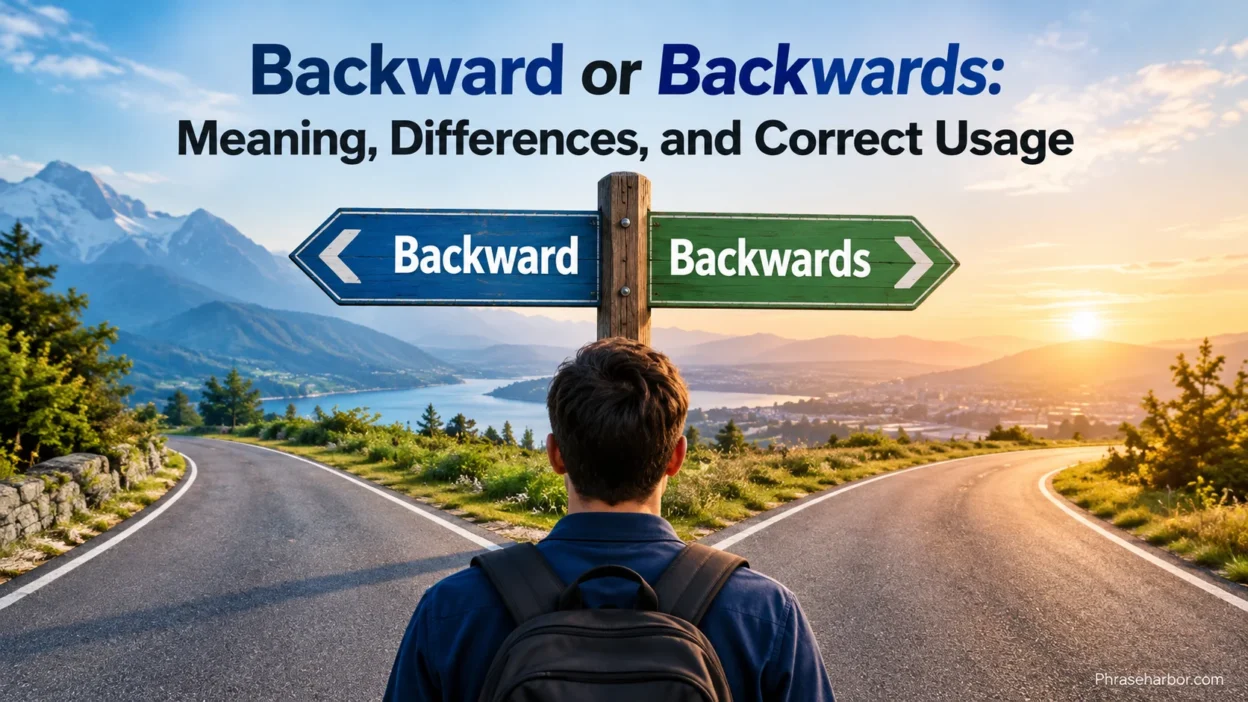
Many people get confused about backward or backwards because these two words look almost the same and often have the same meaning. Both describe backward movement, such as someone walking in reverse, or a step away from progress, which can suggest decline, regression, or moving away from progress.
Their meanings often overlap, but their spelling differences reflect regional differences in the English language. In American English, backward is generally preferred as an adverb, while British English and Commonwealth English commonly use backwards in the same role. Both spellings are correct, and dictionaries usually list both forms as acceptable.
A few years ago, a friend from London texted me, “I walked backwards into the meeting room.” I almost replied, “It should be walked backward.” Then I paused, wondering whether I was actually right. I wasn’t wrong, but neither was she. That moment reminded me how word choice, dialect, and language variation can affect everyday writing and communication.
Quick Answer:
Both backward and backwards are correct. They generally have the same meaning when used as adverbs to describe movement toward the rear or in reverse. The main difference is regional usage.
- Backward: Generally preferred in American English as an adverb. It also functions as an adjective.
- Backwards: Commonly used as an adverb in British English and other varieties of English.
- As an adjective: Use backward, as in “a backward movement” or “a backward glance.”
- In American writing: Prefer walk backward or move backward.
- In British writing: Walk backwards and move backwards are both natural choices.
Examples:
- American English: The boy took a step backward.
- British English: The boy took a step backwards.
- Adjective: The vehicle made a backward movement.
The easiest rule to remember is this: Use backward as an adjective and generally prefer it as an adverb in American English. Choose backwards when it fits the regional style you’re following.
Comparison Overview
Backward and backwards share nearly the same core meaning, but their grammatical roles and regional preferences can differ. The following table summarizes their most important features.
| Feature | Backward | Backwards |
| Basic meaning | Toward the rear or in reverse | Toward the rear or in reverse |
| Part of speech | Adjective and adverb | Primarily an adverb |
| American English | Generally preferred as an adverb | Correct, but less common in many contexts |
| British English | Used as an adjective and adverb | Commonly used as an adverb |
| Example of movement | She stepped backward. | She stepped backwards. |
| Example as an adjective | He made a backward movement. | Not standard in this construction |
| Figurative usage | A backward step in progress | Moving backwards in a project |
| General correctness | Correct | Correct |
The table shows that neither spelling is universally wrong. Your choice depends on how you use the word and which variety of English you’re writing in.
For example, an American writer might say, “The dog walked backward toward the door.” A British writer could naturally write, “The dog walked backwards toward the door.” Both sentences describe the same movement.
However, when the word modifies a noun, backward is the standard choice. You would write “a backward glance,” not “a backwards glance,” in standard edited English.
What Does Backward Mean?
The word backward describes movement toward the rear, a direction opposite to the usual forward direction, or a return to an earlier state. It can function as either an adjective or an adverb.
Its exact meaning depends on the sentence. Sometimes it describes physical movement. In other cases, it refers to a decline, a reversal, or a lack of progress.
Backward as an Adverb
An adverb describes how, where, or in what direction an action happens. When you use backward as an adverb, it explains movement toward the back or in reverse.
This usage is especially common in American English.
Examples:
- The athlete leaned backward to maintain his balance.
- The car rolled backward down the driveway.
- She glanced backward before crossing the street.
- The child counted backward from twenty.
- He walked backward toward the exit without turning around.
In each sentence, backward modifies an action. It tells the reader the direction in which the person or object moves, looks, or counts.
Consider the sentence, “The dancer bent backward during the performance.” The word backward explains the direction of the dancer’s movement.
American English generally favors this form over backwards in comparable sentences. However, that preference doesn’t make the alternative automatically incorrect.
Backward as an Adjective
An adjective describes a noun or pronoun. The word backward can identify a movement, glance, step, or other action directed toward the rear.
Examples:
- The driver made a backward movement.
- She took a backward step.
- He gave the room a backward glance.
- The machine supports forward and backward movement.
- The team took a backward step after losing its funding.
In these examples, backward modifies a noun. It tells the reader what kind of movement, step, or glance occurred.
This grammatical role provides one of the clearest ways to distinguish backward from backwards. In standard edited English, use backward when it directly describes a noun.
For example:
- Correct: The vehicle made a backward movement.
- Not standard: The vehicle made a backwards movement.
The first sentence follows the usual adjective pattern. Remembering this distinction will help you avoid an awkward construction in formal writing.
Backward in Figurative Expressions
Backward doesn’t always describe physical direction. It can also suggest regression, a reversal of progress, or a return to an earlier condition.
For example, someone might say, “The company took a backward step after losing its biggest customer.” The sentence doesn’t describe anyone physically walking backward. Instead, it describes a setback.
Common figurative uses include:
- A backward step: An action that reduces progress or reverses an improvement.
- Backward thinking: Thinking that resists progress or relies on outdated assumptions.
- A backward glance: A literal look toward the rear or a figurative reflection on the past.
- Backward movement: A return toward an earlier position or condition.
- A backward trend: A development that moves away from a desired improvement.
The expression backward thinking can sound strongly critical because it suggests that an idea is outdated or unreasonable. Use it carefully when discussing people, cultures, or social groups.
For instance, “The policy represents backward thinking” criticizes the policy’s ideas. It doesn’t simply describe an earlier historical period.
What Does Backwards Mean?
Backwards is primarily an adverb that describes movement toward the rear, an action performed in reverse, or an order opposite to the usual one.
British English commonly uses this form, although it also appears in American English.
Backwards as an Adverb
When you use backwards as an adverb, it explains the direction or manner of an action. The word can describe physical movement, reversed order, or an action performed from the end toward the beginning.
Examples:
- The child walked backwards across the room.
- She read the word backwards.
- The car moved backwards into the parking space.
- He fell backwards onto the sofa.
- The instructor asked the students to count backwards.
These sentences use backwards to describe how an action happens.
In British English, this construction is entirely natural. A British writer might choose “The child walked backwards” without giving the spelling a second thought.
American readers will understand the same sentence. However, backward is generally the more common choice in comparable American constructions.
Backwards in Everyday Expressions
The word also appears in everyday descriptions of reversed orientation and unusual movement.
Consider these examples:
- Put your shirt on backwards: Wear your shirt with its front facing the wrong direction.
- Read the sentence backwards: Read the words or letters in reverse order, depending on the context.
- Walk backwards: Move with your back leading rather than your front.
- Lean backwards: Tilt your upper body toward the rear.
- Count backwards: Count in descending order, such as ten, nine, eight, and seven.
The exact interpretation depends on the object or action being described.
For example, “She read the sentence backwards” might mean she read the words from right to left or reversed their order. In a puzzle, it could mean reading the letters of a word from the last letter to the first.
Context removes that uncertainty.
Read More: Allude vs. Elude: Meaning, Differences, and Correct Usage
Main Differences Between Backward and Backwards
Although backward and backwards often mean the same thing, their usage differs in several important ways. Understanding these differences helps you choose the form that fits your audience and sentence.
Difference in American English
American English generally favors backward as an adverb. It also uses backward as an adjective.
Examples:
- The child stumbled backward.
- The truck moved backward.
- She looked backward over her shoulder.
- The machine has a backward setting.
- The decision represented a backward step.
American dictionaries commonly recognize backwards as well. Therefore, you shouldn’t treat it as a spelling error whenever it appears in an American sentence.
Still, consistency matters in professional writing. If you’re preparing a document for a US audience, backward is usually the safer default for adverbial use.
For example, write “Move backward three steps” in an American instruction manual. That choice aligns with typical American usage and keeps the wording consistent.
Difference in British English
British English commonly uses backwards as an adverb. It also uses backward as an adjective and sometimes as an adverb.
Examples:
- The child walked backwards.
- He leaned backwards to see the screen.
- She looked backwards over her shoulder.
- The machine allows backward movement.
- The country experienced a backward step in reform.
British English doesn’t require backwards in every adverbial sentence. Both forms appear in established usage, so the distinction is mainly a matter of preference rather than a strict grammatical divide.
If you’re writing for a British audience, backwards will often sound natural when describing movement. However, keep backward in adjective constructions such as “a backward step.”
Difference in Grammar
The grammatical role of a word often matters more than its spelling.
Backward functions as both an adjective and an adverb. Backwards primarily functions as an adverb in standard modern English.
Compare the following sentences:
| Sentence | Grammatical role | Explanation |
| She stepped backward. | Adverb | Describes the direction of the step |
| She took a backward step. | Adjective | Describes the noun step |
| He walked backwards. | Adverb | Describes the direction of walking |
| He made a backward movement. | Adjective | Describes the noun movement |
| The car rolled backward. | Adverb | Describes the car’s movement |
Notice that backward works in both adjective and adverb positions. Backwards is most natural when it modifies a verb or describes an action.
This distinction is especially useful when editing sentences. If the word appears immediately before a noun and describes that noun, backward is generally the appropriate choice.
Difference in Meaning
In most adverbial constructions, backward and backwards have the same meaning. Both can describe movement toward the rear or an action performed in reverse.
For example:
- The child stepped backward.
- The child stepped backwards.
Both sentences describe a child moving toward the rear.
The difference is not the direction of movement. It is the regional preference for one form over the other.
However, context can influence the precise meaning of either word. “Read the instructions backwards” might describe reading in reverse order, while “take a backward step” can describe a setback rather than physical movement.
The surrounding words establish the intended meaning.
When to Use Backward vs. Backwards
Choosing the correct form becomes easier when you consider three things: grammar, audience, and context.
When to Use Backward
Use backward when it describes a noun. In American English, it’s also the preferred adverb in many ordinary sentences.
Choose backward in these situations:
- Before a noun: “The vehicle made a backward movement.”
- In American adverbial writing: “She stepped backward.”
- When describing regression: “The new rule was a backward step.”
- In established expressions: “He gave the past a backward glance.”
- In technical instructions: “Move the lever backward.”
For example, imagine you’re writing instructions for assembling a chair. One step tells the reader to “slide the support backward until it locks.”
That sentence is clear and natural for an American audience. It also avoids unnecessary variation within the instructions.
If you’re unsure which form to choose for American writing, backward is generally the most practical default.
When to Use Backwards
Use backwards when describing an action in a context where that form is natural, especially in British English.
Common examples include:
- The toddler walked backwards toward his mother.
- She leaned backwards to avoid the branch.
- The cyclist looked backwards before changing direction.
- He spelled the word backwards.
- The dog tumbled backwards off the cushion.
British writers can use these sentences naturally without treating backwards as informal or incorrect.
American writers may also use the form, particularly in familiar expressions or when it matches their natural speech. However, backward remains the usual editorial preference in many American contexts.
The important point is to avoid turning a regional preference into an absolute grammar rule. Both forms have legitimate uses.
Backward vs. Backwards: Example Sentences
Examples make the distinction easier to remember. The following sentences show how the words work in different contexts.
| Context | Example with backward | Example with backwards |
| Walking | She walked backward toward the gate. | She walked backwards toward the gate. |
| Looking | He glanced backward at the noise. | He glanced backwards at the noise. |
| Falling | The child fell backward onto the bed. | The child fell backwards onto the bed. |
| Reversed reading | Read the word backward. | Read the word backwards. |
| Physical movement | The cart rolled backward. | The cart rolled backwards. |
| Clothing | His shirt was on backward. | His shirt was on backwards. |
| Figurative progress | The company took a backward step. | This construction isn’t standard with backwards before step. |
The first six pairs illustrate adverbial usage. Both forms can work, although the preferred choice varies by region.
FAQs:
Is backward or backwards correct?
Both backward and backwards are correct spellings. American English generally prefers backward, while British English commonly uses backwards as an adverb.
What is the difference between backward and backwards?
The main difference is regional usage. Both words can describe movement in reverse, but backward is more common in American English, whereas backwards is more common in British English.
Is backward an adjective or an adverb?
Backward can function as both an adjective and an adverb. For example, “a backward movement” uses it as an adjective, while “move backward” uses it as an adverb.
Is backwards acceptable in American English?
Yes, backwards is acceptable in American English, especially as an adverb. However, American writing generally favors backward, so follow your preferred style guide when consistency matters.
How can I remember when to use backward or backwards?
Remember that American English generally favors backward, while British English often favors backwards as an adverb. When using either word as an adjective, choose backward, as in “a backward step.”
Conclusion:
Both backward and backwards are correct, so your choice usually depends on regional preference and grammatical function. American English tends to favor backward, while British English commonly uses backwards as an adverb. However, backward works as both an adjective and an adverb. Understanding these simple differences will help you write clearly, avoid common grammar mistakes, and choose the right form for your audience.