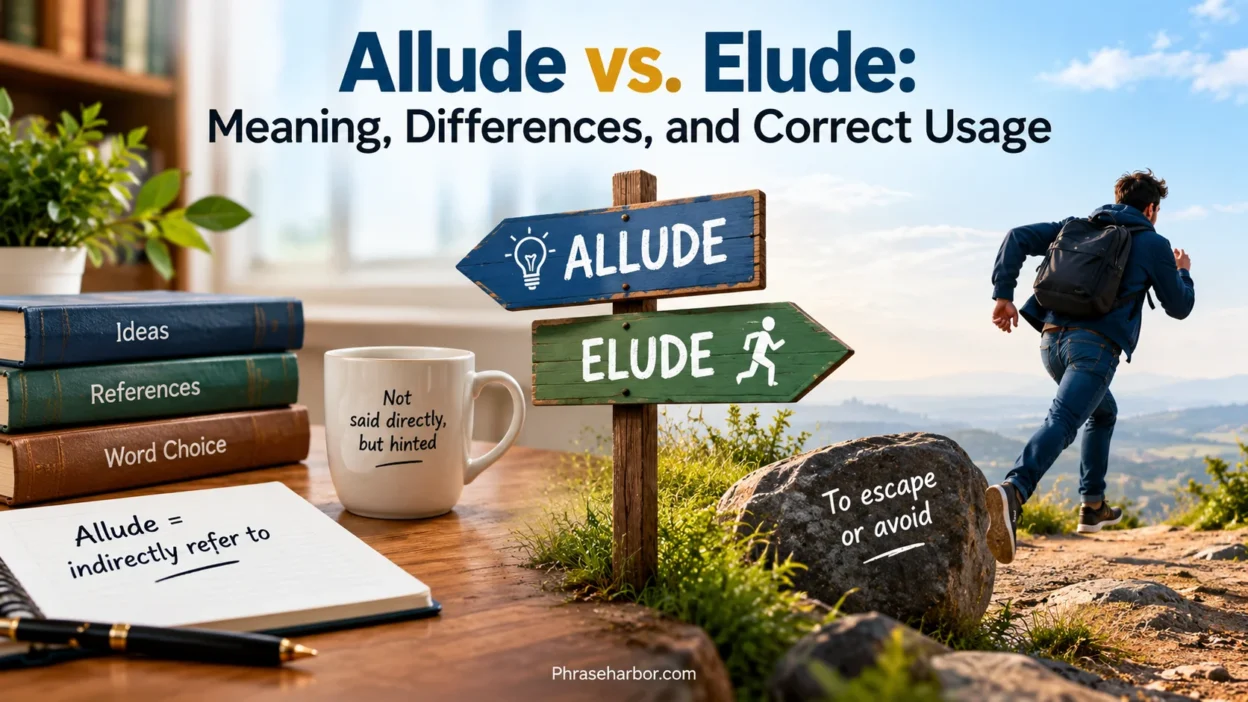
Allude vs. Elude can confuse English learners because the words look alike, but one means hint indirectly while the other means escape or avoid. Allude means to mention something indirectly, such as referring to a person, event, or idea without explaining it directly. Elude means to escape, avoid, or remain difficult to reach.
For example, you might write, “She alluded to the problem during the meeting,” or “The answer continued to elude him.” Understanding these definitions, sentence patterns, and differences helps you choose the right word in everyday writing, speaking, and formal communication. In business communication and professional writing, correct usage supports clarity, precision, and professionalism.
Whether you’re writing project management updates, meeting notes, online booking confirmations, emails, reminders, or a meeting agenda, the right word helps your audience understand your message. Paying attention to US conventions, UK conventions, and relevant style guides also promotes consistent English usage. With clear examples, simple explanations, and practical editing tips, you can avoid grammar mistakes, improve sentence accuracy, strengthen your vocabulary, and build writing confidence.
Quick Answer:
Allude means to mention or refer to something indirectly without stating it openly. Elude means to escape, avoid capture, or remain difficult to understand, remember, find, or achieve.
Here are two examples that show the difference:
- Allude: During the interview, the manager alluded to problems within the department without naming anyone.
- Elude: Despite hours of research, the answer continued to elude the scientist.
Remember this simple distinction: you allude to something when you hint at it, but something eludes you when it escapes your grasp or understanding.
Comparison Overview
Although allude and elude share several letters, they serve different purposes. The table below highlights their meanings, grammatical patterns, and typical uses.
| Feature | Allude | Elude |
| Part of speech | Verb | Verb |
| Primary meaning | Refer to something indirectly | Escape, avoid, or remain beyond reach |
| Common construction | Allude to something | Elude someone or something |
| Typical context | Hints, references, indirect communication | Escape, avoidance, memory, understanding, achievement |
| Example | She alluded to their earlier disagreement. | The suspect eluded the police. |
| Related noun | Allusion | Elusion |
| Related adjective | Allusive | Elusive |
| Past tense | Alluded | Eluded |
| Present participle | Alluding | Eluding |
The most important difference concerns the action each verb describes. Allude involves communicating an indirect reference, whereas elude involves escaping or failing to be grasped.
For instance, a politician may allude to a policy change without explaining it directly. A solution may elude the same politician when the details prove difficult to understand.
What Does Allude Mean?
Definition of Allude
Allude means to refer to something indirectly rather than mentioning it explicitly. When you allude to an idea, person, event, or situation, you expect your audience to recognize the reference without spelling everything out.
The word often appears when people want to communicate something subtly. They may assume their listeners already know the background or prefer not to discuss a subject openly.
Consider this example:
“During the meeting, Jordan alluded to the team’s earlier problems.”
Jordan referred to previous difficulties but didn’t describe them directly. The listeners might understand the reference because they already know what happened.
An allusion doesn’t always involve secrecy or an attempt to avoid a difficult subject. Writers also use indirect references to add meaning, connect ideas, or acknowledge familiar stories and cultural events.
For example, a novelist might describe a character facing an impossible challenge as “a modern-day David against Goliath.” This phrase alludes to the biblical story of David and Goliath without retelling it.
How to Use Allude in a Sentence
The standard grammatical construction is allude to.
You generally use allude with the preposition to when identifying the person, subject, event, or idea being referenced.
Here are several correct examples:
- The speaker alluded to a recent disagreement during her presentation.
- My supervisor alluded to upcoming changes in the company.
- The author alludes to Greek mythology throughout the novel.
- He alluded to his childhood without sharing many details.
- The report alludes to several concerns that require further investigation.
Notice that the word following to identifies the subject of the indirect reference.
You can also use allude without immediately naming the subject if the context makes the reference clear.
For example: “She kept alluding to something that happened last summer.”
The sentence is grammatically complete, even though the reader doesn’t know exactly what happened.
Important grammar tip: Don’t confuse allude to with elude. The preposition to belongs in the usual construction when you mean “refer indirectly.”
Examples of Allude in Different Contexts
The meaning of allude remains consistent across different settings, although the purpose of the reference may change.
Everyday conversation
People often allude to shared experiences without explaining them.
- “You know what happened at the party,” Mia said, alluding to an embarrassing moment.
- He alluded to their disagreement but didn’t want to reopen the argument.
- My friend alluded to a surprise without revealing what it was.
Literature and creative writing
Authors use allusions to connect their work with established stories, historical events, or cultural ideas.
- The poem alludes to the story of Icarus.
- The novel alludes to Shakespearean tragedy through its themes of jealousy and revenge.
- The song alludes to a famous historical event without naming it directly.
An allusion can add depth because readers bring their existing knowledge to the reference.
Workplace communication
Professionals sometimes allude to sensitive matters when they want to communicate tactfully.
- The director alluded to budget concerns during the staff meeting.
- Her email alluded to delays without criticizing the team directly.
- The manager alluded to a possible restructuring later this year.
However, indirect communication can create confusion if readers don’t recognize the reference. When clarity matters, stating the issue directly may be more effective.
News and public statements
Public figures may allude to events or controversies without explicitly identifying the people involved.
- The spokesperson alluded to ongoing negotiations.
- The candidate alluded to earlier policy failures during the debate.
- The statement alluded to concerns raised by community members.
In each example, the speaker refers to something without describing it fully.
Synonyms and Related Words for Allude
Several words express ideas similar to allude, but they don’t always mean exactly the same thing.
| Word or phrase | Meaning | Example |
| Hint at | Suggest something indirectly | She hinted at a possible promotion. |
| Refer to | Mention or identify a subject | He referred to the earlier report. |
| Imply | Suggest a meaning without stating it directly | Her tone implied disappointment. |
| Suggest | Put forward an idea or indicate a possibility | The evidence suggests a different explanation. |
| Make an indirect reference to | Refer to something without naming it explicitly | The novel makes an indirect reference to Roman history. |
These alternatives overlap with allude, but the context determines which one works best.
For example, refer to can describe a direct mention as well as an indirect one. By contrast, allude to specifically emphasizes indirect reference.
Similarly, imply often focuses on a meaning suggested by someone’s words or behavior rather than an explicit reference to a particular subject.
What Does Elude Mean?
Definition of Elude
Elude means to escape, avoid, or remain beyond someone’s reach. It can describe physical escape, successful avoidance, or something that proves difficult to understand, remember, find, or achieve.
The word has both literal and figurative meanings.
In its literal sense, elude often describes someone avoiding capture or escaping pursuit.
For example:
“The fugitive eluded the police for several days.”
The fugitive avoided capture, so eluded is the appropriate verb.
In a figurative sense, elude describes something that remains difficult to grasp mentally or practically.
Consider this sentence:
“The answer eluded me during the examination.”
The answer didn’t physically escape. Instead, the writer couldn’t recall or figure it out at that moment.
You can also use elude when discussing goals, understanding, and success.
- The meaning of the poem eluded the students.
- A permanent solution has eluded researchers for years.
- Despite repeated attempts, victory eluded the team.
In all three examples, something remains out of reach.
How to Use Elude in a Sentence
Unlike allude, elude doesn’t normally require the preposition to before its object.
You can use elude with a person, an institution, an obstacle, or an abstract concept.
Common sentence patterns include:
- Elude someone: The suspect eluded the detectives.
- Elude capture: The animal eluded capture.
- Elude detection: The defect eluded detection during testing.
- Elude understanding: The theory eluded many readers.
- Elude someone’s memory: Her name eluded me.
- Elude achievement: Success eluded the team.
The subject of the sentence is usually the person, thing, answer, or goal that escapes or remains out of reach.
Look at this example: “The solution eluded the engineers.”
The solution is the subject because it remained beyond the engineers’ ability to find. The engineers are the people experiencing the difficulty.
Compare that with “The engineers alluded to the solution.” This means they indirectly referred to the solution. It doesn’t mean they struggled to find it.
The difference is substantial, even though the sentences use nearly identical vocabulary.
Read More: Cancellation vs. Cancelation: Meaning, and Correct Usage
Examples of Elude in Different Contexts
Physical escape
Use elude when someone or something escapes pursuit or avoids capture.
- The burglar eluded the security guards.
- The deer eluded the hunters by disappearing into the forest.
- The suspect eluded capture despite a thorough search.
Problem-solving and research
Sometimes an answer remains difficult to discover despite considerable effort.
- The cause of the malfunction eluded the technicians.
- A reliable explanation eluded researchers for decades.
- The final piece of the puzzle continued to elude the investigators.
Memory and recall
People frequently use elude when they cannot remember a name, date, word, or detail.
- Her last name eluded me during our conversation.
- The exact date of the meeting eluded him.
- The word I wanted to use kept eluding me.
These constructions are natural in American English. They describe a temporary or continuing failure to recall something.
Achievement and success
You can also use elude when a desired result remains unattainable.
- A championship eluded the team for years.
- Despite careful preparation, victory eluded the athlete.
- Financial stability continued to elude the struggling business.
In these examples, the goals remain out of reach rather than physically escaping anyone.
Synonyms and Related Words for Elude
Several words overlap with elude, but their meanings differ in important ways.
| Word or phrase | Meaning | Example |
| Escape | Get free from confinement or danger | The prisoner escaped from custody. |
| Evade | Avoid something, often deliberately | The driver evaded the roadblock. |
| Avoid | Keep away from something unwanted | She avoided unnecessary arguments. |
| Slip away from | Escape quietly or unnoticed | The child slipped away from the crowd. |
| Remain beyond reach | Continue to be unattainable | The answer remained beyond reach. |
| Defy understanding | Resist a clear explanation | The pattern defied understanding. |
Escape often emphasizes getting free from a place or situation. Evade frequently suggests deliberate avoidance, while avoid has a broader range of uses.
Elude can convey either physical avoidance or the figurative idea of something remaining difficult to grasp.
For example, a person can evade a question by refusing to answer it. An answer can elude someone because they cannot figure it out.
Main Differences Between Allude and Elude
Difference in Meaning
The clearest distinction is what each word communicates.
Allude describes an indirect reference. Elude describes escape, avoidance, or something that remains difficult to grasp.
Consider these paired examples:
| Allude | Elude |
| The teacher alluded to the student’s earlier mistake. | The student’s name eluded the teacher. |
| The writer alluded to a famous historical event. | The historical details eluded the writer. |
| The manager alluded to a possible promotion. | A promotion continued to elude the employee. |
| The speaker alluded to a difficult question. | The answer to the question eluded the speaker. |
The first column describes someone indirectly referring to something. The second describes something escaping someone’s reach or understanding.
A useful way to remember this distinction is to ask yourself what the sentence describes. Is someone hinting at a subject, or is something difficult to catch, remember, or achieve?
If the sentence describes an indirect reference, choose allude. If it describes escape or difficulty reaching something, choose elude.
Difference in Sentence Structure
The two verbs also follow different grammatical patterns.
Allude to something
When you use allude to identify the subject of a reference, you normally need to.
- Correct: She alluded to the disagreement.
- Incorrect for the intended meaning: She alluded the disagreement.
The second sentence doesn’t follow the standard construction for referring indirectly to something.
Elude someone or something
The verb elude generally takes a direct object without to.
- Correct: The suspect eluded the officers.
- Incorrect for the intended meaning: The suspect eluded to the officers.
The second sentence doesn’t express the intended meaning of escaping the officers.
However, the distinction isn’t simply about memorizing one preposition. The verbs also express different relationships between the subject and the object.
In “She alluded to the disagreement,” she makes an indirect reference to the disagreement.
In “The disagreement eluded her understanding,” the disagreement remained difficult for her to understand.
FAQs:
What is the main difference between allude and elude?
Allude means to refer to something indirectly without stating it clearly. Elude means to escape, avoid, or remain difficult to find or understand. For example, a speaker might allude to a past event, while a difficult answer might elude a student.
How do you use allude in a sentence?
Use allude when you hint at something or refer to it indirectly. For example, “The manager alluded to upcoming changes during the meeting.” The manager suggested that changes were coming without explaining the details.
How do you use elude in a sentence?
Use elude when something escapes you, remains out of reach, or proves difficult to understand. For example, “Despite studying for hours, the correct answer continued to elude him.” Here, the answer remained difficult for him to find.
Is allude the same as mention?
Not exactly. Mention can mean stating something directly, while allude usually means referring to it indirectly. For example, “She mentioned the deadline” states it directly, while “She alluded to the approaching deadline” suggests it without spelling it out.
What is an easy way to remember allude vs. elude?
Remember that allude is about an indirect reference, while elude is about escaping or staying out of reach. If someone hints at a problem, they allude to it. If a solution remains difficult to find, it eludes them.
Conclusion:
Understanding allude vs. elude helps you choose the correct word in everyday conversations, emails, and professional documents. Use allude when you refer to something indirectly, and use elude when something escapes you or remains difficult to find or understand. With a little practice, you can remember the difference and make your writing clearer and more accurate.