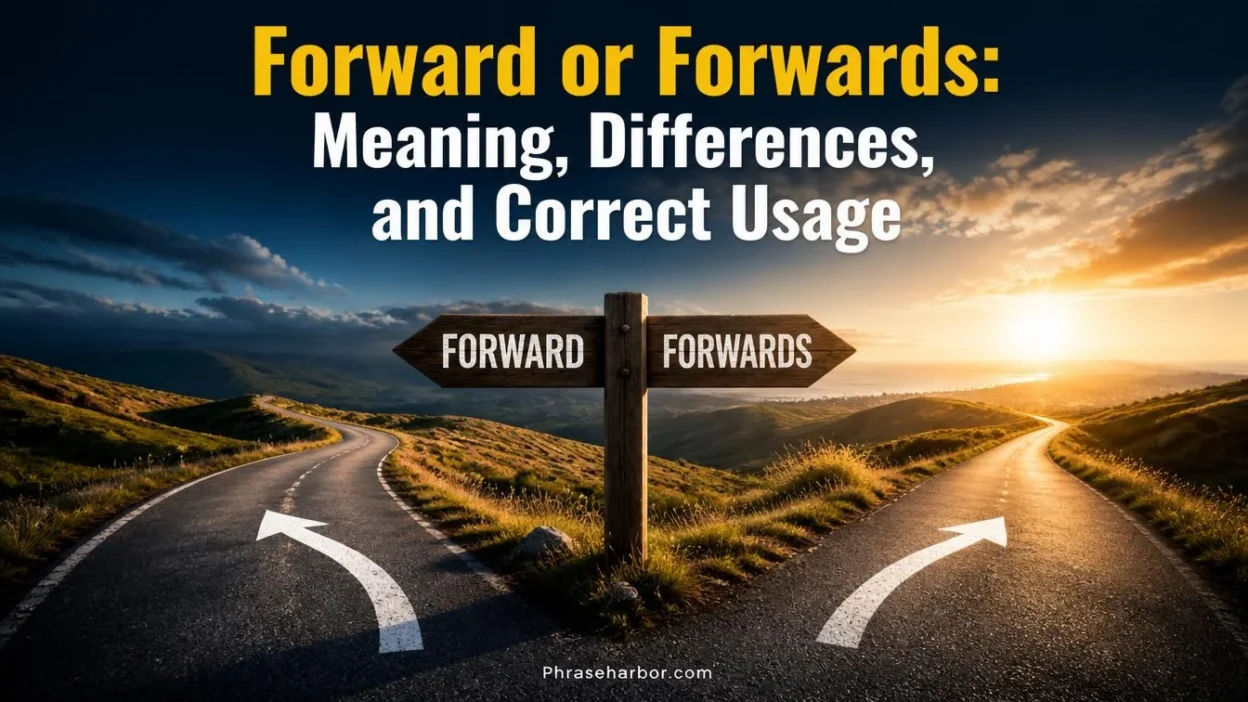
Have you ever wondered whether to write forward or forwards? You might see both forms in books, emails, conversations, and online articles. They often describe the same movement, yet their use can depend on the grammatical role of the word and the variety of English you speak.
The good news is that neither form is automatically wrong. Both forward and forwards can function as adverbs meaning toward the front or ahead. However, American English generally favors forward, while British English commonly uses both forms. The difference becomes clearer when you look at expressions such as look forward to, move forwards, and forward an email.
Understanding these distinctions will help you choose the right word for your audience. Whether you’re writing a professional email, describing physical movement, or explaining a plan, a few simple rules can keep your writing clear and natural.
Quick Answer
Forward and forwards are both correct as directional adverbs. They can describe movement toward the front or ahead. The main difference is regional preference: American English generally favors forward, while British English commonly accepts both.
Use forward when:
- Writing for an American audience.
- Using the word as an adjective, as in forward movement.
- Using it as a verb, as in forward a message.
- Writing the common expression look forward to hearing from you.
Use forwards when:
- Describing movement in a variety of English where the adverbial form is common, particularly British English.
- You want to use a familiar British variant in a sentence such as She stepped forwards.
For most American writing, forward is the safest and most natural choice.
Comparison Overview
The following table summarizes the key differences between forward and forwards.
| Feature | Forward | Forwards |
| Basic meaning | Toward the front or ahead | Toward the front or ahead |
| Part of speech | Adverb, adjective, verb, and noun | Primarily an adverb in directional use |
| American English | Generally preferred | Less common |
| British English | Common | Common as an adverb |
| Example of movement | She moved forward. | She moved forwards. |
| Adjective use | Forward planning | Not standard in this construction |
| Verb use | Forward an email | Not standard as a verb |
| Common expression | Look forward to | Look forward to is the usual form in American English |
The most important point is that these words often have the same meaning when they describe direction. You don’t need to memorize two separate definitions. Instead, pay attention to the sentence, the grammatical role, and your audience.
Main Differences Between Forward and Forwards
Although forward and forwards often mean the same thing, they don’t work interchangeably in every sentence. Their differences become easier to understand when you examine meaning, grammar, regional usage, and common expressions.
Difference in Meaning
As directional adverbs, forward and forwards describe movement toward the front or ahead. Neither word inherently suggests a different speed, distance, or direction.
Consider these examples:
- Forward: The child took two steps forward.
- Forwards: The child took two steps forwards.
Both sentences describe the child moving ahead. The choice reflects a difference in usage preference rather than a meaningful change in direction.
The same principle applies to figurative movement. Someone can move forward with a career or move forwards with a project. In both cases, the idea is progress.
However, context matters. In a sentence such as “Please forward the message,” the word forward means to send something to another recipient. You can’t replace it with forwards because the verb form doesn’t work that way.
Difference in Grammatical Function
One of the clearest distinctions is that forward has several grammatical roles, while forwards is primarily used as an adverb in directional expressions.
| Sentence | Grammatical role | Correct form |
| She walked forward. | Adverb | Forward |
| She walked forwards. | Adverb | Forwards |
| We discussed forward planning. | Adjective | Forward |
| Please forward the email. | Verb | Forward |
| The forward scored a goal. | Noun | Forward |
| The team sent its forwards onto the field. | Plural noun | Forwards |
Notice the final example. Forwards can also be a plural noun in sports, where it refers to players who take attacking positions. That use is different from the directional adverb.
The key is to identify what the word does in your sentence. If it describes movement, both forms may work. If it modifies a noun or acts as a verb, use forward.
Difference Between American and British English
Regional preference explains much of the difference between forward and forwards.
American English generally favors forward. You are more likely to see sentences such as “Move forward,” “We need to move forward with the project,” and “I look forward to your reply.”
British English uses forward as well, but forwards is also common when describing movement. A British speaker might naturally write, “He moved forwards to get a better view.”
These preferences aren’t strict rules that divide the two countries into separate linguistic camps. British writers use forward, and American readers can understand forwards. The distinction is mainly about what sounds natural to a particular audience.
If you’re writing for a US publication, business, or school, choose forward unless the context calls for another established use.
Difference in Formal and Informal Writing
Neither forward nor forwards is automatically informal. Both can appear in everyday conversation, journalism, and other forms of writing.
Still, forward is usually the more practical option in American professional communication. It fits naturally into sentences such as:
- We look forward to working with your team.
- Please forward the signed agreement by Friday.
- The company plans to move forward with the proposal.
British writers can also use forwards in suitable directional sentences, including formal writing. The important consideration is whether the expression sounds natural in the variety of English you’re using.
Writing tip: Don’t change every instance of forward to forwards simply to make your writing sound British. Regional style involves more than adding an s to the end of a word.
Read More: Igniter or Ignitor: Which Spelling Is Correct?
What Does Forward Mean?
The word forward has several related meanings. It can describe physical direction, progress, a position at the front, or the act of sending something to another person.
Its meaning depends on the sentence. Understanding its different grammatical roles will help you avoid mistakes that a simple spelling rule can’t explain.
Forward as an Adverb
An adverb describes a verb, an adjective, or another adverb. When forward functions as an adverb, it often explains the direction of an action.
For example:
- The audience leaned forward to hear the speaker.
- The runner moved forward after the starting signal.
- She stepped forward to introduce herself.
- The project is finally moving forward.
- He pushed the chair forward to make room.
In each sentence, forward tells you how or in which direction someone or something moves. It can also describe progress that isn’t physical.
For instance, when a business moves forward with a new strategy, it proceeds with its plans. Nobody needs to walk anywhere.
Forward as an Adjective
An adjective describes a noun. Forward can describe something positioned toward the front or associated with progress and future planning.
Common examples include:
- Forward movement: Movement toward the front or ahead.
- Forward planning: Preparing for future needs or events.
- Forward position: A position toward the front of something.
- Forward motion: Movement in a particular forward direction.
Consider this sentence: “The vehicle’s forward motion stopped suddenly.”
Here, forward describes the type of motion. The word forwards wouldn’t fit the same construction because the sentence needs an adjective rather than a directional adverb.
Another example is “Forward planning helped the team avoid delays.” The adjective describes planning that anticipates future requirements.
Forward as a Verb
As a verb, forward means to send something onward to another person or destination. It commonly appears in digital communication and mail services.
Examples include:
- Please forward the invitation to the other guests.
- I forwarded the email to my supervisor.
- The postal service will forward your mail to your new address.
- Could you forward me the meeting details?
The verb changes form according to tense and subject: forward, forwards, forwarded, and forwarding.
For example, “She forwards every important update to her manager” is correct. The final s belongs to the verb’s third-person singular form, not to the directional adverb forwards.
This distinction is worth remembering because the same spelling can serve different grammatical purposes. In “She walks forwards,” forwards describes movement. In “She forwards the report,” forwards is a conjugated verb.
Forward as a Noun
The word forward can also refer to a player in an attacking position in sports such as soccer, basketball, and hockey.
For example:
- The forward scored the winning goal.
- The basketball forward grabbed the rebound.
- The coach moved a forward into a more central position.
The plural is often forwards, although the exact terminology depends on the sport and its conventions.
In this context, forwards doesn’t mean “toward the front.” It refers to multiple players. That makes the grammatical role different from the directional use discussed throughout this article.
What Does Forwards Mean?
Forwards is an adverb that commonly describes movement toward the front or ahead. It often appears in British English, although speakers and writers vary in their preferences.
Like forward, it can describe both physical movement and progress toward a goal. The added s doesn’t normally change the basic meaning.
Forwards for Physical Movement
When someone or something moves toward the front, forwards can describe that direction.
Examples include:
- The little boy stumbled forwards.
- She leaned forwards to read the small print.
- The horse moved forwards when the rider gave the signal.
- He took a few steps forwards and opened the door.
Each sentence describes movement. You could use forward in all four examples without changing the central meaning.
However, the most natural choice depends on the audience. A British writer may find forwards entirely ordinary, while an American writer will generally prefer forward.
Forwards for Figurative Movement
The word can also describe progress rather than literal movement.
For example:
- The negotiations moved forwards after several difficult meetings.
- We need to look forwards and prepare for the next challenge.
- The organization continued moving forwards despite the setbacks.
These sentences present progress as movement along a path. The image is easy to understand: instead of standing still, a person or organization advances toward a goal.
Still, some expressions have more established wording than others. “Look forward to hearing from you” is the standard expression in American English. Even where forwards is accepted as a directional adverb, the established phrase is usually best left unchanged in US writing.
When to Use Forward
Choose forward when you need a directional adverb, an adjective, a verb, or a noun. It’s especially useful in American English because it works naturally across many everyday and professional contexts.
Use Forward to Describe Direction
When describing someone moving toward the front, forward is the standard choice in American English.
Examples:
- The passengers moved forward to board the train.
- She bent forward to tie her shoe.
- The dog ran forward when its owner called.
- The line moved forward slowly.
In these sentences, forward answers a simple question: In which direction did the action happen?
Use Forward to Describe Progress
The word often represents improvement, development, or movement toward a goal.
Examples:
- The research team made progress and moved forward.
- We should move forward with the plan.
- Her career moved forward after she completed the training.
- The negotiations took a major step forward.
Notice the expression a step forward. It describes progress, even when nobody takes a literal step.
This figurative meaning appears frequently in workplaces, education, personal development, and public discussions. It offers a simple way to describe improvement without explaining every detail of the process.
Use Forward Before a Noun
When forward modifies a noun, use the form without s.
Correct examples include:
- Forward planning
- Forward movement
- Forward thinking
- Forward position
- Forward direction
Incorrect: forwards planning
Correct: forward planning
The distinction is grammatical, not merely regional. In these examples, forward describes the noun that follows it.
Use Forward When Sending Something
Use forward as a verb when sending an email, message, document, or piece of mail to another recipient.
For example:
- I’ll forward the invoice after lunch.
- Please forward this announcement to the entire department.
- She forwarded the original message to the support team.
This usage is common in business communication. It’s direct, familiar, and easy to understand.
Use Forward in Established Expressions
Some phrases have conventional forms that you should learn as complete expressions.
Examples include:
- Look forward to
- Move forward
- Step forward
- Take a step forward
- Going forward
For instance, “I look forward to meeting you” sounds natural in a professional email. The phrase communicates anticipation without sounding overly casual.
Although some directional expressions permit forwards, established expressions may favor forward regardless of the broader regional pattern.
FAQs:
Is Forward or Forwards Correct?
Both are correct when used as directional adverbs. They can mean moving toward the front or ahead. American English generally favors forward, while British English commonly uses forward and forwards.
Is Forwards Grammatically Correct in American English?
Forwards is a recognized English word, but American English generally prefers forward as a directional adverb. You may encounter forwards in American writing, but it often sounds less typical than the alternative.
Do British People Say Forward or Forwards?
British English uses both forms. For example, a British speaker might say “move forward” or “move forwards.” The preferred form can vary by speaker, context, and expression.
Is It Look Forward or Look Forwards?
“Look forward to” is the standard form in American English. For example, “I look forward to seeing you next week” is correct and natural.
Remember that to is a preposition in this expression, so use a noun or the -ing form after it when appropriate: “I look forward to the meeting” or “I look forward to meeting you.”
Can Forward Be a Verb?
Yes. Forward means to send something to another person or destination. For example, “Please forward the email to your supervisor.”
The verb can change form depending on the sentence: forward, forwards, forwarded, and forwarding.
Final Takeaway
The difference between forward and forwards is simpler than it first appears. Both can describe movement toward the front or ahead, but their regional preferences and grammatical roles differ. For American English, forward is generally the best default. Use it in expressions such as move forward, look forward to, and forward an email. In British English, forwards is also common as a directional adverb.