Have you ever stopped while writing because you weren’t sure whether to use “too many” or “to many”? You’re not alone. These two expressions sound exactly alike, which makes them easy to confuse in emails, school assignments, blog posts, and everyday conversations. However, their meanings and grammatical functions are different.
The good news is that choosing the correct phrase becomes simple once you understand how too and to work in a sentence. “Too many” expresses an excessive number of people or things, while “to many” is grammatically correct when to acts as a preposition connecting an action, feeling, or relationship to a group.
For example, you might say, “There are too many cars on this street” when traffic has become a problem. On the other hand, you could write, “The new park is important to many families” when describing its value to the community.
Both phrases have a place in English. The key is understanding what you want to say and choosing the expression that matches your meaning.
Quick Answer:
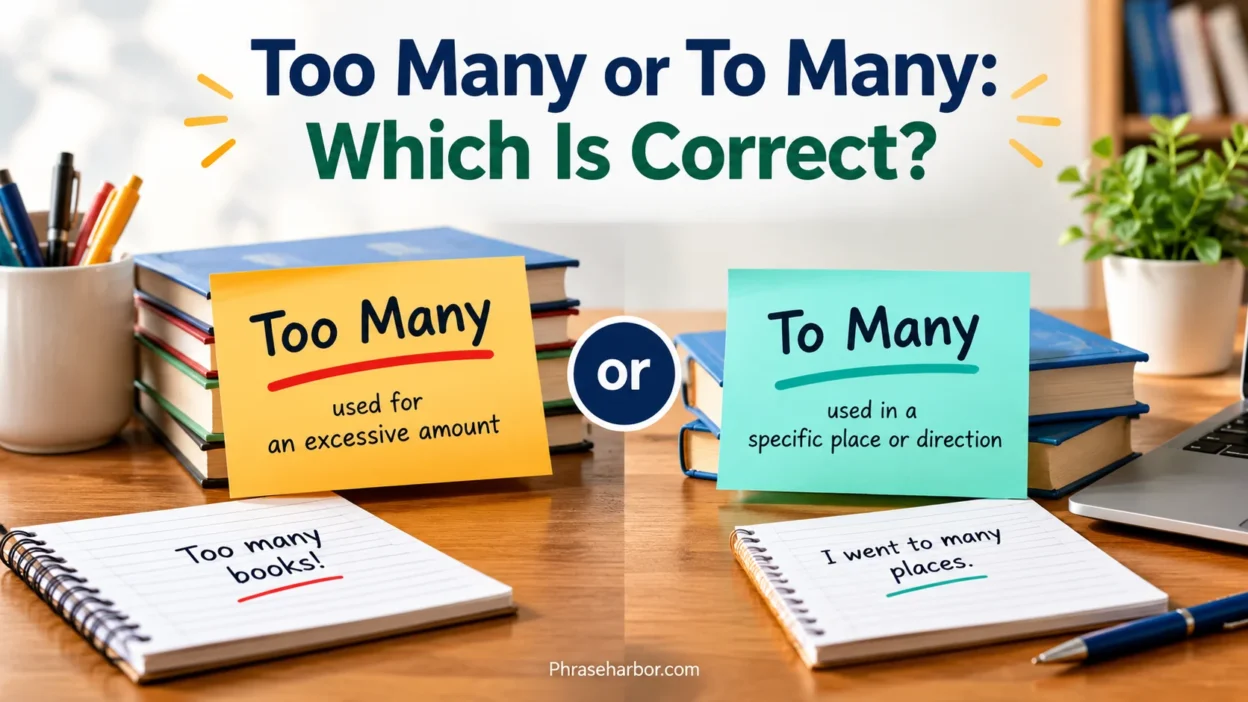
“Too many” is correct when you want to describe an excessive number of countable people or things. “To many” is also correct in certain sentences when to functions as a preposition. The right choice depends on the sentence’s meaning and grammatical structure.
Consider these examples:
- Too many: There are too many people waiting outside.
- To many: The decision was surprising to many employees.
- Too many: I bought too many apples for the recipe.
- To many: The teacher explained the instructions to many students.
In the first and third examples, too many indicates an excessive quantity. In the second and fourth examples, to many refers to the people who experienced a reaction or received information.
Here’s a quick way to remember the difference:
- Use too many when you mean “more than necessary, desirable, or manageable.”
- Use to many when the sentence requires the preposition to, often to indicate a recipient or relationship.
Neither expression is automatically wrong. However, you cannot substitute one for the other without considering the sentence’s meaning.
Comparison Overview
The expressions “too many” and “to many” differ in meaning, grammatical function, and usage. Although they sound identical, their spelling tells readers how each expression works.
| Feature | Too Many | To Many |
| Meaning | An excessive number | To or for a large number of people or things |
| Grammar | Too is an adverb; many is a determiner | To is a preposition; many refers to a large number |
| Main purpose | Expresses excess | Shows a relationship, recipient, or direction |
| Typical use | Complaints, warnings, quantities, and limits | Giving, explaining, mattering, and relating |
| Example | There are too many emails in my inbox. | The announcement came as a surprise to many workers. |
| Is it grammatically correct? | Yes, when used appropriately | Yes, when the sentence requires to |
The biggest difference comes down to the word “too.” It adds the idea of excess, while “to” connects words and ideas within a sentence.
For instance, “There are too many customers” suggests that the number of customers exceeds a comfortable or manageable amount. Meanwhile, “The discount was available to many customers” simply means that a large number of customers could receive the discount.
Once you recognize this difference, you’ll find it easier to choose the correct expression without second-guessing yourself.
Main Differences Between Too Many and To Many
Understanding the individual words makes the distinction much easier. Let’s examine how each expression works and when you should use it.
What Does “Too Many” Mean?
“Too many” means more people or things than are needed, wanted, expected, or manageable. The expression usually communicates excess, although the seriousness of that excess depends on the situation.
For example, imagine preparing dinner for four guests. You accidentally buy twenty loaves of bread. You might say, “I bought too many loaves of bread.” The problem isn’t that you bought bread; it’s that you bought more than the occasion requires.
The same idea applies to work, school, travel, shopping, and everyday decisions.
Consider these examples:
- There are too many cars on the highway during rush hour.
- She has too many assignments to finish tonight.
- We received too many applications for the available positions.
- He made too many mistakes on the final exam.
- The store offers too many choices for someone who wants a quick decision.
In each sentence, the expression points to a quantity that exceeds a particular limit or expectation.
That limit doesn’t always have to be an exact number. Five assignments might be manageable for one student but overwhelming for another. Similarly, ten guests might suit a large house but feel like too many in a small apartment.
Therefore, “too many” expresses an excessive quantity relative to the situation, not necessarily a fixed numerical amount.
What Does “To Many” Mean?
“To many” is correct when “to” functions as a preposition and “many” refers to a large number of people or things. Unlike too many, this expression doesn’t automatically suggest that the quantity is excessive.
You commonly see it when a sentence describes giving something to people, communicating information, or explaining how something affects a group.
For example:
- The organization donated blankets to many families.
- The new policy seems unfair to many employees.
- This book introduces basic science concepts to many young readers.
- The community center provides valuable services to many residents.
- The announcement came as a surprise to many people.
Notice that none of these sentences necessarily expresses excess. The organization may have helped an appropriate number of families. The book may reach its intended audience. The policy may simply affect a large group of employees.
The preposition to establishes a relationship between the rest of the sentence and the people or things described by many.
However, the phrase still needs to fit the sentence’s grammar. You wouldn’t normally write “I have to many assignments” when you mean that your workload is excessive. The correct sentence is “I have too many assignments.”
Why “Too” and “To” Are Different
The words too and to sound alike in standard American English, but they perform different grammatical jobs.
Too is an adverb. It commonly means “also” or “more than is desirable or necessary.” In the expression too many, it conveys excess.
Examples:
- There are too many dishes in the sink.
- The coffee is too hot to drink.
- I want to come too.
In the first sentence, too indicates an excessive number. In the second, it indicates an excessive degree of heat. In the third, it means “also.”
To is commonly a preposition or part of an infinitive verb construction.
Examples:
- She walked to the office.
- He gave the report to his manager.
- They decided to leave early.
- The service is useful to many people.
The final example shows how to introduces the group to whom the service is useful.
Because too and to are homophones, spelling alone doesn’t help you hear the difference. You must identify the intended meaning and grammatical role.
Read More: Flyer or Flier: Meaning, Differences, and Correct Usage
When to Use “Too Many”
Use “too many” whenever you want to describe a number that exceeds what is needed, wanted, or practical. The phrase appears naturally with plural countable nouns.
Too Many People or Objects
One of the most common uses involves physical objects, crowds, and quantities.
Examples:
- There are too many people in the waiting room.
- We packed too many bags for a weekend trip.
- The kitchen has too many appliances on the counter.
- There are too many cars parked outside the building.
In these sentences, the speaker suggests that the quantity creates a problem or exceeds expectations.
For example, a crowded waiting room may lack enough seats. Too many bags can make traveling difficult. Too many appliances may leave little room for preparing food.
Too Many Tasks or Responsibilities
The phrase also works well when discussing work, school, and personal obligations.
Examples:
- I have too many meetings scheduled for Monday.
- She accepted too many responsibilities at work.
- We have too many deadlines to meet this week.
- The students received too many assignments before the holiday.
These examples describe a workload that may be difficult to manage.
Imagine an employee who has six meetings, three reports, and several urgent emails to handle in one afternoon. Saying “I have too many tasks today” communicates the problem directly.
The expression doesn’t mean the tasks are necessarily unimportant. It means the number of tasks exceeds what the person can reasonably handle under the circumstances.
Too Many Choices or Options
Having choices is generally helpful, but an overwhelming number can make decisions harder.
Examples:
- The website offers too many options for new customers.
- We considered too many destinations and couldn’t agree on one.
- There are too many restaurants to choose from near the hotel.
- He opened too many tabs while researching his assignment.
Here, too many describes an abundance that makes the situation less convenient.
The expression is especially useful when the number of available choices creates confusion, delays, or frustration.
Too Many Mistakes or Problems
You can also use the phrase to describe errors, difficulties, and unwanted events.
Examples:
- The report contains too many mistakes.
- We’ve experienced too many delays this month.
- The proposal raises too many questions.
- The team faced too many obstacles to finish the project on time.
In professional writing, this expression can communicate concern clearly. However, when discussing performance with a colleague, you may want to explain the specific problems rather than simply saying there were too many mistakes.
For example, “The report contains too many mistakes” identifies a problem. “The report contains several incorrect figures and missing references” gives the reader more actionable information.
When to Use “To Many”
Use “to many” when to is required by the sentence and many refers to a large number of people or things. This structure often appears after verbs, adjectives, and nouns that establish a relationship with a group.
Giving Something to Many People
When something passes from a person or organization to recipients, to often introduces those recipients.
Examples:
- The charity distributed meals to many families.
- The company sent invitations to many customers.
- The teacher handed worksheets to many students.
- The library offered free memberships to many residents.
In these sentences, to many identifies the people who received something. It doesn’t mean that the recipients were excessive in number.
Compare these two examples:
- The charity gave blankets to many families.
- The charity received too many requests for blankets.
The first sentence identifies the recipients of the blankets. The second describes an excessive number of requests.
The distinction is small in spelling but important in meaning.
Describing What Matters to Many People
The expression also appears after words that describe importance, relevance, or personal impact.
Examples:
- Education matters to many families.
- The new schedule is inconvenient to many employees.
- Access to public transportation is essential to many residents.
- The decision seemed unfair to many students.
Here, to connects an idea or judgment with the people who experience it.
For example, “The new schedule is inconvenient to many employees” means that a large number of employees find the schedule inconvenient. It doesn’t necessarily mean there are too many employees.
Sharing Information With a Large Audience
Some verbs describe communication, explanation, or presentation. Depending on the sentence structure, to many can identify the people receiving the message.
Examples:
- The speaker explained the proposal to many attendees.
- The author introduced the concept to many readers.
- The manager presented the results to many team members.
- The instructor taught the technique to many beginners.
These sentences describe an audience or group of recipients. The phrase to many is appropriate because the sentence concerns who received the explanation, presentation, or instruction.
Remember that the exact verb matters. English verbs differ in how they connect with objects and prepositions. When you’re uncertain, examine the entire sentence rather than deciding based on the phrase alone.
FAQs:
Is “Too Many” Always Correct?
No. “Too many” is correct when you want to describe an excessive number of countable people or things. However, it isn’t appropriate in every sentence involving a large group.
For example, “There are too many visitors” expresses excess. In contrast, “The guide spoke to many visitors” identifies the audience. Using too in the second sentence would change the meaning and disrupt the intended grammatical structure.
Is “To Many” Grammatically Correct?
Yes. “To many” is grammatically correct when the sentence requires the preposition to.
For example, “The new service is helpful to many customers” is correct because to connects the description helpful with the customers who benefit from the service.
However, “I have to many chores” is incorrect if you mean that you have an excessive number of chores. In that context, write “I have too many chores.”
What Is the Difference Between “Too” and “To”?
“Too” commonly means “also” or “more than necessary.” “To” commonly indicates direction, a recipient, a relationship, or the form of an infinitive verb.
Examples:
- The soup is too hot.
- I want to come too.
- She walked to school.
- He gave the book to his friend.
Their identical pronunciation makes them easy to confuse, but their meanings and grammatical functions differ.
Should I Write “Too Many People” or “To Many People”?
Both can be correct, depending on the sentence.
- Too many people: Too many people arrived late.
- To many people: The announcement was confusing to many people.
The first describes an excessive number of people. The second identifies the people who found the announcement confusing.
Choose the expression that matches the intended meaning.
Is It “Too Many” or “Too Much”?
Use “too many” with plural countable nouns and “too much” with uncountable nouns.
Examples:
- Too many books.
- Too many questions.
- Too much water.
- Too much information.
If you can naturally count individual items, too many may be appropriate. If the noun generally describes a mass or uncountable quantity, too much is usually the better choice.
Conclusion:
Choosing between “too many” and “to many” becomes straightforward once you understand their grammatical functions. Use too many to describe an excessive number of countable people or things. Use to many when the preposition to connects an action, description, or relationship to a large group. Also, remember the related distinction between too many and too much: the former generally accompanies plural countable nouns, while the latter accompanies uncountable nouns.