Have you ever typed messege instead of message and wondered whether both spellings were acceptable? You’re not alone. English contains many words whose sounds don’t clearly reveal their spelling, and this common mistake can happen when you’re writing a text, sending an email, or preparing a professional document.
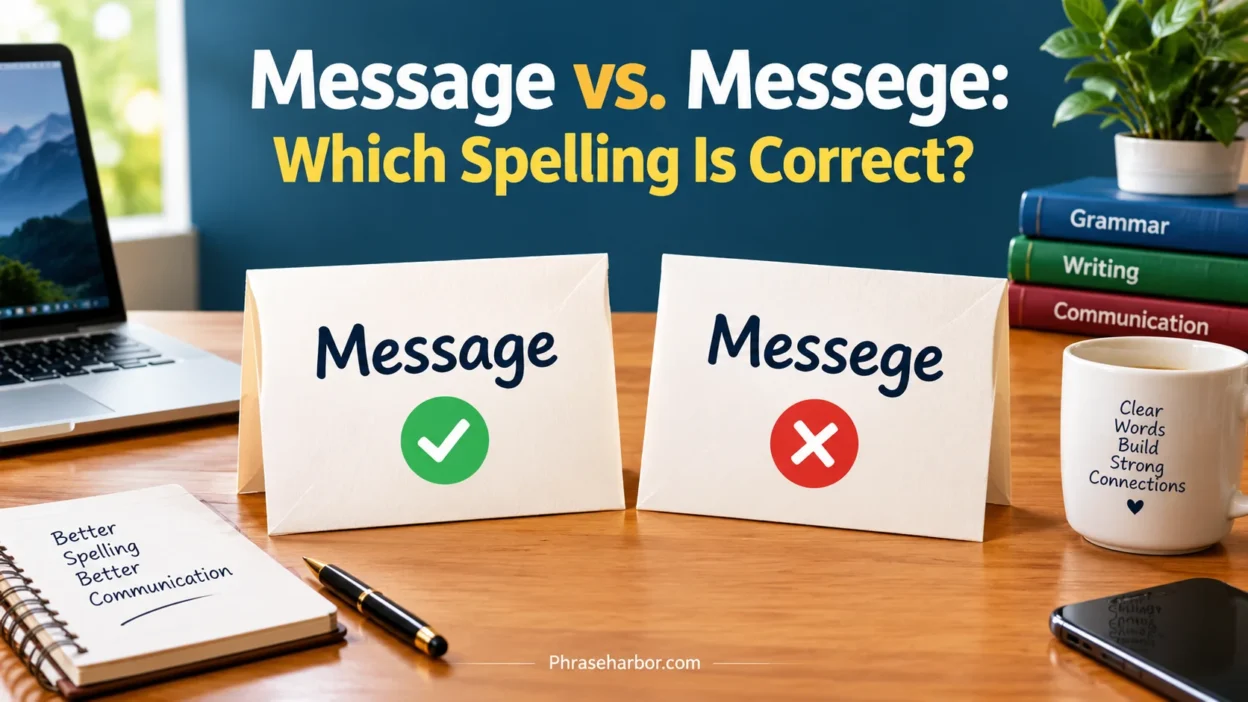
The difference between message vs. messege is simple once you know the rule. Message is the correct spelling in standard American English and British English. Messege is a misspelling and isn’t an accepted alternative. Although the two forms look similar, only one belongs in your everyday writing.
Learning the correct spelling will help you communicate more clearly, avoid embarrassing typos, and write with greater confidence. Let’s look at their meanings, differences, examples, and practical ways to remember the correct form.
Quick Answer
Message is the correct spelling. Messege is incorrect in standard English.
The word message refers to information communicated from one person to another, whether through a text, email, letter, conversation, or another form of communication. It can also function as a verb meaning to send someone a message.
- Correct: I sent you a message this morning.
- Incorrect: I sent you a messege this morning.
- Correct: Please message me when you arrive.
- Incorrect: Please messege me when you arrive.
Remember the spelling M-E-S-S-A-G-E. The letter after the double s is a, not e.
Comparison Overview
The easiest way to understand message vs. messege is to compare their spelling, correctness, meaning, and usage. The difference comes down to one letter, but that small detail determines whether the word is spelled correctly.
| Feature | Message | Messege |
| Spelling status | Correct | Incorrect |
| Standard English usage | Accepted | Not accepted as a spelling of message |
| Meaning | Information communicated to someone | No standard meaning as a variant of message |
| Part of speech | Noun and verb | Not a standard form of the intended word |
| American English | Correct | Incorrect |
| British English | Correct | Incorrect |
| Example | She left me a message. | She left me a messege. |
| Recommended use | Use it in all standard writing | Correct it to message |
The main point is straightforward: always write message when you mean a communication or the act of sending one. You don’t need to choose between American and British spellings because both varieties use the same form.
Main Differences Between Message vs. Messege
Although message and messege differ by only one letter, they aren’t interchangeable. Understanding the distinction will help you recognize the error and avoid repeating it.
Spelling Difference Between Message and Messege
The correct word contains seven letters: M-E-S-S-A-G-E. The misspelled form, messege, replaces the letter a with e in the middle of the word.
Compare the two forms:
- M-E-S-S-A-G-E: Correct spelling
- M-E-S-S-E-G-E: Incorrect spelling
The double s appears in both forms, which can make the mistake less noticeable at a glance. However, the vowel following those letters must be a.
When checking your writing, pay particular attention to the middle of the word. You might recognize the word immediately when reading it, yet type the wrong vowel when writing quickly. A brief proofreading check can catch this error.
Meaning Difference Between Message and Messege
The word message has several related meanings. It can refer to a written or spoken communication, information delivered electronically, or the main idea a speaker or writer wants to express.
For example:
- I received a message from my manager.
- The teacher wrote a message on the board.
- The movie’s message is that honesty matters.
- She will message me after work.
In each example, message communicates information or describes sending that information.
By contrast, messege has no accepted meaning as an alternative spelling of this word. If you encounter it in a sentence, it is generally a spelling mistake that should be corrected.
Usage Difference Between Message and Messege
You can use message in personal conversations, business emails, school assignments, online discussions, and formal writing. The word fits many situations because it describes communication in both traditional and digital forms.
For example, a friend might ask, “Did you get my message?” A coworker might write, “Please send me a message when the report is ready.” A teacher might discuss the message of a poem.
In all these contexts, message is the correct choice. Using messege can distract readers and make otherwise clear writing look less polished.
What Does Message Mean?
The word message is a common English noun and verb. Its meaning depends on how you use it in a sentence, but it always relates to communication or the information being communicated.
Message as a Noun
As a noun, message means a piece of information that someone communicates to another person or group. It can be short or long, personal or professional, written or spoken.
You might send a message through your phone, leave one on a desk, or deliver one on behalf of someone else. The word also describes the central idea behind a speech, story, advertisement, or other form of communication.
Consider these examples:
- Text message: I sent my brother a message about dinner.
- Email message: The customer received a message confirming the appointment.
- Written note: There was a message waiting for me on the kitchen table.
- Spoken communication: The receptionist gave me a message from the doctor.
- Main idea: The book’s message encourages readers to treat others with kindness.
- Public communication: The campaign delivered a message about road safety.
Notice that the word doesn’t refer only to digital communication. Even before smartphones and email became common, people used messages to pass information between individuals.
For example, a student might leave a message for a teacher who isn’t in the classroom. A manager might ask an assistant to deliver a message to a colleague. Both situations involve communicating information.
Message as a Verb
The word message also functions as a verb. In this form, it means to send someone a written communication, usually through a phone, computer, or similar device.
Here are some examples:
- Present tense: I message my friends every weekend.
- Third-person singular: She messages her clients after each meeting.
- Past tense: He messaged me about the change in schedule.
- Present participle: They are messaging each other about the project.
- Infinitive: I need to message my supervisor before noon.
The verb is especially common in everyday digital communication. Instead of saying, “Send me a text message,” someone might simply say, “Message me.”
Both expressions are natural. The shorter verb has become useful because people often communicate through messaging apps and social platforms.
Related Forms of Message
Learning related forms can help you spell the word correctly in different grammatical situations. The spelling changes slightly depending on the form, but the base word remains recognizable.
| Word form | Part of speech or use | Example |
| Message | Singular noun or base verb | I received a message. |
| Messages | Plural noun or verb | She sends messages every day. |
| Messaged | Past tense or past participle | He messaged me yesterday. |
| Messaging | Present participle or gerund | Messaging is convenient. |
Pay attention to the correct vowel in every form. You should write messages, messaged, and messaging, not invented spellings based on messege.
Read More: Plural of Goose: Is It Geese or Gooses? Meaning, and Examples
Is Messege a Correct English Word?
No. Messege is not the standard spelling of message, and dictionaries don’t recognize it as an accepted alternative for the ordinary word meaning a communication.
People may still type or write messege by mistake. You might see it in an online comment, an informal chat, a social media post, or a document that hasn’t been proofread. Its appearance doesn’t make it correct.
English has many legitimate spelling variations. For example, color is standard in American English, while colour is standard in British English. Both are accepted forms with the same meaning.
However, message and messege don’t follow that pattern. There is no American-versus-British spelling distinction here. The standard spelling remains message in both varieties.
Why Does Messege Look Correct to Some Writers?
At first glance, messege may look plausible because it resembles the correct word. Both versions have the same first four letters except for the vowel difference, and both end in ge.
When you type quickly, your brain may focus on the meaning rather than each individual letter. As a result, you can produce a familiar-looking word without noticing that its spelling is wrong.
This happens with many English words. A writer might type definately instead of definitely or seperate instead of separate. The intended meaning remains clear, but the spelling still needs correction.
The best solution is to learn the standard form and recognize the specific part that causes confusion.
Why Do People Confuse Message and Messege?
Several factors can contribute to this spelling mistake. Understanding them can make the correct spelling easier to remember.
Unclear Vowel Sounds
English spelling doesn’t always match pronunciation in a predictable way. In many accents, the unstressed final portion of message contains a reduced vowel sound. This can make the written vowel less obvious to someone who relies heavily on sound.
When a word doesn’t sound exactly as its letters might suggest, writers sometimes choose the wrong vowel. That doesn’t mean the word has two spellings. It means pronunciation alone isn’t always a reliable spelling guide.
Practical tip: When a word feels uncertain, recall its written form rather than trying to spell it entirely by sound.
Fast Typing and Autocorrect
Speed is another common cause. During a quick conversation, you might type messege without noticing the extra vowel choice. If you immediately move on to the next sentence, the mistake can remain on the screen.
Autocorrect can help, but it isn’t perfect. Depending on the software and its dictionary, a misspelling may not always be corrected automatically. You should still review important messages before sending them.
For example, a typo in a casual conversation may have little impact. The same error in a customer email, job application, or business proposal can make the writing seem careless.
Weak Visual Memory
Some people remember how a word sounds but struggle to recall its exact letter sequence. This can lead to repeated errors, especially with common words that writers use without thinking.
One useful technique is to look at the correct spelling, cover it, and write it from memory. Then compare your version with the original. Repeating this exercise helps you pay attention to the exact placement of the letters.
Confusion With Similar Words
English contains many words that share similar sounds or letter patterns. When you encounter several words with related endings, you may unconsciously apply the spelling pattern of one word to another.
However, the correct spelling of message must be learned as its own word. Don’t change its vowel simply because another word uses a different letter in a similar position.
How to Spell Message Correctly
The most reliable way to avoid this mistake is to remember the exact letter sequence and practice using the word in context.
The correct spelling is:
M-E-S-S-A-G-E
Break it into two parts if that makes it easier to remember:
- MESS — the first four letters.
- AGE — the final three letters.
Together, they form MESSAGE.
An Easy Memory Trick for Message
A simple mnemonic is “mess + age = message.” Think of the familiar word mess, followed by age. This trick helps you remember that the correct spelling contains a after the double s.
Keep in mind that this is only a memory aid. It isn’t a claim about the word’s historical origin.
You can reinforce the spelling with a short practice routine:
- Write message five times.
- Use it in three different sentences.
- Write its related forms: messages, messaged, and messaging.
- Check each form against the correct spelling.
- Repeat the exercise later without looking at your notes.
The goal isn’t to memorize a long spelling rule. It’s to make the correct form familiar enough that you recognize a mistake quickly.
Use the Word in Context
Memorizing isolated letters can help, but using the word in meaningful sentences makes the lesson more practical.
Try these examples:
- I left a message for the delivery driver.
- Please message me when you reach the office.
- She sent three messages before receiving a reply.
- He messaged the team about the new deadline.
- We are messaging the customer to confirm the details.
Each sentence reinforces the same base spelling while showing how the word changes according to its grammatical role.
Message vs. Messege Examples in Sentences
Examples make the spelling rule easier to apply because they show how the word works in real situations. The following sentences cover everyday conversations, professional communication, education, and digital messaging.
Correct Examples Using Message
Use message whenever you refer to information being communicated or the act of sending that information.
- Texting: I received a message from my best friend last night.
- Workplace communication: Please leave a message if I’m unavailable.
- Education: The teacher asked students to explain the message of the poem.
- Customer service: We sent a message confirming your order.
- Family communication: My mother left a message asking me to call her.
- Social media: He posted a message thanking everyone for their support.
- Business writing: The manager shared a message about the company’s new policy.
- Verb usage: I’ll message you when the meeting ends.
- Past tense: Sarah messaged her colleague about the appointment.
- Present participle: The two students are messaging about their homework.
These examples demonstrate that message fits both casual and formal situations. You don’t need another spelling when the context changes.
FAQs:
Is It Message or Messege?
Message is correct. Messege is a misspelling in standard English and shouldn’t be used as an alternative. Write message when referring to information communicated to someone or the act of sending that information.
How Do You Spell Message Correctly?
Spell it M-E-S-S-A-G-E. The word has seven letters, including a double s. The important detail is the a that appears after those two letters.
What Does Message Mean?
As a noun, message means information communicated through writing, speech, or another medium. It can also describe the main idea of a speech, book, story, or other communication. As a verb, it means to send someone a message.
Is Messege Ever an Acceptable Spelling?
No. Messege isn’t an accepted spelling variant of message in standard American or British English. If you see it used with the intended meaning of message, treat it as a spelling error.
Is Message Spelled the Same in American and British English?
Yes. Both American and British English use message. Unlike words such as color and colour, this word doesn’t have separate regional spelling variants.
Conclusion:
The difference between message vs. messege comes down to one letter, but only one form is correct in standard English. Message is the accepted spelling in both American and British English.
Messege is a misspelling that you should avoid in everyday writing, academic work, and professional communication. Remember the correct sequence: M-E-S-S-A-G-E. Use message as a noun when referring to information and as a verb when describing the act of sending it. Its related forms include messages, messaged, and messaging.