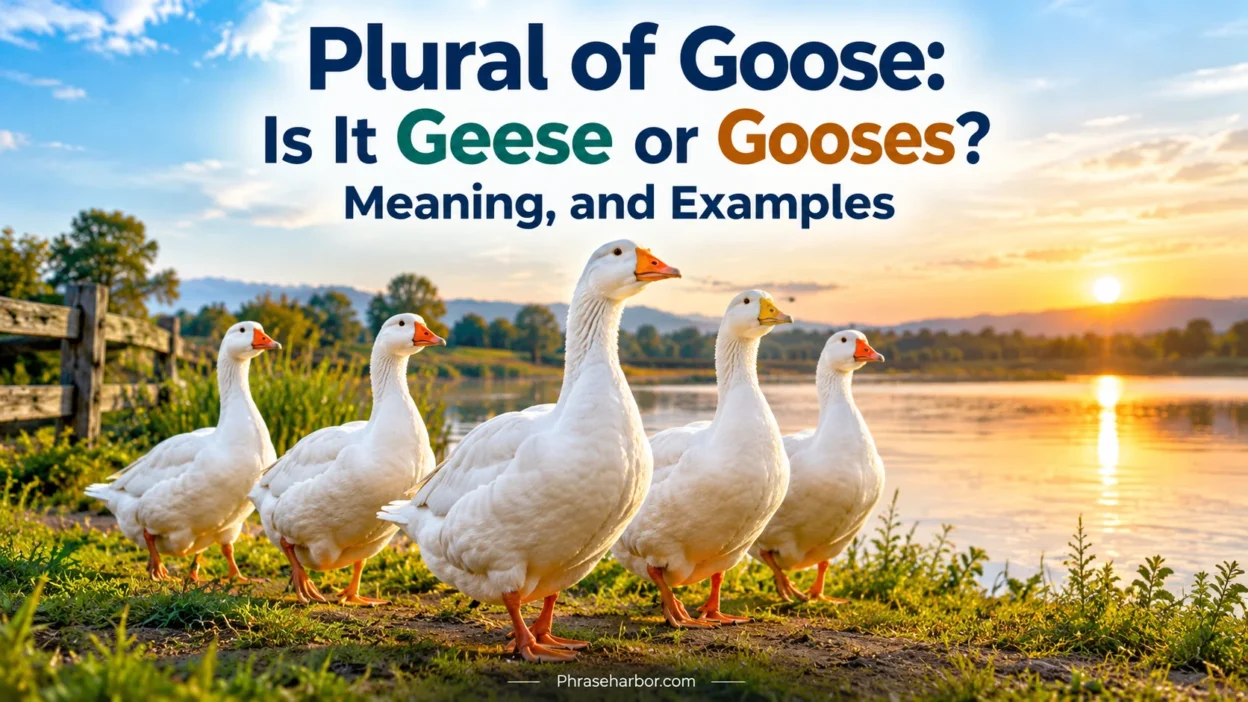
The English language has plenty of spelling surprises, and the plural of goose is a perfect example. Most nouns form their plurals by adding -s or -es. For instance, book becomes books, and box becomes boxes. However, goose follows a different pattern. Its plural form is geese, not gooses.
If you’ve ever wondered why the word changes from goose to geese, you’re not alone. This unusual spelling can confuse students, English learners, writers, and anyone trying to improve their grammar. The good news is that the rule becomes easy to remember once you understand how irregular plurals work.
In this guide, you’ll learn the correct plural of goose, the difference between goose and geese, how to use both words in sentences, and why gooses can sometimes be correct in a different grammatical role. You’ll also discover common mistakes, related irregular plurals, and useful expressions involving the word goose.
Quick Answer:
The plural of goose is geese. Use goose when referring to one bird and geese when referring to two or more birds. The word changes its internal vowel instead of following the usual rule of adding -s or -es.
- Singular: One goose
- Plural: Two geese
- Incorrect as a standard plural: Two gooses
- Example: One goose is walking across the grass.
- Example: Five geese are walking across the grass.
Remember this simple pattern: one goose, two geese.
The plural form doesn’t change according to the number of birds beyond two. Whether you’re talking about three, ten, or a hundred birds, geese remains the correct plural noun.
Comparison Overview
The words goose and geese refer to the same kind of bird, but they serve different grammatical purposes. Understanding their differences helps you choose the correct noun and match it with the appropriate verb.
| Feature | Goose | Geese |
| Grammatical number | Singular | Plural |
| Meaning | One bird | Two or more birds |
| Part of speech | Noun | Noun |
| Common article | A goose | Several geese |
| Present-tense verb | The goose is eating. | The geese are eating. |
| Example with a number | One goose | Four geese |
| Possessive form | Goose’s | Geese’s |
The most important distinction is number. When you describe one bird, use goose. When you describe multiple birds, use geese.
For example, you might say, “A goose is standing beside the lake.” If three more birds join it, the sentence becomes, “Four geese are standing beside the lake.”
Notice that the verb changes too. The singular noun goose generally takes is, while the plural noun geese takes are in the present tense.
Main Differences Between Goose and Geese
Although goose and geese have the same basic meaning, they differ in spelling, number, pronunciation, and grammatical agreement. These differences are easy to understand when you examine them individually.
Singular and Plural Meaning
The word goose identifies one bird. It can refer to a wild goose flying overhead, a domestic goose living on a farm, or a goose swimming in a pond.
The word geese refers to more than one goose. You might see geese grazing in a field, gathering near a lake, or flying together during seasonal migration.
Consider these examples:
- Singular: A goose is resting near the water.
- Plural: Two geese are resting near the water.
- Singular: The goose has white feathers.
- Plural: The geese have white feathers.
The noun itself tells you how many birds you’re describing. In most ordinary contexts, you don’t need another word to explain the difference.
Spelling Differences Between Goose and Geese
The spelling changes in the middle of the word. The singular form contains oo, while the plural contains ee.
- Goose → Geese
- Tooth → Teeth
- Foot → Feet
This pattern is known as an irregular plural. Unlike regular nouns, which usually add -s or -es, these words change internally.
For example, you wouldn’t write foots when referring to the body parts of several people in standard English. You’d write feet. Similarly, the standard plural of goose is geese.
Pronunciation of Goose and Geese
The two words also have different vowel sounds.
- Goose: /ɡuːs/
- Geese: /ɡiːs/
In goose, the vowel sounds like the one in moon. In geese, it sounds like the vowel in see.
The final consonant sound stays the same, but the vowel changes. This difference makes the two words easy to distinguish in spoken English once you become familiar with them.
Verb Agreement With Goose and Geese
Choosing the right noun is only half the job. You must also make sure the verb agrees with it.
Use a singular verb with goose and a plural verb with geese.
| Incorrect | Correct |
| The goose are hungry. | The goose is hungry. |
| The geese is swimming. | The geese are swimming. |
| One geese is missing. | One goose is missing. |
| Three goose are outside. | Three geese are outside. |
These mistakes often happen when writers focus on the meaning but forget the grammatical number. Whenever you use goose or geese, check whether the rest of the sentence matches the noun.
Why Is the Plural of Goose Geese?
The plural of goose is geese because English preserves an older pattern of forming plurals through vowel changes. This pattern developed long before modern English settled into its familiar spelling and grammar rules.
In Old English, the word for goose was gōs, and its plural form was gēs. Over time, these forms developed into the modern English words goose and geese. The spelling changed as English pronunciation and writing conventions evolved.
This history explains why the plural doesn’t follow the regular pattern. English inherited several older plural forms that remain in everyday use, even though most nouns now form plurals by adding an ending.
What Is an Irregular Plural?
An irregular plural noun forms its plural in a way that doesn’t follow the standard rule of adding -s or -es. Some irregular nouns change vowels, while others change their endings or keep the same form.
Examples include:
- Goose → Geese
- Mouse → Mice
- Man → Men
- Woman → Women
- Tooth → Teeth
- Foot → Feet
- Child → Children
These words don’t all follow one identical rule. Instead, English has preserved several historical patterns that developed at different times.
For instance, goose becomes geese, but child becomes children. You can’t reliably predict every irregular plural from its singular spelling alone. Learning common pairs through reading and practice is usually the easiest approach.
Read More: Kink or Fetish: Meaning, Examples, and Common Misconceptions
Why Doesn’t Goose Become Gooses?
Regular plural formation works well for most English nouns. You add -s to bird to get birds, or -es to dish to get dishes. However, goose belongs to a different group.
Its established plural form developed through a historical vowel change. Modern English speakers continue to use that inherited form rather than creating a new plural by adding an ending.
Compare these examples:
| Singular noun | Standard plural | Plural pattern |
| Bird | Birds | Add -s |
| Dish | Dishes | Add -es |
| Goose | Geese | Change the vowel |
| Mouse | Mice | Change the vowel |
| Child | Children | Change the ending |
| Sheep | Sheep | Same form |
The key lesson is simple: English plural rules have exceptions, and goose is one of them.
What Does Goose Mean?
A goose is a waterbird belonging to the family Anatidae, which also includes ducks and swans. Geese are known for their long necks, webbed feet, broad bodies, and calls that can be heard across ponds, wetlands, and open fields.
Some geese live in the wild, while others are raised on farms. Depending on the species, they may feed on grasses, aquatic plants, seeds, and other vegetation. Many wild geese also migrate seasonally between breeding and wintering areas.
The word has uses beyond zoology, too. In everyday English, goose appears in informal expressions, idioms, and certain verb constructions.
Goose as a Common Noun
When goose refers to a bird, it functions as a countable noun. That means you can count individual birds and use numbers or articles with the noun.
Examples include:
- A goose is standing near the gate.
- The farmer feeds one goose every morning.
- A wild goose landed beside the river.
- That goose has a distinctive black neck.
Because goose begins with a consonant sound, the correct indefinite article is a, not an.
You would write “a goose flew overhead,” just as you would write “a duck flew overhead.”
Goose as an Informal Expression
The word goose also appears in informal English with meanings that have little to do with counting birds.
For example, a silly goose is a playful expression for someone acting foolishly or amusingly. It often appears in friendly conversations, especially when someone makes a harmless mistake.
Consider this sentence: “You forgot your coffee again, you silly goose!”
Here, the speaker isn’t talking about a bird. The phrase is a lighthearted way to tease someone.
The word also appears in expressions such as goose egg, which can mean a score of zero, and wild goose chase, which describes a pointless or fruitless pursuit. Understanding the context helps you identify the intended meaning.
Examples of Goose and Geese in Sentences
Examples are one of the best ways to remember irregular plurals. Instead of memorizing the spelling alone, pay attention to how each word works in a complete sentence.
Goose in Example Sentences
Use goose when you mean one bird.
- A goose is swimming across the pond.
- The farmer gave the goose some fresh greens.
- A white goose followed the children around the farm.
- The goose honked loudly when the dog approached.
- We watched a goose build its nest near the lake.
- That goose seems comfortable around people.
- A goose walked across the road and stopped traffic.
- The injured goose rested in a quiet enclosure.
Each sentence refers to one bird. Even when other animals or people appear in the sentence, the noun remains singular.
Geese in Example Sentences
Use geese when you mean two or more birds.
- The geese are gathering near the pond.
- Several geese crossed the grassy field.
- Wild geese often travel in groups.
- The geese made loud calls before sunrise.
- Three geese landed beside the river.
- The farmer keeps six geese on the property.
- A flock of geese flew across the sky.
- The geese moved away when visitors approached.
Notice that the noun stays geese whether the sentence refers to three birds or a much larger group.
Goose and Geese in Questions and Negative Sentences
Questions and negative statements follow the same singular and plural distinctions.
| Sentence type | Singular: Goose | Plural: Geese |
| Statement | The goose is hungry. | The geese are hungry. |
| Question | Is the goose hungry? | Are the geese hungry? |
| Negative | The goose isn’t hungry. | The geese aren’t hungry. |
| Past tense | The goose was nearby. | The geese were nearby. |
| With can | The goose can swim. | The geese can swim. |
The past-tense forms deserve special attention. Use was with a singular goose and were with plural geese.
However, modal verbs such as can, will, and should don’t change according to the number of birds. You can say “the goose can swim” or “the geese can swim.”
What Is the Plural Possessive of Goose?
Possessives show ownership or association. The spelling changes depending on whether you’re referring to one goose or multiple geese.
For a single bird, add an apostrophe and s to form goose’s. For multiple birds, use geese’s.
| Form | Meaning | Example |
| Goose | One bird | The goose is near the fence. |
| Goose’s | Belonging to one goose | The goose’s feathers are wet. |
| Geese | Multiple birds | The geese are near the fence. |
| Geese’s | Belonging to multiple geese | The geese’s nests are protected. |
When to Use Goose’s
Use goose’s when something belongs to or relates to one goose.
Examples:
- The goose’s neck is unusually long.
- We examined the goose’s feathers.
- The goose’s nest was hidden in tall grass.
The apostrophe comes before the s because the singular noun is goose.
When to Use Geese’s
Use geese’s when something belongs to or relates to multiple geese.
Examples:
- The geese’s nests were close to the water.
- We observed the geese’s behavior during feeding.
- The geese’s migration patterns vary by species.
Although geese’s may look unusual, it’s the standard possessive form of the plural noun geese. The apostrophe comes after the plural form because the word doesn’t end in s.
One final distinction matters: geese is the ordinary plural, while geese’s expresses possession. Don’t add an apostrophe when you’re simply talking about several birds.
Is Gooses Ever Correct?
The word gooses can be correct in English, but it generally isn’t the standard plural of the bird. This distinction is important because the same spelling can serve different grammatical purposes.
When you’re talking about multiple birds, use geese. However, gooses can appear as the third-person singular form of the verb goose, which means to poke or prod someone, often as a joke.
FAQs:
What Is the Plural of Goose?
The plural of goose is geese. Use goose for one bird and geese for two or more birds. For example, “One goose is swimming” and “Three geese are swimming” are both correct.
Is It Geese or Gooses?
Geese is the correct standard plural when you’re talking about multiple birds. Gooses can be a verb form, as in “He gooses his friend,” but it isn’t the standard plural noun.
Why Does Goose Change to Geese?
The word preserves an older English plural pattern that changes the vowel inside the noun. Similar patterns appear in foot/feet and tooth/teeth. These forms developed historically and remain part of modern English.
Is Geeses a Word?
Geeses isn’t the standard plural of goose. The correct plural is geese. When showing possession by multiple geese, write geese’s, as in “The geese’s nests are protected.”
What Is the Plural Possessive of Goose?
The plural possessive is geese’s. For example, “The geese’s feathers were wet.” The singular possessive is goose’s, as in “The goose’s feathers were wet.”
Conclusion:
The plural of goose is geese, not gooses. Use goose when referring to one bird and geese when talking about two or more. This irregular plural follows an older English pattern in which the vowel changes instead of adding -s or -es. Remember to use the correct verb forms, such as “the goose is swimming” and “the geese are swimming.” Once you learn this simple rule, you’ll avoid common spelling and grammar mistakes. Keep it easy to remember: one goose, two geese!