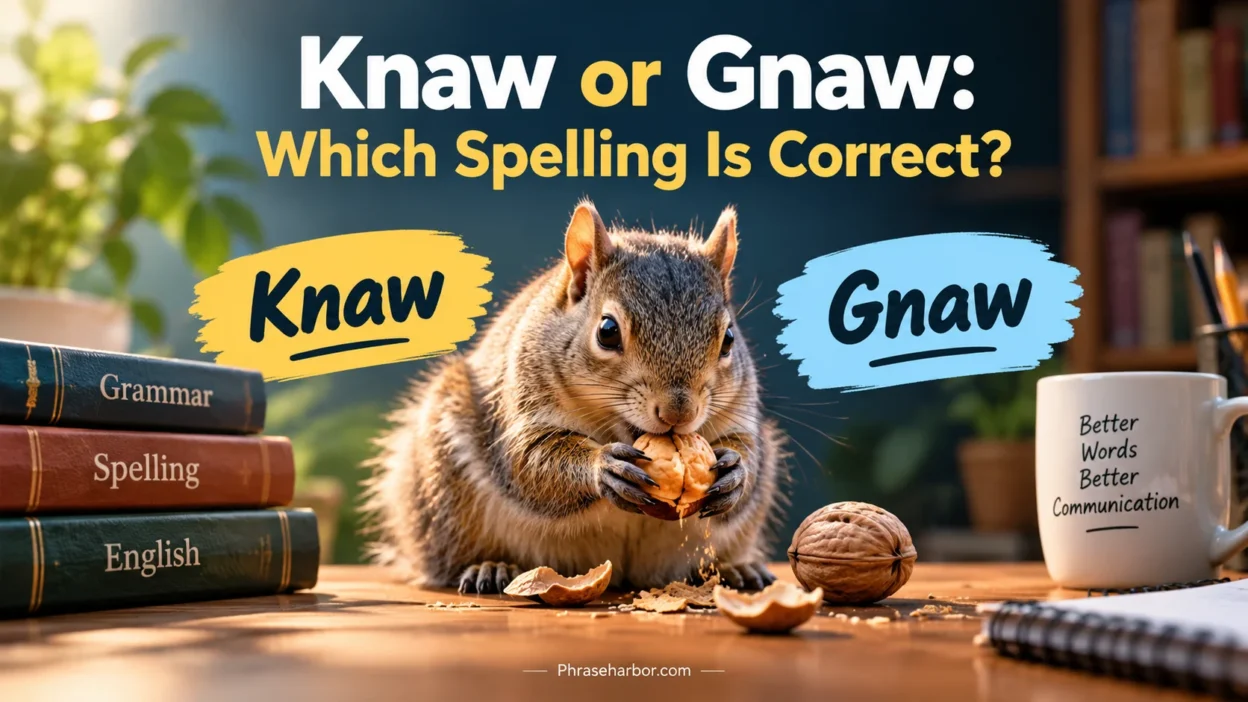
Knaw or Gnaw confuses English learners because gnaw has silent letters, making its pronunciation sound like naw even when the spelling looks unusual. For native speakers, this English language problem often begins when they have heard the word aloud but are unsure how to write it.
The g sound is silent, so knaw may seem reasonable, but it is the wrong spelling and an incorrect spelling mistake. The correct English word is gnaw, as shown in official English dictionaries, grammar books, and academic writing.
Its spelling connects with older word origins, spelling rules, silent consonants, and unusual word forms. Similar examples include knife, knock, knee, and know, although each follows its own pattern.The meaning of gnaw relates to biting, chewing, or wearing something away slowly. Rats can gnaw wood, and animals can gnaw bones, giving the word a literal meaning.
Quick Answer
Gnaw is the correct spelling. Knaw is not the standard spelling of this word.
Gnaw means to bite or chew something repeatedly, especially with the teeth. It can also describe a persistent feeling of worry, doubt, or distress.
For example:
The puppy likes to gnaw on its rubber toy.
The word gnaw is pronounced like “naw.” You don’t pronounce the g.
The basic difference
- Gnaw — correct standard English spelling.
- Knaw — incorrect spelling when intended to mean gnaw.
- Gnaw — pronounced with an initial n sound.
- Gnawed — past tense of gnaw.
- Gnawing — present participle and adjective form.
A useful memory trick is simple: Gnaw has a G, even though you don’t hear it.
Comparison Overview
| Word | Standard Spelling? | Meaning | Pronunciation | Example |
| Gnaw | Yes | To bite or chew repeatedly | “naw” | The dog will gnaw the bone. |
| Knaw | No | Not the standard spelling of gnaw | — | Write gnaw, not knaw. |
The spelling gnaw may look strange at first because English speakers don’t pronounce the initial g. However, silent letters are common in English. Words such as gnat, gnome, knee, and knife also contain letters that don’t appear in their modern pronunciation.
So, if you’re writing an email, article, school assignment, report, or professional document, choose gnaw.
Main Differences Between Knaw or Gnaw
The biggest difference between knaw or gnaw isn’t meaning. It’s correctness.
Gnaw is an established English verb with several meanings and grammatical forms. Knaw, when used as an attempted spelling of this verb, doesn’t serve as a standard alternative.
| Feature | Gnaw | Knaw |
| Standard English word | Yes | No, when intended as gnaw |
| Meaning | Bite or chew repeatedly | No standard meaning as the intended verb |
| Initial sound | /n/ | — |
| Silent letter | g | — |
| Past tense | gnawed | — |
| -ing form | gnawing | — |
| Recommended in formal writing | Yes | No |
This distinction matters because pronunciation can easily mislead you. If you only hear the word, “gnaw” sounds as though it starts with n, which makes knaw or naw seem like reasonable spellings.
English spelling doesn’t always follow sound perfectly.
What Does Gnaw Mean?
Gnaw primarily means to bite or chew something repeatedly. The action usually involves small, persistent bites rather than one quick bite.
Think about a dog with a hard bone. Instead of biting it once and walking away, the dog keeps working at it with its teeth. That persistent action is gnawing.
For example:
- The puppy gnawed on the old bone.
- Mice can gnaw through cardboard.
- The rabbit was gnawing on a piece of wood.
- The squirrel gnawed through the nut shell.
The word often suggests repeated, persistent chewing. That’s one reason it differs from the simpler verb bite.
Gnaw Can Also Mean Persistent Worry
English uses gnaw figuratively as well.
When something gnaws at you, it continues to bother you. The idea comes from the physical sense of repeated biting. Instead of an animal repeatedly biting an object, a troubling thought seems to keep “biting” at your mind.
For example:
The unanswered question continued to gnaw at her.
Here, nobody is physically chewing anything. The sentence describes a persistent mental concern.
You might also say:
Doubt began to gnaw at him.
The doubt doesn’t disappear. It keeps returning, much like an animal repeatedly working at something with its teeth.
Examples of Gnaw in a Sentence
Context makes the meaning of gnaw especially clear.
Literal examples
The mouse gnawed through the cardboard box.
The puppy spent an hour gnawing on its favorite toy.
Beavers gnaw on branches with their strong front teeth.
The rabbit sat quietly, gnawing on a carrot.
These sentences describe physical chewing or biting.
Figurative examples
The mistake continued to gnaw at him.
A sense of guilt began to gnaw at her.
The uncertainty gnawed at everyone involved.
The question had been gnawing at my mind all week.
In these examples, gnaw describes an emotional or mental experience rather than physical chewing.
Why Is Gnaw Spelled With a Silent G?
The unusual spelling of gnaw comes from the history of English.
Modern English contains many spellings that preserve older forms even though pronunciation has changed. The initial g in gnaw was historically connected to an actual consonant sound. Over centuries, English pronunciation shifted, and that sound disappeared in many words beginning with gn-.
The spelling stayed.
That gives modern English words such as:
- gnaw
- gnat
- gnome
Their initial g is silent in modern standard pronunciation.
This is one of the quirks of English spelling. The written form can preserve clues about a word’s history even when modern speakers no longer pronounce every letter.
The Silent G in Gnaw
The g in gnaw is completely silent.
You don’t say “g-naw.” Instead, the word begins with the n sound.
The easiest approximation is:
gnaw → “naw”
The spelling contains two consonants at the beginning, but the pronunciation begins with only one audible consonant sound.
The same pattern appears in gnat:
gnat → “nat”
And in gnome:
gnome → “nome”
Once you recognize this pattern, gnaw becomes much easier to remember.
How to Pronounce Gnaw
Gnaw is pronounced approximately like “naw.”
The g doesn’t receive a separate sound.
For example:
The dog will gnaw on the bone.
You pronounce gnaw as one syllable, beginning with the n sound.
This pronunciation explains why people sometimes create the spelling knaw. They hear an n sound and try to reconstruct the spelling from familiar patterns.
However, pronunciation alone doesn’t determine English spelling.
Is Knaw a Word?
When people write knaw while intending to mean bite or chew repeatedly, they’re generally making a spelling mistake.
The standard spelling is gnaw.
The confusion probably comes from the word’s pronunciation. Since the g is silent, someone unfamiliar with the word may reasonably assume that the spelling begins with a different letter.
There is also a separate spelling pattern involving kn-, as seen in words such as:
- know
- knee
- knife
- knock
- knot
- knight
In these words, the k is silent.
That similarity can make knaw look plausible. It isn’t the correct spelling of gnaw, though.
Why People Write Knaw
English learners often spell unfamiliar words according to sound.
If someone hears:
“naw”
they may try to spell it as naw, knaw, or another familiar-looking combination.
The correct spelling has to be learned from established English usage:
gnaw
This is similar to learning that know begins with kn- even though you only hear the n sound.
Spelling patterns aren’t always predictable from pronunciation. That’s why reading widely and seeing words in context can make spelling easier over time.
Gnaw on Something
The phrase gnaw on commonly describes repeated biting or chewing.
For example:
The dog likes to gnaw on old bones.
The puppy was gnawing on a rubber toy.
The squirrel gnawed on the hard shell.
The preposition on emphasizes the object receiving the repeated chewing action.
You’ll often see this construction when discussing animals and their behavior. However, people can also gnaw on food or objects.
Read More: Lieing or Lying: Which Spelling Is Correct in 2026?
Gnaw at Something
Gnaw at has both literal and figurative uses.
In a literal sentence, it can describe repeatedly biting something:
The rat gnawed at the wooden door.
In a figurative sentence, it often describes a troubling emotion or thought:
The uncertainty gnawed at her.
His regret continued to gnaw at him.
The figurative construction is particularly common in everyday writing because it creates a strong image. A persistent worry is compared to something that keeps taking tiny bites.
Gnaw Away at Something
Gnaw away at adds another sense of gradual, persistent action.
Literally:
The mice gnawed away at the wooden beams.
Figuratively:
Financial stress was gnawing away at his confidence.
The phrase suggests that something gradually weakens, damages, or consumes an object or emotional state.
You can think of it as a slow erosion. One bite doesn’t seem significant, yet hundreds of bites eventually make a noticeable difference.
Gnaw as a Verb
Gnaw is primarily used as a verb.
Its forms are straightforward once you know the base word.
| Verb form | Example |
| Gnaw | Dogs sometimes gnaw bones. |
| Gnaws | The puppy gnaws on its toy. |
| Gnawed | The mouse gnawed through the box. |
| Gnawing | The rabbit is gnawing on a branch. |
The past-tense form is particularly important.
What Is the Past Tense of Gnaw?
The past tense of gnaw is gnawed.
For example:
The dog gnawed on the bone.
The mouse gnawed through the cardboard.
Doubt gnawed at her confidence.
Don’t write knawed when you mean the past tense of gnaw. The correct form remains gnawed.
What Is the Present Participle of Gnaw?
The present participle is gnawing.
For example:
The puppy is gnawing on a toy.
The rabbit was gnawing on a carrot.
The thought kept gnawing at him.
Notice that the spelling drops the final w before adding -ing.
Common Mistakes With Gnaw
Although gnaw looks unusual, most mistakes are easy to correct once you recognize the pattern.
Writing Knaw Instead of Gnaw
The most common mistake is replacing gn- with kn-.
Incorrect:
The dog likes to knaw on bones.
Correct:
The dog likes to gnaw on bones.
Pronouncing the G
Another common mistake is trying to pronounce every letter.
Incorrect pronunciation:
“g-naw”
Standard pronunciation:
“naw”
The g remains silent.
Writing Gnawed Incorrectly
Some writers may carry the spelling confusion into the past tense.
Incorrect:
The puppy knawed on the toy.
Correct:
The puppy gnawed on the toy.
The same initial gn- spelling stays in the past-tense form.
Confusing Gnaw With Chew
Although the meanings overlap, gnaw often emphasizes repeated or persistent biting.
Compare:
The child chewed the food.
with:
The dog gnawed on the bone.
The first sentence focuses on processing food. The second highlights repeated biting.
Gnaw vs. Bite vs. Chew vs. Nibble
These verbs are related, but each creates a slightly different picture.
| Word | Main idea | Example |
| Gnaw | Bite repeatedly or persistently | The dog gnawed on the bone. |
| Bite | Close the teeth around something or cut with the teeth | The dog bit the toy. |
| Chew | Crush or grind something with the teeth | She chewed her food slowly. |
| Nibble | Take small, light bites | The rabbit nibbled the carrot. |
Bite is broader than gnaw. A single action can be a bite.
Chew usually describes repeated movement of the teeth and jaw, especially when eating.
Nibble suggests small, gentle bites.
Gnaw, meanwhile, often conveys persistence. That’s why it works so well for animals working on hard objects and for worries that refuse to disappear.
Gnaw in Figurative English
The figurative use of gnaw adds depth to ordinary writing.
Instead of simply saying:
I was worried about the decision.
You could say:
The decision gnawed at me.
The second sentence creates a stronger mental image. It suggests that the concern repeatedly returned and became difficult to ignore.
Gnaw at Your Mind
The phrase gnaw at your mind describes a thought or concern that keeps troubling you.
For example:
The possibility of failure kept gnawing at his mind.
The expression doesn’t mean literal chewing. It compares persistent mental pressure to repeated physical biting.
You might use it when describing:
- doubt
- regret
- guilt
- uncertainty
- fear
- suspicion
- unresolved questions
Something Gnaws at You
When someone says something is gnawing at them, they usually mean it continues to bother them emotionally.
For example:
Something about his explanation gnawed at me.
That sentence suggests an uneasy feeling without clearly identifying its source.
The expression works particularly well when a person senses that something is wrong but can’t immediately explain why.
Origin and History of Gnaw
The history of gnaw helps explain its strange spelling.
The word comes from Old English, where related forms included gnagan, meaning to gnaw or bite. It belongs to a broader family of Germanic words associated with biting and chewing.
Earlier forms of English pronounced consonants that modern speakers no longer pronounce in the same way. Over time, English pronunciation changed substantially.
The spelling, however, proved more conservative.
That is why gnaw still carries its initial g today.
This isn’t unusual in English. Spellings often preserve older forms long after pronunciation has shifted. Silent letters can therefore act like small historical fingerprints inside modern words.
Gnaw and Other Silent-G Words
You can remember gnaw by grouping it with other words that begin with gn-.
| Word | Modern pronunciation |
| Gnaw | “naw” |
| Gnat | “nat” |
| Gnome | “nome” |
The pattern isn’t perfectly productive across English. Still, these familiar examples provide a useful memory aid.
When you see gn- at the beginning of gnaw, remember that the g doesn’t need to be pronounced.
FAQs:
1. Is “knaw” a correct English word?
No. Knaw is a misspelling. The correct spelling is gnaw.
2. How do you pronounce “gnaw”?
Gnaw is pronounced like “naw.” The g is silent, which is why the spelling can be confusing.
3. What does “gnaw” mean?
Gnaw means to bite or chew something repeatedly, often to wear it away. For example, “The dog gnawed on the bone.”
4. Can “gnaw” be used figuratively?
Yes. Gnaw can describe a feeling or thought that causes ongoing emotional discomfort. For example, “The worry continued to gnaw at her mind.”
5. Why do people spell “gnaw” as “knaw”?
People often write knaw because gnaw sounds like “naw.” Since the g is silent, people may spell the word according to its pronunciation rather than its standard spelling.
Conclusion:
Gnaw is the correct spelling, while knaw is an incorrect spelling. Although the silent g makes the word sound like “naw,” remembering the standard spelling will help you avoid this common mistake. Use gnaw when you mean to bite, chew, wear something away, or describe a persistent worry or feeling.