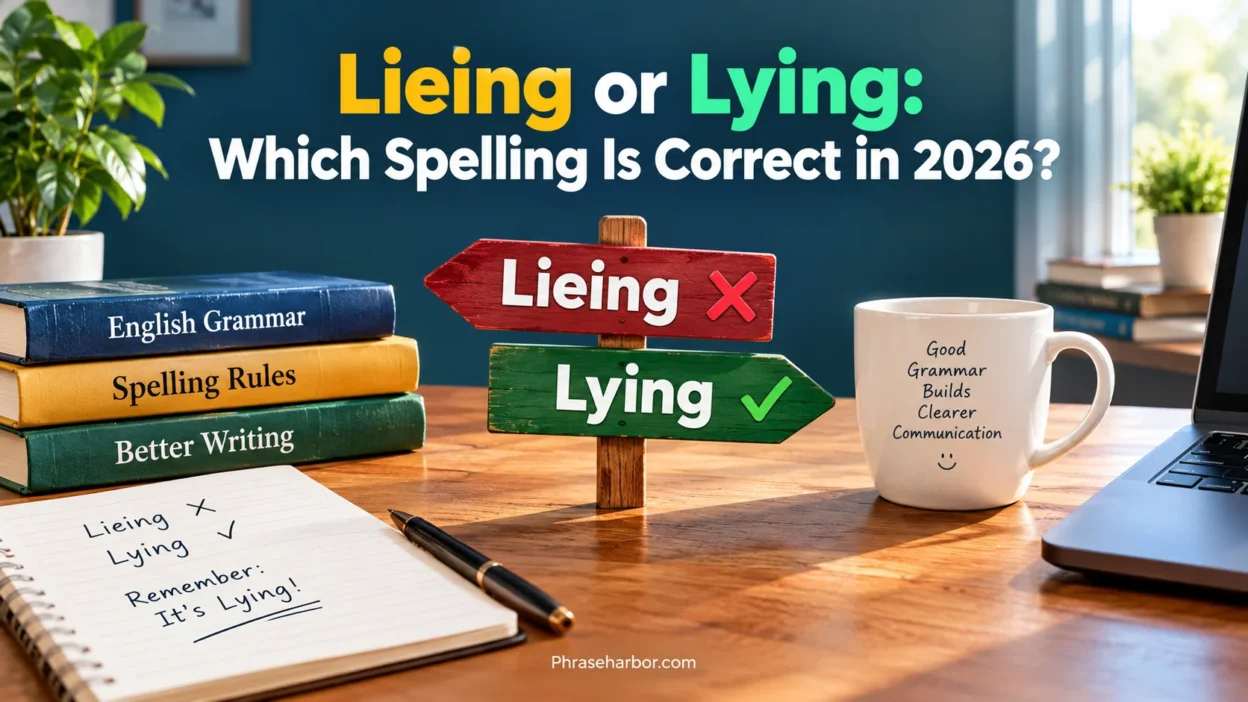
Lieing or Lying is a common spelling question for learners because lie changes to lying when -ing is added. in English. The base word lie does not keep its -ie ending when the -ing suffix is added. Under this simple spelling rule, a verb ending in -ie changes -ie to -y, creating the present participle.
This word formation pattern explains why lie → lying is the correct form, while lieing is an incorrect spelling in standard English. The same spelling pattern appears in die → dying, tie → tying, and vie → vying, which makes the grammar easier to learn once you recognize the rule.
From my experience, this is the part that removes most of the confusion because the spelling change is consistent rather than random.The correct form also becomes clearer when you look at what lying means. It can describe a person in a horizontal position, or it can mean saying something untrue. It is often confused with laying, lay, and lain, so a practical guide using real examples, grammar rules, and a comparison is useful.
Quick Answer
Lying is the correct spelling. Lieing is a misspelling in standard English.
The correct transformation is:
lie + ing → lying
The final -ie changes to -y before the -ing ending is added.
For example:
- She is lying on the couch.
- The dog is lying under the table.
- He is lying about what happened.
- They were lying in the grass.
- I knew he was lying to me.
The word lying has two common meanings. It can mean resting or reclining, as in “She is lying on the bed.” It can also mean telling an untruth, as in “He is lying about his age.”
By contrast, lieing isn’t the standard spelling for either meaning.
The Basic Rule
| Form | Correct? | Meaning |
| lying | Yes | Present participle or gerund of lie |
| lieing | No | Common misspelling |
| laying | Yes | Present participle of lay |
| lie | Yes | Base form of the verb |
| lay | Yes | Past tense of the reclining verb lie |
| lain | Yes | Past participle of the reclining verb lie |
A simple way to remember the answer is this:
Lie becomes lying, not lieing.
Comparison Overview
Lying and lieing aren’t two competing spellings with different meanings. Only one is standard English.
| Feature | Lying | Lieing |
| Standard spelling | Yes | No |
| Base verb | lie | lie |
| Correct -ing form | lying | Incorrect |
| Meaning | Resting, reclining, or telling an untruth | No standard meaning |
| Used in formal writing | Yes | No |
| Used in everyday English | Yes | Only as a spelling mistake |
| Example | She is lying on the sofa. | She is lieing on the sofa. |
| American English | lying | Incorrect |
| British English | lying | Incorrect |
The important point is that lying isn’t an American spelling while lieing is British, nor is the reverse true. Both American and British English use lying.
Main Differences Between Lieing or Lying
The main difference is straightforward: lying is correct, while lieing is not. However, understanding why the difference exists makes the spelling much easier to remember.
Lying Follows the Correct Spelling Pattern
The verb lie ends in -ie. When you add -ing, English changes the final -ie to -y.
That produces:
lie → lying
This spelling pattern prevents the awkward sequence that would appear in lieing. More importantly, it follows an established English spelling rule used with several other verbs.
Consider these examples:
| Base Verb | Correct -ing Form |
| lie | lying |
| die | dying |
| tie | tying |
| vie | vying |
Notice the pattern. The ie doesn’t remain intact when -ing is added.
That’s why writing lieing isn’t simply a minor stylistic preference. It breaks the standard spelling pattern.
Lieing Is a Common Misspelling
People often write lieing because they apply a straightforward rule:
lie + ing = lieing
That approach works for many verbs, such as:
- play → playing
- read → reading
- walk → walking
- jump → jumping
However, English spelling has exceptions and special patterns. Verbs ending in -ie are one of them.
For example, nobody writes dieing in standard English. The correct form is dying.
The same principle applies to lie.
So if you’re unsure, remember the trio:
die → dying
tie → tying
lie → lying
Once those three become familiar, lieing starts to look as unusual as it actually is.
Lying Has Two Major Meanings
One reason lying can be confusing is that it comes from two different meanings of lie.
The first meaning involves position or physical posture.
The child is lying on the floor.
Here, the person is resting in a horizontal position.
The second meaning involves dishonesty or an untrue statement.
The witness was lying about what happened.
Here, the person is deliberately saying something untrue.
Despite the difference in meaning, both forms are spelled lying.
There isn’t one spelling for physical rest and another spelling for dishonesty.
Lying Means Resting or Reclining
When lie means to rest, recline, or remain in a horizontal position, its -ing form is lying.
For example:
- I am lying on the bed.
- The cat is lying beside the window.
- She was lying under a tree.
- The baby is lying quietly in the crib.
- We spent the afternoon lying on the beach.
In each sentence, lying describes a physical position.
This meaning often appears with prepositions such as on, in, under, beside, and against.
For example:
lying on the floor
lying in bed
lying under the blanket
lying beside the pool
The word remains lying regardless of the location.
Lying Means Telling an Untruth
The second meaning of lying relates to dishonesty.
When someone deliberately says something they know isn’t true, that person may be described as lying.
Examples include:
- He is lying about his whereabouts.
- She admitted that she had been lying.
- Don’t start lying to your parents.
- The witness may have been lying.
- I could tell that he was lying.
Again, the spelling doesn’t change.
Whether someone is lying on a sofa or lying about an event, the word is spelled exactly the same way.
Why Is “Lying” Correct?
The spelling lying comes from a specific English spelling rule involving verbs ending in -ie.
When you add -ing to a verb that ends in -ie, the ie changes to y.
The pattern looks like this:
-ie + -ing → -ying
Therefore:
lie → lying
The same process appears in:
- die → dying
- tie → tying
- vie → vying
This is why the spelling lieing doesn’t work.
Why Doesn’t English Simply Add “-ing”?
English spelling rules don’t always operate like simple mathematical formulas. Adding a suffix can sometimes trigger a spelling change.
For example, consider tie.
If English simply added -ing, the result would be tieing. Standard English instead uses tying.
The same thing happens with die:
dieing becomes dying.
Therefore, lie follows the same pattern:
lieing becomes lying.
Think of the final y as replacing the original ie before the -ing ending.
What Does “Lying” Mean?
The word lying can describe either a physical position or an act of dishonesty. Context tells you which meaning applies.
Lying as a Physical Position
When someone is lying, they are resting or reclining.
For example:
Marcus is lying on the couch.
This sentence says nothing about honesty. Marcus is simply resting.
Another example:
The book was lying on the desk.
Here, lying describes the book’s position.
This use doesn’t involve deception at all.
Lying as Dishonesty
When someone is lying, they are saying something false or misleading.
For example:
Sarah is lying about where she went.
Here, the sentence describes dishonesty.
Similarly:
The child was lying about breaking the vase.
The context makes the meaning clear.
Context Does the Heavy Lifting
English often relies on surrounding words to distinguish meanings.
Compare these sentences:
The dog is lying on the carpet.
The dog is lying about stealing the food.
The first sentence describes physical position. The second uses lying in the sense of dishonesty.
The spelling stays exactly the same.
Read More: Repore or Rapport: Which Spelling Is Correct?
Lying vs. Laying: The Confusion You Should Know
If lieing is the spelling mistake, laying creates a different kind of problem.
The two words are both real English words, yet they come from different verbs.
Lying comes from lie.
Laying comes from lay.
The easiest practical distinction is:
- lie = put yourself in a resting position
- lay = put something somewhere
For example:
I am lying on the couch.
You are the one resting.
I am laying the keys on the table.
You are placing the keys somewhere.
That distinction clears up many everyday mistakes.
Lying vs. Laying Examples
| Correct Form | Example | Meaning |
| lying | She is lying on the bed. | She is reclining. |
| lying | He is lying about the incident. | He is being dishonest. |
| laying | She is laying the book on the desk. | She is placing the book. |
| laying | He is laying the baby down. | He is placing the baby down. |
A useful test is to ask whether someone is resting or placing something.
If the person is resting, lying may be correct.
If the person is putting an object somewhere, laying may be correct.
The Complete Verb Forms of “Lie”
The word lying becomes easier when you understand the other forms of lie.
For the verb meaning to recline or rest, the principal forms are:
| Grammatical Form | Word | Example |
| Base form | lie | I lie down after work. |
| Present participle | lying | I am lying down. |
| Past tense | lay | I lay down earlier. |
| Past participle | lain | I have lain here for an hour. |
This pattern can feel strange because lay is also a separate verb.
That’s where many learners get tangled.
Consider this sequence:
Today: I lie on the couch.
Right now: I am lying on the couch.
Yesterday: I lay on the couch.
For two hours: I have lain on the couch.
The forms change with tense and grammar, but the spelling lying remains consistent whenever you need the present participle.
Common Mistakes With “Lying”
Small spelling errors can survive for years because they look logical. Here are the mistakes worth catching.
Writing “Lieing”
Incorrect:
She is lieing on the sofa.
Correct:
She is lying on the sofa.
The problem is the spelling of the -ing form.
Remember:
lie → lying
Not:
lie → lieing
Using “Laying” for Resting
Incorrect:
I am laying on my bed.
If the intended meaning is that you’re reclining, use:
I am lying on my bed.
However, laying can be correct when someone places something somewhere.
I am laying the blanket on the bed.
The difference is subtle but important.
Assuming “Lying” Has Only One Meaning
Some readers associate lying exclusively with dishonesty.
That’s only half the story.
Lying can also mean being in a resting or horizontal position.
For example:
The phone is lying on the table.
The phone isn’t telling a fib. It’s simply positioned on the table.
Writing “Dieing” and “Tieing” the Same Way
The same spelling mistake can happen with related verbs.
Incorrect:
- dieing
- tieing
- lieing
Correct:
- dying
- tying
- lying
Seeing these words together makes the spelling pattern much easier to remember.
How to Remember the Spelling “Lying”
A simple memory trick can save you from repeatedly making the same mistake.
Remember:
IE changes to Y before ING.
Then apply it:
lie → lying
die → dying
tie → tying
vie → vying
Another useful trick is to remember that “lying” contains “ying,” not “ieing.”
If you see lieing, stop and check the spelling.
A Quick Memory Table
| Wrong Pattern | Correct Pattern |
| lie + ing | lying |
| die + ing | dying |
| tie + ing | tying |
| vie + ing | vying |
This isn’t a rule you need to memorize through a grammar textbook. A few examples usually make the pattern stick.
Correct and Incorrect Examples of “Lying”
Real examples are often more useful than a definition alone.
| Incorrect | Correct | Why |
| She is lieing down. | She is lying down. | Lie changes to lying. |
| He was lieing on the floor. | He was lying on the floor. | The -ing form is lying. |
| They are lieing about it. | They are lying about it. | The spelling remains lying. |
| I am lieing in bed. | I am lying in bed. | Lie becomes lying. |
| The dog is lieing outside. | The dog is lying outside. | Lieing isn’t standard English. |
Now compare these with sentences containing laying:
She is lying on the couch.
She is laying the cushions on the couch.
The first describes position. The second describes placement.
FAQs:
Is “lieing” or “lying” correct?
Lying is the correct spelling in standard English. Lieing is incorrect. When lie takes the -ing ending, the -ie changes to -y, giving lying.
Why is “lieing” incorrect?
The spelling rule changes -ie to -y before -ing is added. Therefore, lie becomes lying, not lieing. The same pattern occurs in die → dying and tie → tying.
Does “lying” have more than one meaning?
Yes. Lying can describe being in a horizontal position, such as lying on a bed. It can also mean saying something that is not true.
Is “lying” related to “laying”?
They are related but have different uses. Lying commonly comes from lie, while laying comes from lay and usually means putting or placing something somewhere.
How can I remember the spelling of “lying”?
Remember the simple pattern: verbs ending in -ie usually change -ie to -y before -ing. So, lie → lying, die → dying, and tie → tying.
Conclusion:
Lying is the correct spelling, while lieing is not standard English. Although adding -ing to lie may seem like it should produce lieing, the spelling rule changes -ie to -y. Once you remember this pattern, words such as lying, dying, tying, and vying become much easier to spell correctly.
Whether you are writing an email, school assignment, article, or professional document, choose lying. Understanding this small spelling rule can help you avoid a common mistake and write with greater confidence.