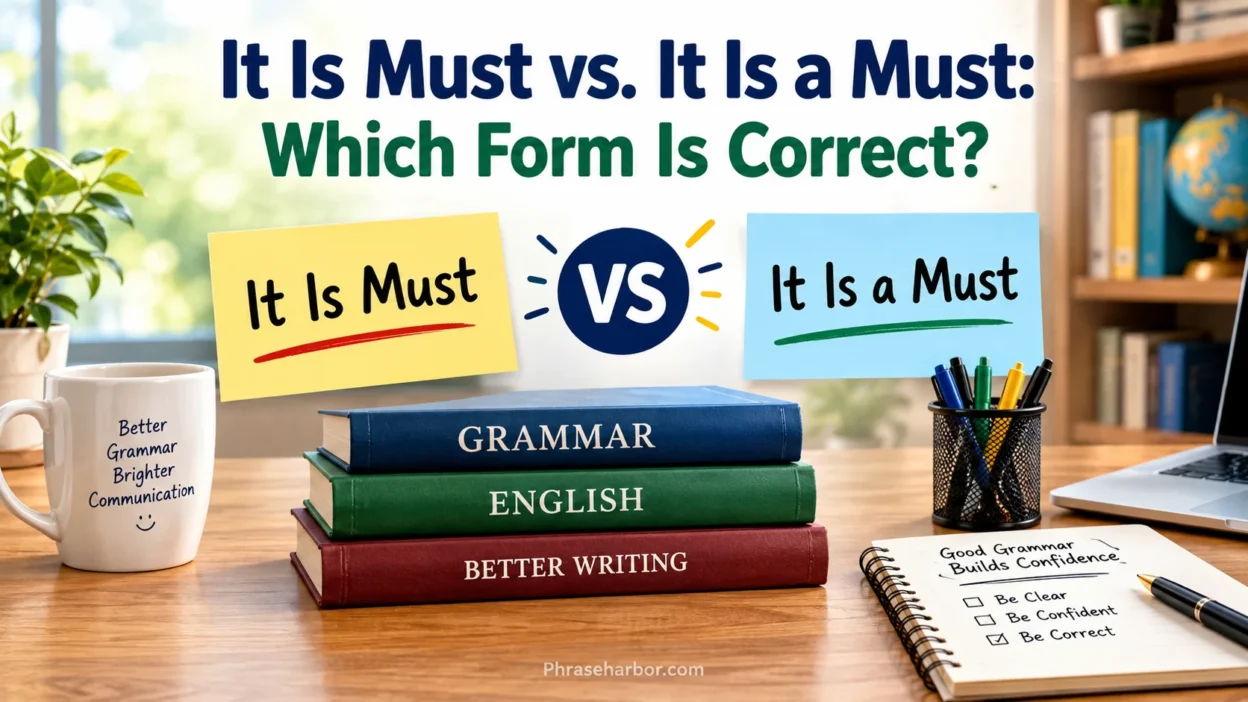
English has many expressions that look almost identical but follow completely different grammar rules. It is must and it is a must are a good example. The difference is only one small article, yet that article changes the entire grammatical structure.
If you’re wondering whether to write “it is must” or “it is a must,” the standard form is “it is a must.” In this expression, must works as a noun and means something necessary, essential, or highly important.
However, must can also work as a modal verb. That’s where the confusion begins. In a sentence such as “You must wear a helmet,” must doesn’t need an article because it directly introduces the base form of a verb.
Quick Answer
“It is a must” is correct when you mean that something is necessary, essential, or highly desirable.
“It is must” is not correct standard English when you intend to use must as a noun with the meaning “something essential.”
For example:
- Correct: A passport is a must for this trip.
- Incorrect: A passport is must for this trip.
- Correct: You must carry your passport.
- Correct: Carrying your passport is a must.
The key difference lies in the grammatical role of must.
In “it is a must,” must functions as a noun. The article a belongs to the noun phrase.
In “you must carry,” must functions as a modal auxiliary verb. It comes before the base verb carry.
So, if you’re using must as a noun, use a must. If you’re using it as a modal verb, place it directly before the main verb.
Comparison Overview
| Expression | Grammatical role | Standard English? | Meaning |
| It is a must | Noun | Yes | It is essential or necessary |
| It is must | Intended noun | No | Incorrect standard construction |
| You must go | Modal verb | Yes | You are required to go |
| It must be true | Modal verb | Yes | It is strongly believed to be true |
| It is necessary | Adjective | Yes | It is required |
| It is essential | Adjective | Yes | It is extremely important |
| It is required | Adjective/passive participle | Yes | It is demanded or needed |
The important point is that “it is a must” and “it must be” aren’t interchangeable. They use must in different grammatical roles.
Main Differences Between It Is Must and It Is a Must
The biggest difference between it is must and it is a must comes down to the role of the word must. English uses must primarily as a modal auxiliary verb, but it can also function as a noun in certain expressions.
When must acts as a noun, it can refer to something that you consider essential or indispensable. That’s why English speakers say “a must.”
For example:
“A valid passport is a must for international travel.”
Here, a must means something essential. The phrase could be replaced with “a necessity” without changing the basic idea.
By contrast, must doesn’t normally function as a noun directly after is without an article.
Therefore:
- A valid passport is a must. ✓
- A valid passport is must. ✗
The tiny word a isn’t decorative. It signals that must has become a countable noun in this particular expression.
It Is a Must: Meaning and Grammar
The expression “it is a must” means that something is necessary, essential, or strongly recommended.
Consider this sentence:
“Regular practice is a must for anyone learning a new language.”
Here, regular practice serves as the subject. is acts as the linking verb. a must functions as the complement.
The structure looks like this:
Subject + is + a + noun
In this sentence, must works as a noun.
You can also replace a must with words such as:
- a necessity
- an essential
- a requirement
- an important thing
For example:
“Regular practice is a necessity for anyone learning a new language.”
The meaning remains broadly similar. The expression a must simply sounds more conversational and emphatic.
Examples of “It Is a Must”
Here are several natural examples:
- A helmet is a must when riding a motorcycle.
- Good communication is a must in customer service.
- A valid ticket is a must before entering the event.
- This book is a must for grammar students.
- Sunscreen is a must during long days outdoors.
- A backup plan is a must when the weather is unpredictable.
Notice that a must describes something viewed as essential.
Why “It Is Must” Is Incorrect
The phrase “it is must” causes problems because it attempts to place the modal verb must directly after is as though must were an adjective or noun.
Standard English doesn’t normally permit that construction.
For example:
“Safety equipment is must in this workplace.”
This sentence is incorrect.
A natural correction would be:
“Safety equipment is a must in this workplace.”
You could also write:
“Safety equipment is essential in this workplace.”
Or:
“Workers must use safety equipment in this workplace.”
Each version uses a different grammatical structure.
The mistake often happens because learners recognize must as a word meaning “necessary.” They then try to place it where an adjective such as necessary would appear.
But must doesn’t work that way in this construction.
You can say:
- It is necessary.
- It is essential.
- It is important.
- It is a must.
You generally can’t replace necessary with must and simply remove the article.
Must as a Modal Verb
The most familiar use of must is as a modal auxiliary verb.
Modal verbs help express ideas such as obligation, necessity, possibility, permission, or certainty. Must commonly expresses a strong obligation or necessity.
For example:
“You must wear a seat belt.”
The structure is:
Subject + must + base verb
Here, must comes before wear.
More examples include:
- You must follow the instructions.
- Visitors must show identification.
- Students must complete the assignment.
- Drivers must obey traffic signs.
- Employees must arrive on time.
Notice something important: must doesn’t need to before the main verb.
So:
- You must leave. ✓
- You must to leave. ✗
That’s one of the defining features of modal verbs.
Must Can Express Strong Necessity
When someone says:
“You must submit the form today.”
The speaker presents submission as necessary.
The sentence doesn’t mean that the form itself is a “must.” Instead, must tells the reader what action is required.
Compare these two sentences:
“You must submit the form.”
“Submitting the form is a must.”
Both communicate necessity. However, the grammar differs.
In the first sentence, must is a modal verb.
In the second sentence, must is a noun.
Must as a Noun
Although must most commonly appears as a modal verb, dictionaries also recognize its noun use.
As a noun, must can refer to something regarded as essential or indispensable.
That’s the meaning behind expressions such as:
“A good dictionary is a must for language learners.”
The noun phrase a must means something essential.
This noun usage also appears in several popular compounds:
- must-have
- must-see
- must-read
- must-visit
- must-do
For example:
“This museum is a must-see attraction.”
Here, must-see works as a compound modifier.
Similarly:
“That book is a must-read for beginners.”
The phrase doesn’t mean the book literally commands itself to be read. It means the book is strongly recommended or considered essential reading.
It Is a Must vs. It Must Be
These two expressions often confuse learners because they contain the same word.
However, their structures differ.
It Is a Must
In “it is a must,” must functions as a noun.
“A first-aid kit is a must.”
The meaning is:
“A first-aid kit is essential.”
It Must Be
In “it must be,” must functions as a modal verb.
“It must be difficult.”
Here, must expresses a strong conclusion or deduction.
The meaning is roughly:
“I strongly believe that it is difficult.”
Another example:
“The lights are off. They must be asleep.”
The speaker makes a logical conclusion based on available evidence.
This distinction is worth remembering because the two structures may look similar while doing entirely different grammatical jobs.
Read More: Vendor vs Vender: Which Spelling Is Correct?
It Is a Must vs. It Is Necessary
Both “it is a must” and “it is necessary” can express necessity. Yet their tone isn’t always identical.
It is necessary sounds more direct and formal.
It is a must often sounds more conversational, emphatic, or promotional.
Compare:
“A valid identification document is necessary.”
“A valid identification document is a must.”
The first sentence sounds suitable for formal instructions. The second feels more conversational.
In professional or academic writing, necessary, essential, or required may fit better depending on the context.
In casual advice, recommendations, travel writing, lifestyle content, and everyday conversation, a must can sound perfectly natural.
When to Use “A Must”
The expression a must works especially well when you want to emphasize that something deserves attention or should not be skipped.
For Requirements
“A valid ticket is a must for entry.”
This emphasizes that the ticket is essential.
For Recommendations
“This restaurant is a must for seafood lovers.”
Here, a must doesn’t describe a legal requirement. Instead, it means the restaurant is strongly recommended.
For Travel
“Comfortable shoes are a must when exploring the city.”
Walking for hours makes comfortable footwear highly important.
For Education
“Regular reading is a must for improving vocabulary.”
The phrase emphasizes the importance of consistent practice.
For Safety
“Protective gloves are a must when handling these materials.”
The expression highlights a necessary safety measure.
When “A Must” May Sound Informal
Although a must is grammatically correct, it isn’t always the best choice for every type of writing.
Formal documents often benefit from more precise wording.
For example, a workplace policy might say:
“Protective equipment is required.”
A casual article might say:
“Protective equipment is a must.”
Both communicate necessity. However, the first sounds more official and regulatory.
Depending on the context, you can replace a must with:
- necessary
- essential
- required
- mandatory
- important
- indispensable
The choice depends on how strong and formal you want the statement to sound.
Common Mistakes With Must
Several mistakes appear when learners try to use must in different grammatical roles.
“It Is Must”
Incorrect:
“A passport is must for international travel.”
Correct:
“A passport is a must for international travel.”
Or:
“A passport is necessary for international travel.”
“You Must to Go”
Incorrect:
“You must to leave now.”
Correct:
“You must leave now.”
Modal verbs such as must take the base form of the following verb.
“It Is a Must to Go”
This construction isn’t necessarily impossible in every context, but it often sounds awkward.
Instead of:
“It is a must to carry identification.”
Use:
“Carrying identification is a must.”
Or:
“It is necessary to carry identification.”
The second and third versions make the grammatical structure clearer.
“It Must to Be”
Incorrect:
“It must to be difficult.”
Correct:
“It must be difficult.”
After modal must, use the base verb without to.
Better Alternatives to “It Is a Must”
Sometimes another expression will make your sentence clearer or more appropriate.
| Expression | Typical tone | Example |
| It is a must | Conversational | A helmet is a must. |
| It is necessary | Neutral/formal | A helmet is necessary. |
| It is essential | Strong/formal | A helmet is essential. |
| It is required | Official | A helmet is required. |
| It is mandatory | Very formal/official | A helmet is mandatory. |
| It is important | Neutral | A helmet is important. |
| You must | Direct | You must wear a helmet. |
The best option depends on your purpose.
If you’re writing a formal policy, required or mandatory may communicate the rule more precisely.
If you’re giving friendly advice, a must may sound more natural.
Real-World Examples of “It Is a Must”
The phrase becomes easier to understand when you see it in different settings.
Travel
“A valid passport is a must for international travel.”
The passport serves as an essential travel document.
Education
“Consistent practice is a must for language learners.”
The phrase emphasizes that practice plays an essential role.
Workplace
“Clear communication is a must in customer service.”
Customer service often depends on accurate and understandable communication.
Safety
“Protective eyewear is a must when working with flying particles.”
The phrase highlights an important safety precaution.
Entertainment
“This film is a must-see for fans of classic science fiction.”
Here, must-see means highly recommended rather than legally required.
Technology
“A reliable backup system is a must for important business files.”
The phrase emphasizes the value of protecting important information.
FAQs:
Is “it is a must” grammatically correct?
Yes. “It is a must” is grammatically correct when must functions as a noun. It means that something is essential, necessary, or highly desirable.
For example:
“A good dictionary is a must for language learners.”
Is “it is must” ever correct?
In standard English, “it is must” isn’t normally correct when you intend must to mean “necessary” or “essential.” Use “it is a must” or choose an adjective such as necessary or essential.
Why do we say “it is a must”?
We use a because must functions as a noun in this expression. The phrase a must refers to something regarded as essential.
For example:
“A passport is a must.”
The phrase has essentially the same idea as:
“A passport is a necessity.”
Is “a must” formal English?
A must is standard English, but it often has a conversational or emphatic tone. In formal documents, alternatives such as necessary, essential, required, or mandatory may fit better.
What is the difference between “it is a must” and “it must be”?
It is a must uses must as a noun.
“A backup plan is a must.”
It must be uses must as a modal verb.
“The backup plan must be ready.”
The grammatical structures and meanings differ.
Conclusion:
The correct expression is “it is a must” when must functions as a noun meaning something essential or necessary. The form “it is must” doesn’t work as the standard equivalent of “it is necessary.” The missing article a creates the grammatical problem. At the same time, don’t forget that must can function as a modal verb. In sentences such as “You must leave” or “You must follow the rules,” it comes directly before the base verb.