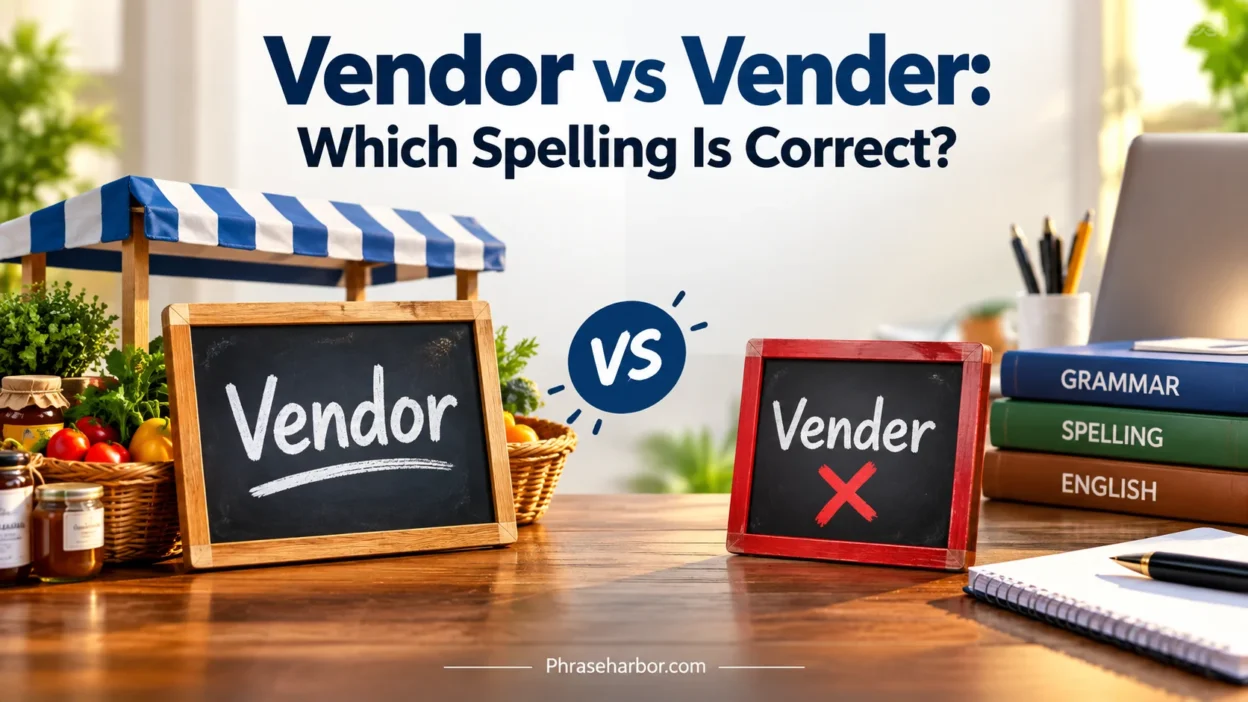
Vendor vs Vender can be confusing because both spellings appear in dictionaries and both refer to someone who sells goods or services. However, they don’t have the same level of popularity in modern English. Vendor is by far the more common spelling, especially in American English and professional writing. Vender is a legitimate variant, but you’ll encounter it much less often.
That difference matters when you’re writing an email, preparing a business document, creating website content, or describing a seller. Choosing the familiar form can make your writing look polished and natural.
The good news is that you don’t need to memorize a complicated rule. Once you understand how the two forms developed and how people use them today, the choice becomes straightforward.
Quick Answer
Vendor is the preferred and much more common spelling in modern American English. It means a person, company, or organization that sells goods or services. Vender has the same basic meaning and is recognized as a variant spelling, but it is comparatively rare.
For most everyday and professional situations, choose vendor.
For example:
- The vendor supplied the company with new equipment.
- We need to contact the software vendor.
- Several food vendors operate at the market.
You could technically replace vendor with vender in these examples without changing the basic meaning. However, vender would look unusual to many modern readers.
| Word | Meaning | Modern Usage | Best Choice for Most Writing |
| Vendor | A person or business that sells goods or services | Very common | Yes |
| Vender | A person or business that sells goods or services | Uncommon | Usually no |
So, if you’re wondering “Vendor or vender?”, the practical answer is simple: use vendor unless you have a specific reason to use the variant vender.
Comparison Overview
Vendor and vender function primarily as nouns. Both identify someone who sells something. The major difference isn’t their basic definition. It is their frequency, familiarity, and conventional use.
Modern business English strongly favors vendor. You’ll see it in procurement documents, contracts, invoices, e-commerce platforms, technology discussions, and corporate communication.
Vender, meanwhile, survives as a valid spelling but appears far less often. It can still be understood easily because its meaning connects directly with the verb vend, which means to sell.
| Comparison Point | Vendor | Vender |
| Part of speech | Noun | Noun |
| Core meaning | Seller or supplier | Seller or supplier |
| Related verb | Vend | Vend |
| American English | Very common | Rare |
| Business writing | Standard | Uncommon |
| Technology writing | Very common | Rare |
| Retail contexts | Common | Uncommon |
| Meaning difference | None of practical importance | None of practical importance |
| Recommended default | Yes | Usually not |
Think of the two spellings as two roads leading to the same destination. One road gets far more traffic.
Main Differences Between Vendor vs Vender
The most important difference between vendor vs vender is usage rather than meaning. Both words describe a seller, yet vendor has become the established spelling in modern English.
Vendor Is the Standard Modern Spelling
Vendor is the form you’ll encounter most often in contemporary writing. It works naturally when you discuss an individual seller, a business, a supplier, or a company that provides commercial products or services.
For example:
- The vendor delivered the order on Tuesday.
- Our company selected a new software vendor.
- The market has several local vendors.
- The purchasing team reviewed each vendor’s proposal.
The word has also developed a broad business meaning. A vendor doesn’t necessarily stand behind a physical storefront with products on shelves. A software company can be a vendor. A consulting firm can be a vendor. An online merchant can be a vendor.
That broad meaning explains why vendor appears so frequently in modern commercial language.
Vender Is a Legitimate Variant
Vender isn’t simply a typo in every situation. Dictionaries recognize it as a spelling variant of vendor.
Its meaning remains essentially the same: a person or organization that sells something.
For example:
The street vender sold handmade crafts.
The sentence is understandable and grammatically valid. Still, many modern readers would expect vendor instead.
That’s an important distinction. A word can be legitimate without being the most natural choice for contemporary writing.
The Two Words Usually Mean the Same Thing
Unlike pairs such as affect and effect, principal and principle, or stationary and stationery, vendor and vender don’t normally represent two different concepts.
Both connect to selling.
The difference is mostly one of spelling preference and usage frequency. Therefore, changing vender to vendor usually doesn’t change the meaning of a sentence.
Vendor: Meaning and Definition
A vendor is a person, company, or organization that sells goods or services.
The term can describe a surprisingly wide range of sellers.
A person selling fruit from a roadside stand is a vendor. A company supplying office furniture can be a vendor. A technology company providing cloud software can also be a vendor.
Vendor in Retail
Retail provides one of the clearest examples.
A vendor may sell:
- Clothing
- Food
- Electronics
- Furniture
- Books
- Handmade products
- Household items
- Personal accessories
For example:
The clothing vendor offered several sizes of the same jacket.
Here, vendor simply identifies the seller.
Vendor in Business
Business English uses vendor in a much broader sense.
A company may purchase services from several vendors, including:
- Software vendors
- Advertising vendors
- Cleaning vendors
- Security vendors
- Equipment vendors
- Transportation vendors
- Printing vendors
- Consulting vendors
In this setting, vendor often sounds more natural than alternatives such as seller.
For example:
The company signed a contract with an outside technology vendor.
Calling that company a “seller” wouldn’t necessarily be wrong. However, vendor better fits the professional context.
Vendor in Technology
Technology has made vendor even more common.
You’ll frequently see phrases such as software vendor, hardware vendor, cloud vendor, and technology vendor.
A technology vendor may sell a physical product, license software, provide subscriptions, or deliver ongoing technical services.
For example:
The business changed its cloud vendor after reviewing several providers.
In modern corporate writing, vendor has become a familiar piece of commercial vocabulary.
Vender: Meaning and Definition
A vender is someone who sells goods or services. It is a recognized spelling variant of vendor.
The word comes from the same underlying idea of selling. Its relationship with vend makes its spelling intuitive.
For example:
The vender offered fresh fruit near the station.
The meaning is clear. However, vendor would be the more familiar choice for most modern American readers.
Why Does Vender Look Unusual?
English spelling contains many words with competing historical forms. Some variants remain common while others gradually become less frequent.
Vender belongs to that second category in contemporary usage. It hasn’t disappeared from English, but vendor has become the dominant form.
That difference can create an interesting trap. Because vender looks perfectly reasonable, writers sometimes wonder whether it has a special meaning.
Usually, it doesn’t.
Why Is Vendor More Common Than Vender?
The popularity of vendor comes from long-established usage and its strong position in modern commercial English.
The word has become deeply embedded in phrases that appear across industries. Once a spelling becomes standard within contracts, accounting, procurement, technology, retail, and business communication, that convention tends to reinforce itself.
Consider the phrase vendor management.
Businesses use it to describe the process of selecting, evaluating, communicating with, and working with external suppliers or service providers. You will overwhelmingly encounter vendor management, not vender management.
The same pattern appears with:
- Vendor agreement
- Vendor contract
- Vendor invoice
- Vendor payment
- Vendor relationship
- Vendor portal
- Vendor selection
- Vendor database
- Vendor management
Repeated professional use makes vendor the natural modern choice.
Is Vender Correct in American English?
Yes. Vender is a recognized word.
However, “correct” and “common” aren’t always the same thing.
A dictionary can recognize a variant even when most writers rarely use it. That’s what happens with vender. The spelling has a legitimate place in English, yet vendor remains much more familiar.
Therefore, calling vender an outright spelling error isn’t accurate.
A better way to describe it is an uncommon variant of vendor.
If you’re writing a formal report or business email, though, vendor is generally the safer choice because readers are accustomed to seeing it.
Vendor in American English
American English overwhelmingly favors vendor in modern commercial contexts.
You’ll find the spelling across industries and communication styles. It appears in everyday descriptions as well as highly specialized business terminology.
For example:
Everyday:
The food vendor sold grilled corn at the festival.
Business:
The procurement department approved a new vendor.
Technology:
The company contacted its software vendor about the licensing issue.
E-commerce:
The online vendor shipped the order within two days.
Notice how easily the word moves between casual and professional contexts. That’s one reason vendor has such a strong position in contemporary English.
Vendor as a Business Term
The word vendor has become more than a simple synonym for seller.
In business, it can describe an external party that supplies products or services to another organization.
That distinction becomes especially useful in procurement.
Imagine a restaurant that needs a new point-of-sale system. The company providing that system could be called a technology vendor.
Now imagine a manufacturer buying packaging materials. The company supplying those materials could also be called a vendor.
The word therefore covers a broad commercial relationship.
Vendor vs Supplier: Are They the Same?
Vendor and supplier overlap significantly, but they aren’t always interchangeable in every business context.
A supplier often emphasizes the act of providing goods, materials, or resources to another business. A vendor can refer more broadly to a seller or commercial provider.
For example, a manufacturer might purchase steel from a supplier. That same company might purchase accounting software from a vendor.
| Term | Common Emphasis | Example |
| Vendor | Selling products or services | Software vendor |
| Supplier | Providing goods or materials | Steel supplier |
| Manufacturer | Producing goods | Electronics manufacturer |
| Distributor | Moving products through a supply chain | Regional distributor |
| Retailer | Selling directly to consumers | Clothing retailer |
| Contractor | Performing contracted work | Construction contractor |
These categories can overlap. A single company may function as both a supplier and a vendor depending on the relationship and context.
Read More: Bad Rap or Bad Rep: Which Phrase Should You Use?
Common Phrases With Vendor
Because vendor dominates professional English, you’ll encounter it in many fixed expressions.
Vendor Management
Vendor management covers the process of handling relationships with external sellers and service providers.
A business may evaluate vendor performance, negotiate terms, monitor costs, and review contracts.
Vendor Agreement
A vendor agreement sets out the terms between a buyer and a vendor.
It may address pricing, delivery, payment, responsibilities, warranties, confidentiality, and termination.
Vendor Contract
A vendor contract is a formal agreement governing the commercial relationship.
Although vendor agreement and vendor contract can overlap in everyday use, the exact legal meaning depends on the document and jurisdiction.
Software Vendor
A software vendor provides software products or services.
This phrase has become particularly common as businesses rely on subscription software and cloud platforms.
Local Vendor
A local vendor typically refers to a seller operating within a particular community or geographic area.
For example:
The festival invited local vendors to sell food and crafts.
Online Vendor
An online vendor sells products or services through the internet.
The seller may operate through an independent website, marketplace, or other digital platform.
Common Mistakes With Vendor and Vender
The biggest mistake involves assuming that vender must always be wrong.
It isn’t.
However, another mistake occurs when writers assume both forms have equal modern popularity. They don’t.
Here are the main points to remember:
- Vendor is the overwhelmingly more familiar spelling.
- Vender is a recognized variant.
- Both generally mean a seller.
- Vendor works naturally in business and professional writing.
- Vender may look unusual because modern usage strongly favors vendor.
- Neither spelling normally represents a different type of seller.
Don’t Confuse Vendor With Vend
The verb vend means to sell.
For example:
The machine vends snacks and drinks.
The noun vendor identifies the seller:
The vendor sells snacks and drinks.
This distinction helps explain why both vendor and vender exist. They connect to the same underlying idea of selling.
Vendor vs Vender in Sentences
Seeing both forms in context makes the difference easier to understand.
Examples With Vendor
The vendor delivered the equipment ahead of schedule.
Several vendors participated in the weekend market.
The company is reviewing its current software vendors.
We contacted the vendor about the damaged shipment.
The online vendor offers free returns.
Examples With Vender
The vender sold handmade jewelry at the fair.
A local vender offered fresh produce near the entrance.
These sentences demonstrate an important point: vender can function grammatically just like vendor.
The issue isn’t sentence structure. The issue is conventional usage.
Side-by-Side Examples
| With Vendor | With Vender |
| The vendor sold fresh bread. | The vender sold fresh bread. |
| We contacted the vendor yesterday. | We contacted the vender yesterday. |
| Several vendors joined the market. | Several venders joined the market. |
| The software vendor updated the system. | The software vender updated the system. |
The meaning remains essentially unchanged. The first column simply reflects the spelling modern readers are much more accustomed to seeing.
Vendor or Vender: Which Should You Use?
For most writing, use vendor.
That’s especially true when you’re writing:
- Business emails
- Reports
- Contracts
- Website content
- Product descriptions
- Academic material
- Technical documentation
- Procurement documents
- Professional correspondence
Using vendor reduces the chance that readers will pause over an unfamiliar spelling.
You might encounter vender in older material, dictionaries, specialized usage, or text that preserves an original spelling. In those cases, changing it automatically may not be necessary.
A useful rule is:
Use vendor as your default spelling. Treat vender as a legitimate but uncommon variant.
That single rule handles most situations.
Vendor vs Vender: Pronunciation
In ordinary English, vendor and vender are pronounced essentially the same.
The spelling difference doesn’t create a meaningful pronunciation distinction for most speakers.
Both typically have the first syllable pronounced like VEN and the second syllable like der.
This similarity partly explains why people sometimes confuse the spellings. When you hear the word rather than see it, there’s no obvious clue telling you which spelling someone intends.
For that reason, spelling becomes especially important in written communication.
FAQs:
Is vendor or vender correct?
Both vendor and vender are recognized English spellings for a person or organization that sells something. However, vendor is far more common and is the preferred spelling for most modern writing.
Is vender a misspelling of vendor?
Not necessarily. Vender is a legitimate variant spelling. However, because vendor dominates modern usage, vender may look like a spelling mistake to many readers.
What does vendor mean?
A vendor is a person, company, or organization that sells goods or services. The term can describe anything from a market seller to a software company.
What does vender mean?
Vender means essentially the same thing as vendor. It refers to a person or entity that sells goods or services.
Is vender used in American English?
Yes. Vender exists in American English as a recognized variant. However, it is much less common than vendor in contemporary American writing.
Conclusion:
When choosing between vendor vs vender, the practical answer is straightforward: vendor is the standard modern spelling to use in most situations. Both words refer to a seller. Vender isn’t automatically incorrect, but it has a much smaller footprint in contemporary English. Vendor, meanwhile, appears everywhere from retail markets to corporate procurement departments and technology companies. If you’re writing for a modern American audience, vendor is the clear default. Use vender only when you have a specific reason to preserve that variant.