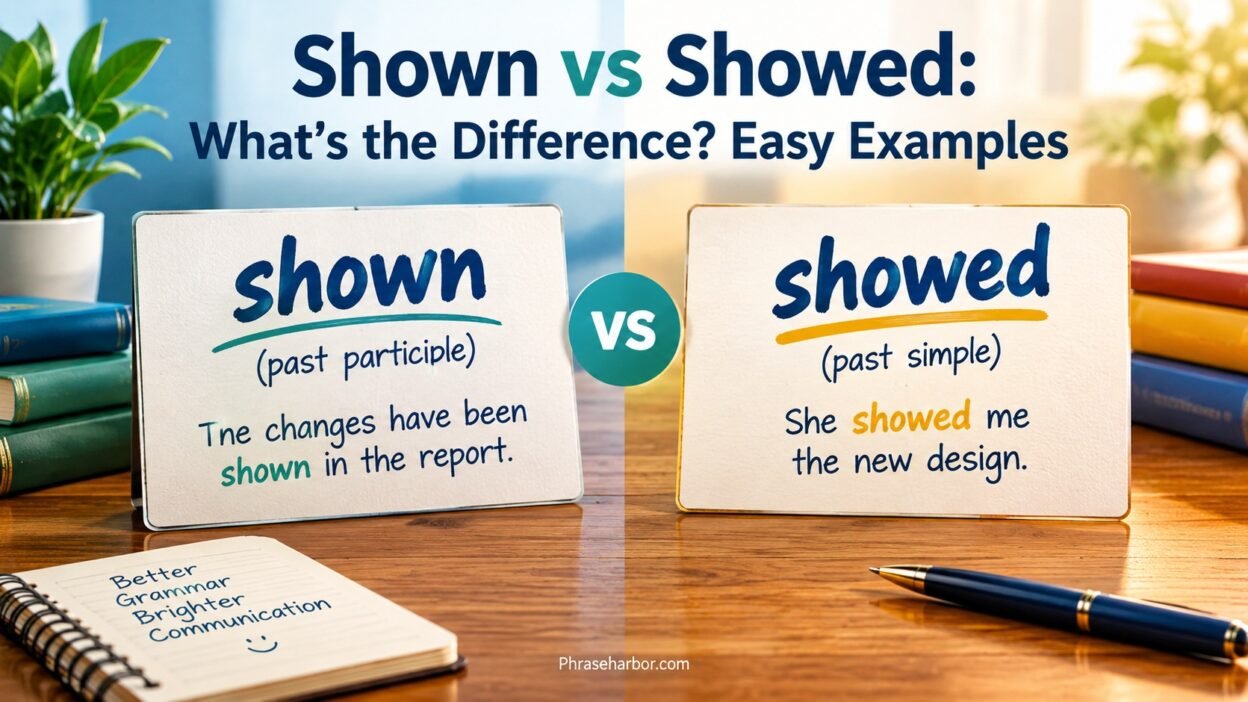
English verbs don’t always follow a simple pattern. Some verbs take -ed in the past tense, while others change form completely. The verb show creates a common point of confusion because its past forms are showed and shown, and you can’t use them interchangeably in every sentence.
The good news is that the difference becomes much easier once you understand what each form does. Showed is the simple past form of show, while shown is its past participle. That small grammatical difference determines where each word belongs.
For example, you can say, “She showed me her new phone yesterday.” However, you would say, “She has shown me her new phone.” The first sentence describes a completed past action. The second uses the present perfect tense.
Quick Answer
The short answer is simple: showed is the simple past tense of show, while shown is the past participle.
The basic verb forms are:
| Verb form | Word | Example |
| Base form | show | I show my work. |
| Simple past | showed | I showed my work yesterday. |
| Past participle | shown | I have shown my work. |
| Present participle | showing | I am showing my work. |
Use showed when you simply describe something that happened in the past.
She showed me the photograph yesterday.
Use shown when another verb helps form a perfect or passive construction.
She has shown me the photograph.
A useful shortcut is this:
- show → showed for simple past
- have/has/had + shown for perfect tenses
- be + shown for passive constructions
- did + show in questions and negative statements
So, “I showed him” is correct. “I have shown him” is also correct. But “I have showed him” is not the standard form.
Comparison Overview
The difference between shown and showed becomes clearer when you place them side by side. Both words come from the same verb, but they perform different grammatical jobs.
| Feature | Showed | Shown |
| Verb | Show | Show |
| Form | Simple past | Past participle |
| Main use | Completed past action | Perfect and passive constructions |
| Usually needs a helping verb? | No | Usually yes |
| Example | She showed me the report. | She has shown me the report. |
| With did | No | No |
| With has/have/had | No | Yes |
| With passive be | Generally no | Yes |
Consider these two sentences:
James showed the manager the documents.
James has shown the manager the documents.
The first sentence places the action in the past. The second connects the action to the present through the present perfect tense.
Neither word is simply a more formal version of the other. Grammar decides which one belongs in the sentence.
Main Differences Between Shown vs Showed
The biggest difference between shown vs showed is grammatical form. Showed works as the simple past form, while shown works as the past participle.
That distinction matters because English uses past participles after certain helping verbs. You can’t simply choose shown because the action happened in the past. The surrounding words determine the correct form.
Showed Is the Simple Past Form
Use showed when you describe an action that happened and finished in the past.
For example:
- She showed me her vacation photos.
- Mark showed us the new office.
- The teacher showed the class an experiment.
- I showed my brother the message.
- The report showed a significant change.
Notice that showed doesn’t need has, have, or had.
You can also use a specific past-time expression with showed:
- yesterday
- last night
- last week
- two days ago
- in 2024
- earlier this morning
- when I was younger
For example:
The doctor showed me the results yesterday.
The action happened at a definite time in the past. That’s a natural setting for the simple past.
Shown Is the Past Participle
Shown is the past participle of show. It commonly appears with helping verbs such as has, have, and had.
For example:
- She has shown great patience.
- They have shown excellent results.
- He had shown me the document earlier.
- The evidence has shown a clear pattern.
Here, shown doesn’t act as an independent simple past verb.
You wouldn’t normally write:
He shown me the document yesterday.
Instead, write:
He showed me the document yesterday.
However, add had and the construction changes:
He had shown me the document before the meeting.
That’s the key distinction.
The Three Main Forms to Remember
A simple three-word sequence can prevent many mistakes:
show → showed → shown
Think of it like:
| Form | Example |
| Present/base | I show |
| Past | I showed |
| Past participle | I have shown |
The same pattern appears in many irregular English verbs. Compare:
- go → went → gone
- see → saw → seen
- take → took → taken
- write → wrote → written
- show → showed → shown
The important point is that showed and shown aren’t competing past-tense choices. They represent different verb forms.
What Does “Showed” Mean?
Showed means that someone displayed, presented, demonstrated, revealed, or directed attention toward something in the past.
The meaning of show can change slightly depending on context, but the grammatical form remains the same.
For example:
Sarah showed me her new apartment.
Here, showed means Sarah allowed me to see or look at something.
Now consider:
The graph showed a sharp increase.
Here, showed means the graph presented or indicated information.
Another example:
His face showed signs of fatigue.
In this sentence, showed means that his face displayed something.
Common Uses of Showed
You can use showed when someone:
- displays an object
- presents information
- demonstrates a process
- reveals a feeling
- directs someone somewhere
- proves or indicates something
- allows someone to see something
For example:
The guide showed us the entrance.
The experiment showed a different result.
Her expression showed that she was surprised.
He showed me how to fix the printer.
Each sentence describes a past event without requiring a perfect or passive construction.
What Does “Shown” Mean?
Shown is the past participle of show. It can mean displayed, revealed, demonstrated, indicated, or presented, but its grammatical role differs from showed.
Consider:
The study has shown a connection between the two factors.
The word shown works with has to create the present perfect.
Now look at:
The painting was shown at the gallery.
Here, shown works with was in a passive construction.
So, shown isn’t merely another way to write showed. Its position in the sentence tells you why it appears.
Common Uses of Shown
You’ll often see shown after:
- has
- have
- had
- is
- are
- was
- were
- been
Examples include:
The results have shown steady improvement.
The documentary was shown on television.
The figures had shown a similar trend before.
The image is shown below.
The results have been shown in the table.
These patterns make shown easier to recognize.
Shown vs Showed in the Past Tense
When you simply want to describe a completed action, showed is generally the form you need.
I showed my friend the new website.
You don’t need a helping verb.
If you write:
I shown my friend the new website.
the sentence doesn’t have the required grammatical structure. Shown needs an appropriate auxiliary verb in this kind of use.
Compare the following:
| Sentence | Correct? | Reason |
| I showed him the photo. | Yes | Simple past |
| I shown him the photo. | No | Missing helping verb |
| I have shown him the photo. | Yes | Present perfect |
| I had shown him the photo. | Yes | Past perfect |
| I was shown the photo. | Yes | Passive construction |
A quick test helps. If you’re talking about something that happened at a definite past time and you’re not using a perfect or passive construction, showed will usually fit.
Shown vs Showed With “Have,” “Has,” and “Had”
This is where many learners make mistakes.
After have, has, and had, use the past participle shown.
Correct:
- I have shown him the document.
- She has shown remarkable progress.
- They have shown strong interest.
- We had shown them the results.
- He had shown me the location.
Incorrect in standard English:
- I have showed him the document.
- She has showed remarkable progress.
- They have showed strong interest.
- We had showed them the results.
Why does this happen? English learners sometimes treat showed as though it were the only past form. However, perfect tenses require a past participle.
The formula is straightforward:
have/has/had + past participle
Therefore:
have shown
has shown
had shown
This rule also applies to many other irregular verbs:
- have seen
- has written
- had taken
- have gone
- has shown
Shown vs Showed in Passive Voice
The word shown also appears frequently in passive sentences.
Compare these two sentences:
The museum showed the painting.
The painting was shown at the museum.
The first sentence uses active voice. The museum performs the action.
The second sentence uses passive voice. The painting becomes the focus.
Common passive forms include:
- is shown
- are shown
- was shown
- were shown
- has been shown
- have been shown
- had been shown
For example:
The results were shown to the committee.
The film was shown at a local theater.
The data has been shown in several reports.
The photographs were shown during the presentation.
The passive structure usually follows a form of be + past participle. Since shown is the past participle, it fits naturally into these constructions.
Read More: Jobsite or Job Site: What Is the Difference & Which Is Correct?
“Was Shown” vs “Showed”
These two structures can describe the same event from different angles.
Consider:
The teacher showed the students the experiment.
The teacher performs the action.
Now change the focus:
The experiment was shown to the students.
The experiment receives the action.
This difference isn’t about tense alone. It also concerns voice.
| Active | Passive |
| The teacher showed the experiment. | The experiment was shown to the class. |
| The museum showed the painting. | The painting was shown at the museum. |
| The presenter showed the results. | The results were shown to the audience. |
Both forms can be useful. Choose the structure that keeps the important information in focus.
“Has Shown” vs “Showed”
The distinction between has shown and showed involves more than verb form. It can also change how you present the timing of an event.
Use showed for a completed past event:
The test showed a problem yesterday.
Use has shown when the past action has a connection with the present:
The test has shown a recurring problem.
The simple past often works naturally with finished time periods:
The report showed an increase last year.
The present perfect works naturally when the time period continues or the result matters now:
The report has shown an increase over the past year.
That doesn’t mean every sentence with showed refers to something irrelevant now. Context matters. The key difference comes from how English speakers frame the time and relevance of the event.
“Had Shown” vs “Showed”
Had shown uses the past perfect. It helps establish that one past event happened before another past event.
Consider:
She showed me the letter before she left.
This sentence is perfectly grammatical.
You could also say:
She had shown me the letter before she left.
The past perfect gives stronger grammatical emphasis to the earlier event.
For example:
By the time the manager arrived, the assistant had shown the customers the new product.
There are two past events:
- The assistant showed the product.
- The manager arrived.
The past perfect places the showing earlier in the sequence.
You don’t always need had shown when the sequence is already obvious. However, it can make the timeline clearer.
Can You Say “Have Showed”?
In standard English, use have shown, not have showed, when show functions as a past participle.
Correct:
We have shown the customer the options.
Incorrect in standard English:
We have showed the customer the options.
The confusion makes sense because showed already looks like a completed past form. Yet English doesn’t form the present perfect by simply adding have to the simple past.
The pattern is:
have + past participle
Therefore:
have shown
not:
have showed
The same rule applies to has and had.
Is “Shown” Ever Used Without “Have” or “Be”?
In ordinary verb constructions, shown commonly appears with an auxiliary verb. However, English can also use past participles inside participial phrases or as modifiers.
For example:
The evidence shown in the report supports the conclusion.
Here, shown in the report modifies the evidence. It isn’t functioning as a simple past verb.
You wouldn’t replace shown with showed:
The evidence showed in the report supports the conclusion.
That version doesn’t work in the intended structure.
Another example:
The photographs shown above provide more detail.
Again, shown above describes the photographs.
These constructions are different from saying:
He shown me the photographs.
That sentence needs an auxiliary verb or the simple past form showed.
FAQs:
Is “shown” the past tense of “show”?
Not exactly. Showed is the simple past form of show. Shown is the past participle.
The basic sequence is:
show → showed → shown
For example:
She showed me the letter.
She has shown me the letter.
Is “showed” grammatically correct?
Yes. Showed is the standard simple past form of show.
For example:
He showed me his new car yesterday.
You should use showed when you’re describing a straightforward completed action in the past.
Should I say “have showed” or “have shown”?
Use have shown in standard English.
We have shown the customer the options.
The construction have + past participle requires shown.
Is “shown” always used with “has,” “have,” or “had”?
No. Shown also appears in passive constructions and participial phrases.
Examples include:
The movie was shown last night.
The images shown above explain the process.
So while has/have/had + shown is a major pattern, it isn’t the only one.
Is “shown” or “showed” more common?
Neither form is universally correct in place of the other. Their frequency depends on the grammatical structure and meaning of the sentence.
Use showed for the simple past. Use shown in constructions that require the past participle.
Conclusion:
Once you stop treating showed and shown as interchangeable past forms, the distinction becomes much clearer. Look at the helping verb, identify the sentence structure, and then choose the form that fits. That’s the simplest way to keep shown vs showed straight in everyday English.