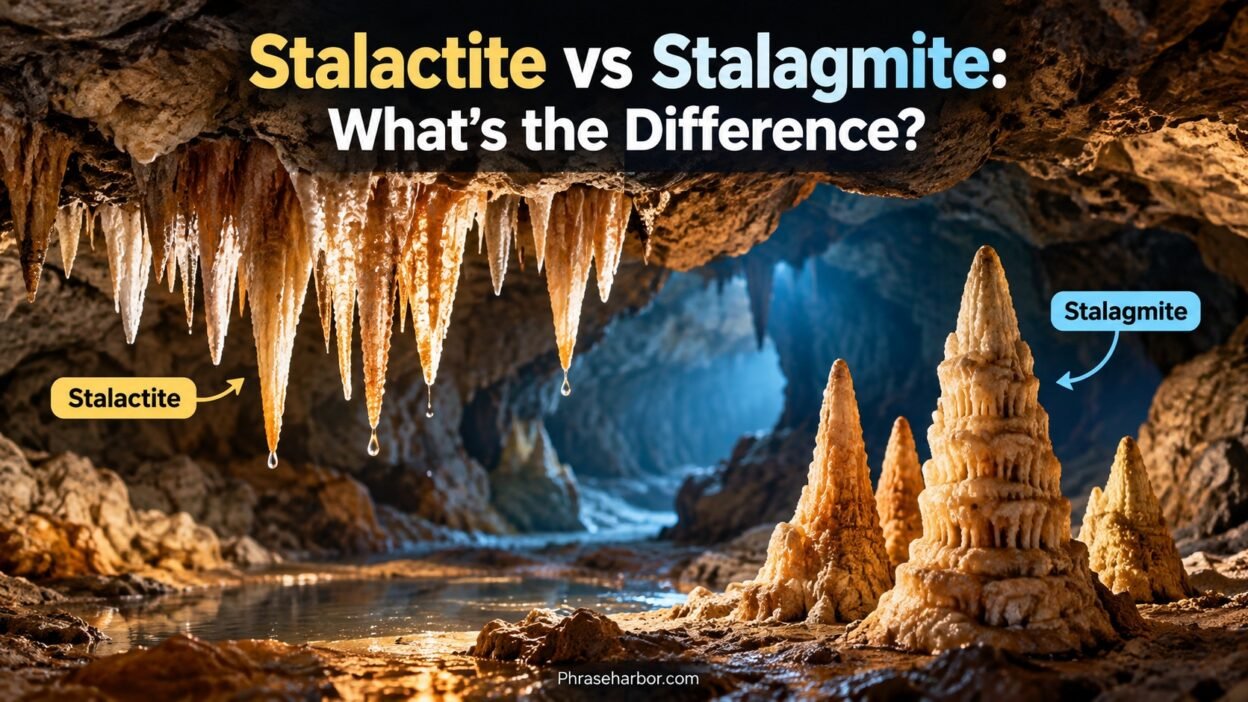
Stalactite vs Stalagmite becomes easier when you use a simple memory trick: stalactites hang from above, while stalagmites rise from below as minerals build upward from the floor. When I first came across these cavern words, I understood why the terms can seem famously confusing.
A simple mnemonic is to remember that a stalactite hangs from the roof, while a stalagmite might reach the top from the floor. Inside a cave, cavern, or subterranean world, these natural cave formations develop through a slow natural process. Rain water becomes mineral-rich as it seeps through cracks in limestone and reaches the weakest parts of the rock.
Each drip, drop, and dripping sediment carries mineral deposits that slowly accumulate and harden. Over hundreds of years and thousands of years, this formation becomes a geological formation, creating cone-like structures, cave spikes, and icicle-like shapes.
Quick Answer
The easiest way to remember the stalactite vs stalagmite difference is this:
- Stalactite: grows down from the cave ceiling.
- Stalagmite: grows up from the cave floor.
- Stalactites form where mineral-rich water enters through the ceiling.
- Stalagmites form where those droplets hit the floor and leave mineral deposits.
- Both are types of speleothems, which are mineral deposits that form inside caves.
- Calcite is one of the most common minerals found in limestone-cave speleothems.
- If a stalactite and stalagmite eventually connect, they can form a column or pillar.
The easiest memory tricks
Stalactites hang tight to the ceiling.
Stalagmites might reach the ceiling.
Another simple trick is to associate the letters with their locations:
- Stalactite → C → Ceiling
- Stalagmite → G → Ground
These memory tricks don’t explain the geology. They simply make the vocabulary much easier to remember.
Comparison Overview
| Feature | Stalactite | Stalagmite |
| Location | Cave ceiling or overhang | Cave floor |
| Growth direction | Downward | Upward |
| Water source | Mineral-rich water entering from above | Droplets falling onto the floor |
| Typical appearance | Icicle-like, tapered, tubular, or irregular | Cone-shaped, rounded, broad, or irregular |
| Early form | Often begins as a soda straw | Begins as mineral deposits on the floor |
| Common mineral | Calcite in many limestone caves | Calcite in many limestone caves |
| Water movement | Water flows along or through the formation | Water splashes onto the floor |
| Can connect? | Yes | Yes |
| Connected formation | Part of a column | Part of a column |
| Main identifying feature | Hangs from above | Rises from below |
The most reliable difference isn’t the shape. It’s the location and direction of growth.
A stalactite could be thick, thin, crooked, rounded, or almost completely unlike an icicle. A stalagmite might have a sharp point or a broad dome. Nature doesn’t follow a geometry textbook.
If it hangs from the ceiling, it’s a stalactite.
If it rises from the floor, it’s a stalagmite.
Main Differences Between Stalactite vs Stalagmite
The difference between a stalactite and a stalagmite comes down to where mineral deposition occurs and how water moves through the cave.
Let’s look at each formation separately.
What Is a Stalactite?
A stalactite is a mineral formation that grows downward from the ceiling, wall, or another overhead surface inside a cave.
It develops when water carrying dissolved minerals enters an underground cavity. The water usually travels through tiny cracks, fractures, and pores in the rock above the cave.
When the water reaches the cave’s open air, some of its dissolved carbon dioxide escapes. That chemical change can cause minerals such as calcite to precipitate from the water.
Tiny amounts remain on the surface.
Then another drop arrives.
And another.
And another.
Over a very long period, those tiny deposits accumulate and create a visible formation.
That’s why a stalactite isn’t simply a piece of rock hanging from a ceiling. It’s more like a geological drip record, built layer by layer by water.
How a Stalactite Forms
In a typical limestone cave, the process can look like this:
Rainwater → soil → carbon dioxide → limestone → dissolved minerals → cave ceiling → stalactite
Here’s what happens in more detail.
Rainwater enters the ground
Rainwater doesn’t remain chemically unchanged as it travels underground.
As it passes through soil, it encounters carbon dioxide produced by plant roots, microorganisms, and decomposition. This can make the water mildly acidic.
Water interacts with limestone
The water moves through cracks and pores in limestone.
Limestone primarily consists of calcium carbonate, commonly in the mineral form calcite. Mildly acidic groundwater can dissolve some of that material.
The water therefore carries dissolved calcium and carbonate-related chemical components as it moves underground.
Water reaches the cave
Eventually, the water enters an air-filled cave.
Conditions inside the cave differ from those underground. Carbon dioxide can escape from the water into the cave atmosphere.
That shift encourages calcium carbonate to precipitate.
Mineral deposits accumulate
A tiny amount of calcite remains behind on the ceiling.
The next drop adds another microscopic layer.
Over time, repeated deposition creates a visible formation.
What Is a Soda Straw?
Many stalactites begin as soda straws.
A soda straw is a thin, hollow mineral tube that hangs from the cave ceiling. Water travels through the inside of the tube and deposits material around its rim.
The result looks remarkably similar to a drinking straw.
As mineral deposition continues, the tube can become thicker. Eventually, additional material may build around the outside and transform the delicate tube into a more substantial stalactite.
However, not every soda straw becomes a massive stalactite.
Changes in water flow, mineral supply, cave conditions, or the physical structure of the formation can interrupt its growth.
What Is a Stalagmite?
A stalagmite is a mineral formation that grows upward from the floor of a cave.
Its formation usually begins when water drips from the ceiling or from a stalactite above.
When the droplet strikes the cave floor, it spreads or splashes across the surface. Dissolved minerals can precipitate and remain behind.
Repeated droplets gradually build a deposit.
Unlike a stalactite, the stalagmite doesn’t grow downward from its starting point. It accumulates upward from the ground.
How a Stalagmite Forms
The basic process is:
Water enters cave → droplet falls → droplet hits floor → minerals precipitate → deposit remains → repeated dripping builds stalagmite
The shape depends heavily on how the water arrives.
A steady drip falling onto one small area may produce a relatively narrow formation. Water that splashes across a wider area can create a much broader deposit.
That’s one reason stalagmites don’t all look like perfect cones.
What Are Stalactites and Stalagmites Made Of?
In many limestone caves, calcite is the main mineral found in stalactites and stalagmites.
Calcite is a crystalline form of calcium carbonate, with the chemical formula CaCO₃.
However, cave formations aren’t limited to calcite.
Depending on the geological setting and chemistry of the water, speleothems can contain minerals such as:
- Calcite
- Aragonite
- Gypsum
- Dolomite
- Halite
- Other less common minerals
This distinction matters because people sometimes say that stalactites are “made of limestone.”
That’s not quite the best way to describe them.
Limestone is often the host rock, especially in classic limestone caves. The mineral deposited to form the speleothem is commonly calcite.
The difference is subtle but scientifically important.
Read More: Thanks Everybody or Thanks Everyone: Which Is Correct?
What Is a Speleothem?
Speleothem is the broader geological term for a mineral deposit that forms inside a cave.
Stalactites and stalagmites are two types of speleothems.
Other examples include:
- Flowstone
- Soda straws
- Helictites
- Cave popcorn
- Cave pearls
- Rimstone dams
- Columns
Think of “speleothem” as the family name.
Stalactite and stalagmite are individual members of that family.
This terminology helps geologists describe cave deposits without having to classify every formation as either a stalactite or stalagmite.
Stalactite vs Stalagmite Shape and Appearance
Shape provides useful clues, but it shouldn’t be your primary identification method.
Common Stalactite Shapes
Stalactites can appear as:
- Long, narrow tubes
- Sharp cones
- Thick icicle-like formations
- Rounded pendants
- Layered structures
- Curved or irregular growths
- Massive ceiling deposits
A classic stalactite often has a pointed bottom.
But don’t let that fool you into thinking every stalactite has to look like an icicle.
Water doesn’t always arrive in exactly the same way. Even tiny differences in cracks, mineral concentration, airflow, and drip rate can change the final shape.
Common Stalagmite Shapes
Stalagmites may appear as:
- Conical mounds
- Rounded domes
- Broad piles
- Cylindrical columns
- Irregular towers
- Multi-lobed formations
A stalagmite can also have a relatively flat top.
Again, location matters more than appearance.
If you’re standing in a cave and see a strange mineral formation, first ask:
Does it hang from above or rise from below?
That’s your best clue.
How Do Stalactites and Stalagmites Form?
The chemistry becomes easier to understand when you look at the entire underground journey of water.
Water Begins at the Surface
Rain falls onto the landscape.
Some water runs across the surface while some infiltrates the ground.
The underground portion moves through soil and rock.
Soil Adds Carbon Dioxide
Soil contains biological activity.
Plant roots and microorganisms contribute carbon dioxide to the soil environment. Water moving through this carbon-dioxide-rich soil can become mildly acidic.
This chemical change helps groundwater interact with limestone.
Groundwater Dissolves Rock
The acidic water can dissolve portions of limestone as it moves through cracks.
That process helps transport calcium and carbonate-related components underground.
Over geological time, groundwater can contribute to the development and enlargement of caves.
The Cave Becomes an Open Space
Once water enters an air-filled cave passage, the chemistry changes.
Carbon dioxide can escape from the water.
That shift can encourage calcium carbonate to precipitate.
The mineral then accumulates on cave surfaces.
Some deposits remain on ceilings.
Others accumulate on floors.
Still others spread across walls or flow over surfaces.
That’s how a cave can gradually acquire its famous mineral decorations.
What Happens When a Stalactite and Stalagmite Meet?
Sometimes the two formations eventually connect.
Imagine a stalactite slowly extending downward while a stalagmite slowly rises toward it.
If both continue growing and their paths line up, they can eventually touch.
Once connected, they can form a column, also called a pillar.
Stalactite + Stalagmite = Column
A column extends continuously between the cave floor and ceiling.
However, this doesn’t happen automatically.
The two formations need compatible growth patterns and enough time. Water flow can shift. A drip point can stop supplying minerals. Environmental conditions can change.
So many stalactites and stalagmites remain separate throughout their existence.
Stalactite vs Stalagmite vs Column
| Formation | Starting surface | Growth pattern | Typical location |
| Stalactite | Ceiling | Downward | Overhead |
| Stalagmite | Floor | Upward | Ground |
| Column | Connected floor and ceiling deposits | Continuous pillar | Between floor and ceiling |
A column shouldn’t be confused with an unusually large stalactite.
It represents the connection of growth from above and below.
How Long Does It Take for Stalactites and Stalagmites to Form?
There isn’t a universal growth rate.
That’s one of the most important facts to understand about cave formations.
Some deposits can grow relatively quickly under favorable conditions. Others accumulate incredibly slowly.
Growth depends on factors such as:
- Water supply
- Drip frequency
- Mineral concentration
- Carbon dioxide levels
- Temperature
- Humidity
- Cave ventilation
- Rock chemistry
- Soil conditions
- Surface climate
- Seasonal changes
A common mistake is to say that every stalactite grows at a fixed rate such as “one inch every 100 years.”
That’s an oversimplification.
Real caves don’t operate like clocks.
One drip may carry a different amount of dissolved material from the next. A drought can reduce water flow. Changes in vegetation can affect soil chemistry. Construction or land-use changes above a cave can alter groundwater pathways.
Some cave deposits can preserve evidence spanning extremely long periods.
For example, the National Park Service notes that a stalagmite in Lehman Caves at Great Basin National Park has been estimated to be about 2.2 million years old.
That’s a useful reminder that cave formations can become extraordinarily old geological records.
Stalactite vs Stalagmite: What Controls Their Growth?
The formation process depends on more than simply “water dripping.”
Several environmental variables work together.
Water Availability
No water means no ongoing delivery of dissolved minerals.
A cave beneath a dry landscape may receive far less drip water than one beneath a wetter environment.
Mineral Concentration
Water must carry suitable dissolved material for mineral deposition to occur.
Higher mineral availability can support more deposition under the right chemical conditions.
Carbon Dioxide
Carbon dioxide plays an important role in the chemistry of groundwater and cave deposition.
Changes in carbon dioxide concentration can influence whether calcium carbonate remains dissolved or precipitates.
Cave Ventilation
Air movement can affect carbon dioxide levels inside a cave.
That can influence mineral deposition and therefore the growth of speleothems.
Temperature and Humidity
Cave environments tend to be relatively stable compared with the surface. Even so, temperature and humidity can affect evaporation and cave chemistry.
Drip Location
Where water lands matters.
A drop hitting one tiny point repeatedly can create a narrow formation. Water spreading over a larger surface can produce a wider deposit.
This is why two stalagmites growing only a short distance apart can look completely different.
Why Do Caves Have Stalactites and Stalagmites?
Cave development and speleothem formation are related but aren’t exactly the same process.
Water can help dissolve rock as it travels underground.
Later, that same water can deposit minerals inside an air-filled cave.
It’s almost like nature uses water first as a sculptor and later as a builder.
Cave formation
Groundwater can dissolve soluble rock and enlarge underground passages.
Cave decoration
Mineral-rich water entering those passages can later deposit minerals on cave surfaces.
This distinction helps explain why a cave can contain both empty passages and elaborate mineral formations.
The cave itself may have developed long before its most dramatic stalactites and stalagmites appeared.
Case Study: Lehman Caves
Lehman Caves in Nevada’s Great Basin National Park offers a striking example of how diverse cave formations can become.
The cave contains numerous speleothems, including stalactites and stalagmites.
The National Park Service explains that speleothems develop through mineral deposition from groundwater entering caves.
Some formations at Lehman Caves are exceptionally old. One stalagmite has been estimated at approximately 2.2 million years old.
That age puts the formation in an entirely different category from the human timescale.
For comparison, recorded human history occupies only a tiny fraction of two million years.
This is why cave formations deserve protection. A visitor can damage a formation in seconds that took geological ages to develop.
FAQs:
What is the main difference between a stalactite and a stalagmite?
A stalactite grows downward from the cave ceiling, while a stalagmite grows upward from the cave floor. Both develop from mineral-rich water and take a long time to form.
How can I remember which one hangs from the ceiling?
Use the simple mnemonic: a stalactite has a “c” that can remind you of the ceiling. A stalagmite grows from the ground toward the ceiling.
How do stalactites and stalagmites form?
They form when water carrying dissolved minerals moves through cracks in rock, especially limestone. As drops enter a cave, they leave behind mineral deposits that slowly accumulate and harden.
Can a stalactite and stalagmite become one formation?
Yes. If a stalactite growing downward eventually meets a stalagmite rising upward, they can join and form a cave column or pillar.
Why should visitors avoid touching cave formations?
Touching them can leave skin oils and cause human interference with their natural growth. Delicate formations can take hundreds of years or even thousands of years to develop, so careful observation helps protect them.
Conclusion:
Understanding Stalactite vs Stalagmite becomes simple once you remember their direction: stalactites hang from above, while stalagmites rise from below. Both are remarkable cave formations created through a slow geological process involving water and minerals. Keeping this distinction in mind makes cave exploration more enjoyable and helps you appreciate the patience and natural beauty behind these underground structures.