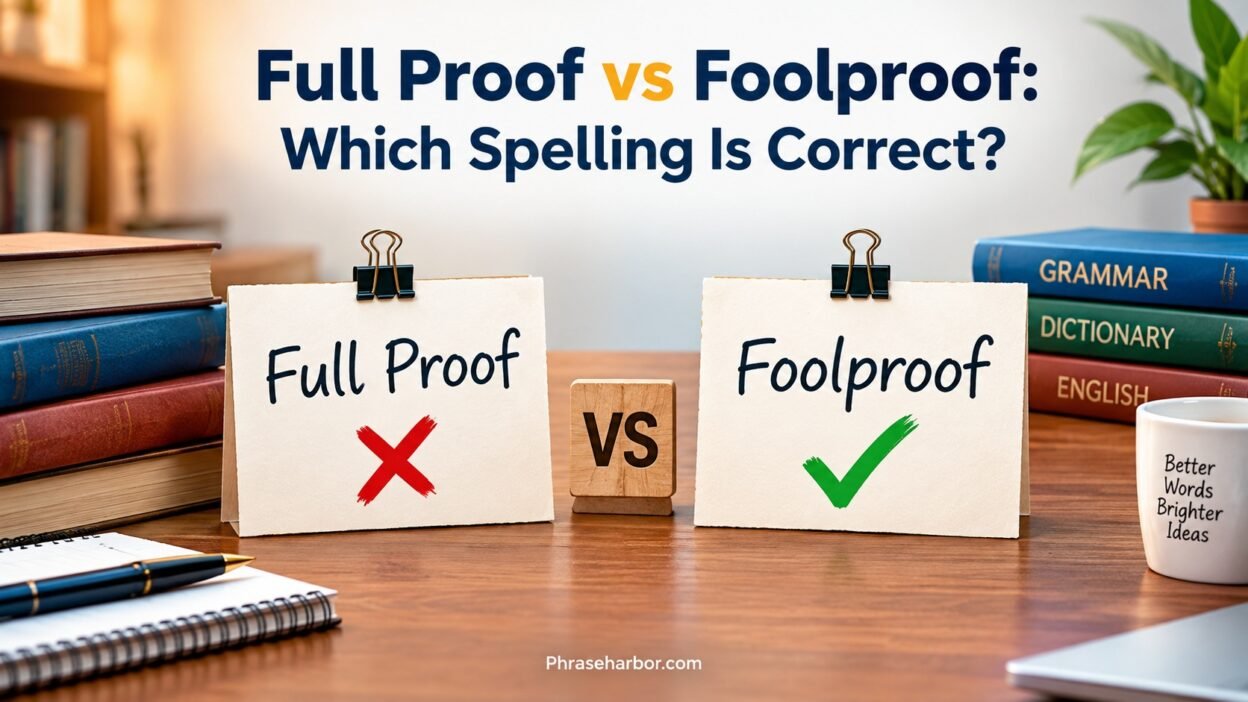
The Full Proof vs Foolproof debate often begins because both forms sound similar when spoken aloud, creating confusion in everyday English and writing. Full proof and foolproof may appear in social media posts, business emails, online forums, professional documents, emails, and everyday conversations.
These forms are sometimes used interchangeably, but fullproof is the wrong form, while foolproof is the correct word and correct spelling in standard English. The English language contains many grammatical surprises, and this example shows why logical guesswork can be misleading.
Full can suggest complete, while proof may mean evidence or resistance, making full proof seem reasonable. However, foolproof is an established compound adjective with an accepted meaning. It describes something simple, plain, and reliable, leaving little opportunity for error, misuse, or failure.
Quick Answer
Foolproof is the correct spelling when you mean something that is very reliable, easy to use, difficult to get wrong, or resistant to mistakes and misuse.
The correct form
- Foolproof — standard spelling
- Foolproof method — correct
- Foolproof plan — correct
- Foolproof system — correct
- Foolproof recipe — correct
Forms to avoid when you mean “foolproof”
- Full proof — not the standard spelling of the adjective
- Fullproof — not the standard form
- Full-proof — sometimes encountered, but foolproof is the established form
For example:
Correct: This recipe is foolproof.
Incorrect for this meaning: This recipe is full proof.
The distinction matters because foolproof is one word. It combines fool with proof to describe something designed to withstand mistakes, misuse, or failure.
Cambridge Dictionary defines foolproof as describing a plan or machine that is so simple and easy to understand that it cannot easily go wrong or be used incorrectly.
Comparison Overview
The easiest way to understand full proof vs foolproof is to compare the forms directly.
| Form | Standard for this meaning? | Meaning | Example |
| foolproof | Yes | Very difficult to get wrong or misuse | “We need a foolproof method.” |
| full proof | No, when intended to mean foolproof | Two separate words that may have a literal meaning in a particular context | “The evidence provides full proof” |
| fullproof | No | Common misspelling of foolproof | Avoid it |
| full-proof | Not the usual modern form | A variant sometimes seen in writing | Prefer foolproof |
There’s an important detail here: full proof isn’t automatically meaningless whenever those two words appear next to each other.
English can place full and proof together as separate words when the sentence gives them their ordinary meanings. For example, a writer might describe something as providing “full proof” in a literal context. That doesn’t make full proof an alternative spelling of foolproof.
The question is always one of meaning and word formation.
If you mean “designed to prevent mistakes,” use foolproof.
Main Differences Between Full Proof vs Foolproof
The biggest difference between full proof vs foolproof comes down to whether you’re dealing with an established compound adjective or two independent words.
Foolproof is a single compound word
Foolproof functions as one adjective.
It can describe a method, plan, machine, system, process, recipe, procedure, strategy, or set of instructions.
For example:
- a foolproof method
- a foolproof plan
- a foolproof recipe
- a foolproof system
- a foolproof procedure
- a foolproof design
The word carries a specific idea: the thing has been designed so that ordinary mistakes, misunderstanding, or misuse are unlikely to cause failure.
Full and proof are normally separate words
Full and proof are both legitimate English words. They simply don’t combine to create the standard adjective meaning “unlikely to fail.”
Full can mean complete, containing as much as possible, or having all the expected elements.
Proof can mean evidence that establishes something as true. It can also describe resistance or protection in compounds such as waterproof. Merriam-Webster lists both the evidentiary meaning of proof and its adjective sense of being able to resist or repel something.
That distinction explains why fullproof isn’t the correct spelling.
The spelling reflects the word’s actual structure
Think of the correct word as:
fool + proof = foolproof
Not:
full + proof = fullproof
The first part is fool, not full.
That isn’t a minor spelling preference. It reflects how the word was formed and what it means.
What Does Foolproof Mean?
Foolproof is an adjective that describes something designed to prevent errors, misuse, or failure.
Merriam-Webster defines it as something “so simple, plain, or reliable” that it leaves no opportunity for error, misuse, or failure.
Cambridge gives a similar explanation. Its American Dictionary describes foolproof as something designed to be easily done or operated without the possibility of mistake or failure.
In everyday language, you can think of foolproof as:
So easy or reliable that it’s extremely difficult to get wrong.
Consider a recipe.
Suppose a recipe has only five ingredients, gives precise measurements, explains every step clearly, and doesn’t require complicated cooking techniques. You might call it a foolproof recipe.
That doesn’t mean the recipe possesses magical powers. Someone could still burn the food or substitute the wrong ingredient. The word simply emphasizes how resistant the process is to ordinary mistakes.
Oxford gives the same practical idea with examples such as a foolproof recipe and notes that no system can ever be completely foolproof.
Why Is It “Foolproof” and Not “Full Proof”?
The answer becomes much easier once you understand the word’s construction.
Fool + proof
The word foolproof combines:
- fool — a person who might make an unwise or careless mistake
- proof — resistant to or protected against something
The second element appears in many familiar English compounds.
Compare:
| Compound | Basic idea |
| waterproof | Resistant to water |
| fireproof | Resistant to fire |
| soundproof | Designed to block or resist sound |
| tamper-proof | Designed to resist tampering |
| bulletproof | Designed to resist bullets |
| foolproof | Designed to resist mistakes or misuse |
Merriam-Webster specifically notes that proof can function as an adjective meaning “able to resist or repel” and is often used in combinations such as windproof.
That makes the structure of foolproof much clearer.
A waterproof jacket resists water.
A foolproof process resists foolish mistakes.
The two words form a new adjective with a specialized meaning.
Why People Write “Full Proof”
The mistake makes sense once you consider how the word sounds.
Full and fool sound similar
In American English, full and fool are pronounced differently:
- full: /fʊl/
- fool: /fuːl/
The vowel sounds aren’t identical. However, in fast conversation the distinction can become less noticeable, especially to someone encountering the word primarily through speech.
That’s where the spelling problem starts.
Someone hears:
“a foolproof method”
Then remembers something that sounds roughly like:
“full proof method”
Because full is a familiar word and proof is also a familiar word, the brain can assemble them into a phrase that looks logical.
Unfortunately, familiarity isn’t the same thing as correctness.
“Full” also seems logical
There’s another reason the error survives.
Full means complete or entire.
Proof can refer to evidence or a test of quality.
So full proof can appear to mean something like “complete proof.” That interpretation may sound reasonable in certain sentences.
But it doesn’t produce the adjective foolproof.
This is a classic example of why English spelling depends on established word forms rather than simply combining words that seem semantically plausible.
Is Full Proof a Correct Phrase?
The answer requires a little nuance.
Full proof is not the standard spelling of foolproof.
However, the words full and proof can appear next to each other as separate words if the context gives them independent meanings.
That’s an important distinction.
For example, imagine a sentence in which full modifies the noun proof. The writer may literally mean complete or sufficient evidence. In that situation, full and proof aren’t pretending to be one word.
The problem occurs when someone writes full proof but actually means:
“a method that is extremely difficult to get wrong.”
In that case, the correct word is foolproof.
A useful test
Ask yourself:
Am I describing something that resists mistakes or misuse?
If the answer is yes, use:
foolproof
If you’re literally describing the amount or completeness of proof, then full proof may be grammatically possible depending on the sentence.
The intended meaning decides the form.
Is Fullproof a Word?
When you’re using the word to mean “unlikely to fail,” fullproof is not the standard spelling.
You shouldn’t turn full proof into one word simply because the intended meaning is a compound adjective.
English has many compound words that work this way:
- waterproof
- foolproof
- childproof
- shockproof
- leakproof
- greaseproof
But fullproof isn’t the established word for the meaning you’re looking for.
So instead of writing:
“We developed a fullproof system.”
write:
“We developed a foolproof system.”
That single extra o matters.
Is Fool-Proof Correct?
You may occasionally see fool-proof with a hyphen.
The hyphenated form appears in real English usage, including examples collected by Cambridge. However, major dictionaries list foolproof as the standard headword.
For modern general writing, foolproof is the safest and most conventional choice.
Use:
The instructions are foolproof.
Rather than:
The instructions are fool-proof.
The same principle applies to professional writing, websites, reports, educational material, and everyday communication. When there’s no special reason to preserve an older or stylistic hyphenation, foolproof is the cleanest choice.
How to Use Foolproof Correctly
The word usually appears as an adjective.
Foolproof before a noun
This is one of its most common patterns.
Examples:
- “She created a foolproof system for organizing invoices.”
- “The manufacturer designed a foolproof safety mechanism.”
- “He found a foolproof way to remember the steps.”
- “The website needs a foolproof checkout process.”
- “This is a foolproof recipe for beginners.”
The adjective comes before the noun it describes.
Foolproof after a linking verb
You can also place foolproof after verbs such as is, seems, and looks.
Examples:
- “The process is foolproof.”
- “The new system seems foolproof.”
- “This approach isn’t completely foolproof.”
- “The instructions should be foolproof.”
This structure is especially useful when you’re evaluating an existing system.
Foolproof Doesn’t Literally Mean Impossible to Fail
This is one of the most important points about the word.
Calling something foolproof doesn’t create an absolute guarantee.
In ordinary conversation, the word usually means extremely resistant to error rather than mathematically or physically incapable of failure.
Oxford explicitly gives the example:
“No system can ever be completely foolproof.”
That sentence captures the practical meaning perfectly.
Imagine a website that prevents users from submitting an incomplete form. The system checks every required field and explains errors immediately.
You could reasonably call that interface foolproof.
Yet the server could still crash.
The database could still fail.
A user could still encounter an unexpected technical problem.
So foolproof is often a strong practical description rather than an absolute promise.
Common modifiers with foolproof
You’ll often see the word used with terms such as:
- almost foolproof
- virtually foolproof
- nearly foolproof
- not completely foolproof
- as foolproof as possible
These combinations make sense because they acknowledge the gap between exceptional reliability and literal perfection.
Foolproof vs. Fail-Safe: What’s the Difference?
Foolproof and fail-safe sometimes appear in similar discussions, but they don’t mean exactly the same thing.
A foolproof design focuses primarily on preventing human mistakes, misuse, or confusion.
A fail-safe design focuses on what happens when something fails.
Consider an elevator.
A control system that prevents a user from selecting an invalid command could be described as foolproof.
A mechanism that moves the system into a safe state when a critical component fails is fail-safe.
The distinction becomes clearer in this table:
| Term | Main focus | Example |
| Foolproof | Preventing mistakes or misuse | “a foolproof setup process” |
| Fail-safe | Remaining safe after failure | “a fail-safe braking mechanism” |
| Reliable | Consistent performance | “a reliable server” |
| Error-proof | Preventing specific errors | “an error-proof data-entry process” |
| Infallible | Incapable of being wrong or failing | “an infallible argument” |
| Simple | Easy to understand or perform | “a simple procedure” |
These words overlap, but replacing one with another can subtly change your meaning.
Read More: Patron vs. Benefactor: What’s the Difference?
Foolproof vs. Error-Proof
Error-proof is particularly close to foolproof.
Both can describe something designed to prevent mistakes. However, error-proof sounds more technical and often focuses on specific, identifiable errors.
For example:
“The software uses an error-proof validation system.”
That wording emphasizes technical controls that prevent incorrect input.
By contrast:
“The software has a foolproof setup process.”
This emphasizes the overall ease and reliability of the process.
In manufacturing, engineering, software, and quality control, error-proofing can have a more specialized meaning than everyday foolproof.
Foolproof in Everyday Examples
The word appears naturally across many areas of life.
Cooking
Cooking provides one of the clearest examples.
A recipe that uses simple ingredients, precise measurements, forgiving cooking times, and straightforward instructions may be called a foolproof recipe.
For example:
“This foolproof rice recipe doesn’t require any special equipment.”
The word tells the reader that the process should be easy to execute successfully.
Technology
Technology often creates situations where foolproof fits naturally.
A smartphone setup wizard can be called foolproof if it guides users through every important step and prevents common mistakes.
For example:
“The new app has a foolproof installation process.”
The claim focuses on ease of use and resistance to user error.
Business
Businesses frequently create procedures designed to reduce mistakes.
For example:
“The accounting team developed a foolproof approval process.”
That could mean the process includes clear authorization rules, required documentation, automated checks, and safeguards against accidental omissions.
Instructions
Clear instructions are another natural use.
“The manual provides foolproof instructions for assembling the desk.”
Here, foolproof suggests that even someone unfamiliar with the product should be able to follow the instructions successfully.
Planning
The word also works with strategies and plans.
“We need a foolproof backup plan.”
This means the plan should remain dependable even when something unexpected happens.
FAQs:
1. Is “full proof” correct?
No. Full proof is generally considered a spelling mistake when you mean something that is reliable and difficult to misuse. The correct word is foolproof.
2. What does “foolproof” mean?
Foolproof describes something that is very simple, reliable, and difficult to use incorrectly. For example, a foolproof method should be easy to follow and unlikely to fail.
3. Is “fullproof” a word?
No. Fullproof is not the standard spelling of the adjective. When describing a plan, system, method, or device that is difficult to misuse, use foolproof.
4. Why do people confuse “full proof” and “foolproof”?
The confusion mainly comes from pronunciation. The two forms sound very similar when spoken, and full and proof are both familiar English words. This can make the incorrect form look reasonable.
5. How can I remember the correct spelling?
Remember that foolproof means something designed to prevent a “fool” from making an error. Keeping the words together as foolproof can help you avoid the common spelling mistake.
Conclusion:
Foolproof is the correct standard spelling when you mean something simple, reliable, and difficult to misuse or fail. Full proof and fullproof should not be used as alternatives in standard English. When writing emails, reports, academic work, or professional content, choosing foolproof keeps your spelling accurate and your writing clear.