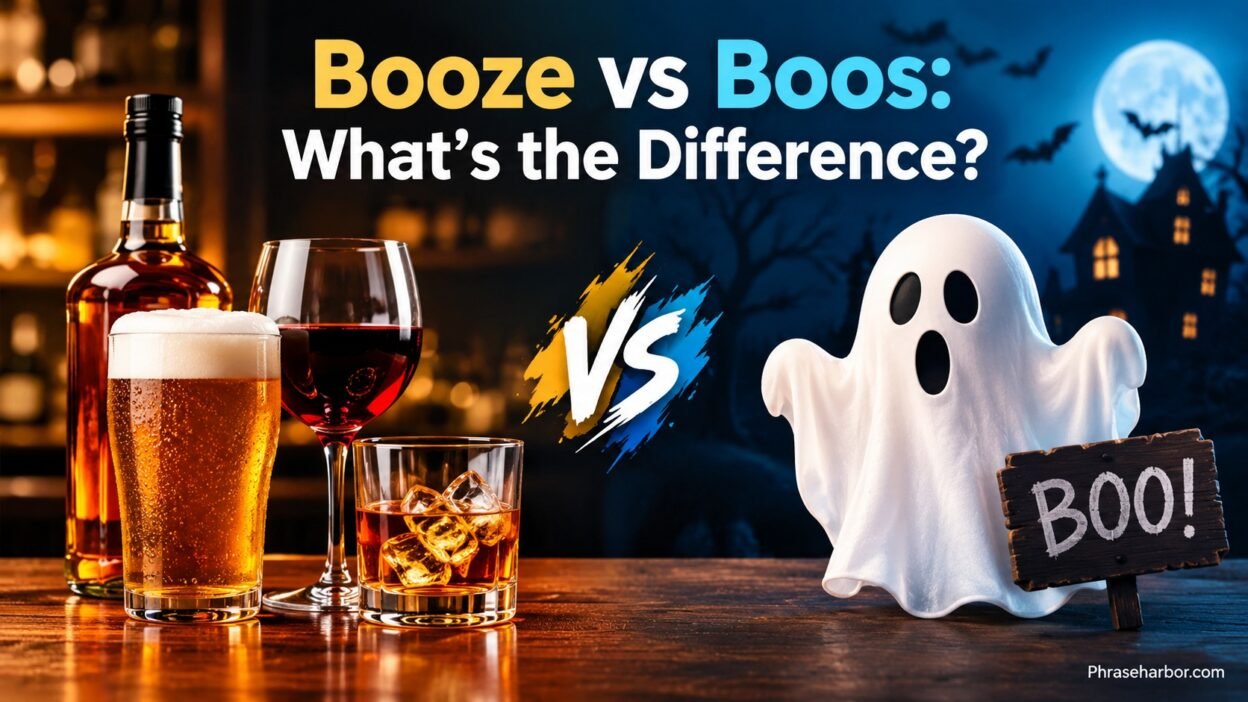
Booze vs Boos can confuse English learners because these homophones sound almost identical but have completely different meanings. In writing, casual conversation, social posts, messages, captions, blogs, and parties, this difference matters.
Booze is a slang term for alcohol, an alcoholic beverage, or drinks, while boos is the plural form of boo, showing disapproval and contempt. From my experience explaining English, I’ve seen native speakers, fluent speakers, and advanced speakers make this common mistake because the words sound similar when spoken aloud.
A tiny spelling change can completely change the meaning of a sentence, shift the entire tone, and leave an expression awkward, incorrect, or misunderstood. To avoid mixing up the words, actively think about the context, usage, nuances, and tone before you use them.
Quick Answer
The simplest way to remember booze vs boos is this:
- Booze means alcohol or alcoholic drinks. It can also be used as a verb meaning to drink alcohol.
- Boos means sounds or expressions of disapproval. It is also the third-person singular form of the verb boo.
- Booze and boos are homophones because they have the same pronunciation but different spellings and meanings.
- Use booze when the context involves drinking or alcohol.
- Use boos when the context involves criticism, rejection, or audience disapproval.
| Word | Meaning | Common grammatical use | Example |
| Booze | Alcohol or alcoholic drinks | Noun and verb | They brought some booze to the party. |
| Boos | Sounds of disapproval | Plural noun or verb | The player heard boos from the crowd. |
A quick substitution test can help. If you can replace the word with alcohol, use booze. If you can replace it with jeers or sounds of disapproval, use boos.
Comparison Overview
The difference between booze and boos becomes much clearer when you compare their meanings side by side.
| Feature | Booze | Boos |
| Basic meaning | Alcohol or alcoholic drinks | Expressions of disapproval |
| Pronunciation | /buːz/ | /buːz/ |
| Sound | Same as “boos” | Same as “booze” |
| Word type | Noun and verb | Plural noun and verb form |
| Register | Informal | Generally neutral |
| Singular form | Booze | Boo |
| Related verb | Booze | Boo |
| Example | We bought some booze. | The crowd gave boos. |
| Memory clue | Something people drink | Something people hear |
The spelling difference is small, but the meaning difference is substantial.
Consider these two sentences:
They bought some booze for the party.
Here, booze means alcoholic drinks.
They heard boos from the crowd.
Here, boos means sounds of disapproval.
The pronunciation doesn’t tell you which word the speaker means. Context does the work.
Main Differences Between Booze vs Boos
Although booze and boos sound identical, several important differences separate them.
Booze Means Alcohol
Booze is an informal word for alcoholic drinks. It can refer broadly to beer, wine, spirits, cocktails, or other alcoholic beverages.
For example:
- We need to buy some booze for the party.
- The restaurant doesn’t allow customers to bring their own booze.
- They had plenty of booze left after the celebration.
- He decided to avoid booze for a few weeks.
The word doesn’t normally identify one particular type of alcoholic drink. Its meaning is broad and informal.
If a sentence talks about something people drink for its alcohol content, booze may fit.
Booze Can Also Be a Verb
The word booze doesn’t only function as a noun. It can also work as an informal verb.
As a verb, to booze means to drink alcohol, often suggesting drinking socially or heavily depending on the context.
For example:
- They went out to booze after work.
- He used to booze every weekend.
- She doesn’t booze anymore.
- The group spent the evening boozing at a bar.
This verbal use is informal. In formal writing, drink alcohol is usually clearer and more neutral.
Boos Mean Expressions of Disapproval
Boos is the plural of boo when boo means a vocal expression of disapproval.
People may boo someone or something they dislike, disagree with, or consider disappointing. The sound can occur at sporting events, concerts, political events, theaters, public gatherings, and other situations involving an audience.
For example:
- The referee received boos from the fans.
- The actor walked offstage to a mixture of applause and boos.
- Loud boos filled the stadium.
- The decision was met with boos from the audience.
Here, boos has nothing to do with alcohol.
Boos Can Also Function as a Verb
There’s another grammatical detail worth knowing. Boos can be a verb.
It is the third-person singular present form of boo.
Compare:
- I boo the referee.
- You boo the referee.
- They boo the referee.
- He boos the referee.
- She boos the referee.
In this construction, boos describes an action rather than a sound treated as a noun.
For example:
The fan boos whenever the referee makes a bad call.
Here, boos is a verb.
Compare that with:
The fan’s boos echoed around the stadium.
In this sentence, boos is a plural noun.
That small grammatical distinction can matter when you’re trying to understand how the word functions in a sentence.
Why Do Booze and Boos Sound the Same?
The main reason booze vs boos causes confusion is pronunciation.
Both words are normally pronounced /buːz/. The vowel sound is the long “oo” sound found in words such as food and moon. Both words also end with the same /z/ sound.
That makes them homophones.
What Are Homophones?
Homophones are words that sound alike but have different spellings and meanings.
English has many examples:
- to / too / two
- there / their / they’re
- right / write
- see / sea
- flower / flour
- brake / break
- booze / boos
Homophones create a special problem for writers because pronunciation cannot always reveal spelling.
If someone says:
“There were boos from the audience.”
You know what the word means from the surrounding sentence. However, if someone simply says “booze,” you need context to determine whether they’re discussing alcohol or audience reaction.
Why the Endings Look Different
The words have different spellings because they developed as separate words with separate meanings.
- booze ends in -ze
- boos ends in -s
Yet both endings produce the same final /z/ sound in these words.
This is a good reminder that English spelling doesn’t always map neatly onto pronunciation. Several different spellings can represent the same sound.
What Does Booze Mean?
The word booze has a long history in informal English and is now widely recognized as a casual term for alcohol.
Booze as a Noun
When used as a noun, booze generally refers to alcoholic drinks.
Examples include:
- The store sells booze until late in the evening.
- They brought their own booze to the gathering.
- There was too much booze left over after the event.
- He doesn’t keep booze in the house.
In everyday conversation, booze often sounds more casual than alcohol.
Compare:
The restaurant serves alcohol.
with:
The restaurant serves booze.
The first sounds neutral and suitable for many formal contexts. The second sounds conversational and informal.
Is Booze a Countable Noun?
In its common meaning of alcohol, booze is generally used as a mass noun.
That’s why these constructions sound natural:
- some booze
- a lot of booze
- too much booze
- plenty of booze
- a bottle of booze
You wouldn’t normally say “three boozes” when simply referring to three alcoholic drinks.
If you want to count individual drinks, use a specific noun:
- three beers
- two bottles of wine
- four cocktails
- several drinks
There are less common uses of booze that can behave differently, but everyday writers usually don’t need them.
Booze as a Verb
As a verb, booze means to drink alcohol.
Its tone remains informal.
For example:
They spent the weekend boozing with friends.
The word boozing can sometimes suggest heavy or excessive drinking. However, the exact strength of that suggestion depends on context.
A more neutral sentence would be:
They spent the weekend drinking with friends.
That distinction matters when choosing vocabulary for professional or formal writing.
What Does Boos Mean?
Boos comes from the word boo, which represents a vocal expression of disapproval.
Imagine an audience watching a performance. If people dislike what they see, they might shout “boo!” The collective sounds are boos.
Boos as a Plural Noun
When boos functions as a noun, it describes those sounds or expressions.
For example:
- The referee heard boos from the stands.
- The politician faced boos during the speech.
- The singer was surprised by the boos.
- The actor ignored the boos and continued performing.
The word frequently appears in descriptions of public reactions.
Boos in Sports
Sports provide one of the clearest contexts for boos.
Fans might boo:
- a referee’s decision
- an opposing player
- their own team’s performance
- a controversial ruling
- a substitution
- a poor performance
For example:
The home team’s manager was greeted with boos after the loss.
Here, the word describes the audience’s negative reaction.
Boos in Entertainment
The same idea applies to theater, concerts, comedy shows, movies, and other performances.
An audience might respond with applause when it likes something. It might respond with boos when it strongly dislikes something.
That gives you a useful contrast:
| Positive reaction | Negative reaction |
| Applause | Boos |
| Cheers | Jeers |
| Praise | Disapproval |
The precise reaction depends on the situation, but boos specifically refers to the vocal expression of disapproval.
Booze vs Boos in Real Sentence Examples
Seeing the words in context is one of the fastest ways to understand the difference.
Examples With Booze
Here are several natural examples:
- They bought some booze before the party.
- The hotel doesn’t allow guests to bring their own booze.
- He gave up booze last year.
- There wasn’t enough booze for everyone at the event.
- They spent the evening boozing with friends.
In each sentence, the context involves alcohol or drinking.
Examples With Boos
Now compare them with these examples:
- The referee was met with boos from the crowd.
- The singer heard boos after the performance.
- The fans responded with loud boos.
- The politician faced boos during the speech.
- He boos whenever the opposing team scores.
None of these sentences involves alcohol. The context concerns disapproval.
Examples Using Both Words
The difference becomes especially memorable when both words appear together.
The bar had plenty of booze while the losing team heard boos from the fans.
Another example:
There was plenty of booze at the celebration, but no reason for boos.
And another:
The players celebrated with their teammates while the opposing fans responded with boos.
These examples show why spelling matters. Changing one letter can completely alter the meaning.
Booze vs Boos: Common Mistakes
Because both words sound identical, writers often choose the wrong spelling when they rely on sound alone.
Mistake: Using Booze for Disapproval
Incorrect:
The crowd gave booze to the referee.
That sentence suggests the crowd gave alcohol to the referee.
Correct:
The crowd gave boos to the referee.
Now the sentence clearly describes vocal disapproval.
Mistake: Using Boos for Alcohol
Incorrect:
They brought some boos to the party.
That spelling refers to expressions of disapproval.
Correct:
They brought some booze to the party.
Now the sentence refers to alcoholic drinks.
Mistake: Assuming Spell-Check Will Catch It
This is one of the most important practical points.
A spelling checker may not flag either booze or boos because both are legitimate English words.
Consider:
They bought some boos for the party.
Every word is spelled correctly. The sentence is still wrong if the intended meaning is alcoholic drinks.
This is a word-choice error, not a spelling error.
That means context and proofreading matter more than spell-check alone.
Read More: Having vs. Having Had: Which Is Correct? Meaning, and Examples
How to Remember the Difference Between Booze and Boos
A simple memory trick can prevent most mistakes.
Booze Is Something You Drink
Think:
Booze = alcohol.
If the sentence involves drinking, bars, alcoholic beverages, beer, wine, spirits, or cocktails, booze is probably the word you need.
For example:
We need some booze for the party.
Boos Are Something You Hear
Think:
Boos = disapproval.
If the sentence involves a crowd, audience, fans, criticism, a referee, a performance, or public rejection, boos is probably correct.
For example:
The referee heard boos from the stands.
Use the Substitution Test
When you’re unsure, replace the word mentally.
If alcohol works:
They bought some alcohol for the party.
Then booze works:
They bought some booze for the party.
If jeers works:
The player heard jeers from the crowd.
Then boos works:
The player heard boos from the crowd.
This technique works because it focuses on meaning rather than sound.
Booze vs Boos: Grammar and Usage
Understanding the grammar behind each word makes the distinction even easier.
Booze Can Be a Noun or Verb
As a noun:
Booze was available at the event.
As a verb:
They boozed all night.
As a present participle:
They were boozing with friends.
The noun is generally informal. The verb is also informal.
Boos Can Be a Noun or Verb Form
As a plural noun:
The crowd’s boos were loud.
As a verb:
The crowd boos the referee.
The distinction comes from how the word functions in the sentence.
| Sentence | Function of the word |
| The crowd’s boos were loud. | Plural noun |
| The crowd boos the referee. | Verb |
| They bought some booze. | Noun |
| They booze on weekends. | Verb |
This is one reason grammar can help solve homophone problems. Look at what the word is doing in the sentence.
FAQs:
What does booze mean?
Booze is an informal word for alcohol or an alcoholic drink. It’s commonly used in casual conversations and social settings.
What does boos mean?
Boos is the plural of boo. It describes sounds or expressions of disapproval made by people, often during a performance, sports event, or public speech.
Are booze and boos homophones?
Yes. Booze and boos sound very similar when spoken, but they have different spellings, meanings, and uses.
How can I remember the difference between booze and boos?
Think of booze as something people drink, while boos are sounds people make when they show disapproval. This simple memory trick can help you avoid mistakes.
Which is correct: booze or boos?
Both are correct, but the right choice depends on your meaning. Use booze for alcohol and boos for expressions of disapproval.
Conclusion:
Understanding booze vs boos becomes easier when you focus on their meanings and context. Booze refers to alcohol, while boos refers to expressions of disapproval. Although they sound similar, their uses are completely different. By checking the spelling and meaning before writing, you can use both words correctly and avoid confusing your readers.