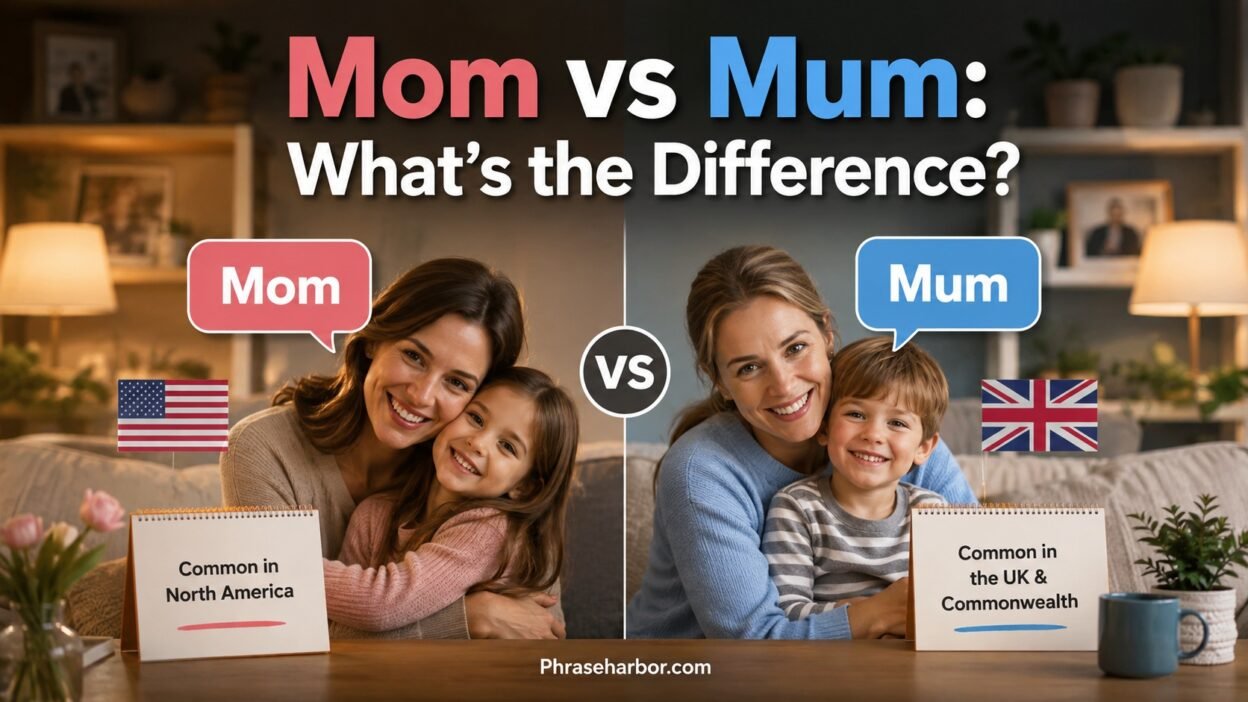
If you’ve ever wondered whether mom and mum mean different things, the short answer is simple: they usually mean exactly the same thing mother. The difference comes mainly from regional English usage.
American English generally uses mom, while British English typically uses mum. You’ll also find mom in Canadian English and mum in Australian and New Zealand English. Other regional forms, such as mam, appear in parts of Britain and Ireland.
The difference becomes more interesting when you look at pronunciation, capitalization, related words such as mommy and mummy, plural forms, and how each word works in a sentence.
Quick Answer
Mom and mum are informal words for mother. The main difference is the variety of English in which each word is commonly used.
- Mom is the usual informal term in American English.
- Mum is the usual informal term in British English.
- Mom is also widely used in Canadian English.
- Mum is widely used in Australian and New Zealand English.
- Both words have the same basic meaning when they refer to a mother.
- Neither spelling is universally “more correct.”
- Mother is the more formal and neutral term.
- Mommy and mummy are related forms that generally have a more child-oriented tone.
For example:
American English: “My mom is coming over tonight.”
British English: “My mum is coming over tonight.”
The meaning doesn’t change. Only the regional form does.
Comparison Overview
| Feature | Mom | Mum |
| Basic meaning | Mother | Mother |
| Main variety | American English | British English |
| Also common in | Canada | Australia, New Zealand |
| Register | Informal | Informal |
| Plural | Moms | Mums |
| Possessive | Mom’s | Mum’s |
| Related child form | Mommy | Mummy |
| Typical pronunciation | /mɑm/ | /mʌm/ |
| Formal equivalent | Mother | Mother |
| Direct address | “Thanks, Mom.” | “Thanks, Mum.” |
The important point is that mom vs mum is primarily a regional spelling and pronunciation difference, not a difference in the person being described.
Main Differences Between Mom and Mum
Although the two words share the same basic meaning, several details distinguish their use.
1. Regional English
The clearest difference is geography.
Mom is strongly associated with American English. If someone writes, “My mom works at a hospital,” readers will generally recognize the sentence as American English.
Mum, meanwhile, is the normal form in British English. A British speaker would typically say, “My mum works at a hospital.”
This distinction is similar to other regional differences in English:
- apartment vs flat
- elevator vs lift
- vacation vs holiday
- truck vs lorry
- color vs colour
- mom vs mum
The words aren’t necessarily competing definitions. They’re often different regional choices for the same concept.
2. Pronunciation
The spelling difference also reflects a difference in the usual pronunciation.
Cambridge Dictionary gives the US pronunciation of mom as /mɑm/ and the UK pronunciation of mum as /mʌm/.
The vowel is the key difference.
For many American speakers, mom contains the vowel sound found in words such as hot or father, depending on the speaker’s dialect.
In British English, mum generally uses the STRUT vowel, the same broad vowel heard in words such as cup and luck.
Regional accents can change exactly how these sounds are realized. English pronunciation isn’t a single fixed system, so dictionary transcriptions describe standard varieties rather than every local accent.
3. Spelling
The spelling is straightforward:
- Mom → American English
- Mum → British English
The difference isn’t created by adding or removing a letter according to a general spelling rule. These are established regional forms that developed as part of different English varieties.
That’s why changing mum to mom isn’t simply correcting a spelling mistake. You may actually be changing the variety of English.
4. Related forms
The same regional distinction appears in related words.
American English commonly uses:
- mom
- mommy
British English commonly uses:
- mum
- mummy
For example:
“My mom picked me up from school.”
“My mum picked me up from school.”
For younger children, you might hear:
“Mommy, can you help me?”
or:
“Mummy, can you help me?”
These forms can carry differences in age, familiarity, or tone depending on the speaker and context.
5. Formality
Neither mom nor mum is normally the formal word for a mother.
The neutral formal term is mother.
Compare:
- Informal: “My mom called me.”
- Informal: “My mum called me.”
- More formal or neutral: “My mother called me.”
That doesn’t mean mom or mum sounds inappropriate. These words are completely natural in personal conversations, interviews, biographies, stories, journalism, and many other contexts.
The choice depends on the relationship and the tone of the writing.
What Does “Mom” Mean?
Mom is an informal American English word meaning mother.
It can refer to a person’s mother when speaking about her:
“My mom lives in Chicago.”
It can also work as a direct form of address:
“Mom, can you help me?”
The capitalization changes because the grammatical role changes.
In the first example, mom functions as a common noun after the possessive determiner my. In the second, Mom functions more like a personal name.
Examples of “Mom”
Here are some natural examples:
- “My mom makes the best pancakes.”
- “I called my mom after work.”
- “Mom, where are my keys?”
- “Her mom drove her to school.”
- “I bought flowers for Mom.”
The word is especially characteristic of American everyday speech.
What Does “Mum” Mean?
Mum is the common informal British English word for mother.
For example:
“My mum lives in Manchester.”
You might also hear:
“Mum, can you pass me the salt?”
Like mom, mum can function as both a noun referring to someone’s mother and a direct form of address.
Examples of “Mum”
Common examples include:
- “My mum works nearby.”
- “I called my mum this morning.”
- “Mum, I’m home!”
- “Her mum made dinner.”
- “I bought something for Mum.”
These sentences sound natural in British English.
Where Is “Mom” Used?
United States
The United States is the clearest home of mom.
American dictionaries and style guides commonly use mom as the informal term for mother. It appears throughout everyday speech and writing.
You’ll encounter it in:
- Family conversations
- Children’s books
- Newspapers
- Advertising
- Personal correspondence
- Fiction and dialogue
- Social media
- Informal professional communication
If you’re writing specifically for an American audience, mom is normally the natural choice.
Canada
Mom is also widely used in Canadian English.
Canada has its own English conventions and regional vocabulary. It shouldn’t simply be treated as identical to American English. However, mom is an established Canadian form.
This means a Canadian writer using mom isn’t necessarily following American English.
Regional variation
Language doesn’t stop at national borders.
Some speakers use regional forms that don’t fit neatly into a simple mom = America / mum = Britain formula. That’s particularly important when discussing British and Irish English.
For example, mam is used in several regional varieties.
The practical lesson is simple: national labels describe broad patterns, not every speaker’s vocabulary.
Where Is “Mum” Used?
United Kingdom
Mum is the standard informal British term for mother.
You’ll hear it throughout the UK, although regional vocabulary can vary.
Examples include:
“I’ll ask my mum.”
“Mum’s making dinner.”
“I need to call my mum.”
British English therefore uses mum in situations where American English would normally use mom.
Australia
Australian English commonly uses mum.
An Australian speaker might naturally say:
“My mum is picking me up.”
The word fits Australian English even though Australian English has many vocabulary and pronunciation features of its own.
New Zealand
Mum is also widely used in New Zealand English.
As with Australia, this doesn’t mean New Zealand English is simply British English transplanted to another country. It has developed its own linguistic characteristics while retaining many forms associated with British English.
Mom vs Mum in Sentences
Putting the words side by side makes the distinction easier to see.
| American English | British English |
| My mom is a doctor. | My mum is a doctor. |
| I called my mom. | I called my mum. |
| Mom, can you help me? | Mum, can you help me? |
| My friend’s mom is here. | My friend’s mum is here. |
| I bought this for Mom. | I bought this for Mum. |
Notice something important: the grammar doesn’t fundamentally change.
The noun changes from mom to mum, while the rest of the sentence can remain identical.
Should “Mom” and “Mum” Be Capitalized?
Capitalization depends on how the word functions in the sentence, not simply on whether you’re using American or British English.
Capitalize “Mom” or “Mum” as a Name
When the word directly addresses the person or effectively substitutes for their name, capitalization is standard:
- “Thanks, Mom.”
- “Mom, can I borrow your car?”
- “I’ll ask Mum.”
- “Mum, look at this!”
Think of it as a naming function.
You could replace Mom with a person’s actual name:
“Thanks, Sarah.”
The same principle helps explain:
“Thanks, Mom.”
Use Lowercase After “My,” “Her,” or “His”
When the word functions as an ordinary noun, lowercase is normally appropriate:
- “My mom is visiting.”
- “Her mum lives nearby.”
- “His mom called.”
- “I spoke to his mum.”
Compare:
“I asked Mom.”
with:
“I asked my mom.”
The first uses Mom as a name-like form. The second treats mom as a common noun.
Mom vs Mum: Mommy, Mummy, Mama, and Mam
The vocabulary surrounding mothers goes beyond these two words.
Mommy vs Mummy
Mommy is strongly associated with American English, while mummy is the usual British counterpart.
For example:
- American English: “Mommy, I’m tired.”
- British English: “Mummy, I’m tired.”
These forms often occur in speech directed by or toward young children.
However, adults can use them too. Their tone depends on context, relationship, age, and region.
Mama
Mama is much broader geographically.
It appears in different English-speaking communities and can have different cultural associations. It isn’t simply an interchangeable replacement for mom or mum in every context.
Depending on the speaker, mama can sound affectionate, traditional, regional, or childlike.
Mam
Mam is another regional form.
It appears particularly in parts of Britain and Ireland. In some communities, it is a normal everyday word rather than an unusual alternative.
This is one reason it’s misleading to describe all British English as using only mum.
Read More: Dammit vs Damnit: Which Spelling Is Correct?
Mom vs Mum: Grammar and Plural Forms
Both words function primarily as nouns when they mean mother.
Their plural forms are also predictable:
- mom → moms
- mum → mums
Examples:
“The school invited all the moms.”
“The school invited all the mums.”
Possessives work in the same basic way:
- mom’s
- mum’s
For example:
“That’s my mom’s car.”
“That’s my mum’s car.”
The apostrophe indicates possession in both varieties.
A Useful Point About the Word “Mum”
There’s an important complication with mum.
The word doesn’t always mean mother.
In English, mum can also appear in expressions such as “keep mum,” meaning to remain silent or not reveal information.
For example:
“He kept mum about the surprise.”
Mum can also refer to a chrysanthemum, particularly in American English.
So context matters.
If someone writes:
“My mum is at home.”
the intended meaning is obvious.
But:
“Keep mum.”
has nothing to do with someone’s mother.
Is “Mom” or “Mum” More Correct?
Neither one is universally more correct.
Correctness depends on the variety of English you’re using.
If you’re writing American English, mom is normally the appropriate choice.
If you’re writing British English, mum is normally the appropriate choice.
The same principle applies to many regional English differences. A British writer doesn’t need to change colour to color simply because one spelling appears more often online. Likewise, an American writer doesn’t need to replace mom with mum.
A Simple Rule
Use this as your default:
| Your audience | Preferred word |
| American | Mom |
| Canadian | Mom is widely used |
| British | Mum |
| Australian | Mum |
| New Zealand | Mum |
| Other regions | Check local usage |
Regional variation means this table is a practical guide rather than an absolute linguistic law.
Which One Should You Use in Writing?
Writing for an American Audience
Choose mom when you’re writing for readers who expect American English.
For example:
“Five Things Every Mom Should Know About Child Safety”
Using mum in an otherwise American article could look like an accidental switch in regional style.
Writing for a British Audience
Use mum for a British audience.
If the rest of your article uses British conventions such as colour, favourite, and centre, switching suddenly to mom can make the writing feel inconsistent.
Writing for an International Audience
When your audience spans several English-speaking countries, choose a consistent editorial approach.
If you’re specifically comparing the words, of course, use both:
Mom vs Mum: What’s the Difference?
If you’re writing a general article for an international audience, identify your chosen English variety and maintain it throughout.
Consistency matters more than pretending one form works everywhere.
FAQs:
Is “mum” British and “mom” American?
Broadly, yes. Mum is the usual informal British English form, while mom is the usual American English form.
However, Canadian English commonly uses mom, while Australian and New Zealand English commonly use mum. Regional forms such as mam also exist.
Do “mom” and “mum” mean the same thing?
Yes. When they refer to a parent, both mom and mum mean mother.
The main difference is regional usage.
Is “mum” correct in American English?
Mum exists in American English with other meanings. For example, American dictionaries recognize mum in expressions involving silence and as a shortened form of chrysanthemum.
But when an American speaker means mother, mom is normally the expected informal form.
Is “mom” correct in British English?
Mom exists in English and is widely recognized, but mum is the normal informal term for mother in standard British English.
A British speaker might use mom for regional, personal, historical, or character-specific reasons.
Are “mom” and “mum” pronounced differently?
Usually, yes.
Cambridge gives:
- mom: /mɑm/ in US English
- mum: /mʌm/ in UK English
Individual accents can produce further differences.
Conclusion:
The difference between mom vs mum is much simpler than it may first appear. Mom is the standard informal term for mother in American English and is also widely used in Canadian English. Mum is the standard informal term in British English and is widely used in Australian and New Zealand English.