If you’ve ever typed “dammit” and wondered whether it should actually be “damnit,” you’re not alone. The two spellings look almost identical, sound virtually the same, and appear in casual conversations, books, social media, and online writing.
The confusion becomes even greater because English has another form: “damn it.” That version keeps the original two-word structure, while dammit has developed into a single word.
So, which spelling should you use?
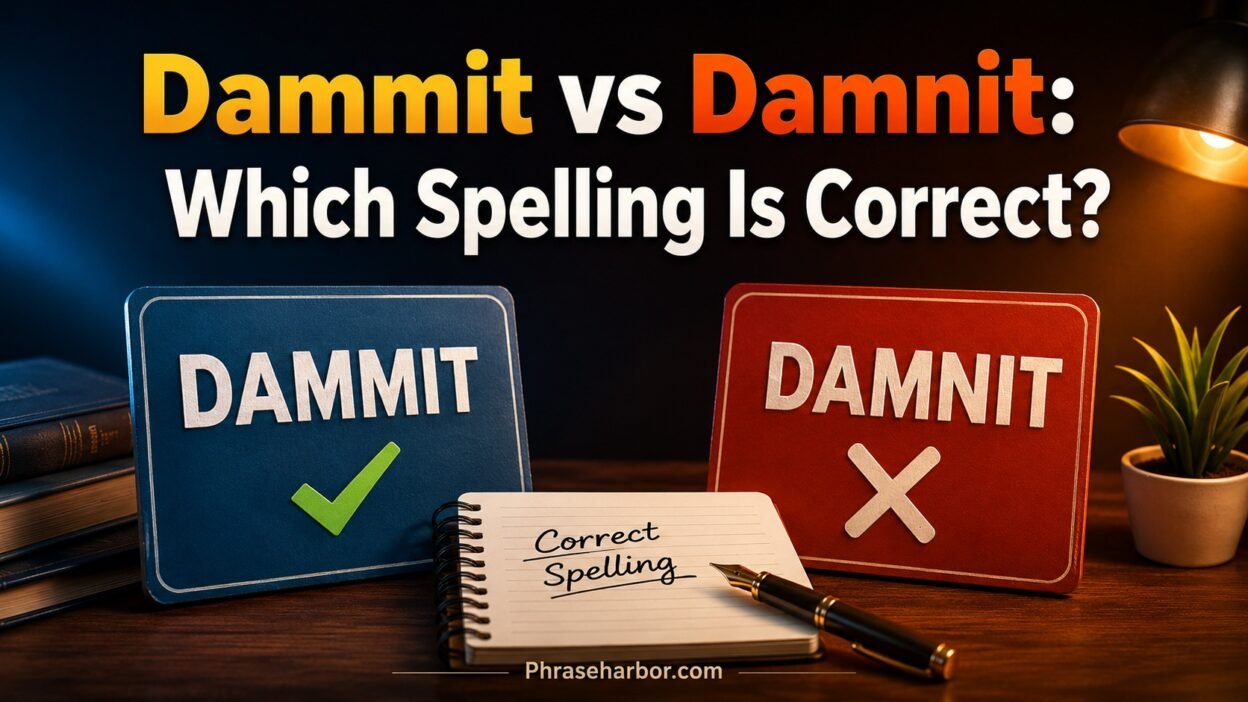
The safest answer is dammit when you want the established one-word spelling. Damn it is also correct as a two-word expression. Damnit is more complicated: some dictionaries recognize it as a variant, while other references classify it as nonstandard.
Quick Answer
Dammit is the best default spelling when you want the established one-word form.
However, the three forms have slightly different spelling conventions:
| Spelling | Status | Meaning | Best use |
| dammit | Established one-word form | Expresses anger, frustration, annoyance, or emphasis | Best default |
| damn it | Two-word expression | Same basic meaning | Correct when written as separate words |
| damnit | Variant or nonstandard form, depending on the reference | Same basic meaning | Mainly informal or context-specific writing |
Cambridge Dictionary lists damnit as a variant of dammit, while other references, including Wiktionary, describe damnit as a nonstandard contraction.
Therefore, if you’re writing an article, email, story, or other piece of edited English and simply want the safest choice, use dammit.
If you prefer the original phrase, damn it works too.
The simplest rule
Use “dammit” as the standard one-word spelling, “damn it” as the two-word form, and treat “damnit” as a variant rather than the default.
Comparison Overview
The difference between dammit vs damnit isn’t really a difference in meaning. Both spellings represent the same basic exclamation.
The real issue is standard spelling, dictionary treatment, and context.
| Feature | Dammit | Damnit | Damn it |
| Number of words | One | One | Two |
| Basic meaning | Frustration, anger, annoyance, emphasis | Same | Same |
| Common in informal English | Yes | Yes, but less standard | Yes |
| Established dictionary entry | Yes | Recognized as a variant by some references | Yes, as separate words |
| Safest choice in edited writing | Yes | Usually no | Yes |
| Formal expression | No | No | No |
| Derived from | Damn it | Damn it | Original phrase |
The important point is that spelling preference doesn’t necessarily determine whether people understand the expression. A reader will almost certainly understand damnit. The question is whether it is the spelling you want in polished writing.
For most situations, dammit wins.
Main Differences Between Dammit vs Damnit
The main difference between dammit vs damnit is their status in standard written English.
Dammit
Dammit is an established one-word spelling of the expression damn it. It functions as an interjection and is commonly used to express frustration, anger, irritation, disappointment, or strong emphasis.
For example:
Dammit, I forgot my wallet.
Here, dammit communicates frustration about making a mistake.
It can also appear at the end of a sentence:
I told you this would happen, dammit.
The word doesn’t change the basic grammatical meaning of the sentence. Instead, it adds emotional force.
Damnit
Damnit represents the same basic expression, but its status is less straightforward.
Some dictionaries recognize it as a variant. Cambridge Dictionary, for example, lists damnit as a variant of dammit. Other references describe it as nonstandard.
That makes an important distinction:
“Nonstandard” doesn’t necessarily mean “imaginary.”
English contains thousands of forms that appear regularly in real-world speech and writing without becoming the preferred spelling in edited standard English.
So while you may encounter damnit frequently, dammit remains the safer choice when you’re deciding which spelling to use yourself.
Damn it
Damn it preserves the original two-word construction.
Compare:
Damn it, I forgot my keys.
with:
Dammit, I forgot my keys.
The meaning is essentially the same. The difference comes from how the expression is written.
The two-word version can sometimes feel slightly more deliberate because it visibly retains damn and it as separate words.
What Does Dammit Mean?
Dammit is an informal exclamation used to communicate a strong emotional reaction.
Its exact emotional force depends on context.
It can express:
- Frustration
- Anger
- Irritation
- Disappointment
- Impatience
- Surprise
- Emphasis
- Exasperation
Consider these examples:
Dammit! I missed the bus.
This expresses frustration.
Dammit, that’s exactly what I warned you about.
This communicates frustration and emphasis.
Finish the job, dammit.
Here, the word intensifies the speaker’s command.
That last example shows why dammit doesn’t always simply mean “I’m angry.” It can strengthen an existing statement.
Is dammit a swear word?
Dammit is an informal expletive derived from “damn it.”
It is generally milder than many stronger English swear words, but it is still not appropriate for every audience or situation.
Whether it sounds offensive depends on several factors:
- Who is speaking
- Who is listening
- The setting
- The speaker’s tone
- The culture or community
- The purpose of the writing
For example, dammit may sound completely ordinary in fictional dialogue between adults. The same word could look unprofessional in a formal business letter.
The dictionary label matters here. Cambridge describes dammit as a very informal exclamation.
Why Is It Spelled “Dammit”?
The answer becomes clearer when you look at the phrase’s origin.
Dammit comes from “damn it.”
Over time, speakers began treating the frequently used expression as a single spoken unit. English often develops contractions and fixed forms in precisely this way.
The basic progression can be understood as:
damn it → frequently spoken together → dammit
This doesn’t mean every possible spelling based on pronunciation becomes standard. English spelling depends heavily on convention and historical usage.
That’s why dammit became established while damnit remained less standardized.
Why does dammit have two m’s?
This is one of the most common questions about the spelling.
The word combines the ending of damn with it, producing the established spelling dammit.
The double m isn’t a general English rule that automatically applies whenever two words merge. It’s simply part of the conventional spelling that developed for this particular word.
That’s an important distinction because English spelling contains many historical forms that don’t follow a simple sound-to-letter formula.
Is Damnit a Word?
This question deserves a more careful answer than a simple yes or no.
Damnit appears in actual English usage and is recognized by some reference works as a variant of dammit.
Cambridge Dictionary lists damnit as a variant. Wiktionary, meanwhile, describes it as a nonstandard contraction and notes its association with Southern U.S. English.
So there are two separate questions:
- Does “damnit” occur as an English form?
- Is “damnit” the preferred standard spelling?
The answer to the first is yes.
The answer to the second is generally no.
That distinction is useful whenever you’re discussing English vocabulary. A word can exist in real usage without being the preferred form in formal or edited English.
Why do people spell it “damnit”?
The spelling makes sense phonetically.
When people pronounce dammit, the word can sound as though it contains an n before the final syllable because the source word is damn.
Someone who has heard the expression but rarely seen it written might naturally spell it damnit.
That’s one reason the variant continues to appear.
Dammit vs Damnit vs Damn It: What’s the Difference?
Although these forms overlap in meaning, they aren’t identical in spelling status.
Dammit
Dammit is the strongest choice when you need a single word.
Example:
Dammit, I left my phone in the car.
It is established, recognizable, and widely understood.
Damnit
Damnit is a variant spelling.
Example:
Damnit, I left my phone in the car.
The meaning remains clear. However, an editor may change it to dammit because dammit is the more established spelling.
Damn it
Damn it consists of two separate words.
Example:
Damn it, I left my phone in the car.
This form is not a misspelling of dammit. It is the original two-word expression.
The practical distinction
Think of the three forms this way:
damn it = two words
dammit = established one-word form
damnit = variant or nonstandard one-word form
That framework makes the choice much easier.
How to Use “Dammit” in a Sentence
The position of dammit can change the rhythm and emotional impact of a sentence.
At the beginning
Dammit, I forgot to lock the door.
This immediately establishes frustration.
As a standalone exclamation
Dammit!
Here, the word functions independently as an emotional outburst.
At the end
I knew I should have checked the weather, dammit.
Putting it at the end can make the sentence sound more forceful or emotionally charged.
In dialogue
“Dammit, Sarah. You can’t keep doing this.”
This is common in fiction because dialogue often needs to convey emotion quickly.
For emphasis
“You have to finish this today, dammit.”
The word reinforces the speaker’s determination.
When Should You Use “Damn It” Instead?
There isn’t a rule saying that dammit must always replace damn it.
Sometimes the two-word form fits the sentence better.
Consider:
Damn it, I knew this would happen.
The phrase clearly functions as an independent expression followed by a sentence.
You can also place it later in a sentence:
I don’t understand why you did that, damn it.
Because damn and it remain separate words, the construction retains a little more of its original grammatical structure.
Is “damn it” more formal than “dammit”?
Not really.
Both forms are informal expressions.
The fact that damn it contains two words doesn’t suddenly make the expression suitable for academic writing or formal business communication.
That’s an important distinction.
Word structure and language register are two different things.
When Is “Damnit” Appropriate?
If you’re writing your own polished content, dammit is generally the better choice.
Still, there are situations where damnit can make sense.
Informal personal writing
People often use nonstandard spellings in texts, social media posts, comments, and casual messages.
Fictional dialogue
If a character naturally uses damnit, changing it to dammit could remove part of the character’s voice.
Quoted material
When reproducing someone’s exact wording, preserving the original spelling can be important.
Regional or stylistic writing
A writer may deliberately use a variant spelling to reflect a particular speech pattern or community.
The key is intentionality.
If you use damnit because you deliberately want that form, that’s different from using it because you assumed it was the standard spelling.
Read More: Specter vs. Spectre: Which Spelling Is Correct?
Common Mistakes About Dammit and Damnit
Several popular explanations oversimplify the issue.
Mistake: “Damnit is always wrong.”
That’s too absolute.
Some dictionaries recognize damnit as a variant. Its classification isn’t identical across all reference sources.
A better statement is:
Damnit is a recognized variant in some references, but dammit is the safer standard spelling.
Mistake: “Dammit and damn it have different meanings.”
They don’t have substantially different meanings.
Both come from the same underlying expression and can communicate frustration, anger, annoyance, or emphasis.
The major difference is whether the expression appears as one word or two.
Mistake: “If it’s in a dictionary, it’s formal.”
Dictionary inclusion doesn’t mean a word works in every setting.
Dictionaries routinely label words as:
- Informal
- Very informal
- Slang
- Vulgar
- Archaic
- Regional
- Nonstandard
Dictionary recognition and formal acceptability are not the same thing.
Mistake: “Spellings should always match pronunciation.”
English doesn’t work that neatly.
Words often have conventional spellings that can’t be predicted perfectly from their pronunciation.
That’s especially true for words that developed through contractions, historical changes, and frequent spoken use.
Dammit vs Damnit in Professional Writing
Even if you choose the correct spelling, you should consider whether you should use the expression at all.
Dammit is informal.
That makes it a poor choice for many professional situations.
Usually avoid it in:
- Academic papers
- Formal reports
- Job applications
- Business proposals
- Customer communications
- Legal documents
- Professional presentations
- Formal correspondence
Instead of:
Dammit, we missed the deadline.
A professional report might say:
Unfortunately, we missed the deadline.
Or:
The deadline was missed because the final approval arrived late.
The second approach communicates the relevant information without adding an emotional outburst.
Where it can work
The situation changes in creative and informal writing.
For example:
“Dammit, I thought you were already gone.”
That sentence sounds natural in dialogue because the character’s emotional reaction matters.
The lesson isn’t “never use dammit.”
It’s use it where the voice and audience justify it.
Dammit vs Damnit: Real-World Usage Examples
The following examples show how context affects the best choice.
Casual conversation
“Dammit, I forgot my keys again.”
Why it works: The expression reflects immediate frustration.
Fiction
“Dammit, Jake. You knew the risks.”
Why it works: Strong emotional language can make dialogue sound more natural.
Personal message
“Dammit, I thought the appointment was tomorrow.”
Why it works: Informal communication allows greater flexibility.
Formal email
Instead of:
“Dammit, the shipment still hasn’t arrived.”
Use:
“Unfortunately, the shipment still hasn’t arrived.”
Why: The second version communicates the problem without unnecessary emotional language.
Academic writing
Instead of:
“Dammit, this creates a serious problem for the theory.”
Use:
“This creates a significant problem for the theory.”
Why: Academic prose normally avoids conversational expletives.
FAQs:
Is it “dammit” or “damnit”?
Dammit is the safest standard one-word spelling. Damnit also occurs in English and is listed as a variant by Cambridge Dictionary, although other references classify it as nonstandard.
Is “damnit” a real word?
Yes, damnit occurs in actual English usage. Its dictionary status varies. Cambridge lists it as a variant of dammit, while Wiktionary describes it as a nonstandard contraction.
Is “dammit” one word or two?
Dammit is one word.
The original expression damn it contains two words.
Is “damn it” correct?
Yes. Damn it is a valid two-word expression.
You don’t need to combine the words into dammit every time.
Is “damnit” a misspelling?
It can be treated as a nonstandard spelling, but calling it an outright misspelling in every context is too broad. Some dictionaries recognize it as a variant.
Conclusion:
When it comes to dammit vs damnit, dammit is the safest choice if you want the established one-word spelling. Damn it is also correct when you write the expression as two separate words. Damnit, meanwhile, appears in real-world English and is recognized as a variant by some dictionaries, but it isn’t the preferred standard form in most edited writing.