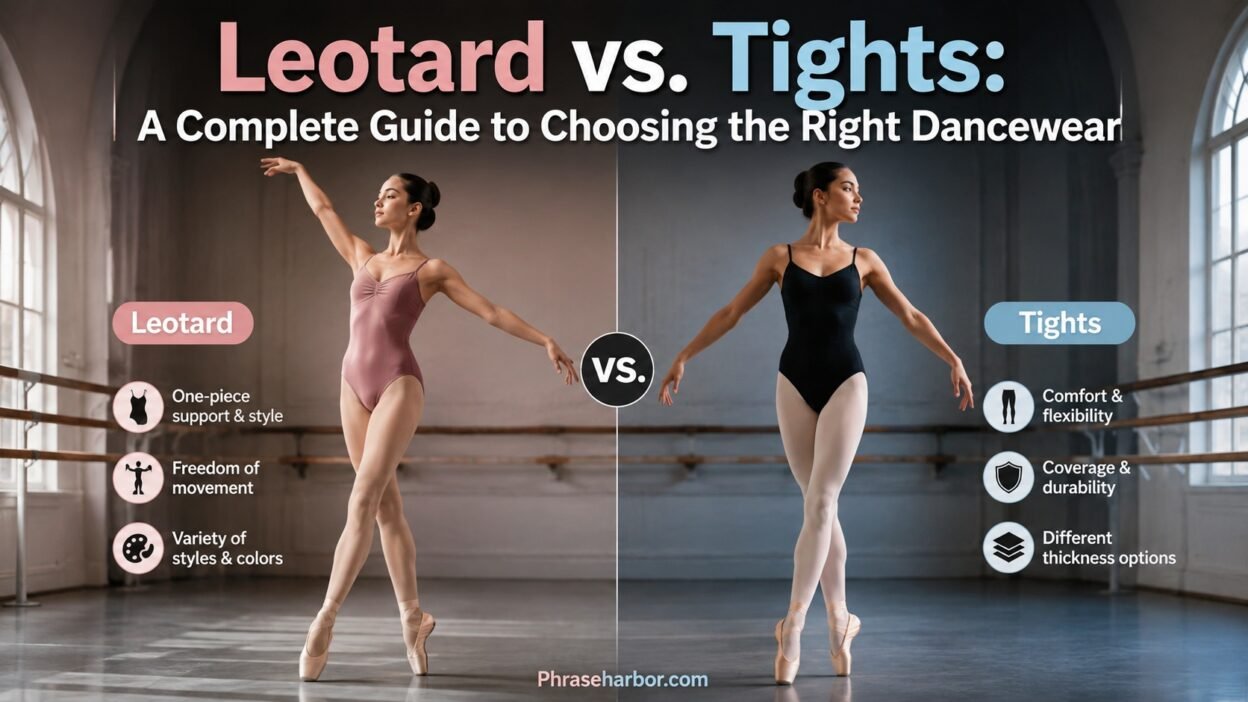
If you’re new to dance, gymnastics, ballet, or performance wear, leotards and tights can look like two versions of the same thing. They both fit closely to the body, use stretchy fabrics, and appear frequently in dance studios and performance settings. However, they serve different purposes.
A leotard covers the torso, while tights cover the legs. That’s the basic distinction, but the practical differences go much further. Their construction, fit, coverage, fabric, foot design, and role in different activities all affect which garment makes sense.
The confusion usually starts when the two are worn together. A dancer wearing a black leotard with pink tights may look as though they’re wearing one complete garment, but the outfit actually consists of two separate pieces. The leotard provides the body’s main garment while the tights extend coverage down the legs.
Quick Answer
The simplest answer to leotard vs. tights is this:
- A leotard is a one-piece garment that covers the torso and extends to the crotch.
- Tights are close-fitting legwear that covers some or all of the legs.
- A leotard normally leaves the legs exposed.
- Some tights cover the feet while others leave them exposed.
- Leotards and tights are often worn together, particularly in ballet and other dance classes.
Think of them as two different pieces of a puzzle. The leotard handles the torso. Tights handle the legs.
Comparison Overview
- Neither garment is automatically a substitute for the other.
- The correct choice depends on the activity, personal comfort, and dress code.
| Feature | Leotard | Tights |
| Main purpose | Covers the torso | Covers the legs |
| Construction | One-piece garment | Separate legwear |
| Torso coverage | Yes | No |
| Leg coverage | Minimal, around the crotch | Yes |
| Arm coverage | Depends on style | No |
| Foot coverage | No | Depends on style |
| Common in ballet | Yes | Yes |
| Common in gymnastics | Yes | Sometimes, depending on discipline and rules |
| Can be worn alone? | Often | Depends on the setting and style |
| Can be worn together? | Yes | Yes |
| Common materials | Nylon, spandex, cotton blends, performance fabrics | Nylon, spandex, microfiber and blends |
| Main fit concern | Torso length, straps, leg openings | Waist, hips, legs and feet |
| Typical role | Base garment | Leg coverage or additional layer |
The biggest point to remember is that leotards and tights aren’t competing garments in many dance environments. They’re often designed to work together.
Main Differences Between Leotard vs. Tights
The difference between a leotard and tights becomes much clearer when you compare their coverage, construction, purpose, fit, and use.
Coverage
Coverage is the easiest way to distinguish the two.
A leotard covers the torso. It usually starts around the shoulders and continues down to the crotch. The legs remain exposed from the leg openings downward.
Tights do almost the opposite. They cover the legs from the waist or hips toward the ankles or feet. Depending on the design, they can cover the entire foot, stop at the ankle, or leave an opening around the foot.
That creates several possible combinations:
- Leotard only = torso covered, legs exposed
- Tights only = legs covered, torso exposed
- Leotard + tights = torso and legs covered
- Leotard + tights + skirt = additional coverage and styling
This division of coverage explains why dancers commonly wear both.
Construction
A leotard is constructed as a single body garment. It resembles a swimsuit in its basic shape, although dance and performance leotards can have very different cuts, fabrics, sleeves, backs, and necklines.
Tights are constructed as legwear. They generally have two fitted leg sections connected at the waist or hips.
The construction affects how each garment behaves during movement.
A properly fitted leotard should stay close to the body while the dancer bends, jumps, stretches, turns, or moves across the floor. Tights need to remain smooth across the legs without excessive sagging or bunching.
Purpose
Leotards provide a stable base for movement and make the body’s position easier to observe.
That’s especially useful in ballet and other technical dance forms where instructors frequently assess:
- Posture
- Hip alignment
- Leg position
- Back position
- Knee alignment
- Core engagement
- Overall body placement
Tights serve a different role. They provide leg coverage, warmth, visual consistency, and sometimes foot coverage.
In performance settings, tights can also create a continuous visual line between the legs and feet. Footed ballet tights are particularly useful for this reason.
Fit
Leotard fit depends heavily on torso length.
A dancer can have the correct chest and hip measurements yet still find a leotard uncomfortable if the torso is too short. Excessive pulling around the shoulders or crotch can restrict movement and make the garment distracting.
Tights have a different set of fit requirements. The waistband should sit securely without digging into the skin. The fabric should remain reasonably smooth through the hips, knees, calves, and ankles.
A good fit should feel secure without making movement uncomfortable.
Tighter doesn’t automatically mean better.
What Is a Leotard?
A leotard is a close-fitting, one-piece garment designed to cover the torso while allowing unrestricted movement of the arms and legs.
The garment has a long history in performance and movement disciplines. Today, you’ll find leotards in ballet, gymnastics, contemporary dance, figure skating, theater, acrobatics, and other performance settings.
Modern leotards come in many designs.
Common Leotard Styles
Sleeveless Leotards
Sleeveless or tank-style leotards leave the shoulders and arms uncovered.
They’re common in dance training because they provide a large range of movement around the shoulders and arms.
Short-Sleeve Leotards
Short sleeves provide more upper-arm coverage without covering the entire arm.
They’re useful when a studio dress code calls for sleeves or when a dancer simply prefers additional coverage.
Long-Sleeve Leotards
Long sleeves extend toward the wrists and can provide more warmth and coverage.
They’re especially useful during colder training conditions or for particular performance designs.
Open-Back Leotards
Open-back designs can provide ventilation and a different visual style.
However, the amount of back exposure varies considerably. A studio or competition may have specific requirements regarding how much skin can be exposed.
High-Neck Leotards
Higher necklines provide more coverage around the chest and upper back.
These designs are common when a dancer wants a more secure feeling around the neckline.
Why Do Dancers Wear Leotards?
A leotard isn’t simply decorative clothing.
Its close fit allows teachers and coaches to see the body’s position more clearly than they could through oversized shirts or loose sweatshirts.
For example, during a ballet plié, an instructor may need to observe the relationship between the hips, knees, ankles, and feet. Loose clothing can hide some of those details.
The leotard also prevents excess fabric from getting in the way.
That matters during:
- Turns
- Jumps
- Floor work
- Stretching
- Partner work
- Inversions
- Gymnastics skills
- Choreography
In gymnastics, clothing fit can be particularly important because athletes move rapidly through positions that involve rotation, inversion, and contact with apparatus.
What Are Tights?
Tights are close-fitting garments designed primarily to cover the legs.
Dance tights aren’t simply ordinary fashion tights. They come in different constructions designed for movement, repeated stretching, and specific footwear requirements.
Footed Tights
Footed tights extend over the entire foot.
They’re especially common in ballet because they create an uninterrupted appearance from the hips down through the feet.
Footed tights also work well when dancers wear ballet slippers or other footwear over the tights.
Footless Tights
Footless tights stop around the ankle.
They leave the foot exposed, which makes them useful when dancers need direct contact between their feet and the floor.
They’re common in styles where barefoot movement matters.
Convertible Tights
Convertible tights offer a particularly practical design.
They usually have an opening around the underside of the foot that allows the dancer to pull the fabric over or away from the foot.
That means one pair can function in both a footed and footless configuration.
For dancers who frequently change between shoes and barefoot work, this can be more convenient than carrying two different pairs.
Stirrup Tights
Stirrup tights cover most of the foot while leaving the heel and much of the foot exposed. A band passes underneath the foot to keep the garment in place.
They offer some of the visual benefits of full-length tights while allowing more of the foot to remain accessible.
Leotard vs. Tights in Ballet
Ballet is one of the clearest examples of how leotards and tights work together.
A traditional ballet class may involve a leotard, tights, and ballet shoes, although exact requirements vary by school and class.
Tights provide leg coverage while the leotard creates a close-fitting upper-body foundation.
Why Ballet Teachers Often Prefer Close-Fitting Clothing
Ballet technique depends heavily on alignment.
Teachers may need to see:
- The position of the pelvis
- Knee tracking
- Leg rotation
- Ankle alignment
- Spinal posture
- Shoulder placement
- Overall body coordination
A loose sweatshirt can make those observations harder.
That doesn’t mean every ballet class requires exactly the same outfit. Schools and teachers set their own policies, while examination organizations can have specific requirements.
For example, publishes dress and training requirements for its programs and examinations.
Typical Ballet Combination
A common ballet outfit might include:
- Leotard
- Ballet tights
- Ballet slippers
- Optional skirt or approved warm-up layer
The exact combination can change according to the school, age group, class level, rehearsal, or performance.
Leotard vs. Tights in Gymnastics
Gymnastics creates a different situation.
The leotard is the primary garment in many gymnastics settings. Tights aren’t universally required.
Gymnasts perform movements such as:
- Tumbling
- Handstands
- Rolls
- Jumps
- Spins
- Leaps
- Acrobatic skills
- Apparatus work
A garment needs to stay secure through all of these movements.
Do Gymnasts Wear Tights?
Sometimes.
The answer depends on the gymnastics discipline, organization, level, and applicable competition rules.
For example, USA Gymnastics rules for rhythmic gymnastics include provisions concerning long tights and how they may be worn with the leotard.
The important lesson is simple: don’t turn one competition rule into a universal rule for every gymnast.
Training clothes, competition costumes, and requirements for different gymnastics disciplines can differ.
For official requirements, consult USA Gymnastics and the rules that apply to the specific discipline.
Read More: Receiver vs Reciever: Which Spelling Is Correct?
Can You Wear a Leotard and Tights Together?
Yes. Wearing a leotard with tights is completely normal in many dance settings.
The two garments complement each other because they cover different areas.
A dancer might wear:
- A sleeveless leotard with footed tights
- A long-sleeve leotard with convertible tights
- A short-sleeve leotard with footless tights
- A leotard with tights and a dance skirt
Do Tights Go Under or Over a Leotard?
Both arrangements can exist.
In many traditional dance outfits, tights are worn underneath the leotard. This creates a clean appearance around the waist and hips.
Some performers or disciplines may use tights over the leotard instead.
The correct arrangement depends on the garment, activity, costume design, and dress code.
There isn’t a universal rule that applies to every dancer.
Leotard vs. Unitard: What’s the Difference?
The leotard vs. tights question sometimes gets mixed up with another garment: the unitard.
A unitard is essentially a one-piece garment that extends farther down the body than a traditional leotard.
| Garment | Torso | Legs | Feet |
| Leotard | Covered | Usually uncovered | Uncovered |
| Tights | Uncovered | Covered | Depends on style |
| Unitard | Covered | Covered | Usually uncovered |
| Footed unitard | Covered | Covered | Covered |
This distinction matters because a unitard can look like a leotard and tights have been combined into one garment.
They’re not necessarily two separate pieces, though. A unitard is constructed as one garment.
Tights vs. Leggings: Are They the Same?
Tights and leggings can look similar, but they’re not always the same type of garment.
Traditional dance tights are usually designed as close-fitting hosiery or performance legwear. They may be relatively lightweight and can be footed, footless, convertible, or stirrup-style.
Leggings are generally designed more like standalone pants.
The differences can include:
- Fabric weight
- Opacity
- Waistband construction
- Seams
- Foot coverage
- Intended use
- Durability
- Layering
For a dance class, don’t assume leggings automatically meet the dress code simply because they resemble tights.
The studio’s requirements matter more than the visual similarity.
How to Choose Between a Leotard and Tights
The best choice starts with the activity.
Choose a Leotard When You Need:
- Secure torso coverage
- A close-fitting base layer
- Clear visibility of body alignment
- Freedom around the legs
- A garment that stays in place during movement
Choose Tights When You Need:
- Leg coverage
- Additional warmth
- Foot coverage
- A continuous visual line through the legs
- A layer beneath or over another garment
Choose Both When You Need:
- Torso and leg coverage
- Traditional ballet or dance attire
- A complete dancewear base
- A specific studio-required combination
FAQs:
Is a leotard the same as tights?
No. A leotard covers the torso while tights cover the legs. They are separate garments, although dancers frequently wear them together.
Can you wear tights without a leotard?
Yes, depending on the activity and dress code.
Some settings allow tights with another fitted top. Others specifically require a leotard.
Do tights go under a leotard?
They commonly do in ballet and dance, but the arrangement isn’t universal.
Some costumes and disciplines use tights over the leotard.
Do leotards cover your legs?
A traditional leotard doesn’t cover the legs beyond the leg openings around the hips.
A unitard does extend down the legs.
Are leggings the same as tights?
Not necessarily.
Leggings are generally constructed and marketed as standalone pants, while dance tights are typically designed as close-fitting legwear or hosiery.
Conclusion:
The difference between a leotard and tights comes down to what each garment covers and how you use it. A leotard provides close-fitting coverage for the torso, while tights cover the legs and may extend over the feet depending on the style.
For many dancers, the two work best together. A leotard offers a secure base for movement, while tights provide leg coverage, warmth, and a clean visual line. Footed, footless, convertible, and stirrup tights each serve different needs, so the right choice depends on the activity.