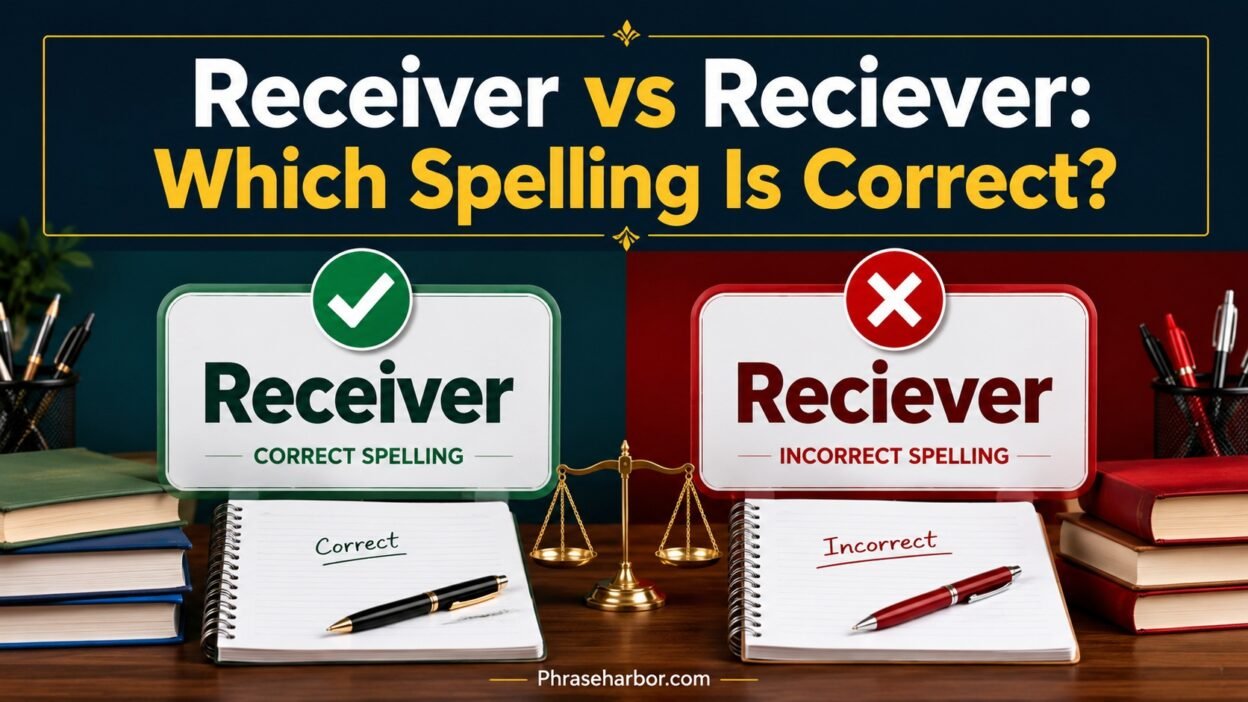
Receiver and reciever look almost identical, yet only one is correct. If you’ve ever paused while typing this word and wondered whether the i should come before the e, you’re dealing with a very common English spelling trap.
The correct spelling is receiver.
The spelling reciever is incorrect in standard English. It doesn’t represent a separate word or an accepted alternative spelling. Instead, it’s a common misspelling caused by confusion about the ie/ei letter pattern and the spelling of words ending in -ceive.
The word receiver appears in everyday English as well as technology, sports, business, law, and electronics. You might talk about a receiver who accepts a package, a radio receiver that picks up signals, or a football receiver who catches a pass. Although these meanings differ, they all use the same spelling.
Understanding the word’s relationship with receive makes the spelling much easier to remember. Once you recognize that receiver comes from receive, the correct letter order becomes far less confusing.
Quick Answer
Receiver is the correct spelling.
Reciever is a misspelling.
| Spelling | Correct? | Meaning |
| receiver | Yes | A person or thing that receives something |
| reciever | No | Common misspelling of receiver |
The easiest way to remember the spelling is:
The receiver receives.
Notice that both receiver and receives contain the same receiv sequence.
So, when you’re unsure, think:
receive → receiver
Not:
recieve → reciever
The correct spelling is R-E-C-E-I-V-E-R.
Comparison Overview
The difference between receiver vs reciever is simple once you look at the letters closely.
| Feature | Receiver | Reciever |
| Standard spelling | Correct | Incorrect |
| Letter sequence | cei | cie |
| Related verb | receive | No standard verb “recieve” |
| Dictionary word | Yes | No |
| Standard plural | receivers | — |
| Common use | Everyday, technical, sports, legal | Misspelling |
The key difference is the position of i and e.
In receiver, the relevant sequence is cei:
r-e-c-e-i-v-e-r
In reciever, the letters become cie:
r-e-c-i-e-v-e-r
That small change makes the second spelling incorrect.
Receiver vs. Reciever at a Glance
If you’re writing quickly, you don’t need to memorize a complicated spelling rule. Remember the base word:
receive
Then form the noun:
receive → receiver
This connection is more reliable than trying to apply a broad “i before e” rule every time.
Main Differences Between Receiver vs Reciever
The biggest difference is that receiver is a real standard English word while reciever is not.
Receiver Is the Correct Word
Receiver is a noun formed from the verb receive. Broadly speaking, it refers to someone or something that receives something.
For example:
- The receiver signed for the package.
- The wireless receiver detected the signal.
- The football receiver caught the pass.
- The court appointed a receiver to manage the company’s assets.
The exact meaning changes according to context, but the spelling remains receiver.
Reciever Is a Spelling Error
Reciever is simply a misspelling of receiver.
You may encounter it in emails, social media posts, comments, search queries, or other informal writing. Its appearance in those places doesn’t make it an accepted spelling.
For professional writing, academic work, business communication, websites, applications, and published material, use receiver.
The Letter Order Causes the Confusion
The most noticeable problem is the ei/ie sequence.
Many English learners remember a simplified spelling rule:
“I before E except after C.”
That rule can point you toward the correct spelling here because receiver comes after c. However, English spelling has many exceptions and complications. It’s better to understand the specific pattern than rely on the slogan alone.
The useful pattern is:
receive → receiver
That gives you the spelling directly.
What Does Receiver Mean?
The noun receiver has several established meanings. The basic idea stays consistent: a receiver is something or someone that receives.
Receiver as a Person Who Receives Something
In its broadest sense, a receiver can be a person who gets, accepts, or takes possession of something.
For example:
The receiver confirmed that the package had arrived.
Here, receiver simply describes the person who received the package.
You could also write:
- The receiver signed the delivery form.
- The receiver accepted the documents.
- The receiver acknowledged the payment.
This everyday meaning comes directly from the verb receive.
Receiver as an Electronic Device
In electronics, a receiver is a device designed to receive signals and often convert or process them into useful information.
A radio receiver, for example, receives radio-frequency signals and processes them so they can produce audio.
Other examples include:
- radio receivers
- television receivers
- wireless receivers
- audio receivers
- GPS receivers
- signal receivers
The word doesn’t necessarily describe one particular type of technology. Its meaning depends on the kind of signal and system involved.
For instance, a wireless receiver might accept data transmitted over radio waves. An audio receiver may process signals from different sources and send them to speakers.
Receiver in Sports
In American football, a receiver is an offensive player whose role often involves catching passes from the quarterback.
A typical sentence would be:
The receiver caught a 25-yard pass near the sideline.
The term is commonly associated with wide receivers, although the broader concept of receiving a pass can involve other offensive positions as well.
In this context, receiver doesn’t have a special spelling. It’s exactly the same word.
Receiver in Business and Law
Receiver also has a specialized legal and financial meaning.
A court may appoint a receiver to take control of or manage certain property, assets, or business operations. This can happen in situations involving financial disputes, insolvency, or the protection of assets.
For example:
The court appointed a receiver to manage the company’s assets.
This meaning is more technical than the everyday sense of the word. However, the underlying idea remains similar: the receiver takes possession or control of something.
Why Is Receiver Spelled “Receiver”?
The spelling becomes easier when you start with the verb receive.
The relationship looks like this:
receive → receiver
The word receiver contains the spelling sequence receiv-, which comes from receive.
That’s why the following spelling is correct:
r-e-c-e-i-v-e-r
The incorrect form changes the middle sequence:
r-e-c-i-e-v-e-r
That ie arrangement doesn’t belong in this word.
The -Ceive Spelling Pattern
One useful way to understand receiver is to look at other English words containing -ceive.
Examples include:
- receive
- deceive
- conceive
- perceive
- conceivable
- deceiver
- perceiver
These words preserve the cei sequence.
Compare:
receive
deceive
perceive
receiver
deceiver
This gives you a practical spelling pattern to recognize.
The Base Word Is Your Best Clue
When you’re unsure whether to write receiver or reciever, don’t try to spell the whole word from memory.
Start with:
receive
Then add the noun-forming ending:
receive → receiver
That method reduces the chance of switching the letters around.
Is “I Before E Except After C” the Rule?
The familiar saying “i before e except after c” can help with receiver, but it shouldn’t be treated as an absolute rule for English spelling.
English contains many words that don’t fit neatly into that rhyme. Pronunciation and word origin also affect spelling patterns.
For this particular word, the more useful fact is straightforward:
receiver comes from receive.
The spelling of receive already gives you the correct cei sequence.
So instead of asking:
Does i come before e?
Ask:
How is receive spelled?
That question leads directly to receiver.
How to Spell Receiver Correctly
Here’s the spelling broken down:
R-E-C-E-I-V-E-R
You can divide it visually into:
receiv + er
The first part connects it to receive. The ending -er forms a noun that can describe a person or thing performing an action.
Consider similar formations:
- teach → teacher
- drive → driver
- receive → receiver
- deceive → deceiver
The spelling of the base word remains important.
A Simple Spelling Check
If you’re typing the word and hesitate, use this three-step check:
- Write receive.
- Keep the receiv- sequence.
- Add -er.
The result is:
receiver
This works much better than guessing between receiver and reciever.
How to Pronounce Receiver
Receiver is commonly pronounced approximately as:
ri-SEE-ver
The IPA pronunciation is:
/rɪˈsiːvər/
The main stress falls on the middle syllable:
re-CEI-ver
The spelling can look more complicated than the pronunciation. That’s one reason people may remember the sound correctly while still writing the letters in the wrong order.
Receiver and Receive Sound Related
Compare these words:
- receive — /rɪˈsiːv/
- receiver — /rɪˈsiːvər/
The pronunciation clearly shows their relationship.
The second word essentially adds an -er ending to the same basic word.
That’s another useful memory aid:
receive + er = receiver
Receiver in Sentences
Seeing the correct spelling in different contexts makes the pattern easier to remember.
Everyday Use
The receiver signed the delivery receipt.
Here, receiver means the person who received the package.
Technology
The wireless receiver picked up the incoming signal.
Here, receiver refers to equipment that receives a signal.
Sports
The receiver caught the ball just before stepping out of bounds.
Here, the word refers to a player who receives a pass.
Business and Law
The court appointed a receiver to oversee the company’s assets.
Here, receiver has a specialized legal meaning.
Communication
The message reached the receiver within seconds.
In this sentence, the receiver is the person or system that gets the message.
Notice something important: the spelling never changes even though the meaning does.
Read More: Of Course vs Ofcourse: Which Is Correct?
Common Misspellings of Receiver
Reciever is by far the most obvious mistake, but other incorrect forms can appear when people type the word from memory.
| Incorrect form | Correct form | Problem |
| reciever | receiver | Switches ei to ie |
| reciver | receiver | Omits an e |
| receiever | receiver | Adds an extra e |
| recever | receiver | Omits letters from the middle |
These errors don’t create accepted alternative spellings. They simply reflect different ways of mistyping the same word.
Why “Reciever” Is So Common
The mistake makes sense when you consider how English spelling works.
Many words contain ie, including:
- believe
- piece
- field
- chief
- achieve
That familiar pattern can encourage writers to put ie into receiver.
However, receive belongs to the -ceive group. The correct sequence is therefore cei, not cie.
Receiver vs. Receive
These words are closely related but serve different grammatical roles.
| Word | Part of speech | Meaning | Example |
| receive | Verb | To get or accept something | “I receive emails daily.” |
| receiver | Noun | Someone or something that receives | “The receiver detected the signal.” |
The easiest way to see the relationship is:
I receive the signal.
The receiver detects the signal.
The verb describes the action. The noun identifies the person or thing involved in receiving.
Receiver vs. Reception
Reception is another related noun, but it has a different meaning.
For example:
- The phone has poor reception.
- The receiver picked up the signal.
In the first sentence, reception describes the quality or process of receiving. In the second, receiver identifies the device doing the receiving.
Related Words That Can Help You Remember the Spelling
Several related words reinforce the -ceive pattern.
| Word | Meaning |
| receive | To get or accept something |
| receiver | Someone or something that receives |
| deceive | To mislead someone |
| deceiver | Someone who deceives |
| perceive | To become aware of or understand something |
| conceive | To form an idea or concept |
| receptive | Willing or able to receive something |
| reception | The act or process of receiving |
You don’t need to memorize every related word. However, recognizing the shared spelling pattern can make receiver much easier to recall.
How to Remember the Correct Spelling of Receiver
The best spelling tricks are short enough to use when you’re actually writing.
Use “The Receiver Receives”
This is probably the simplest memory aid:
The receiver receives.
Both words begin with receiv-.
If you remember receives, you can reconstruct receiver.
Remember the “CEI” Sequence
Focus on these three letters:
C-E-I
The word contains:
re + cei + ver
Not:
re + cie + ver
That small visual distinction can prevent the most common spelling error.
Connect It to Receive
When in doubt, return to the base word:
receive → receiver
If you know how to spell receive, you already know most of the spelling of receiver.
FAQs:
Is “reciever” a correct spelling?
No. Reciever is a misspelling.
The correct spelling is receiver.
How do you spell receiver correctly?
Spell it:
R-E-C-E-I-V-E-R
The important middle sequence is cei.
Why do people spell receiver as reciever?
The error usually comes from confusion over ie/ei spelling patterns. English contains many words with ie, so writers sometimes incorrectly transfer that pattern to receiver.
The correct spelling follows receive:
receive → receiver
Is receiver a noun or a verb?
Receiver is a noun.
The related verb is receive.
For example:
The receiver receives the package.
Here, receiver names the person while receives describes the action.
What is the plural of receiver?
The plural is receivers.
For example:
The technicians tested several receivers.
Conclusion:
When it comes to receiver vs. reciever, the answer is clear: receiver is the correct spelling, while reciever is a common misspelling. The easiest way to remember it is to connect receiver with the verb receive. Both words use the receiv sequence. The phrase “the receiver receives” can also help lock the spelling into memory.