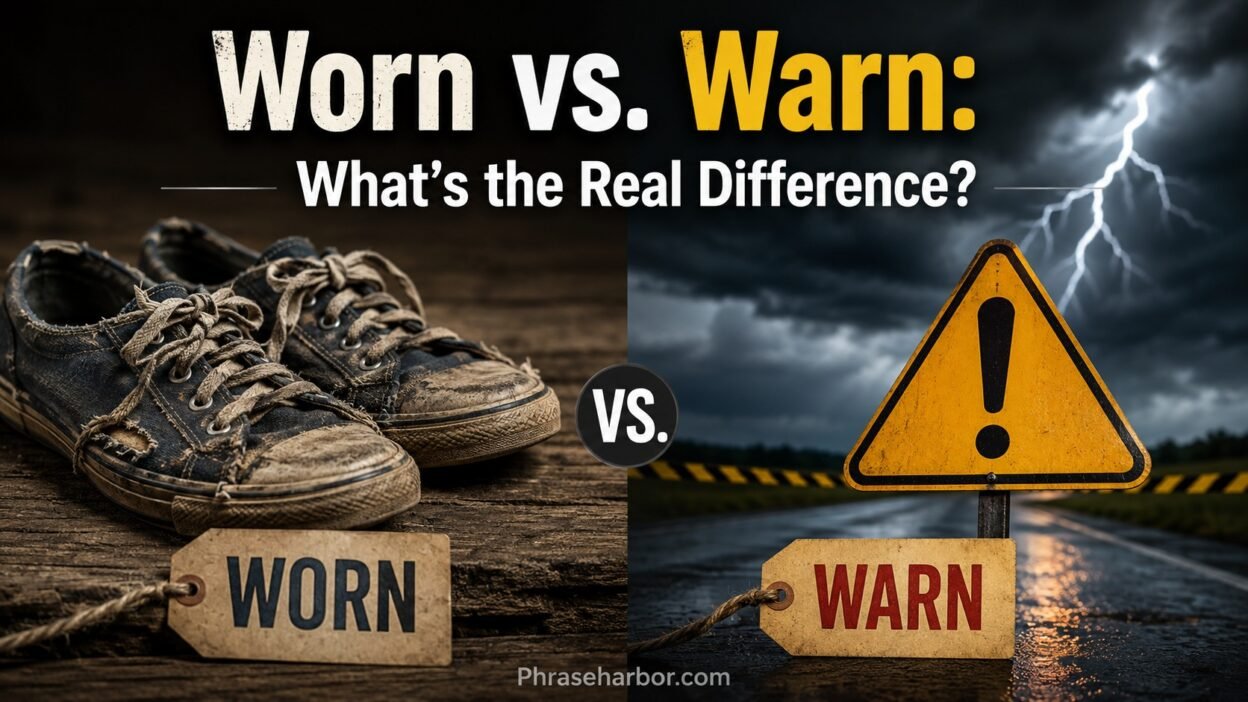
Worn vs. warn can be confusing because these two words look and sound remarkably similar. However, they don’t have the same meaning, and they play very different roles in a sentence. Worn is connected to the verb wear, while warn means to alert someone about a possible danger, problem, or consequence.
For example, you might say, “I have worn these shoes for years,” when talking about something you have used. On the other hand, you might say, “I warned him about the slippery floor,” when telling someone about a potential danger. Once you connect worn with wear and warn with warning, the distinction becomes much easier to remember.
Quick Answer
The main difference between worn vs. warn is their meaning and grammatical function.
- Worn is the past participle of wear. It can refer to clothing or something that has become damaged or less fresh because of use.
- Warn is a verb that means to alert, caution, or advise someone about a possible danger, problem, or consequence.
- Worn is commonly used with helping verbs such as has, have, and had.
- Warn can be followed by structures such as warn someone about something, warn someone of something, or warn someone not to do something.
- In many varieties of American English, worn and warn are pronounced the same or very similarly. Context therefore becomes especially important.
Consider these two sentences:
“She has worn that jacket many times.”
“She warned me about the icy road.”
The first sentence concerns wearing a jacket. The second concerns giving a warning. That’s the key difference.
Comparison Overview
| Feature | Worn | Warn |
| Basic meaning | Used, worn on the body, or affected by use | To alert or caution someone |
| Word type | Past participle of wear; can also function adjectivally | Verb |
| Base verb | Wear | Warn |
| Verb forms | Wear → wore → worn | Warn → warned → warned |
| Main idea | Wearing or showing effects of use | Giving information about danger or risk |
| Example | “I have worn these shoes before.” | “I warned him about the storm.” |
| Common related word | Worn-out | Warning |
| Pronunciation in American English | Often /wɔrn/ | Often /wɔrn/ |
| Easy memory clue | Worn → wear | Warn → warning |
The spelling difference is only one letter, but that small difference changes the meaning completely. Think of worn as belonging to the wear family and warn as belonging to the warning family.
Main Differences Between Worn vs. Warn
The easiest way to understand worn vs. warn is to focus on what each word communicates.
Worn describes a relationship with wearing or use. It often appears when someone has put on clothing, shoes, accessories, or other wearable items. It can also describe an object that has become damaged, faded, thin, or rough after repeated use.
Warn, however, describes an action of communication. When you warn someone, you’re giving that person information that may help them avoid danger, trouble, harm, or an unwanted result.
Compare these examples:
- “He has worn the same boots for five winters.”
- “He warned us about the dangerous trail.”
- “The carpet looks worn near the doorway.”
- “The guide warned visitors about loose rocks.”
Notice the pattern. Worn describes a condition or past use, while warn describes an act of cautioning someone.
Simple rule: If the sentence connects to wearing or use, choose worn. If it involves alerting or cautioning, choose warn.
What Does “Worn” Mean?
Worn is primarily the past participle of the irregular verb wear.
The verb wear describes putting clothing or accessories on your body or having them on your body. Its three main forms are:
- Wear — present/base form
- Wore — simple past
- Worn — past participle
For example:
- “I wear glasses every day.”
- “I wore glasses yesterday.”
- “I have worn glasses since childhood.”
The word worn doesn’t normally stand alone as the simple past form of wear. That’s an important grammar point. You don’t usually say, “I worn this shirt yesterday.” Instead, you say, “I wore this shirt yesterday.”
Worn as the Past Participle of Wear
A past participle often works with a helping verb.
Common combinations include:
- have worn
- has worn
- had worn
- will have worn
- have been worn
- has been worn
For example:
“She has worn that dress several times.”
“They had worn their uniforms before the ceremony.”
“These shoes have been worn only twice.”
This pattern is different from simple past wore:
| Correct Form | Example |
| Wear | “I wear comfortable shoes.” |
| Wore | “I wore comfortable shoes yesterday.” |
| Worn | “I have worn these shoes for years.” |
Understanding this pattern helps prevent another common mistake: using worn when wore belongs in the sentence.
Worn Can Describe Damage From Use
Worn doesn’t only relate to clothing. It can describe something that has gradually lost its original condition because people have used it repeatedly.
For example:
- worn carpet
- worn tires
- worn furniture
- worn steps
- worn flooring
- worn pages
- worn fabric
Consider the sentence:
“The wooden stairs became worn after decades of daily use.”
Here, worn doesn’t mean someone put the stairs on. Instead, it means repeated use caused visible deterioration.
That’s a useful distinction because English often lets worn describe both something you wear and something that experiences wear.
Worn Can Describe Someone’s Appearance
The word worn can also describe a person who looks tired, exhausted, or affected by stress.
For example:
“After several sleepless nights, he looked worn.”
This use is figurative. The person hasn’t necessarily experienced physical wear in the same way as a pair of shoes. Instead, worn suggests that fatigue, stress, or hardship has affected their appearance.
You’ll also see phrases such as:
- worn face
- worn expression
- worn appearance
- worn look
These expressions usually suggest that someone looks tired or drained.
What Does “Warn” Mean?
Warn is a verb that means to tell someone about a possible danger, problem, risk, or negative consequence.
When you warn someone, you give them information before something potentially harmful or unwanted happens.
For example:
“The weather service warned residents about the approaching storm.”
The warning gives residents a chance to prepare or take action.
You can warn someone about many different things:
- physical danger
- severe weather
- scams
- mistakes
- unsafe conditions
- possible consequences
- rules
- financial risks
- difficult situations
The word doesn’t always involve immediate physical danger. You can also warn someone about something that could create inconvenience, embarrassment, loss, or trouble.
Warn Someone About Something
One common grammatical structure is:
warn + someone + about + something
Examples include:
- “She warned me about the traffic.”
- “The teacher warned us about the difficult exam.”
- “They warned him about the faulty equipment.”
- “I warned her about the icy steps.”
This structure clearly identifies both the person receiving the warning and the issue involved.
Warn Someone of Something
Another structure uses of:
warn + someone + of + something
Examples:
- “The sign warned drivers of falling rocks.”
- “The doctor warned him of possible complications.”
- “Officials warned residents of rising water levels.”
Both about and of can work, although the natural choice depends on the context and style of the sentence.
Warn Someone Not to Do Something
You can also use warn when advising someone against a particular action.
The common structure is:
warn + someone + not to + verb
Examples:
- “I warned him not to touch the machine.”
- “She warned us not to enter the building.”
- “The coach warned the players not to ignore the instructions.”
This form is especially useful when the warning directly concerns a person’s behavior.
Warn Someone That Something May Happen
Another useful structure is:
warn + someone + that + clause
For example:
“The mechanic warned me that the brakes needed attention.”
“She warned us that the road might close.”
This construction lets you explain the possible consequence instead of simply naming a danger.
Worn vs. Warn Pronunciation
Pronunciation can make worn vs. warn particularly tricky.
In many varieties of American English, worn and warn have the same or nearly the same pronunciation. Both are commonly pronounced with the /wɔrn/ sound.
That means hearing the word alone may not always tell you which spelling the speaker intends.
Context does the heavy lifting.
Imagine someone says:
“I have worn this before.”
The surrounding words make the meaning clear because have worn belongs to the verb wear.
Now consider:
“I warn you to be careful.”
The grammatical structure identifies warn as the verb meaning caution.
This is a good example of why spelling and context matter. English contains many homophones and near-homophones, so sound alone doesn’t always provide enough information.
Worn vs. Warn in Example Sentences
Seeing the words side by side makes their difference easier to recognize.
| Sentence With Worn | Sentence With Warn |
| “I’ve worn these shoes all week.” | “I warned him about the slippery floor.” |
| “The jacket looks worn after years of use.” | “The sign warns visitors about the danger.” |
| “She has worn that necklace before.” | “The guide warned us about the steep climb.” |
| “The old carpet is badly worn.” | “The forecast warned people about strong winds.” |
| “He looked worn after the long journey.” | “She warned me not to drive too fast.” |
The contrast becomes clear when you focus on the action or condition.
Worn answers questions such as:
- What has someone worn?
- What has become damaged through use?
- Does someone look tired or exhausted?
Warn answers questions such as:
- Who received the warning?
- What danger or problem did someone identify?
- What action did someone advise against?
Common Mistakes With Worn vs. Warn
Because the words look and sound alike, spelling errors can sneak into otherwise clear writing.
Mistake: Using Warn for Wearing
Incorrect:
“She has warn that blue dress before.”
Correct:
“She has worn that blue dress before.”
The correct word is worn because the sentence describes wearing clothing.
Mistake: Using Worn for a Warning
Incorrect:
“I worn him about the broken glass.”
Correct:
“I warned him about the broken glass.”
The sentence describes an act of cautioning, so the verb warned belongs here.
Mistake: Confusing Worn With Wore
Incorrect:
“I worn the jacket yesterday.”
Correct:
“I wore the jacket yesterday.”
Because wear is an irregular verb, its forms don’t follow the normal -ed pattern.
Remember:
wear → wore → worn
The simple past is wore. The past participle is worn.
Worn vs. Warn vs. Wore
These three words deserve special attention because learners sometimes mix them together.
| Word | Function | Meaning | Example |
| Wear | Base verb | Have clothing or something on | “I wear boots in winter.” |
| Wore | Simple past | Had clothing or something on in the past | “I wore boots yesterday.” |
| Worn | Past participle | Past form used with helping verbs | “I have worn these boots for years.” |
| Warn | Verb | Alert or caution someone | “I warned him about the ice.” |
A quick grammar test can help.
If you can replace the word with wear, wore, or another form of wear, you’re probably dealing with worn.
If the meaning involves giving someone a warning, use warn or one of its forms.
Read More: City vs Town vs Village: What’s the Difference?
Worn vs. Warn: Easy Ways to Remember the Difference
A simple memory trick can save you from repeated spelling mistakes.
Remember “Worn” With “Wear”
The spelling connection is straightforward:
Wear → Wore → Worn
All three belong to the same verb family.
If you’re talking about clothing, shoes, accessories, or something damaged through use, think worn.
For example:
“These jeans are worn.”
Remember “Warn” With “Warning”
Think:
Warn → Warning → Caution
If you’re telling someone about danger or a possible problem, think warn.
For example:
“I warned you about the storm.”
The extra a in warn can help you connect it mentally with alert or alarm.
A One-Line Memory Trick
Worn is connected to wear; warn is connected to warning.
That’s usually enough to separate the two words instantly.
Worn vs. Warn in Everyday English
Both words appear regularly in everyday communication, but they show up in completely different situations.
You might use worn when discussing:
- clothes
- shoes
- uniforms
- accessories
- furniture
- roads
- floors
- tires
- books
- someone’s appearance
You might use warn when discussing:
- safety
- weather
- traffic
- health advice
- rules
- scams
- potential problems
- dangerous conditions
- unwanted consequences
For example, imagine a rainy morning.
A parent might say:
“I’ve worn these boots many times.”
A few minutes later, the same parent might say:
“I warned you that the sidewalk would be slippery.”
One word describes use. The other describes caution.
FAQs:
Is “worn” the same as “warn”?
No. Worn and warn have different meanings even though they can sound alike in American English. Worn relates to wearing something or deterioration caused by use. Warn means to alert or caution someone about a possible problem or danger.
What is the difference between worn and wore?
Wore is the simple past form of wear, while worn is its past participle.
For example:
- “I wore the jacket yesterday.”
- “I have worn the jacket many times.”
You normally use worn with a helping verb such as have, has, or had.
Is warn a verb?
Yes. Warn is a verb meaning to alert, caution, or advise someone about something that could cause trouble or harm.
For example:
“The teacher warned the students about the difficult test.”
What is the past tense of wear?
The simple past tense of wear is wore.
The three main forms are:
wear → wore → worn
For example:
- Present: “I wear glasses.”
- Past: “I wore glasses yesterday.”
- Past participle: “I have worn glasses for years.”
How do you use worn in a sentence?
Use worn when you need the past participle of wear or when describing something affected by repeated use.
Examples:
- “She has worn this dress before.”
- “The carpet looks worn.”
- “He appeared worn after the long journey.”
Conclusion:
The difference between worn vs. warn becomes simple once you connect each word with its meaning. Worn belongs to the wear family and works as the past participle of wear. It can describe clothing that someone has used, objects damaged through repeated use, or even someone who looks tired.